
AI for businesses: a complete guide to getting started
AI for business: how an Italian company adopts it in practice. ISTAT 2025 data, the first process, tools, GDPR, the AI Act and Law 132/2025.
Reading time: 17 min
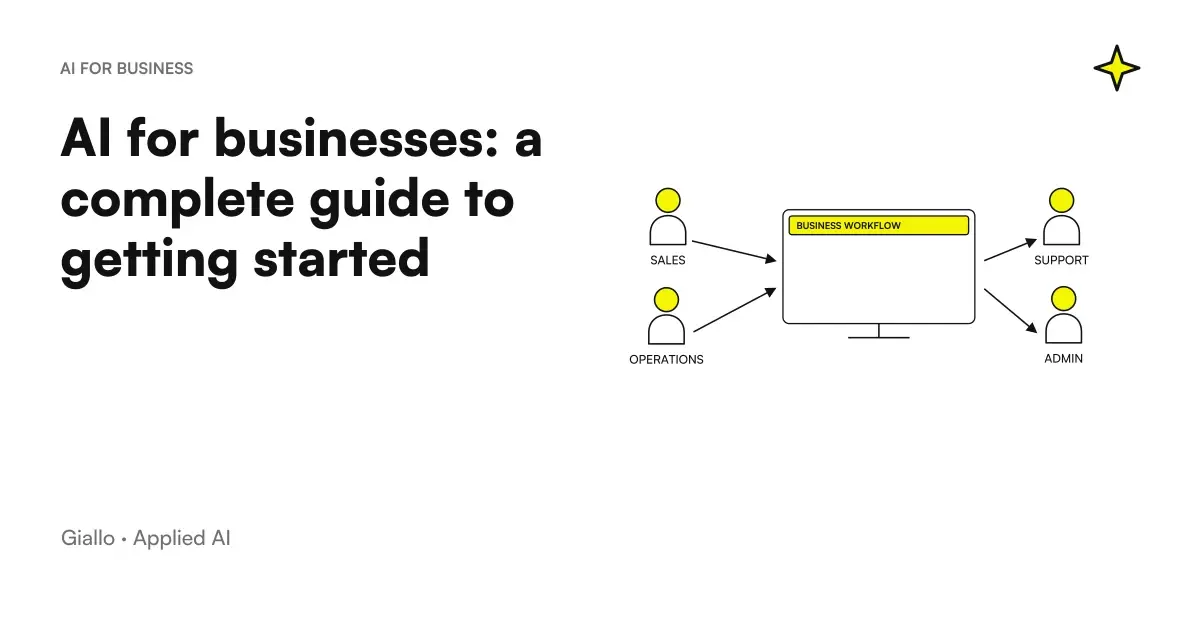
For an Italian business, adopt the AI for businesses is to make four decisions in a row: which process to entrust first to artificial intelligence, in what form to get it in (an assistant, a function of management software, an automation, a software tailored), which rules to write about data and people, which number to measure before and after. They don't need a research department or an expensive platform. You need to choose the point where AI takes away repetitive work and leaves the signature to the responder.
If you feel like you're late, the official data resizes it. According to the survey ISTAT Enterprises and ICT 2025, in 2025 16.4% of companies with at least 10 employees use at least one AI technology: twice as many as 2024, yet over eight out of ten companies have not yet started. Among large companies the share reaches 53.1%, among SMEs it stops at 15.7%.
This guide starts from those numbers and follows the adoption step by step: the forms in which AI enters the company, the choice of the first process, the rules to be put in line (GDPR, AI Act after the Digital Omnibus, Italian law 132/2025), the path from testing to production, the support that is needed. If you first want to understand how technology works, the basis is in Artificial intelligence: what it is and how it works.
In summary
- Over eight out of ten Italian companies with at least 10 employees still do not use AI: those who leave now with method are not late.
- AI enters the company in four forms: subscription assistant, functions already present in the management software or office suite, automations connected to a model, software or custom agents.
- The first process is chosen by frequency, describability and ease of control, not by the effect of the demo.
- The rules to know are three blocks: GDPR, AI Act with the revised dates from the Digital Omnibus of July 2026, Law 132/2025 on the use of AI in work.
- A Pilot with human review and a starting number are worth more than any presentation: it only extends if the comparison before and after holds.
- For Google AI responses there are no dedicated tricks: they count indexed pages, text information, and updated task profile.
How many Italian companies already use AI, and to do what
The official source for understanding where an Italian company is located is the annual ISTAT survey on the use of digital technologies in companies with at least 10 employees. The 2025 edition, published on December 15, 2025, tells of an adoption that has doubled in one year and is increasingly unbalanced towards large companies.
| Use of AI (ISTAT, Enterprise and ICT 2025) | 2023 | 2024 | 2025 |
|---|---|---|---|
| Companies with at least 10 employees using at least one AI technology | 5,0% | 8,2% | 16,4% |
| SMEs (10 to 249 employees) | not reported | 7,7% | 15,7% |
| Large enterprises (250 employees and above) | not reported | 32,5% | 53,1% |
| Distance between large companies and SMEs | about 20 points | 25 points | 37 points |
The most useful data for those who have to choose where to start is about the type of AI. Among the companies that use it, the most common technology is the extraction of information from text documents (70.8%), followed by text, image or audio generative AI (59.1%) and speech recognition (41.3%); the most frequent areas are marketing and sales (33.1%), administrative processes (25.7%) and research and development (20.0%), according to the same ISTAT report. In practice the AI that works today in Italian companies reads documents and writes texts: offers, orders, emails, practices.
A second figure serves as a warning. 33.4% of companies that claim to use AI do not indicate any precise business purpose (they were 15.5% in 2024), and 83.3% of them have between 10 and 49 employees: ISTAT It reads it as a still initial, experimental and unstructured use. It is the typical scenario of those who start without method: some subscription activated, no process really changed.
Finally, the obstacles. Among the companies that have assessed AI without adopting it, the most cited brakes are lack of expertise (58.6%), lack of clarity on legal consequences (47.3%), absent or poor quality data (45.2%), privacy and data protection concerns (43.2%) and costs (43.0%), as reported by the ISTAT detection. The following sections tackle these five brakes one at a time.
The four forms in which AI enters a company
When a holder asks what model of AI to use in the company, usually the real question is another: in what form does artificial intelligence enter everyday work. There are four forms and they change who runs it, where the data passes and how much work it takes to get it up and running.
| Shape | What He Does at Work | Where data passes | Who runs it | When it makes sense |
|---|---|---|---|---|
| Subscription Assistant | Drafts, summaries, analysis of documents at the request of the person | On the server of the provider, with the conditions of the chosen plan | Every user, within an internal policy | Individual use and first team training |
| AI already inside the software you use | Integrated functions in management software, CRM, mail or office suites | At the software provider, with the contract you already have | The provider; you decide whether to activate it | The process lives all within that software |
| Automation connected to a model | A step of the process done automatically (read, rank, compile) with revision | From your stream to the model via API, with settings to verify | A technician or consultant, then an internal contact person | Frequent processes traversing multiple tools |
| Customized Software or Agent | Company-specific logic, deep integration with systems | Where you decide, even on your own servers with open weight models | Who develops, with an internal referent | Central process that no software ready covers |
The second line is the one that many companies skip. 49.5% of companies with at least 10 employees use ERP management software and 21.7% a CRM, according to ISTAT: Before buying anything else, ask the provider of your management software what AI functions are already planned, what data they work on and with what agreement on the treatment. For a commercial company that lives on price lists, orders and transport documents, management software is often the most sensible starting point, because it contains the records of customers and articles that serve to respond well.
The model name matters less than it looks, and versions often change: before choosing always check the official supplier page. To orient yourself between model families there are guides on how to choose an AI model and up which model suits an SME. If the data cannot exit the company it evaluates the Local AI Models; to decide between ready plan and dedicated development there is the comparison AI by subscription or customized. To choose between Copilot, Gemini, ChatGPT Business and Claude Team there is Best AI for Companies.
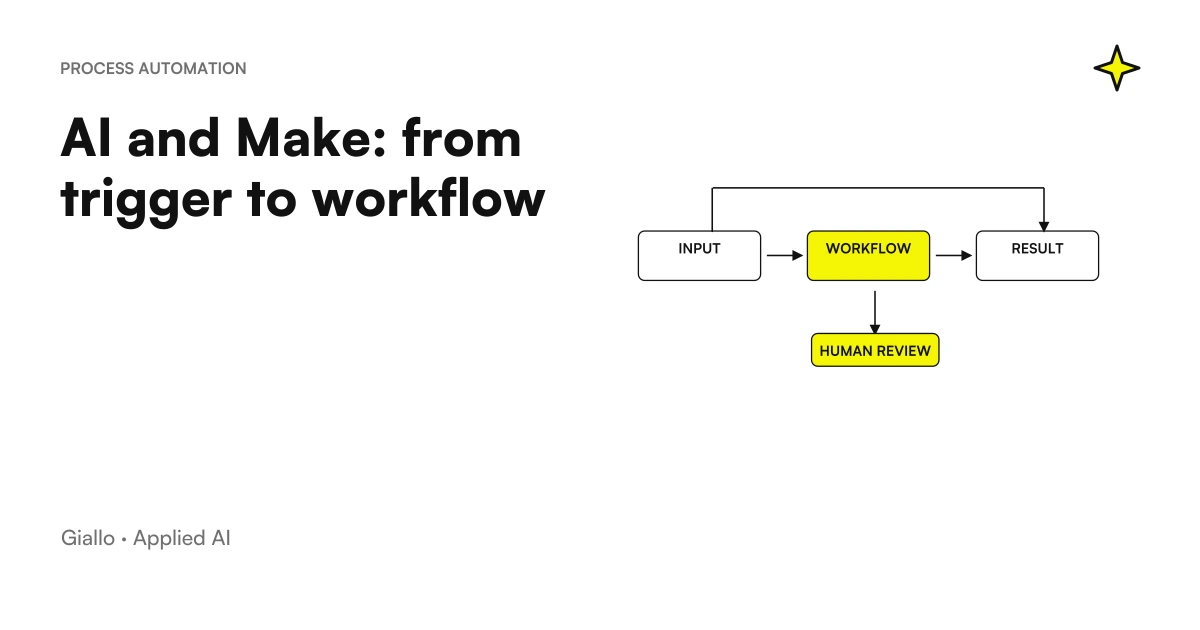
How to choose the first process without being guided by the demo
The most spectacular demonstrations are rarely the first project right. The first process is chosen with a short test, to be done together with those who do that work every day.
- Does that happen often? Every day or every week, not once a quarter: saving only accumulates on volume.
- Do you describe yourself on a page? What comes, what has to come out, who decides in doubtful cases. If the answer is always "depends", the process must first be reordered.
- Does control cost less than work? Rereading a draft bid is faster than writing it; rechecking a complex calculation sometimes isn't.
- Do you have today's number? Time for practice, errors, waiting days of the customer. Without this given the final comparison becomes an opinion.
The best candidates almost always stand in the areas that ISTAT indicates as the most used, sales and administration, because there the work is made of documents and texts that are repeated. The department by department map is in AI by business function, while what to automate in an SME helps to compile the list of candidates. These are the four starting points that occur most often.
Sales and marketing: offers, product sheets, follow-up
The AI prepares the first draft of the offer starting from the customer's list and history, writes data sheets produced by the technical data and remembers the calls to be made. The trade corrects prices and conditions before sending. Further reading in AI for CRM and Sales and AI to create quotes.
Administration: Passive invoices, documents, reminders
The AI reads documents arrived in different formats, matches them to the right practice or supplier and prepares prompts consistent with the schedule. The recording remains with who signs it. The detail is in AI for Accounting.
Customer service: order status, returns, guarantees
Answers to repeated questions built on your documents and order data, with switching to a person for complaints and sensitive cases. See AI for Business Customer Care.
Purchases and production: supplier offers, order confirmations, manuals
Comparison of quotations arrived in different formats, verification of order confirmations with respect to the order sent, quick search in technical manuals. AI for purchases and suppliers.
Choose a circumscribed process to test
A generic AI request becomes design when it identifies input, decision, and output. These insights cover different needs: they serve to define the first driver, not to choose twenty automations together. Each guide separates ordinary cases from exceptions and indicates control of the person.
| Concrete problem | Process Guide |
|---|---|
| The message comes to the right person | Sort emails and attachments |
| Originals and receipts, connected | Organizing the PEC |
| From Fields to the Import Proposal | PDF orders in management software |
| A comparison of three documents | DDT, orders and invoices |
| From Receipt to Review | Expense notes with AI |
| Prices and conditions in the same unit | Compare supplier offers |
| Account status before draft | Payment solicitations |
| Clause, date and verification | Deadlines for contracts |
| Propose union, preserve the historical | Duplicate in CRM |
| From Demand to Commercial | Qualify inbound requests |
| Budget and decision-maker | Approve Purchases |
| Checklists, shortcomings and checks | Customer Documents |
| Changes before publication | Update the price lists |
| A response with source and timestamp | Respond on Order Status |
| Request, verification and decision | Returns and RMA |
| Priorities, facts and handshake | Handling complaints |
| Understanding What Has Changed | Versions of documents |
| Research respects accesses | Knowledge base and permissions |
| Choose between export and interface | Management software without API |
| Identity, Conflict, and Writing Rules | CRM and management software aligned |
Rules to be lined up before the first stream
Lack of legal clarity is the second brake cited by businesses. For a company that uses AI on offers, documents and support, however, the main rules stand in a table, provided they are read in the updated version: the dates of the AI Act changed in July 2026.
| Norma | What do you ask, in summary | Since |
|---|---|---|
| GDPR, art. 28 | A contract (DPA) with each provider that processes personal data on your behalf, with appropriate guarantees | Already applicable |
| GDPR, Art. 22 | Right of persons not to be subject to decisions based solely on automated processing with legal or similar effects, except for exceptions and with protections | Already applicable |
| GDPR, Art. 35 | Impact assessment before treatments with new technologies that may present a high risk | Already applicable |
| AI Act, Art. 4 | Measures to support the AI literacy of those who use systems on behalf of the company, without a specific level to be guaranteed | Obligation from 2 February 2025, text rewritten by Regulation (EU) 2026/1744 |
| AI Act, Art. 50 | Whoever provides a system that interacts with people must let them know that they are talking to an AI, unless it is obvious | From 2 August 2026 |
| AI Act, High Risk Systems | Obligations for Annex III systems, including those used to select staff or assess workers | From 2 December 2027 (for Annex I from 2 August 2028) |
| Law 132/2025, Art. 11 | Inform the worker of the use of AI in the cases and manners of Article 1-bis of Legislative Decree 152/1997 | Effective October 10, 2025 |
Translated into shares, for most companies it means: a DPA signed with each AI provider that sees personal data, a corporate policy on the use of AI that tells what tools are used and with what data, a basic training for those who use them, a clear warning when a customer speaks with an automatic assistant. If you commission a chatbot that responds with your company's name or brand, the AI Act may consider you a provider of that system (Article 3), then clarify the roles in the contract with the developer. The obligations are explained in AI Act: what obligations does an SME really have, the part about personal data in GDPR and artificial intelligence in the company.
The point many businesses discover late concerns employment. Article 11 of Law 132/2025 refers to Article 1-bis of Legislative Decree 152/1997, which addresses fully automated decision-making or monitoring systems used for recruitment, employment relationship management, task allocation, surveillance and evaluation. An assistant that prepares email drafts is unlikely to fall within that scope; a system that allocates shifts or evaluates performance needs to be checked with an employment consultant before purchase, not afterwards.
From the first test to the production flow: six stages
- Inventory of repetitive processes. For each department it lists the activities that are repeated, how many times a month, how long a practice lasts and who carries it out. Ask who does them: the process described by the person responsible and the real one often do not coincide.
- Choice and measurement of the starting point. One process, the one that passes the four-question test. It records times, errors and expectations on a sample of true practices.
- Form and contract. Decide which of the four forms to use and, before linking any data, verify DPA, place of processing and use of data for model training.
- Pilot with revision. AI prepares, one person approves of each outcome. Write down what you correct and why: those notes serve to improve instructions and examples.
- Rules and training. Written policy, people trained on the tools they will really use, an internal referent that collects problems and requests.
- Comparison and decision. Put the next next next to the first. If it holds, the flow becomes ordinary and the second process reuses integrations and rules of the first. If it does not hold, correct before spending more.
The timing depends on the form chosen: an assistant or a management software function is tried in a few weeks, an integration between multiple systems requires a real project with a calendar. To set the test there is the guide to AI Pilot Project, to decide what to measure that on KPI of an AI project, for the part about people training the team on AI.
Two possible departures: a distributor and a company that produces on order
The following examples are scenarios built to show the method, not customer cases.
A distributor of electrical equipment with 25 employees. Orders arrive by email in different forms: PDFs generated by the customer’s management software, rows written in the message body, photos of a handwritten form. Today, an employee copies them into the management software. The first workflow reads the order, recognises customer and items by comparing them with master records, prepares the draft order and flags codes it cannot find; the employee checks, corrects and confirms. The measures to compare are the time between the email’s arrival and the order’s entry, and the number of rows corrected by hand. As for rules, orders contain contact persons’ data, so a DPA with the model provider is needed.
A metalworking company of 60 people that produces on order. Technicians and customer support spend part of the day searching manuals, data sheets and old offers. Here the first flow is an internal knowledge base: the assistant responds by citing the document and the page from which it takes the information, according to the schema RAG. Personal data is almost absent and the main risk is the wrong answer, which is why the source always remains visible and questions without reference document are reported. The method is described in AI for the business knowledge base.
The two cases follow the same method but have different risks: the first weighs personal data and contracts, the second the correctness of answers and the confidentiality of technical drawings. That is why the rules are decided process by process.
What support it takes to get going, and what costs to budget
Lack of skills is the first brake cited by companies. Not all departures, however, require external help, and understanding when it is needed avoids two opposite mistakes: paying for a consultation to activate a subscription, or building an integration with management software on your own.
You can leave alone when
- use is individual: drafts, summaries, research on non-confidential documents;
- the AI function is already included in the software you use and the provider explains how to activate it;
- in the company there is a person who can write the policy and be a reference for colleagues.
You need external support when
- AI must read or write in management software, CRM or shared mail;
- the flow processes customer or employee data and serves contracts and assessments;
- you have to choose between multiple suppliers and you have no criteria to compare them;
- the process involves multiple departments and no one has time to coordinate it.
On the cost, be wary of who gives a figure before seeing the trial. The items to be budgeted are always the same: licenses per user of the ready tools, consumption of the model when working via API (you pay by volume), configuration and integration, maintenance when changing connected models or software, and the internal time of those who define the process and control the results. The detail is in how much AI costs in the company and in hidden costs of AI projects; to evaluate who proposes a project there is how to choose an AI provider.
If you prefer to be accompanied, one AI Consulting serious starts from the process map and closes the job leaving in the company someone able to follow the tools alone.
What Google AI responses show about your company, and how to update it
One question that comes up more and more often is about the other side of AI: how to update the information about your company that appears in the responses generated. For Search AI functions, Google is explicit on the page AI Features and Your Website: no special optimizations, dedicated files or particular markups are needed, and to appear as a support link a page must be indexed and suitable to show a snippet.
- Keep your activity profile up to date on Google (timetables, services, contacts) and, if you sell data online, data in Merchant Center: the documentation specifically mentions them.
- Write important information in text form on the site, not just inside images or PDFs.
- Make the structured data match what you see on the page.
- If you want to limit what is shown, the controls are the same as always: nosnippet, data-nosnippet, max-snippet or noindex.
For other assistants looking on the web the same practical principle applies: consistent and up-to-date information in the public sources you control, starting with the company site.
Where AI projects are jammed in Italian companies
- Subscriptions without trial. Licenses activated for everyone and no activity changed: it is the profile of that third party of companies that uses AI without a precise purpose. Start from a process and buy the licenses that serve that.
- Records in disorder. If the article archive has duplicates and the management software is not up to date, AI inherits the clutter and propagates it faster. Sometimes the first job is a data cleanup.
- Training postponed. Anyone who does not know what to expect from the instrument uses it as an oracle or abandons it at the first mistake. Some session on real office cases changes the outcome of the pilot.
- The legal block, or its opposite. There are those who do not leave for fear of the rules and those who paste customer data into the free version of a chatbot. The table of rules above is enough to avoid both.
- Too many open yards. Three projects in parallel become three projects in half. The second part when the first has its comparison before and after.
- Results taken for true. A model produces the most plausible text, not the verified one: numbers, prices and normative references must be checked. The theme is deepened in AI hallucinations: how to avoid them.
What changes if you hear about superintelligence?
When a supplier uses the term ‘super intelligence’, ask what capacity it proposes today and on what process it has verified it. Artificial superintelligence is a more specific concept than AI: it does not automatically make a product capable of managing every business activity. Meta's personal superintelligence should be read distinguishing vision, announced functions and availability.
For a company, the decision remains concrete: the assistant consults the data, the agent chooses the steps, the operator authorizes the actions that require a check. AI Agents and Superintelligence separates autonomy and capacity. If you are deciding when to invest, find an explicit comparison between waiting for superintelligence and using available AI, with an economic example declared hypothetical.
The first week: what to do before buying any instrument
If you decide to leave, the first week does not require purchases. Gather department managers for an hour and inventory repetitive tasks; choose a candidate with them who passes the four-question test; measure on a week's work how much it costs today; check which AI functions are already included in the software you pay for. With this four information any interlocutor, internal or external, can tell you if the project is standing.
For a small business without internal IT the path has different times and constraints, collected in the Practical AI Guide for SMEs and on the page AI for SMEs. To see how to build a process map with priorities, try the demo AI audit of business processes.
If you want that map built on the processes of your company, with the first stream already chosen and its starting number, the AI audit by Giallo Studio It starts right there.
Giallo Studio guides: methodology and sources
How we apply it in the company
Related resources
 Artificial intelligence: concrete examples from everyday life to work
 AI for SMEs: a practical guide to really getting started
 AI for Business Functions: Where to Start
 AI Act: what obligations does an SME really have
 Corporate policy on the use of AI: how to write it
 AI Pilot Project: How to Set It Up
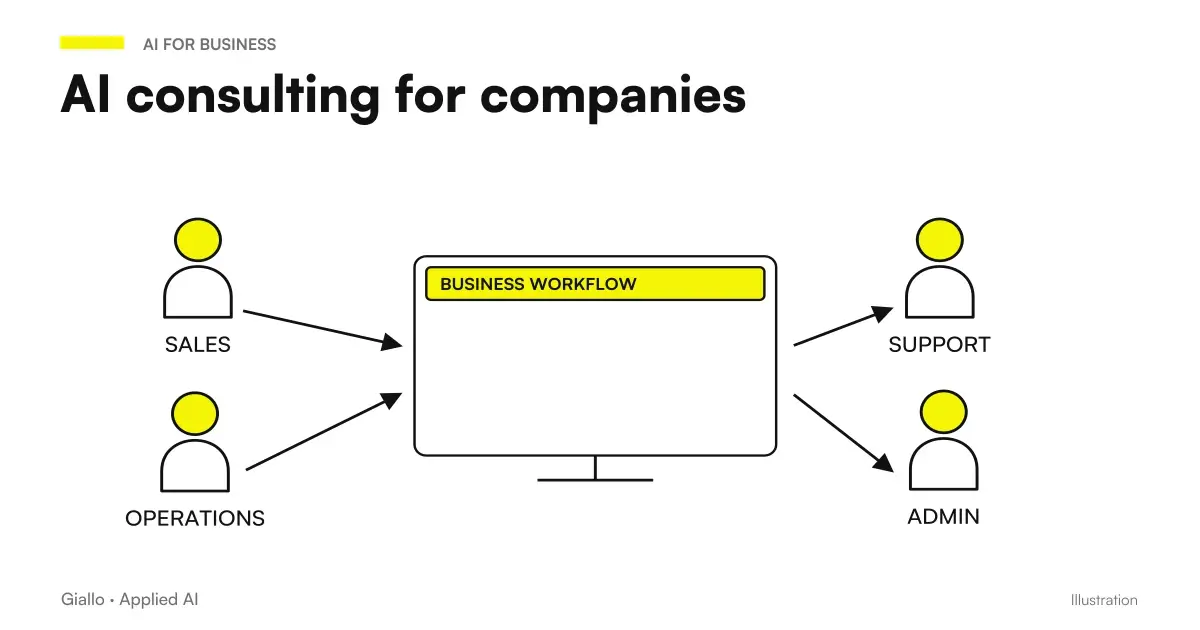 AI consulting for companies: what it is and when it is needed
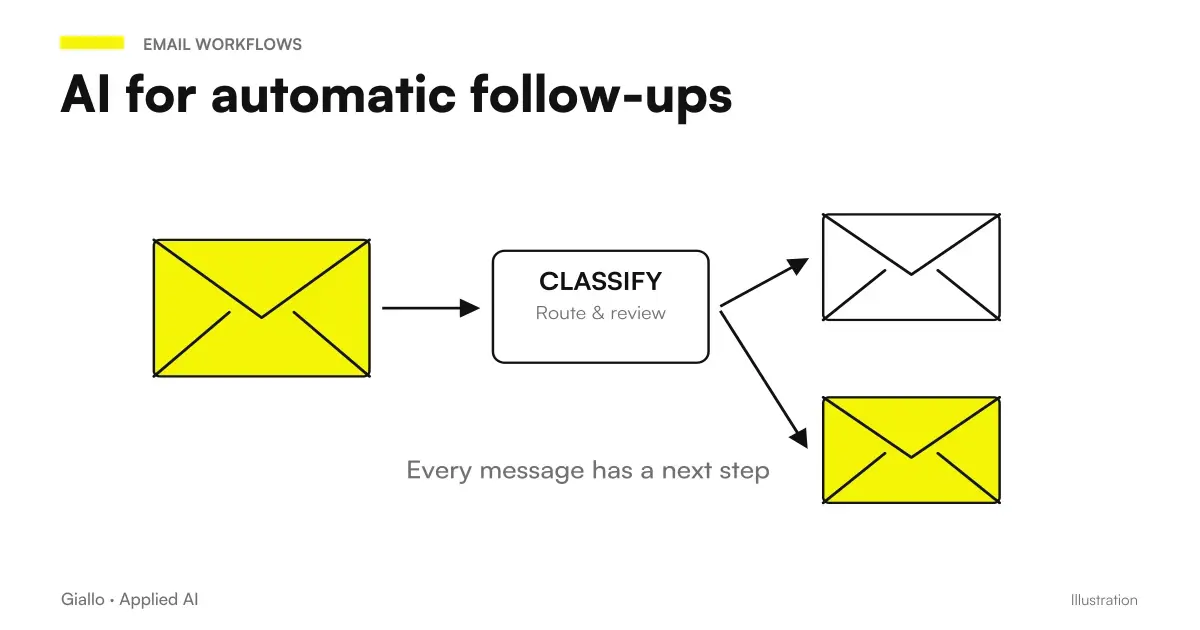 AI follow-ups: keep track of every contact
AI by sector
The same reasoning, applied to the other areas we follow.
- AI for driving schools: enrolment, lessons and exam reminders
- AI for call centres: what changes?
- AI for car rental: renter fines, contracts and return damage
- AI for catering and banqueting: event quotes and customers
- AI for insurance agencies: renewals, quotes and complaints
- AI for consultants: proposals, client data and project delivery
- AI for craftspeople: custom quotes, job orders and electronic invoicing
- AI for Accounting: What It Can Really Do
- AI for automatic appointment scheduling
- Creating quotes with AI: how to speed up the process
- AI for travel agencies: quotes, packages and assistance to travellers
- AI for CRM and sales: automate the sales process
FAQ
How many Italian companies already use artificial intelligence?
According to the ISTAT Enterprises and ICT survey published in December 2025, around one in six businesses with at least 10 employees used at least one AI technology in 2025, twice the share of the previous year. Among large businesses, the share exceeds half. The most widespread technologies are information extraction from text documents and generative AI.
Where does a company that wants to adopt AI start?
With a frequent process that can be described and easily checked, whose current timings and errors you already know. Choose the simplest solution that addresses it (an assistant, a feature in the business management system, or an automation), test it on real cases with human review, and compare before and after. Only then move on to the next process.
What obligations of the AI Act already apply to a company that uses AI?
Article 4, revised by the Digital Omnibus of 2026, requires users of AI systems to adopt measures supporting AI literacy, meaning the basic skills of the people who use those systems on their behalf. From 2 August 2026, providers of systems that interact with people must make it clear that they are AI systems. Obligations for high-risk systems under Annex III, such as recruitment systems, have been postponed to 2 December 2027.
Do I need to inform employees if we use AI in the company?
Act 132/2025, in Article 11, asks the employer to inform the worker in the cases and manners of Article 1-bis of Legislative Decree 152/1997, that is, when fully automated systems affect recruitment, management of the employment relationship, tasks, surveillance or evaluation. An assistant that prepares drafts of emails is a different case from software that assigns shifts or evaluates performance. Check your case with the employment adviser.
Our business management software has AI features: should we start there?
Often, yes, because the necessary data is already there and the provider already has a contract to process it. Before activating the features, ask which data they use, where it is processed, and whether the contract covers processing with AI. If the process instead involves emails, PDFs, and other software, you need an automation that connects the pieces.
How do I update the information about my company that appears in Google's AI responses?
Google states that for its AI functions, no special optimizations or dedicated markup are needed: the page must be indexed and suitable to appear with a snippet. Keep the Business Profile up to date on Google and, if you sell online, Merchant Center, write the important information in text form on the site and make sure that the structured data matches what you see on the page.
What kind of support does a company need to start with AI?
For individual use of an assistant, an internal policy and some training are enough. When AI needs to read from or write to the business management system, CRM, or shared inbox, someone needs to design the workflow, manage the data agreements, and leave the company with a point of contact able to oversee it. An initial process audit helps decide which workflows are worth the work.