
AI for CRM and sales: automate the sales process
AI in CRM and sales: lead qualification, automatically updated records, quotes and follow-ups, with practical examples.
Reading time: 10 min
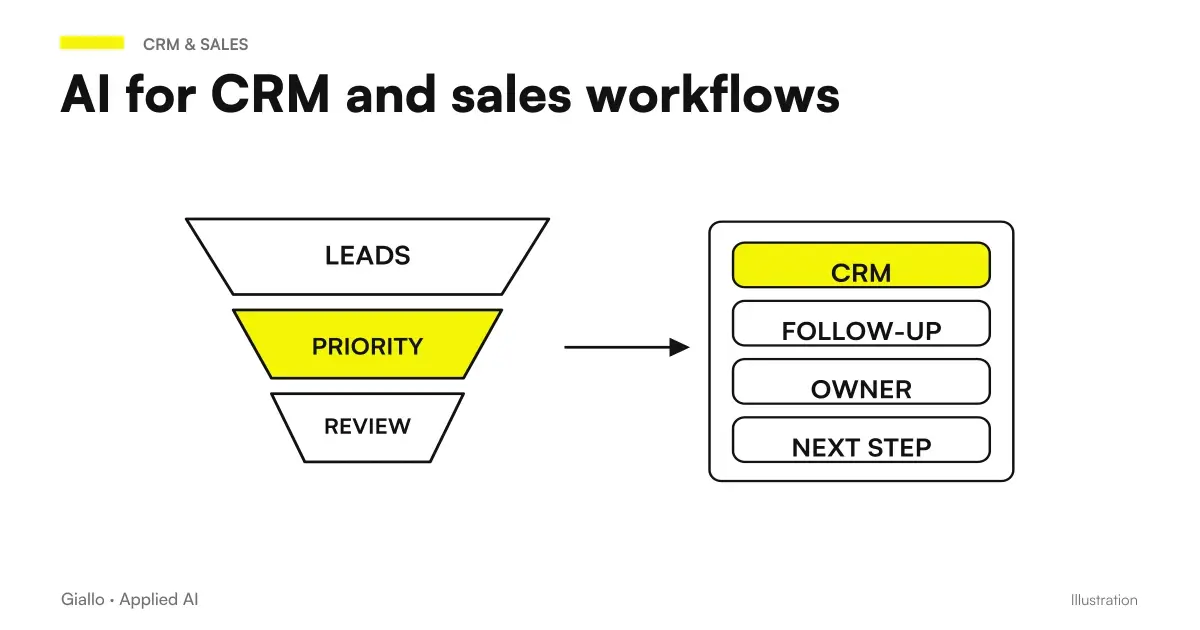
The time of a commercial in an SME is divided, almost always, into two very unequal parts: the part where he talks to a customer or a real negotiation, and the part where he updates cards, writes the second message to those who did not respond, and tries to understand which of the requests arrived this morning deserves a phone call within an hour. AI for CRM and sales is the use of language models and scoring models within commercial management software to automate just the second part, the mechanical one, leaving the first one intact.
It does not replace those who sell. It reads what the CRM already contains, transforms it into a priority order and ready-to-review drafts, and returns hours that today end up copying and pasting between emails, spreadsheets and management software.
In summary
- AI doesn't decide who to buy or how much to discount: Prepare the data, not the business decision.
- The automatic score of a lead is only useful if it comes with motivations, not as a mute number.
- A CRM updated on its own after every call is the difference between reliable reporting and memory-invented reporting.
- It almost always starts from what CRM already offers natively, not from a new project.
- The most ignored non-technical prerequisite is data cleanup: a dirty CRM produces dirty automations.
What changes, phase by phase, when AI enters the pipeline
The business process of an SME usually has a limited number of steps, but they are steps that are repeated dozens of times a month with the same questions to ask each time.
| Pipeline Phase | What AI does | What Remains to the Commercial |
|---|---|---|
| Arrival of the request | Read the message, extract company, declared need and source channel | Decide if and how to respond first |
| Qualification | Assigns a motivated score based on industry, site behavior, and request content | Validate your score with what you know about the market |
| First Contact | Prepare a response draft based on the profile collected | Adjust the tone, decide what to promise |
| Offer | Structure the items from historical records and the price list | Set price and conditions |
| Silence of contact | Report how many days no reply arrives and prepare the reminder | Decides whether and how to intervene personally |
| Closure | Update status, outcome, and next steps in the tab | Manage the final negotiation and sign |
The middle column has a common trait: they are all activities that start from data already present and follow a recognizable pattern. For a broader picture of how these automatisms link together, see what is meant by AI automation.
Why a score on the lead isn't enough if it doesn't explain where it came from
Qualifying a lead means answering a practical question: which requests are worth spending time on today, and which can wait for tomorrow. Hand-made, with thirty requests a day from different channels, this judgment takes time that almost no commercial team really has. A useful proposal must be able to be compared with the chosen business criteria; the route JEV to qualify leads in CRM distinguishes the score from the decision to discard or contact a person.
The scoring tools that the most popular CRMs have already integrated work on just that. Salesforce describes Einstein Lead Scoring and Einstein Opportunity Scoring as tools that assign a score (up to 99 for opportunities) based on how much a request resembles the patterns of closed negotiations in the past, learning from the data and activities already recorded in the CRM. HubSpot, on the opposite side of the entry qualification, describes on the official page of its Customer Agent a tool that intercepts site visitors, interrogates them according to criteria set by the company and assigns them to the right commercial, learning from the supporting content and pages of the site.
The common point between the two approaches: neither replaces the final judgment. They return an order of priority with a legible motivation behind it, not a verdict. If you already work with a structured CRM, the demo of lead scoring AI in CRM shows how a score looks in practice with its motivations, before deciding if and how to build it for your process.
A legal point to keep in mind: assigning a score to a contact based on his behavior is however a processing of personal data, and serves a valid legal basis, typically the execution of pre-contractual measures requested by the data subject or the legitimate interest of the company, according to Article 6 of the GDPR. Especially when scoring runs on a model outside the CRM: in that case the model provider treats data on your behalf, and you need an agreement to regulate it.
A customer card that writes itself after every phone call
There is a job that almost all commercials postpone, and that almost everyone knows they have to do: open the card after a call, write what they said, update the negotiation phase. Delayed enough times, the CRM stops being reliable, and a tool that you no longer use becomes a dead tool even if it still costs the subscription.
The AI intervenes right here, in a fairly direct way: it reads the incoming and outgoing emails and extracts the highlights, transcribes a recorded voice memo after a call and extracts the agreements made and the next steps, signals the negotiations that have not received a contact in too long. None of these three tasks require judgment: it requires only constancy, and it is precisely constancy that an automatic system never loses, unlike a person with twenty other things to do.
The benefit is not the speed itself, but the cascading effect: an updated tab makes the report of the week reliable, and a reliable report allows decisions about the team that with memory-invented data cannot be made. To understand how this type of automation is integrated into a company's processes, read How to automate processes in an SME.
Three ways to connect to AI, from the most immediate to the most challenging
There is no need to choose between "no AI" and "a complex project". There are intermediate levels, and it almost always makes sense to start with the first.
| Level | How it works | When it makes sense |
|---|---|---|
| Native CRM modules | You activate the AI functions already included in the plan you use | CRM is a widespread tool with documented AI modules |
| No-code automation | A tool like Make or Zapier links a CRM event (new lead, email received) to an external AI model | CRM has no native AI or needs tailored behavior |
| Custom Agent | A AI Agent designed for the specific process reads events, decides and updates independently on multiple touchpoints | The volume is high and the process is already standardized |
The jump in complexity from the first to the third level is real, but even the first level, alone, already eliminates a substantial part of the mechanical work. It is not worth waiting for the most ambitious project to start getting the first automatisms out of the way.
A distributor of industrial components that stops losing reorders
Think of a distributor that sells spare parts and components to workshops and small manufacturing companies, with a large catalog and customers who tidy up at fairly regular intervals, but not identical with each other: who every two months, who every six. Before any automation, these reorders only started if the customer remembered to call, or if a commercial, by chance, reconsidered that name.
With the order history linked to the CRM, the system signals when a customer approaches his typical reorder interval without a new request having arrived, and prepares a draft contact that cites the last order and the usual delivery times. The salesman reviews, adjusts if needed, sends. In such an example, the gain is not the speed of a single message: it is that no regular customer disappears from the radar just because no one thought about it that day.
A consulting firm with thirty open negotiations in the head of one person
Another typical case concerns long sales cycles. A business consulting firm with few commercials often follows thirty or more opportunities in parallel, each at a different stage and with a different focus to give. The problem is not to close the hottest leads, those you notice on their own: it is not to lose by inertia the lukewarm ones, stopped for weeks waiting for an internal approval of the customer.
With AI connected to CRM, every week the system has been detecting contactless negotiations for too long and preparing a draft resume for each one, with a precise reference to the last recorded conversation. The merchant receives a short list to review, not a blank sheet to fill by reconstructing the status of each negotiation by heart. To understand how this part is structured more specifically, read AI for automatic follow-up.
Where an AI CRM project ruins itself
Leaving without a defined process. An automation applied to a confused process does not put it in order, it performs it faster. First you write the qualification criteria and the standard format of an offer, then you automate.
Let the CRM stay full of dirty data. No automation repairs incomplete or duplicate boards. If the CRM is not reliable today, the first project is to fix it, do not connect an AI model over it.
Expect the system to close the negotiations. Score, draft, and reminder set the stage. Objection reading, price negotiation, handshake remain human skills that no model replicates today.
Don't define metrics first. Without a conversion rate, average response time or number of negotiations lost to measured inactivity before starting, there is no way to know if the project worked three months later.
The origin of the contact must remain legible even when the advertising channel changes. ChatGPT Ads on Conversion Formats and Measurement they pose the same problem: connecting events to the pipeline and distinguishing an attributed conversion from an actually closed sale.
Where to start if CRM today is little more than a contact list
The most realistic entry point is the one with the most visible bottleneck, not the most complete project. Watch where your team wastes the most time each week: updating tabs, qualifying incoming leads, or reminders to firm negotiations. Choose one of these three, not all together.
Then check what your CRM already offers at no additional cost: if it is one of the most popular tools, it is likely that some of the scoring or suggestions are already included in the plan you pay for. Only if it is missing altogether, or if the process is too specific for a standard module, does it make sense to look at a no-code automation or a custom project. To orient yourself among the tools available today, read the Best AI for CRM; for a broader view of how to set up the first AI project in the company, the Practical Guide to AI for SMEs is a good starting point. Once you have chosen the first stream to automate, the bidding phase is often the next: AI to create quotes covers in detail how you get from the customer's request to the ready draft.
The business process of an SME rarely needs more sellers. It needs the time of the sellers who are already there to stop ending up in work that a system can do for them. Measure before and after with the ROI calculation of an AI project: without that comparison, you will never know if the bottleneck you chose was really the right one.
If you want to understand which first stream makes sense to automate in your business process, the AI consulting services by Giallo Studio they always start from here: a diagnosis of the current process, before any technical integration.
Giallo Studio guides: methodology and sources
How we apply it in the company
Related resources
 Creating quotes with AI: how to speed up the process
 AI follow-ups: keep track of every contact
 AI for customer onboarding: automate the first moment that matters
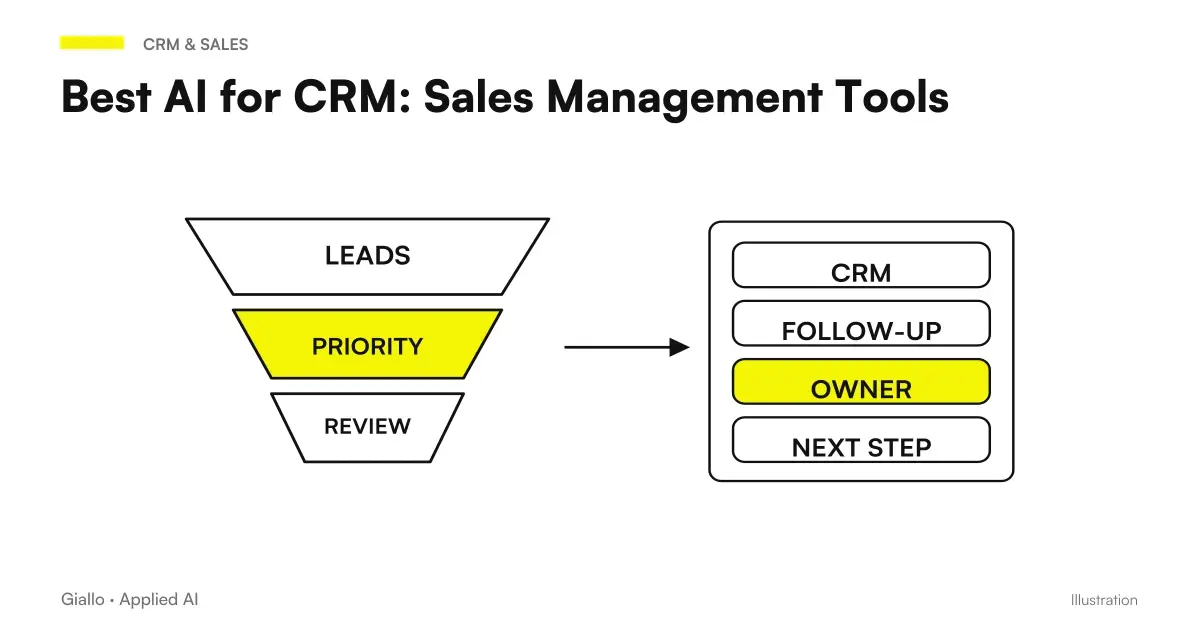 Best AI for CRM: Sales Management Tools
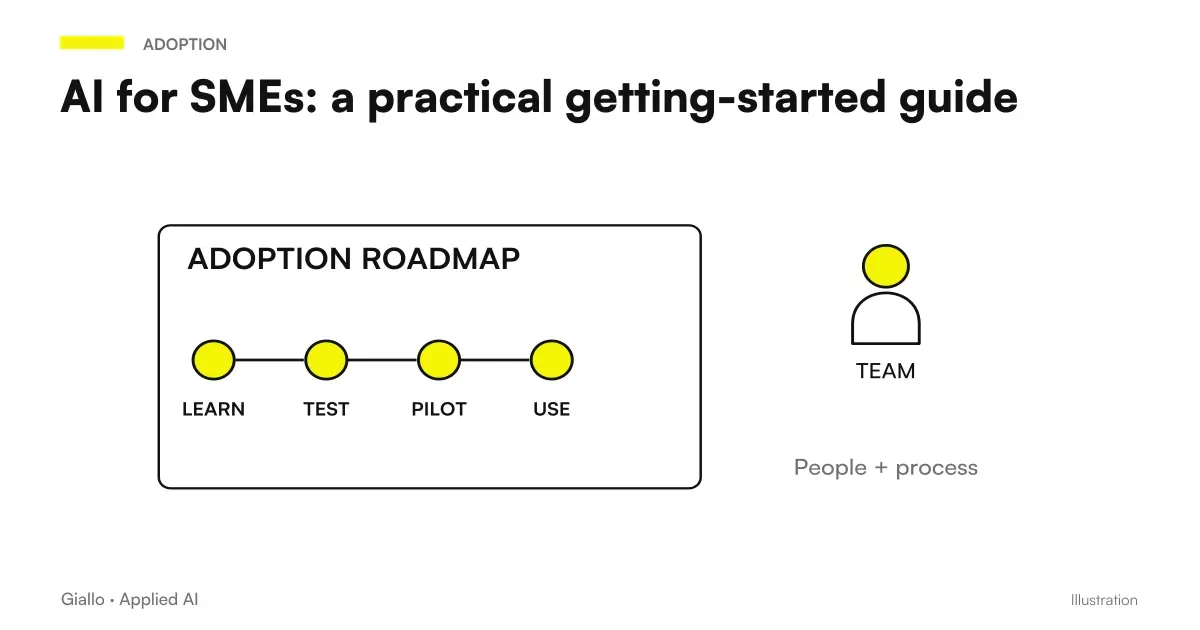 AI for SMEs: a practical guide to really getting started
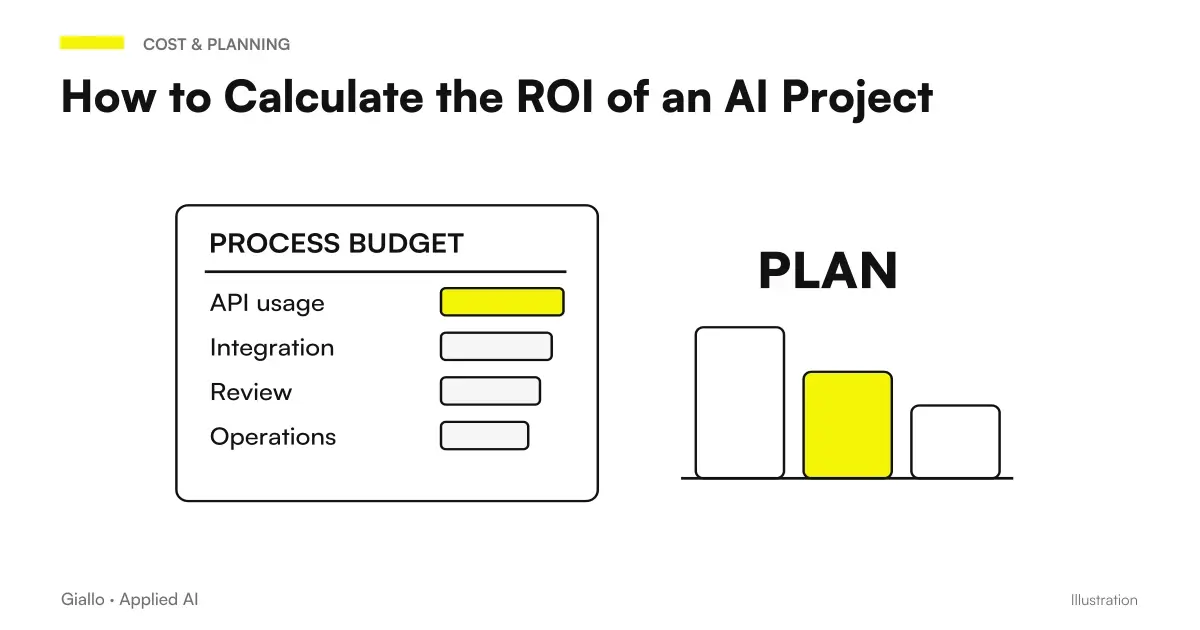 How to Calculate the ROI of an AI Project
 AI for catering and banqueting: event quotes and customers
 AI for shops: customer messages, stock by size, returns and loyalty cards
AI by sector
The same reasoning, applied to the other areas we follow.
- Creating quotes with AI: how to speed up the process
- AI for Business Customer Care: How It Really Works
- AI for Accounting: What It Can Really Do
- AI for dentists and dental practices: recalls, quotes and scheduling
- AI for consultants: proposals, client data and project delivery
- AI for e-commerce: compliant returns, product descriptions, discounted prices and reviews
- AI for catering and banqueting: event quotes and customers
- AI for electricians: wallboxes, solar power and installation deadlines
- AI for call centres: what changes?
- AI for pharmacies: customers, service bookings and loyalty
- AI for businesses: a complete guide to getting started
- AI and e-invoicing: what can be automated
FAQ
Does a CRM with built-in AI replace the salesperson?
No. It handles the work that depends on data and recurring patterns: lead scoring, follow-up drafts, and updating records. Reading unspoken objections, negotiating prices, and signing remain with a person, because they require a relationship context that the CRM does not contain.
How can I trust a score awarded by a model and not by a person?
A useful score always comes with reasons: which signals determined it, not just the final number. If your tool returns a score without an explanation, the salesperson cannot validate it and ends up ignoring it or following it blindly. Always ask for the explanation, not just the ranking.
Do I need to change CRM to add AI features?
In most cases not. The most popular CRMs already have native AI modules to activate, or connect to an external model through no-code tools without touching the system that the team already uses. Changing CRM only makes sense if the current one does not expose APIs and blocks any automation.
Can AI set the price in a quote generated in the CRM?
No, and it shouldn't: it doesn't know the real margins, the availability of the team at that time or the specific relationship with that customer. It prepares the structure, the entries and the descriptions; the price remains a human decision, leaning on the data but not delegated to the system.
What happens to a contact's data when they are read by an AI model outside of CRM?
Depends on where the model runs and what the contract with that provider is. The legal basis of the processing (typically the execution of a contract or the legitimate interest, according to Article 6 of the GDPR) must be verified and an agreement is needed with the provider who processes that data on your behalf. In case of doubt, check with your privacy consultant.
Does a lead score designed for one sector work the same way in another?
No: it depends on how much historical conversion data that CRM has and how long the sales cycle is. A company with a few months of history or with very different negotiations gets less reliable scores than one with years of homogeneous data. The score improves with use, it is not accurate from the first day.