
Compare supplier quotes with AI: prices, quantities and terms on a common basis
Compare supplier quotes with AI: unit prices, batches, transport and terms on a common basis. Missing data and a shortlist for approval.
Reading time: 12 min
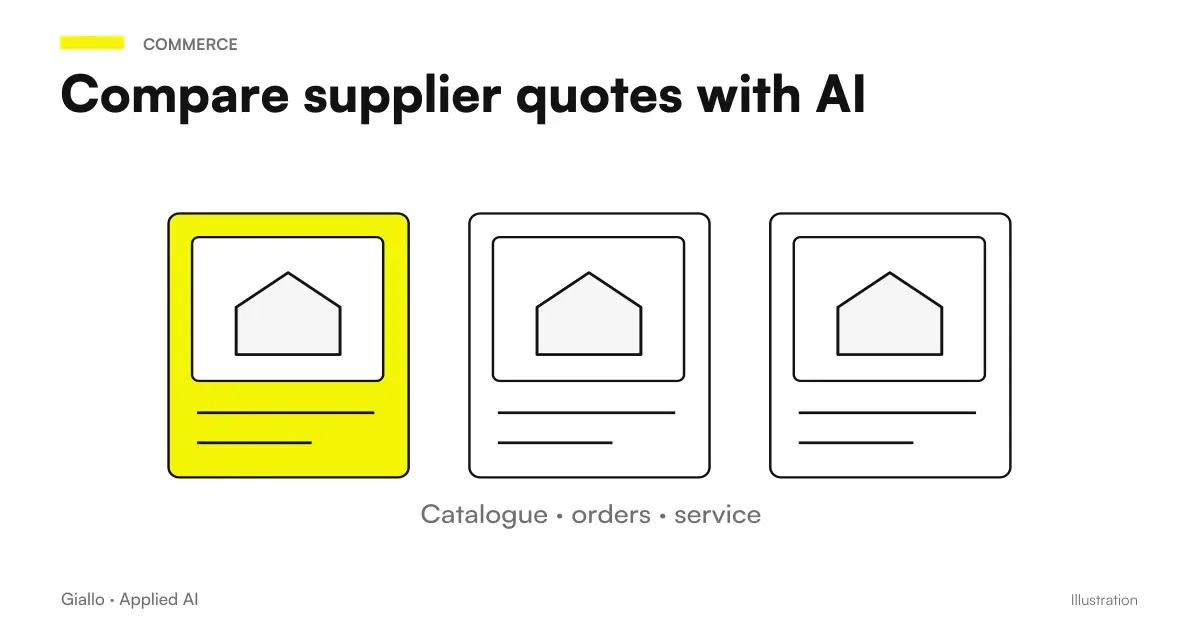
Comparing supplier quotes with AI means preparing offers on a common basis, keeping sources, conditions and missing data visible. Unit price, quantity, minimum lot, transport and time must be comparable before a shortlist. The lowest total does not prove that the offer best meets the company's need.
This page is about who buys and has already collected different proposals. Writing a sales quote follows another path. Here the useful result is a table that allows the purchasing manager to decide, without hiding a condition within a generic summary.
Technical primitives are documented at 9 October 2026; examples are hypothetical. The guide to AI for purchases and suppliers also covers checks of conditions over time. The circumscribed comparison should be included in the framework of AI for businesses.
In summary
- The common need is defined before normalizing the offerings.
- "Unspecified", "included", and "equal to zero" are different states.
- Quantity, units and lots can change the comparison of totals.
- Transport, times and conditions remain visible next to the price.
- Each equivalence must have a source or verification.
- Shortlist, choice and order are separate decisions.
What common need to use as a basis for comparison?
Write down what needs to be purchased and what conditions matter. Variant, unit, quantity and destination may be required for a material. For a service they can serve perimeter, duration, activities included and required result. If the need is not defined, a uniform table may give a false impression of comparability between bids answering different questions.
Identify indispensable and negotiable requirements. An offer may have an attractive price but not include a necessary feature. The system must show the point, without turning it into a secondary preference to improve the overall score. The decision on what is indispensable belongs to the project manager.
Keep the date and version of the request too. If you send an updated brief to only one supplier, the offers may not cover the same scope. The comparison must flag this asymmetry. Calling every document a "quote" is not enough: you need to know which need it represents. The guide to AI to analyze business documents helps to distinguish extraction and interpretation of sources.
Before processing everything, you can ask the system for a map of the bids: object, version and missing points. The auditor shall verify that the common basis is correct. Only then are the relevant entries calculated or compared. This step avoids investing in the normalization of documents that the team will have to update anyway.
Which fields to put in the comparison table?
The comparison must maintain original value, normalized value, and source. A uniform number without reference makes it difficult to understand how it was obtained. n8n documents the extraction of structured information by attributes or schema; the function can prepare the fields, without proving that the offers are equivalent. Official Information Extractor.
| Field | Information required | Doubt to highlight |
|---|---|---|
| Voice | Product or activity offered | Different Perimeter |
| Quantity and units | Price base | Different packaging or measures |
| Minimum Lot | Constraint of the proposal | Buying Higher Than Need |
| Price | Original Value and Currency | Discount or base unclear |
| Indicated taxes | Field reported in document | Absent or to be verified |
| Transport | Included, separate or unspecified | Uncomparable cost |
| Timings | Indication and condition reported | Unconfirmed date |
| Exclusions | Excluded activities or materials | Necessary part absent |
| Validity | Information available | Version or term to be clarified |
Don't make an absent field zero. "Transport not specified" requires a question; "transport included" describes a condition; "transport to zero" is a data to be verified if it appears in the source. They are three different states and influence the decision. The same rule applies to ancillary services and minimum quantities.
For VAT and other tax items, report what is indicated and report what is missing. This page does not set out the applicable processing. The competent contact person checks the case and the purchasing manager uses a consistent basis to decide. Do not attribute to the model the tax choice behind a seemingly complete total.
How to normalize units, quantities and lots?
Standardization must follow approved equivalences. A package offer and a piece offer require data on the content. Two similar descriptions do not prove that quality, variant or size coincide. The system may propose a comparison, but it must indicate when the equivalence has not been verified.
A purely demonstrative example: the company needs a hundred units, while a bid imposes a lot of two hundred. The unit price may be lower, but the purchase required is different. The table should show both the price and the constraint of the lot, without automatically declaring that proposal more convenient. The numbers illustrate the problem, not a case or a real result.
If an item includes multiple materials, it may not be possible to distribute the price between the components. Indicates the aggregate entry and the limit of the comparison. Do not invent a unit cost for each item just to complete the table. The manager can ask the supplier for a detail or evaluate the offer as a package, with that explicit perimeter.
Approved conversions should be verifiable with clear rules. The AI part helps to read the document and propose the correspondences; the calculation does not need to become a creative response. This separation makes it possible to control whether a difference depends on the source, equivalence or formula applied.
How to compare times, transport and exclusions?
Conditions may have more weight than a small price difference. An indicative delivery is not a confirmed date; a time calculated from the order confirmation does not necessarily start from the receipt of the quote. The comparison must keep the relevant sentence or reference, without turning a condition into a certain day.
Transport may be included, quantity bound or unspecified. The destination must be that of the common need. An offer to pick up from the supplier is not directly equivalent to an on-site delivery. The handler can choose a different mode, but that choice must be visible instead of remaining hidden in the total.
For services, it controls excluded activities and responsibilities. A care proposal may include different hours, interventions, or outcomes. Do not automatically interpret an ambiguous clause. The system shall present the passage and application to be verified with the appropriate contact persons. The shortlist must indicate the limit, without turning uncertainty into a low vote decided by the model.
Questions to be prepared when two offers are not comparable
What voice or condition is missing? Which unit was used? Does the lot cover the need or does it impose a different purchase? Are transport and ancillary activities included? What event do the times run from? Show the source and prepare the questions for the referent, keeping the communication as a draft until it is authorized.
How to use a shortlist without delegating the choice?
A useful shortlist explains the criterion. It can group bids that meet the requirements, incomplete bids and bids with different conditions. It should not be limited to an overall score. The person in charge must see why a proposal was included and what data might change its position.
If the company uses weights or rating rules, they must be agreed upon and versioned. The model does not decide the value of reliability, timing or quality in place of those who know the supply. An element not present in the documents must remain absent, not be filled with reputation deduced from a convincing name or language.
n8n documents human review for tool actions: the process may involve a review of the proposal before an action. The function does not prove that the choice of provider is correct. Official Human Review. The commercial decision must remain recognizable, with the material on which it was made.
The transition to responsible is deepened in approval of purchases with AI. The choice does not yet imply an order or payment. For writing offers to your customers use instead AI quote automation: it is a different process and should not be confused with the comparison between suppliers.
How to keep versions and questions open?
An up-to-date offer should retain the link to the previous one. The comparison shows what has changed and which version is used. If the provider answers a question in the email body, that information can change the basis; the referent must verify its role. Do not delete the previous conditions without making the relevant update visible.
Open questions must have a handler. A table with many cells “to be clarified” can only be useful if someone knows what to do next. Group applications by supplier and indicate those that prevent a decision. Preparing a message may be part of the job, but sending follows the authorized path.
If the need changes from a single purchase to a recurring catalog, the process changes. update supplier price lists with AI is about external data that is versioned in the catalog. Here the comparison serves a specific decision: it must not automatically update all business conditions just because a new offer looks better.
Two hypothetical scenarios for small purchasing offices
A food laboratory compares a supply of packages
Imagine an Italian laboratory that receives offers for packages intended for a production. The table preserves material, size, unit, lot and delivery mode. A canned proposal is not compared with a piece by piece before checking the content. A missing technical detail generates a question, not a fabricated equivalence.
The manager shall assess the needs, storage capacity and operational constraints. The offer with lower unit price may require a different batch. The system brings the comparison clear; the choice considers what the referent knows. The scenario does not present a measured savings and does not demonstrate capacity on documents of a specific supplier.
A professional firm compares maintenance services
Imagine a Milanese studio that collects proposals for the maintenance of its instruments. The table distinguishes duration, activities included, interventions excluded and conditions of the times. A similar total does not demonstrate an equivalent service. The system presents differences with the source and points that require comparison.
The referent decides what requirements are needed. If a proposal is incomplete, it can ask for an integration before the shortlist. An ambiguous phrase is not transformed into a certain commitment. The next phase of verification of supplies is discussed in DDT control, orders and invoices, when the process concerns relevant materials and delivery documents.
When is the comparison to stop instead of producing a ranking?
Stop at the point when the offers don't respond to the same need. The system can prepare a map of differences, but it should not build a comparable total by adding components that do not have a common base. An updated request or supplier detail may be the next most useful step of the shortlist.
Another limit concerns non-documental data. Operational reliability, experience of collaboration and consequences of depending on a single supplier can be information that the manager knows. The model must not attribute a value to these factors without a source. The table prepares the decision and leaves a recognizable space for the referee's assessments.
Make uncomparable proposals visible without presenting them as worse. An offer can be valid for a different perimeter and request a decision on that perimeter. The reason should describe the fact that it prevents comparison, avoiding generic judgments about the supplier. This makes the result purposeful and makes it possible to ask for precise integration.
If the system proposes a ranking, the auditor must be able to reconstruct the criteria and see the missing information. A seemingly complete ranking can hide a weight choice that no one has approved. The test should also compare cases where the correct answer is “not yet comparable.” They are useful evidence to decide if the project helps the purchasing office, without inventing the choice in its place.
How to measure the test and set the cost?
Prepare a sample with homogeneous offers and difficult cases: aggregate entries, different batches, absent transport and updated versions. A referent builds the expected comparison. It measures completeness of fields, correct equivalences, necessary questions and corrections. It also checks whether the summary helps decide or forces you to reread each document without orientation.
The budget includes extraction, normalization, rules, review and maintenance. An agreed limit for the pilot helps to evaluate the work without calling it a standard cost. Do not infer an economic return from the shortlist. The measure must use real decisions and data, distinguishing quality of comparison and purchase result.
It avoids rankings based only on the total, missing costs turned into zero and suppliers chosen by the model without criteria. An anonymized example of request and offers allows Giallo to evaluate a AI agent for the purchasing office on your comparison, with a manager who can confirm the equivalences and conditions to use.
Giallo Studio guides: methodology and sources
How we apply it in the company
Related resources
 AI for businesses: a complete guide to getting started
 AI for procurement and supplier management
 AI for business document analysis: a practical guide
 AI quote automation: save hours on every offer
 Check delivery notes, orders and invoices with AI before recording them
 AI purchase approvals: complete requests and traceable decisions
 Update supplier price lists with AI: changes for approval
 Verify chatbot citations with Jev AI
FAQ
How to compare supplier quotes with AI?
Extract items and conditions into a common structure, leaving the reference to the document. Make explicit units, lots, transport, indicated taxes and missing data before proposing a shortlist.
Does the lowest total identify the best provider?
No, offers with different quantities or conditions may not be comparable. Reliability, timing and constraints require a decision of the purchasing manager.
How should you handle an item missing from a quote?
Indicate it as unspecified, distinct from zero or included. Missing data may require a question to the supplier before the comparison.
Does AI decide on VAT treatment?
No, it must report the field indicated and make visible if it is missing. The tax interpretation and the total useful to the decision require the appropriate verifications.
Which metric to use in the test?
Compare completeness of fields, correctness of equivalences and necessary corrections. Evaluate whether the comparison helps to decide without hiding important conditions.
Does the workflow place an order with the chosen supplier?
It is not implied. The page is about preparing the comparison and the shortlist; purchasing approval and the order are separate steps.