
Artificial superintelligence: meaning and applications
Artificial superintelligence: meaning, available evidence in 2026 and differences from AI. A practical guide to interpreting announcements and applications.
Reading time: 14 min
The Artificial superintelligence indicates general capabilities far superior to human ones: not just speed, memory or skill in one exercise. The English acronym is ASI, Artificial Superintelligence. In Italian usage, the search query “super intelligence” also often refers to this concept, but the term is not a new name for all artificial intelligence.
Distinction matters when reading an ad or evaluating a business proposal. In the historical document Superalignment, OpenAI expressly used "superintelligence" to indicate a higher level of capacity than AGI. A supplier can then work towards that goal without having already demonstrated it in a product. OpenAI, Introducing Superalignment.
For a company the useful question is twofold: what does the promise mean and what can the proposed system carry out, under the conditions of its own work? This guide clarifies the concept, delimits the public evidence examined at the 10 October 2026 and links any doubt to the related in-depth analysis. The illustrated applications are possibilities of AI to be evaluated, without attributing to them ASI capabilities.
In summary
- Artificial superintelligence and artificial intelligence are not synonymous: the first term requires a specific statement about capabilities.
- A superhuman result in a circumscribed context does not demonstrate superhuman generality.
- Operational autonomy, document knowledge, and quality of reasoning describe different properties.
- The public sources examined document progress, but they are not enough to classify a product as ASI.
- An SME can choose a useful project through verifiable results, without waiting for a prediction on superintelligence.
What is artificial superintelligence?
The decisive point is the word General. A system that can solve a problem better than a person can remain limited to that problem. To speak of superintelligence, in the sense used here, superiority should extend to a very broad set of cognitive activities, including new situations.
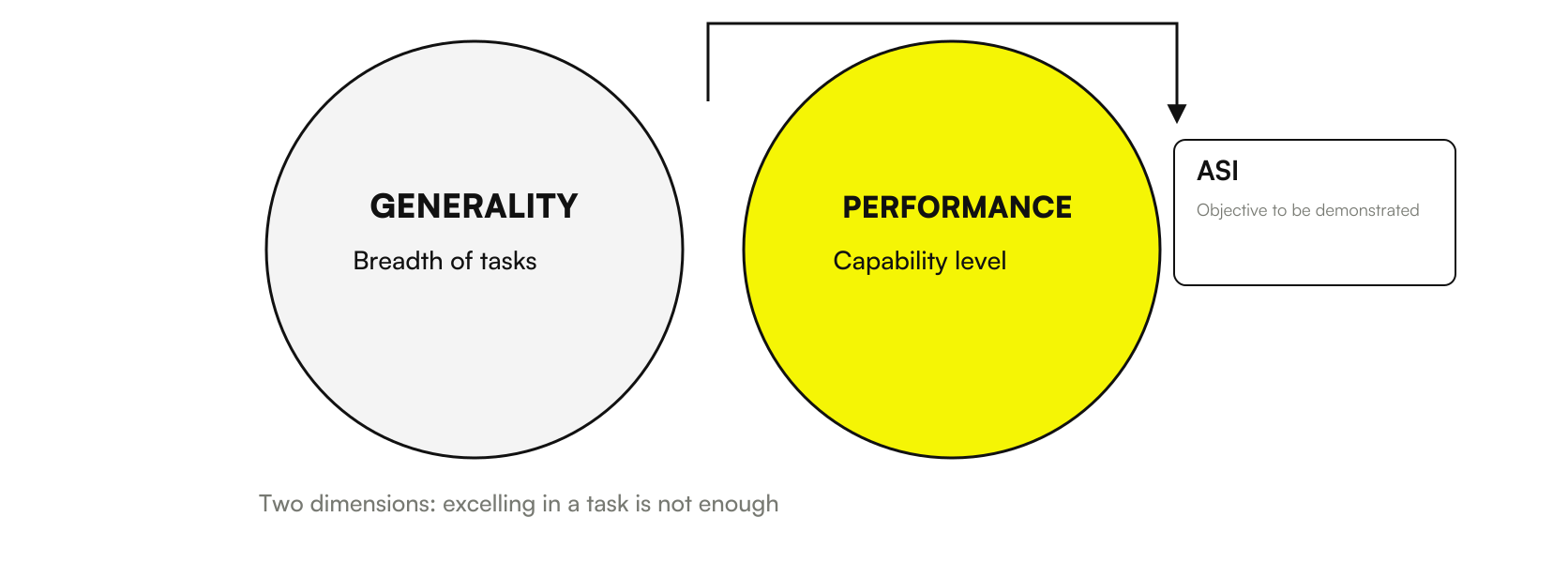
Google DeepMind's paper Levels of AGI proposes to distinguish depth of performance and breadth of capabilities; it places ASI in the general superhuman case. It's a research framework, not a commercial stamp. Product assignments in the paper refer to the publication period and do not rank the 2026 models. Morris and others, Levels of AGI.
An understandable formulation for an entrepreneur is this: "Is this system only successful in what we have prepared it for, or does it maintain exceptional performance when business, data, and constraints change?". The second question is much more challenging than the first. It requires evidence that does not end in successful conversation with a chatbot.
However, it is not necessary to assign a level of intelligence to every instrument purchased. A document reader can be useful because it quickly locates a clause and links it to the source. The value of that service remains understandable even without a statement about the overall superiority of the system. For the broadest category, the guide to what is artificial intelligence offers the starting picture.
Why can't ASI, AGI and AI be traded?
AI, or AI in Italian, is the category that includes systems with very different characteristics. AGI indicates general artificial intelligence, but the definitions adopted by organizations do not completely coincide. ASI makes a further claim to general performance.
The OpenAI Charter, for example, defines AGI through highly autonomous systems that outperform people in most economically relevant work. The criterion brings together work, performance and autonomy. It is necessary to cite it as the definition of OpenAI, without presenting it as the threshold shared by each laboratory. OpenAI Charter.
In corporate communication, a small inaccuracy can create a very large expectation. If a proposal describes a service as “superintelligence for your office,” the reader could expect to handle any exception, decision or document. The service could instead be designed for a few recurring requests, with human intervention in unusual cases. It's two different promises.
The complete comparison between the criteria is in AI, AGI and ASI: differences between intelligence and autonomy. Here it is enough to withhold a rule: before discussing whether a system has reached a threshold, ask which threshold was chosen and how it was measured.
What signals are not enough to demonstrate superintelligence?
A system can impress for reasons that do not match the ASI definition. It can write with confidence, consult a huge archive, use programs or remember previous choices. Each ability deserves an evaluation, but the transition to general superiority must be demonstrated separately.
| Observed signal | What makes it possible to observe | What remains to be verified |
|---|---|---|
| Convincing response on a catalogue | Understanding and Retrieving Present Information | Management of contradictory data and out-of-catalogue activities |
| Excellent result in a test | Performance under the conditions of that test | Transfer to different tasks and constant quality |
| Autonomous use of a management software | Performing authorized actions in the environment | Decision correctness and exception management |
| Memory of Preferences | Retention or retrieval of information | Acquisition of new general skills |
| Better code production | Improvement with respect to a specific criterion | Validity of the criterion and compliance with other constraints |
| Trade name "superintelligence" | Positioning declared by the supplier | Technical evidence for the adopted ASI definition |
The table is a tool for reading proposals, not an alternative scientific taxonomy. It serves to keep close the claim and evidence that can support it. An offer becomes clearer when it describes observable results and conditions of failure.
A simple example: if an assistant answers correctly on the material of a component, he has solved a question about the catalog. If he also finds a compatible variant, he faced an additional constraint. Before giving it general competence, one should know how it behaves when compatibility is undocumented, two sources contradict or the customer asks for a never-expected change.
Does superintelligence already exist in the public evidence of 2026?
In the public sources examined for this guide we did not find a sufficient demonstration to classify a product as ASI according to the general superhuman criterion adopted. It is a conclusion limited to the corpus consulted, not the claim of having verified every existing system or every private evaluation.
Documented progress remains relevant. The official GPT-6 Astra page describes computer work skills and professional activities; the DeepMind communication on Gemini Deep Think describes contributions to mathematical and scientific research. They are sources of their respective suppliers and should be read with the conditions of the experiments, without automatically obtaining an ASI certification. OpenAI, GPT-6 Astra, Google DeepMind, Deep Think in Search.
To assess the existence of superintelligence, questions other than those of a subscription comparison are needed: what activities have been tried, how broad are they, who has verified the outcome and what assistance has been needed? The Guide Does superintelligence already exist? Evidence in 2026 examines precisely this passage between documented results and possible conclusions.
A demo can be authentic and, at the same time, insufficient to the broader thesis. The problem is not to liquidate a good result, but to correctly describe its scope.
What applications of AI can be evaluated without an ASI test?
A company can design document assistance, draft preparation, and process support without solving the issue of general intelligence first. The starting criterion is a precise job: what information enters, what result must come out and who accepts it.
When the path is predictable, a workflow with explicit steps can be evaluated. When dynamic decisions are needed on the next step, an agent can be evaluated. Anthropic distinguishes these architectures in the Building effective agents guide; the distinction describes how the process is directed, not an ASI threshold. Anthropic, Building effective agents.
For example, preparing a draft response from an approved document is a delimitable request. Deciding on a commercial promise on an uncertain supply alone adds a different kind of responsibility. The fact that both actions can start with a message does not make them equivalent.
The Guide to the AI Agents and Superintelligence in SMEs deepens the relationship between autonomy and capacity. To understand the basic functioning of an agent, however, it is useful AI agents: what they are and how they work.
Does memory, context, and self-improvement make a superintelligent system?
Remembering a conversation can improve the continuity of care. Consulting business documents can make an answer more relevant. Neither observation, taken alone, demonstrates a general capacity superior to that of a human.
The Anthropic documentation on Contextual Retrieval describes techniques to retrieve information from a document base and add it to the context used by the model. The system obtains material useful to the response; it is not enough to infer that it has acquired a new general competence. Anthropic, Contextual Retrieval.
For an enterprise the concrete control is the path of the source. If a price list is changed, it is necessary to know which version is retrieved. If a user cannot read a document, the system must comply with that limitation. If the source does not contain the answer, the assistant must make the gap visible. A longer memory alone does not correct incorrect information or improper access.
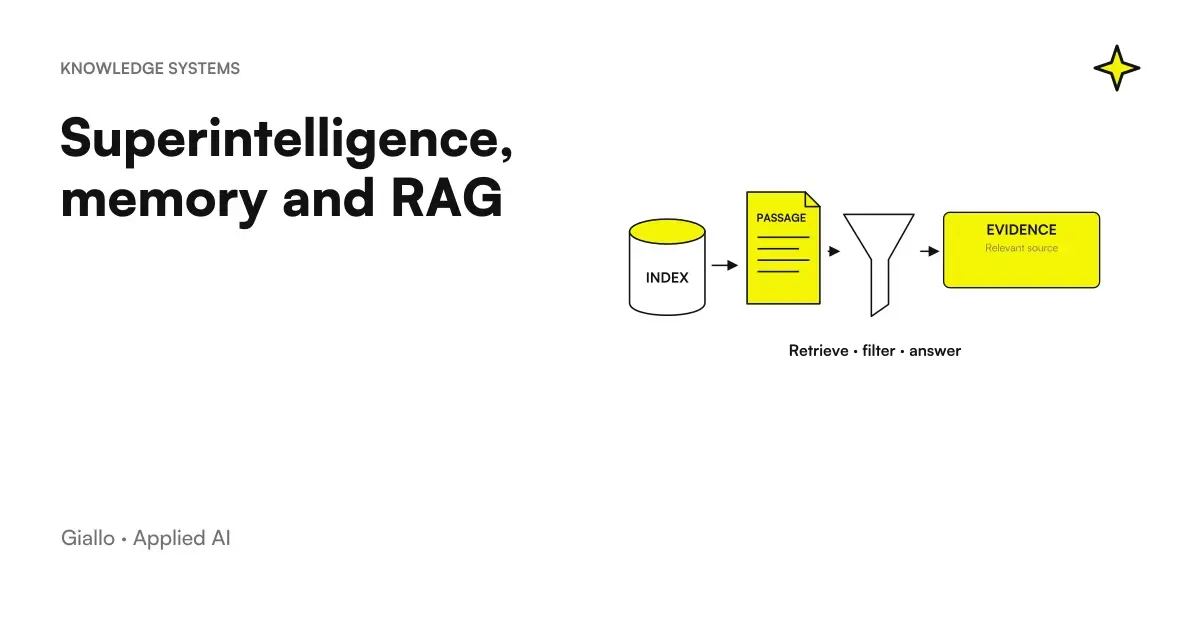
The deepening superintelligence, memory and RAG clarify this boundary. The tutorial on What is RAG instead describes the method of document retrieval.
Even “AI that improves itself” requires precision. AlphaEvolve searches for and modifies algorithms through evaluators prepared for the problem. Optimizing a component according to a measurable criterion does not demonstrate an unlimited general self-improvement. The distinction emerges from the original paper. Google DeepMind, paper AlphaEvolve. Case is developed in How self improvement works with AlphaEvolve.
How do questions change at a beverage distributor?
Consider one hypothetical scenario: a local distributor receives requests from restaurants on availability, formats and delivery conditions. The company wants an assistant who reads the catalog and prepares a response to be approved. It is not a Giallo customer case nor a measured result.
The first test might seem surprising: the system interprets a misspelled request, links a trade name to the correct tab, and prepares a clear text. The manager might informally describe him as “better than us at finding the products.” The useful description of the result is more specific: he recognized that request and retrieved that information.
The difficult case comes when the restaurateur asks for an equivalent product, an out-of-zone delivery or conditions reserved for another type of customer. The assistant must distinguish what he knows from the catalog from what a commercial decision requires. Proposing a documented alternative and asking for confirmation on delivery can be the correct behavior, even if it appears less autonomous.
A sensible test for this scenario retains the original request, the version of the catalog and the reason for the acceptance of the draft. If the system uses the right catalog but promises an unauthorized delivery, the result is not acceptable. If he signals that a trade condition is missing, his prudence can help the job.
This example shows why the question “is it a superintelligence?” It is not necessary to choose the project. The firm can evaluate a circumscribed assistant, establishing what he must find and what he must leave to the manager. The complexity of the archive remains a data and process issue, not an ASI test.
What is the boundary in a plant maintenance company?
One second hypothetical scenario concerns a small business that prepares maintenance work. The technician receives a report, consults previous reports and must compose a list of materials to be verified before the inspection.
AI could be proposed as a support for preparation: bringing together dispersed information, highlighting contradictions between reports and turning notes into a readable card. To test the value you have to compare the card with the documents, not just appreciate the shape.
Suppose the most recent report talks about a replaced component, while an earlier photo shows the original version. The system should make the difference explicit and not silently choose a configuration. In this context, knowing many notions about plants does not replace checking the actual situation.
The goal of support can be defined without delegating diagnoses or security decisions. The manager must be able to understand which parts of the card are extracted from the sources, which are hypotheses and which require an on-the-spot check. An ordered draft is not an authorization to perform the intervention.
If the supplier uses “superintelligent” to describe this application, the enterprise can ask for a concrete translation: what changes in preparation and how is it demonstrated? The answer could be a useful documentary capacity, sufficient to motivate a limited project. Presenting it in this way helps set realistic expectations, without denying the interest of technical progress.
How to read a proposal that uses the word “superintelligence”
Locate the sentence that contains the promise. If it concerns the general level of capabilities, ask for definition and relevant evidence. If it concerns a business function, ask for a complete example with data, result and conditions of use.
He then observes the case that the demo does not show: a missing source, a contradictory data or a decision that requires approval. The answer to that case makes the application boundary clearer.
Finally, it separates what is already included in the proposal from a future function or limited availability. A search goal may be interesting, but it does not replace the service the company will receive.
What mistakes lead to overestimation of superintelligence?
Exchanging fluid language for complete proficiency. A well-written text may contain a wrong interpretation of a document. When proof is about business documentation, control must pass from sources and exceptions, not tone security. The Guide to the AI hallucinations and how to avoid them It addresses the quality of responses.
Confusing permission to act with intelligence. Allowing the system to edit a record increases what it can do in the environment. It does not automatically improve its judgment on the change. Permission must correspond to verified behavior; the theme is developed in superintelligence, alignment and control.
Turning a supplier's statement into an independent audit. The announcement is a primary source for what the company declares. Before extending a result to its business, it is necessary to understand who has done the test, with what tools and what support.
Waiting for an ASI date to sort out your data. Any document project needs sources that are recognizable, up-to-date and accessible to the right people. Postponing this work does not make the next project any easier. The decision on investment and waiting is dealt with in superintelligence for SMEs: waiting for it or using AI today?.
Promising universal replacement from a local success. An application can be very effective in preparing a draft and encounter difficulties in the final decision. Expanding the scope requires new evidence; changing the name of the system does not extend the evidence already gathered.
From which in-depth study should we start to understand superintelligence?
The theme is best understood by choosing the actual question. Each deepening addresses a different boundary, so reading can follow the need of the enterprise.
- To interpret the acronyms and compare the criteria, parts from AI, AGI and ASI: differences. It is useful when two interlocutors use "general" or "autonomous" with different meanings.
- To judge the announcements of 2026, read What evidence exists of superintelligence. Focus is what results allow you to conclude.
- For the term adopted by Meta, go to Personal Superintelligence and Muse Spark. The positioning of the product requires a reading attributed to the supplier.
- To understand the components of the systems, consult the technologies of OpenAI, Anthropic, Google and Meta. The comparison concerns the operation, without a universal ranking.
- For AI improvement hypothesis via AI, choose AlphaEvolve and self improvement. The central distinction is between verifiable optimization and general improvement.
- For the relationship between actions and intelligence, read AI Agents and Superintelligence. Increasing autonomy requires a separate decision on responsibilities.
- For the idea of a system that "knows the company", it goes to memory, context and RAG. Retaining information and acquiring capabilities do not coincide.
- To understand the problem of supervision, deepen alignment and control of agents. Multiple capabilities do not solve the verification of actions alone.
- To decide on a limited investment, use the SME Decision Guide. The point is to choose what to test, prepare or postpone.
How to translate the concept into a business choice?
The first practical consequence is write the perimeter of the expected result. If the need is to find information, the proposal must demonstrate recovery and accuracy. If the need is to decide the next step, it must demonstrate quality of choices. If the need is to perform an action, it must specify permissions and confirmations.
It is useful to keep three sentences separate: "the supplier declares", "the test shows" and "our process requires". The first carries a promise; the second describes a test; the third defines corporate acceptance. When they only partially coincide, the distance must be resolved before the project is extended.
A process card may contain a successful example, an ambiguous example, and one that requires human intervention. You don't have to call it a superintelligence test. It serves to understand whether the proposed application can produce the useful result in the conditions of the enterprise. The complete boot method is in the guide AI for businesses.
Understanding superintelligence thus helps to read the present better: it preserves interest in research and makes the choice of a service more precise. If you have a proposal to interpret or a process to delimit, a AI Consulting can turn the promise into requirements, examples, and acceptance tests.
Giallo Studio guides: methodology and sources
How we apply it in the company
Related resources
 AI, AGI and ASI: differences between intelligence and autonomy
 Does superintelligence already exist? Evidence in 2026
 Meta Personal Superintelligence: What Muse Spark Does
 Superintelligence: the technologies of OpenAI, Claude and Google
 AI that improves itself? How does AlphaEvolve work
 AI Agents and Superintelligence: What Changes for an SME
 Superintelligence, memory and RAG: getting to know the company
 Superintelligence and control: how to verify agents
 Superintelligence for SMEs: waiting for it or using AI today?
FAQ
What does artificial superintelligence mean?
It indicates a level of general capacity that is vastly higher than human capacity, according to the definition adopted. It is not enough to excel in a single task: it is necessary to demonstrate the breadth and quality of performance.
Is Super Intelligence a New Name for Artificial Intelligence?
No. Artificial intelligence is the general category; superintelligence indicates a more specific condition of capabilities. Using the term in the name of a product does not prove that that condition is achieved.
What does ASI mean?
ASI is the acronym for Artificial Superintelligence, i.e. artificial superintelligence. It should be distinguished from AGI, Artificial General Intelligence, whose definitions and thresholds vary between authors and organizations.
Does artificial superintelligence already exist in 2026?
The public sources examined as of 10 October 2026 do not provide sufficient evidence of the superhuman generality required by the framework adopted here. This conclusion is limited to the verified corpus, rather than a universal proof of absence.
Is an autonomous AI agent a superintelligence?
Autonomy describes which steps the system can decide and execute. Superintelligence, on the other hand, is about the level and breadth of capabilities. An agent can manage a circumscribed activity without demonstrating superhuman general capabilities.
Does an SME have to wait for superintelligence to use AI?
It can assess the AI available on a delimited problem, with appropriate documents and a verifiable result. The decision depends on quality, cost and process control, without the need to predict an ASI arrival date.