
SaaS · App · PWA
Athleex
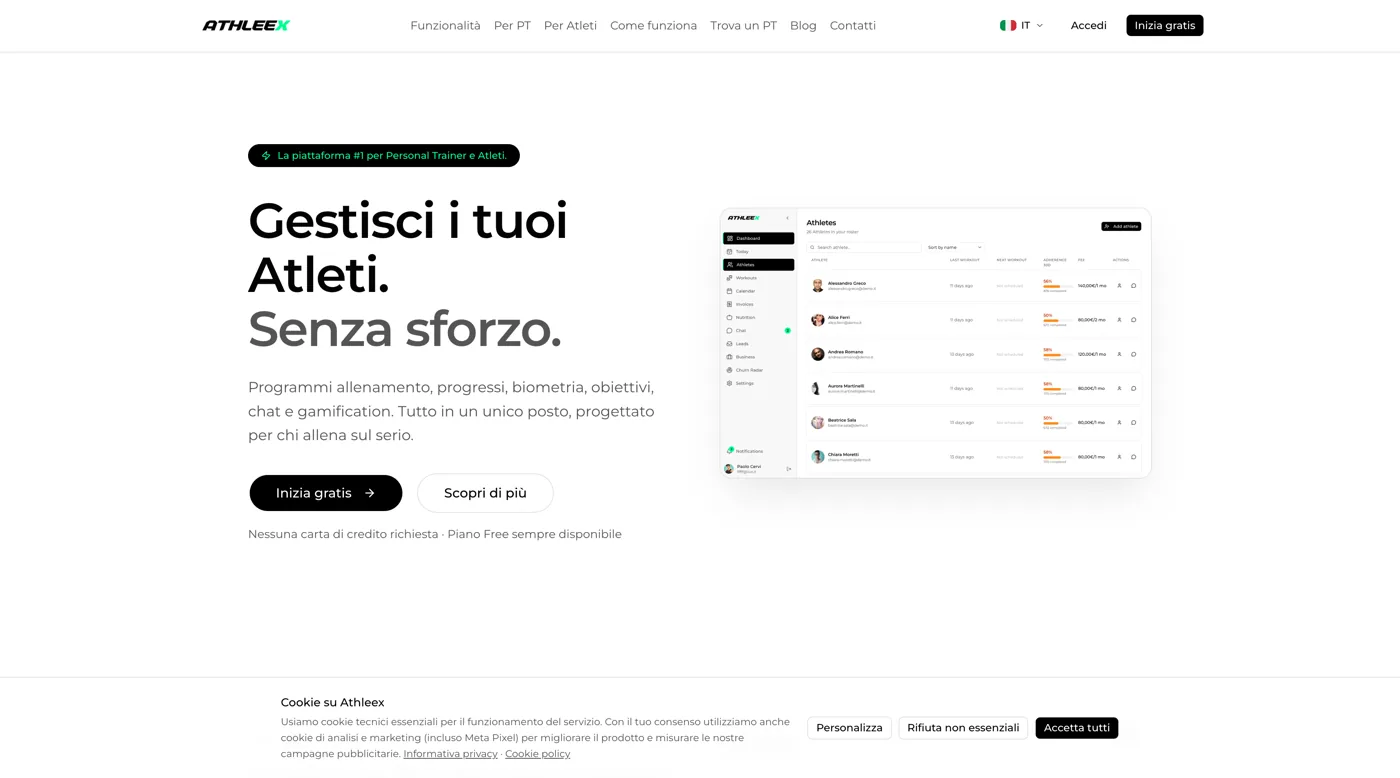
Athleex is a SaaS platform for personal trainers and coaches: athletes, training, nutrition, invoicing, chat and push notifications. One web codebase is distributed as native apps on App Store and Google Play and an installable PWA on iOS and Android.
athleex.com
The context
Athleex began with a clear ambition: to give personal trainers and coaches one tool to genuinely manage their work, rather than another app that solves one part of the problem and leaves the rest uncovered. Professional fitness is full of partial solutions: a spreadsheet for workout plans, business software for payments, a chat for talking to athletes and a different app for nutrition. Each does half the job, and none communicates with the others.
Athleex brings all of this into one platform: athlete management, workout planning, nutrition plans, billing, communication and notifications. It is a working product trainers use every day to support the people they train, rather than a brochure website.
The Challenge
The challenge was not imagining the features, but making them work together. A personal trainer does not want to learn five different software tools. They want to open one app on their phone and find their athletes, training plans, payments and messages in one place, without friction.
The product therefore needed two things together that usually exclude one another. On one side, the speed and flexibility of a web product, allowing continuous updates and improvements without waiting. On the other, an app-store presence: for a professional product, being downloadable from App Store and Google Play signals credibility and provides the discovery channel users expect. The technical challenge was precisely to combine these two worlds instead of choosing one.
One codebase, three ways to install it
The most important architectural decision was to build Athleex as a single high-performance web application and then make it available in three forms, all powered by the same code: as a website and web-app from the browser, as a PWA installable directly from the phone, and as a native application published on the App Store and Google Play.
This approach has a major advantage: one codebase to maintain and one place to fix problems or add features, with improvements reaching every version at the same time. It avoids maintaining two separate products and the risk of the mobile app staying several versions behind the web.
Native Apps on the App Store and Google Play
Athleex is available as both an installable website and an app published on the App Store and Google Play. We built a native wrapper around the application to deliver full iOS and Android apps while retaining one codebase shared with the web.
An app-store presence is more than a visual detail. Personal trainers can find Athleex where they expect it, download it with a tap and see its icon alongside their other professional apps. It also lets us use native phone features where needed: reliable push notifications, in-app payments following Apple and Google rules, and operating-system integration, while retaining the advantages of the web underneath.
The most delicate task was meeting the two stores' strict, differing rules, from review processes and in-app purchase requirements to sessions and permissions. Packaging a web product in a native container and passing Apple and Google reviews requires attention to dozens of details users never see, but which determine whether an app is approved or remains stuck in the queue.
The PWA: immediate installation, zero friction
Alongside the native apps, Athleex can still be installed as a PWA directly from the browser, without going through an app store. It is the fastest route: the athlete receives a link from their trainer, opens it and, in a few taps, has the app on their home screen, running full-screen without the browser bar or the storage footprint of a traditional installation.
Having both routes — app stores and a PWA — is an advantage that comes from building everything on a single web foundation. People who want the app from a store can download it there; those who want to get started immediately can install it as a PWA. In every case, it is the same product, updated in real time. When we fix something or add a feature, the improvement reaches everyone together, without the version fragmentation typical of mobile products, where half the users fall behind because they do not update.
What we have built
Athleex gives trainers complete athlete management: profiles, goals, biometric data, assessments and progress tracking. Its workout builder lets them create programmes, assign them to athletes and collect logs of sets, repetitions, load and perceived exertion, showing what happens between sessions.
The platform includes nutrition plans, multi-currency invoicing for trainers with clients in different countries, integrated chat keeping athlete conversations together, and a business dashboard providing a clear view of performance. Every part fits with the others: data entered once is available wherever needed, without duplication or copying.
Business management software for trainers
Business management is at the heart of Athleex. A personal trainer is also a small-business owner who needs to organise clients, programmes, payments and communications. Athleex brings this into one interface to reduce administrative time and return it to the work that matters: supporting people.
The business management web app is information-rich but easy to read. Statuses, priorities, data and key actions are visible at a glance, without unnecessary decoration where decisions need to be made quickly. We follow the same principle for every custom system: understand the real work process, then design an interface that reflects it.
Multiple languages and notifications
Athleex speaks six languages. This is more than a superficial translation: the whole experience, including communications with athletes, was designed to work in several markets from the start. For a product aiming to grow beyond national borders, built-in multilingual support removes one of the most common barriers to adoption.
Push notifications are the other half of what keeps the platform active: how Athleex reaches athletes even when the app is closed, with a newly assigned workout plan, a message from their trainer or a reminder. Making them work reliably across both native apps and the PWA, on iOS and Android, is far from straightforward technical work — and it is precisely what keeps Athleex present in its users’ routines.
The result
The result is one product across all the relevant channels: native apps downloadable from App Store and Google Play, a PWA installable in seconds, and browser access. Trainers get one tool instead of five, updated in real time and available everywhere. Athletes get an app on their home screen, with notifications and training plans, accessible in the way they prefer.
We do not promise figures we do not have. What we can say with certainty is that the chosen architecture — a single web codebase delivered as native store apps and an installable PWA, with multilingual support and reliable notifications — removes the barriers that usually hold back adoption of this type of product, both for trainers and for the people they train.
Why This Project Matters
Athleex is interesting because of the decisions behind it, rather than the length of its feature list. Building one codebase and distributing it as both native store apps and a PWA is not a shortcut: it is how we combine the presence and trust of app stores with the speed of a web product that can be improved every day without intermediaries.
This is how we approach ambitious projects: first understand how the people using the product actually work, then choose the architecture that gives them the most value with the least friction. For Athleex, that meant giving personal trainers a complete tool, available everywhere, that grows with them rather than constantly catching up with their needs.
New Project
We bring yours online as well.
Whether it's a site, an automation or an AI agent: tell us the goal and see how to get there.