
AI for Business Customer Care: How It Really Works
AI customer support for business: chatbots, agents, privacy and customer transparency. Regulatory requirements with direct sources.
Reading time: 10 min
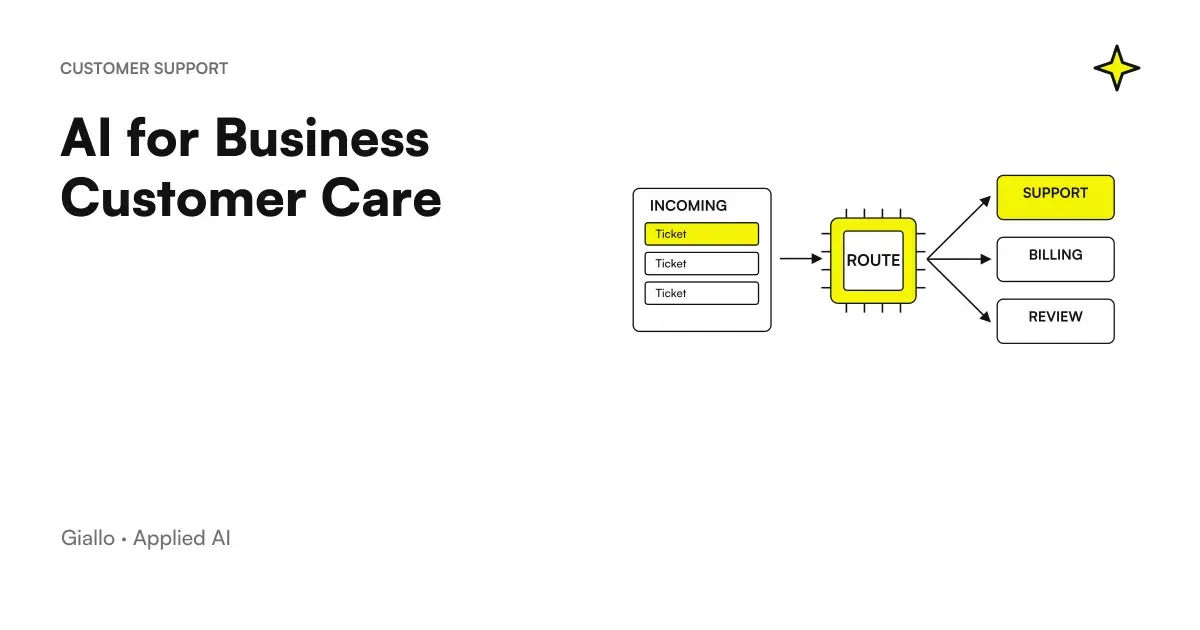
Customer care is often the first point where an SME sees a measurable effect from AI: the volume of requests is high, many are repetitive, and the waiting time is felt both on the customer side and on the side of those who always answer the same question.
AI doesn't cover everything: it doesn't handle angry customers as well as an experienced operator, it doesn't decide on complaints or exceptions, it doesn't improvise outside its perimeter. On a precise part of the work, the repetitive and loud one, however, changes the pace in a concrete way, and brings with it some obligations to customers that are worth knowing before leaving, not after.
In summary
- AI covers FAQ, sorting, response drafts and status updates, not complex or emotional cases.
- Chatbot and AI Agent are two different tools: only the second accesses external systems and performs actions.
- Since August 2, 2026, the customer has the right to know that he is talking to an AI, under the AI Act's obligation.
- We need an agreement with the supplier under the Article 28 of the GDPR, not just a good technical configuration.
- The perimeter should be kept tight at the beginning: better few reliable answers than many uncertain.
What AI can do today in customer care
Not all customer care is automated in the same way. This table separates functions by mechanism and reasonable level of autonomy to be entrusted to a system.
| Function | How it works | Who decides in the end |
|---|---|---|
| Response to FAQs | Retrieves the response from the knowledge base and sends it | The system, autonomously |
| Ticket Sorting | Read the request and route it to the right department | The system, autonomously |
| Response Draft | Prepare the text, the operator revises it | The operator |
| Order or Practice Status | It reads from the business management software and answers with up-to-date data | The system, if integration exists |
| Complaints and refunds | Collect the case data and prepare the dossier | The operator |
| Emotional or delicate situations | Recognize the tone and transfer | A human operator, always |
The criterion behind this table is simple: where the error has low consequences and the answer is verifiable, the system decides. Where the error costs money or in relation, a person decides, with the information already collected by AI.
Chatbot or agent: two different tools, not two names for the same thing
The term "chatbot" is used to indicate very different things between them, and the choice between the two models changes the type of project.
Chatbot AI
- Answer on a textual basis: FAQ, documentation, instructions
- It does not access CRM or management software
- It doesn't perform actions, just answers
- Faster Configuration
AI agent
- Read and write on external systems
- Can open a ticket or update a practice
- Maintains context between different sessions
- Requires integrations via API
In practice many companies combine the two levels: a chatbot for information questions, an agent for operations that touch real data. To better understand the distinction, you can read What are AI Agents and the guide to chatbots, assistants and agents.
How to build, without skipping steps
- Analysis of received requests. It starts from a sample of real requests from the last few months, classified by topic and frequency. It determines what to automate first.
- Perimeter tight. The system responds only on configured arguments, everything else passes to the human. The perimeter widens when quality is verified, not before.
- Written knowledge base. FAQ, procedures, service conditions in a structured form. If they do not exist, they must be written before configuring any system.
- Integrations. For an agent who reads real data, an API link with CRM or management software is needed: it is the technical part that decides the level of autonomy attainable.
- Escalation rules. By tone, by argument, by failure of automatic response after a couple of attempts.
- Tests on real questions. Before launch, not after: it is the step that reveals knowledge base gaps before a customer finds them.
- Gradual start. On part of the requests, with human review of the first answers, before scaling.
To learn more about how AI agents are configured in business processes, the Practical guide for SMEs goes into detail.
Telling the customer who answers an AI: What has changed since 2026
When an automatic system responds in the place of a person, the customer has the right to know, and shortly it will no longer be just a choice of voluntary transparency.Article 50 of the AI Act establishes that AI systems intended to interact with physical persons must be designed so that the user knows they are dealing with an AI, unless it is already evident from the context. The obligation shall apply from 2 August 2026, the date laid down in Article 113 of that Regulation.
In practice, for a chatbot or agent who writes directly to the customer, this means a clear wording at the beginning of the conversation, not just a line in the privacy policy. For the broader obligations affecting an SME, the framework is in AI Act: what obligations does an SME really have.
Privacy: what it really takes, with sources
An AI system that reads customer requests processes personal data, and this involves precise obligations, not generically "paying attention to the GDPR".
Legal and informational basis. Who collects data must inform the data subject at the time of collection about the owner, purposes and recipients, as provided by the Article 13 of Regulation (EU) 2016/679. For customer care this means that the existing information must be updated when introducing an automated system that treats the same requests.
Contract with the supplier. If the AI system is managed by an external provider, as it almost always is, that provider acts as a data processor. The Article 28 of the GDPR requires a contract that establishes the subject, duration, nature of the processing, type of data and mutual obligations: not a confirmation email, a written act.
Sensitive data outside the perimeter. Health data, financial situation or judicial data should not be processed by a generic AI system without a specific assessment. The topic is deepened in AI and GDPR: what an SME needs to know.
Two different starting points, depending on the type of requests
Think of an e-commerce business selling one type of product, with a small team manually answering questions on order status, sizes or availability, and response times that grow during peak hours. Here, that is the simplest part to automate: answers checkable against the management software in real time, with a clear scope from day one. The rest — disputed returns or unhappy customers — remains with those who have the context to decide.
Instead, think of a professional studio that receives many emails about deadlines and standard documentation, but that does not want integrations with its management software in the first phase. Here it makes more sense a simple chatbot on the most common questions, with immediate escalation to the professional for everything that requires a specific assessment: no interpretations, no opinions, just information that is already written somewhere.
In both cases the starting point is not the technology but the kind of demands that come every day: how many are repetitive, how many really require human judgment.
Respond on the status of an authorized order
A transactional question requires identity, operational source and date of data. The guide to AI assistant for order status treats authorized consultation, incomplete tracking and partial shipments. It measures recovery errors and additions in the response separately: reading a correct event does not authorize you to promise an absent delivery date from the source.
What to measure, without inventing thresholds
A customer care AI system should be measured, but the targets you often read online are industry averages that say little about your specific case.
| What to watch | How it is measured | What it compares to |
|---|---|---|
| Auto-Resolution | Requests closed by the system without human intervention | The volume handled before AI |
| First Response Time | From reception to first response to customer | The previous average time |
| Customer Satisfaction | Post-interaction evaluation, if collected | The level before introduction |
| Escalation | Share of requests passed to the operator | It must remain consistent, not disappear |
The useful comparison is always with your before and after, not with a number read in a generic report: each company starts from a different mix of requests, and the same percentages do not mean the same thing everywhere.
Mistakes that cost the most in the first few months
Opening everything up now. Activating the automatic response on every topic from day one is the most common and the most risky choice: problems are found by customers, not internal tests.
Knowledge base misspelled. A system responds only as well as the information it is based on. Unupdated procedures produce wrong answers, which are worse than no answers.
No escalation rules. A system that doesn't know when to switch to a person ends up answering even where it shouldn't, and the customer notices it before anyone else.
Neglecting the information and the contract with the supplier. They are not bureaucratic details: without an up-to-date notice and an agreement with the provider under Article 28 of the GDPR, the processing is not in compliance, regardless of how the system works.
Not saying that it is an AI. With the AI Act on the way, those who do so now avoid having to change everything quickly later.
How many requests a day it takes to justify the project
There is no valid threshold for everyone, but a simple method to decide it: look at the requests received in recent months and count how many are repeated almost identically. If they are a consistent part, writing the correct answers in a structured form is the first step, before even choosing a system, because it already reduces the response time when the operator has them ready in front.
The next step is to decide if a chatbot is enough on the information questions or if an agent connected to the real systems is needed. A practical demo of how it is structured is in AI customer care for SMEs. For e-commerce, the applied case is deepened in AI for e-commerce; for a custom-built project, the services of AI agents of Giallo Studio start from the analysis of requests, not from a standard package. If the main channel is email, it is also worth reading How AI Works to Respond to Business Emails and AI for ticket management, which delves into the side of structured queue requests management.
Giallo Studio guides: methodology and sources
How we apply it in the company
Related resources
 AI to Respond to Business Emails: How It Works
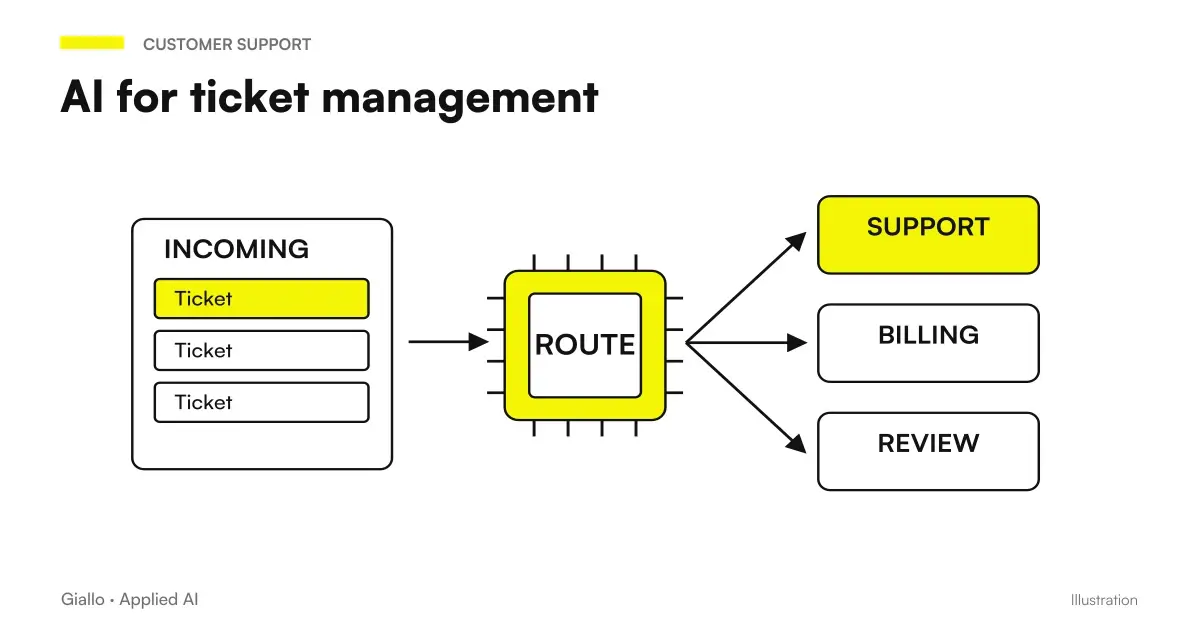 AI for ticket management: shorter waits, more resolutions
 AI Chatbots: What They Are and How They Work
 AI for SMEs: a practical guide to really getting started
 GDPR and artificial intelligence in the company
 AI Act: what obligations does an SME really have
 AI for catering and banqueting: event quotes and customers
 AI for shops: customer messages, stock by size, returns and loyalty cards
AI by sector
The same reasoning, applied to the other areas we follow.
- AI for CRM and sales: automate the sales process
- AI for dentists and dental practices: recalls, quotes and scheduling
- Creating quotes with AI: how to speed up the process
- AI for e-commerce: compliant returns, product descriptions, discounted prices and reviews
- AI for Accounting: What It Can Really Do
- AI for electricians: wallboxes, solar power and installation deadlines
- AI for consultants: proposals, client data and project delivery
- AI for pharmacies: customers, service bookings and loyalty
- AI for catering and banqueting: event quotes and customers
- AI and e-invoicing: what can be automated
- AI for call centres: what changes?
- AI for physiotherapists: bookings, reminders and patients
FAQ
What can AI do in an SME's customer care?
Answer frequently asked questions, classify and route requests, prepare response drafts for the operator, and update the customer on the status of an order or case. Complex or emotional cases remain with the operator, with the context already gathered by the system.
What is the difference between an AI chatbot and an AI agent in customer care?
A chatbot answers questions based on predefined texts without accessing other systems. An AI agent reads from and writes to a CRM or business management system and can perform actions, such as updating a case or sending a confirmation. Many companies use both together for different tasks.
Do you have to warn the client that he is talking to an AI and not a person?
Yes. Article 50 of Regulation (EU) 2024/1689 (AI Act) requires systems that interact with people to make their nature known, unless it is already apparent from the context. The rule applies from 2 August 2026, but it is good practice to adopt it earlier.
Do you need a written agreement with the AI system provider for customer care?
If the provider processes customer data on your behalf, yes: Article 28 of the GDPR requires a contract that establishes the subject matter, duration, nature of the processing and obligations of the provider. Without that agreement the processing is not compliant, regardless of how well configured the system is.
How do you prevent the system from responding incorrectly or inventing information?
By defining a narrow scope: the system answers only on the topics for which it has been configured and hands everything else to a person. Testing with real questions rather than generic ones before launch reveals gaps before a customer finds them.
How do you know if customer care AI is working?
By comparing a few indicators with the period before its introduction: how many requests the system resolves independently, how quickly the first response arrives, and how many requests still end up with an operator. The meaningful comparison is your own before-and-after performance, rather than industry averages.