
AI for travel agencies: quotes, packages and assistance to travellers
AI for travel agencies: quotes and itineraries, when a chat proposal becomes a package, required information, cancellation rights and travel support.
Reading time: 10 min

The AI for travel agencies saves time on the work that surrounds the sale: the vague request to bring to a quote with dates, flights and accommodation, questions about documents, prices and waivers that arrive before departure, calls from those who have a problem while on the road. An assistant attached to your suppliers and contracts prepares drafts and first answers, and the agent confirms.
In the agency, however, almost every answer has a legal weight. The Tourism Code, in the text rewritten by Legislative Decree 62/2018 to transpose the Directive (EU) 2015/2302 on travel packages, it binds to precise definitions information obligations, guarantees and responsibilities. An assistant who combines flight and hotel chat can create a package without anyone noticing, so his rules are written from the norm.
In summary
- Combined flight and hotel for the same trip and offered at a single price, or presented as a ‘package’, trigger the rules of the tourist package.
- Before the signature the traveller receives the standard information form and the information of Article 34: the assistant checks that none are missing.
- On passports, visas and health formalities the assistant responds only with the official cards and the date he consulted them.
- Price increases after signing are only allowed for fuel, taxes and exchanges, if the contract provides for them and with prior notice.
- The traveller may withdraw before departure; if extraordinary circumstances occur, the agent, not the software, decides.
- During the trip the organizer must assist those in difficulty: the assistant gives the first information and calls the agent on duty.
When the proposal made in chat becomes a tourist package
The Code identifies four types of tourist service: passenger transport, non-residential accommodation, car and vehicle rental, and other tourist services that are not part of the first three. For the Art. 33 a package exists when at least two different types of travel service are combined for the same trip and one of the listed conditions is met: a single trader combines them before a single contract is concluded; or they are purchased at a single point of sale and selected before payment, offered, sold or invoiced at an inclusive or total price, or advertised as a “package”. The definition also covers online bookings in which the customer’s name, payment details and email address are passed to another trader, and the second contract is concluded within 24 hours of confirmation of the first.
For an AI assistant these conditions are operating instructions. An answer such as "flight and hotel, all inclusive, at this price" is the description of a package, with everything that follows. The same applies to the site that, after the flight, proposes the hotel of a partner by passing him the customer data.
Organizer or seller: what role does your agency play
The Code calls organizer the professional who combines packages and sells or offers them for sale, directly or through another professional, and also the one who transmits the traveler's data to another professional in the online booking connected. Call Seller the professional other than the organizer who sells packages combined by an organizer.
An agency that resells a tour operator's catalog acts as a seller; an agency that puts flight and accommodation together for a customer falls within the definition of an organizer. For the assistant the role changes the documents to be attached and the answers to be given on guarantees and responsibilities, so it must be fixed first, practice by practice if needed.
The quote and information to be given before signing
Before the traveller is bound, the Art. 34 asks the organiser, and the seller when there is, to deliver the standard information form in Annex A and a precise list of information. These are the fields that a package quote must contain:
- destinations, itinerary, dates and number of nights;
- means, categories and times of transport, stops and coincidences;
- Location and category of accommodation, including meals, tours and excursions included in the price;
- approximate size of the group, language of services, suitability for people with reduced mobility;
- total price with taxes, fees and additional costs, down payment and balance schedule;
- minimum number of participants and deadline within which the organizer can cancel if it does not reach;
- general information on passports and visas, with approximate time to obtain them, and health formalities;
- Expenses of withdrawal, optional or compulsory insurance, extremes of protection in the event of insolvency.
An AI assistant works well on this list because it is a mechanical check. Compose the draft with supplier data, report the empty field (the category of the hotel that the supplier did not indicate, the return time not yet confirmed) and attach the right form. To generate ever-equal documents the schema is that of the document automation with AI.
The last field is about customers' money. The Art. 47 provides that package organization contracts are assisted by insurance policies or bank guarantees that, if the organizer or seller becomes insolvent, ensure the reimbursement of the price paid and the immediate return of the traveler when the package includes transport. The assistant reports the coverage details from the agency's registry, identical in every quote.
An example. A couple writes on WhatsApp on Sunday evening: "We would like to go to Japan in spring, for about ten days, with a mid-range budget." The assistant asks for the departure airport, flexible or fixed dates, travel style and interests, then prepares a draft with two flights and three hotel combinations drawn from the agency’s suppliers. On Monday morning, the travel agent finds the complete case file, makes a selection, corrects the itinerary and sends the quote with the information form. General passport and entry information comes from the country’s official information sheet, not from memory.
Passports, visas and health formalities: answers only from official sources
Questions about documents are the most frequent and the most risky. The site Safe Travel, edited by the Crisis Unit of the Farnesina with the ACI, publishes ballots for each country with updates on safety and health conditions, and the ministry recommends rechecking them just before leaving because the situation and rules of foreign countries change. For visas, a check with the consulate of the country of destination is always advisable.
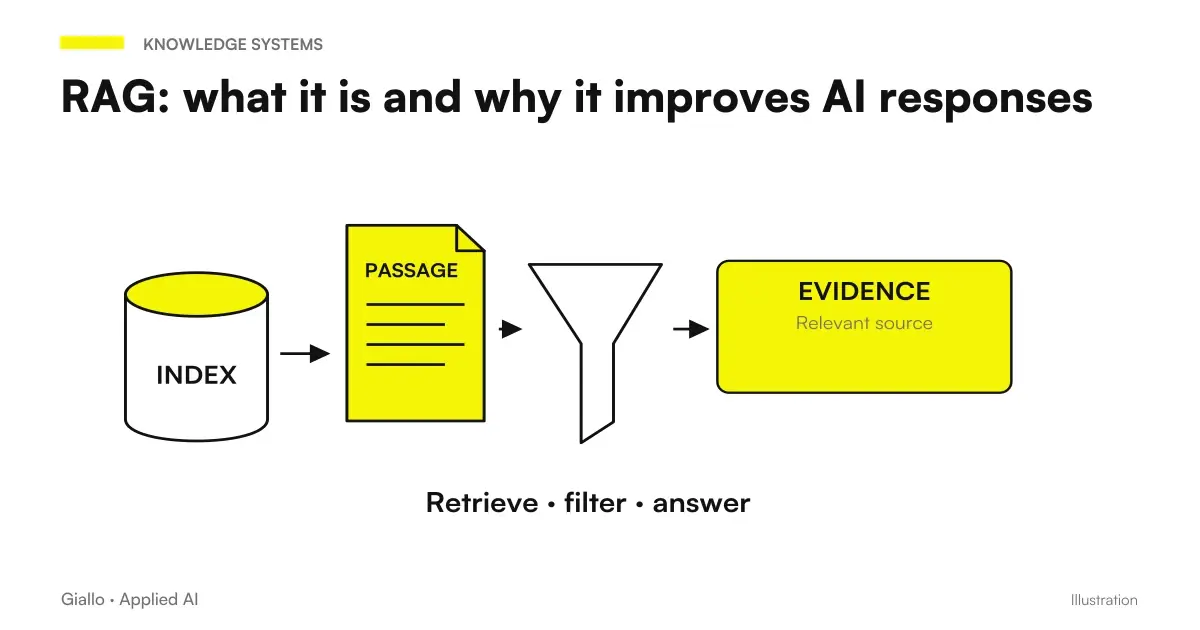
An AI assistant here doesn't have to "know" anything. You must search for the official card at the time of the application, report its content with the link and date of consultation, and add when the referral to the consulate is needed. It is the principle of RAG: the answer arises from documents recovered at the moment, not from the memory of the model. For a minor travelling, for an expiring passport or for a dual citizenship the application passes to the agent.
Price increases and waivers: the answers that the assistant does not improvise
After signing the price can rise only if the contract expressly provides, and only for three causes: the cost of fuel or energy in transport, taxes and fees imposed by third parties, exchange rates. L'Art. 39 requests that the increase be communicated on a durable medium, with justification and calculation, at least 20 days before the start of the package; if it exceeds 8 per cent of the total price, the traveller has the rights to Article 40, including the right to withdraw without charge.
Think of a tour operator who sold a group trip to Jordan when the airline applies a fuel surcharge. The assistant calculates the increase for each traveller, checks that the clause is in the contract and that the departure is far enough, prepares the communication with the calculation and sends it to the agent for approval. If the increase exceeds the threshold, it opens a practice for each traveler, because everyone can choose whether to accept or withdraw.
The withdrawal follows the Art. 41. The traveller may withdraw at any time before departure, by paying adequate and justifiable expenses or the standard expenses provided for in the contract. It pays nothing if unavoidable and extraordinary circumstances at the place of destination or nearby substantially affect the package, and the organizer reimburses within 14 days. In contracts negotiated outside business premises there are five days to withdraw without penalty, excluding cases of significantly discounted rates compared to current offers.
| Traveler's question | What the assistant does | Where's the rule |
|---|---|---|
| "Can I cancel the trip?" | Report the costs of withdrawal written in the contract and open the practice for the agent | Art. 41, paragraphs 1-3 |
| "There's an alert in the area, can I give up without paying?" | Record the request and pass it immediately to the agent, without giving an evaluation | Art. 41(4) |
| "Why did the price go up?" | Shows the increased entry and calculation already sent | Art. 39 |
| "Do you need a visa?" | Report the official card with the date of consultation and return to the consulate | Art. 34, letter f |
| "What if the agency fails?" | Indicates warranty details written in the contract | Art. 47 |
| "I'm stuck at the airport" | Gives contacts and first information, notifies the agent on duty | Art. 45 |
During the trip: who responds to the customer stuck at the airport
The Code does not leave assistance to goodwill. The Art. 45 obliges the organiser to provide adequate assistance without delay to the traveller in need: information on health services, local authorities and consular assistance, help to communicate at a distance and to find alternative tourist services. A reasonable cost can only be asked if the problem caused it by the traveler, intentionally or through his fault.
An assistant on WhatsApp, also active at night, covers the first part of this obligation. For each practice it has the destination card with emergency numbers, contact details of the consulate and the local correspondent, and uses it to respond immediately. At the same time notify the agent on duty with the summary of the practice: the booking of an alternative flight or hotel for the night makes it a person. How to build a channel like this is explained in the guide to WhatsApp chatbots for businesses, while to sort the requests after sale is useful the ticket management with AI.
Five Mistakes an Assistant Makes an Agency
- Confirm prices and availability read the day before, when airfares and hotel availability change from hour to hour. Each proposal must indicate when it was calculated.
- It combines services from different providers in chats without knowing that it is building a package.
- He answers on visas by heart, with outdated rules.
- He tells a client that he can give up for free for a weather alert, when it is up to the agent to determine if there is an unavoidable and extraordinary circumstance.
- It sends the communication of an increase without the calculation, or close to the start, and makes it questionable.
All five are born from the same defect: an assistant who responds to make the client happy instead of reading contracts, cards and rules of the agency. The remedy is to write those rules first, as with any customer care with AI.
Neighborhood agency or tour operator: the first step is different
If you sell mainly packages of others, start from the control of quotes: information form, fields of art. 34, details of the organizer's warranty. It's a repetitive job, and a mistake there weighs more than a slow response. If you build tailor-made trips or organize groups, start with on-the-go assistance and price review management, where the organizer has direct obligations and tight deadlines. In both cases an agency that also manages hotel stays finds other useful flows in AI for hotel.
The framework for tourism and hospitality is on the page AI for tourism and hospitality. If you want to know what steps of your agency you can entrust to an assistant without discovery with respect to the Tourism Code, the AI audit by Giallo Studio starts from your quotes and real contracts and delivers you the list of flows to be automated first.
Giallo Studio guides: methodology and sources
How we apply it in the company
Related resources
 AI for hotels: booking, guest requests and automated reviews
 WhatsApp Chatbots for Business: How It Works and When It's Best
 RAG: what it is and why it improves AI responses
 Document automation with AI: contracts, forms and PDFs automatically
 AI for Business Customer Care: How It Really Works
 AI for ticket management: shorter waits, more resolutions
 AI for marketing agencies: content, reports and AI labels
 AI for insurance agencies: renewals, quotes and complaints
AI by sector
The same reasoning, applied to the other areas we follow.
- AI for marketing agencies: content, reports and AI labels
- AI for automatic appointment scheduling
- AI for procurement and supplier management
- AI for craftspeople: custom quotes, job orders and electronic invoicing
- AI for wedding planners: suppliers, deadlines and guest data
- AI for insurance agencies: renewals, quotes and complaints
- AI for veterinary clinics: recalls, prescriptions and pet owners
- AI for car rental: renter fines, contracts and return damage
- AI for staff shift scheduling
- AI for driving schools: enrolment, lessons and exam reminders
- AI for removals: inventory, quotes, permits and damage
- AI for businesses: a complete guide to getting started
FAQ
If the chatbot offers flight and hotel for a single price, am I selling a package?
Very probably, yes. The Italian Tourism Code defines a package as a combination of at least two different types of travel services for the same trip when, for example, a single professional combines them before a single contract is concluded or sells them at a flat-rate or total price. This brings information, guarantee, and liability obligations: your agency’s role needs to be clarified with your adviser before activating the assistant.
What must I give the client before they sign a package travel contract?
Article 34 of the Tourism Code requires the standard information form provided for in Annex A and a list of information: characteristics of services, total price with taxes and additional costs, payment methods, minimum number of participants, general information on passports and visas, withdrawal fees, insurance and details of protection in the event of insolvency. The assistant can check that each quote contains them all before sending.
Can the tour operator increase the price after signing?
Only if the contract provides for it, and only for fuel or energy costs in transport, taxes and charges imposed by third parties, or exchange rates. The increase must be communicated on a durable medium, with justification and calculation, at least twenty days before departure; above eight percent, the traveller has the rights provided by Article 40, including the right to withdraw.
Can the customer cancel the trip without paying?
The client can always withdraw before departure, paying appropriate cancellation charges or the standard charges specified in the contract. They pay nothing if unavoidable and extraordinary circumstances at the destination substantially affect the package, and for contracts negotiated away from business premises they have five days to withdraw without penalties, except for offers with substantially discounted prices. Assessing the case is the agent’s responsibility, not the chatbot’s.
Can the chatbot tell a customer if they need a visa?
It can relay the official country information page and the instruction to check with the consulate, together with the date on which it consulted that page. The Code requires the traveller to be informed about passport and visa requirements, including the approximate time needed to obtain them, and about health formalities: these rules change, and an answer given from memory may be outdated.
What does the agency have to do if a customer gets stuck during the trip?
Article 45 of the Code obliges the organizer to provide adequate assistance without delay to the traveller in difficulty, with information on health services, local authorities and consular assistance, help to communicate at a distance and to find alternative services. The assistant can immediately give the first information and notify the agent on duty, who decides and books.
What happens to customers' money if the organizer fails?
Package travel arrangements are supported by insurance policies or bank guarantees which, in the event of insolvency or bankruptcy of the organiser or seller, guarantee reimbursement of the price paid and immediate return if the package includes transport. The details of this coverage are part of the information to be given before signing.