
Superintelligence for SMEs: waiting for it or using AI today?
Superintelligence for SMEs: test AI today, prepare data or wait? A decision matrix and hypothetical calculation covering freed capacity, costs and limitations.
Reading time: 12 min
An SME does not have to predict the arrival date of superintelligence to decide what to do with a process today. The useful choice has three outcomes: test a circumscribed case, prepare the necessary data or postpone that specific case. Depends on available capacity, verifiable quality and working conditions, not the label of the next model.
Waiting can be reasonable when an essential ability is lacking or we do not know how to control the result. Instead, it can become an unmotivated waiver when the problem is already addressable and a reversible test could clarify its value. Saying "we wait for ASI" often leaves undetermined what should change to reopen the decision.
This article is about choosing between acting, preparing, and postponing. The guide to ROI of an AI project It delves into the general economic assessment; here we use only one demonstrative example to see which hypotheses make sense a test and which can invalidate it.
In summary
- The referral must be linked to a verifiable condition, without inventing an ASI deadline.
- A test is useful when the task is delimited and the result can be checked.
- Preparing sources and responsibilities can be the right step even without choosing a model right away.
- The released capacity may have value, but it does not automatically become cash savings.
- Quality, corrections, and recurring costs can change the decision even when the demo works.
What problem should superintelligence solve for this SME?
The first question makes the reason for the wait concrete. Are we waiting for a system capable of interpreting inputs that are not being managed today? Better quality on difficult cases? A sustainable cost? Or business data that the model can't create in our place? These dependencies require different interventions and tests.
If the problem is a messy source, a future superior ability might help, but the promise does not identify who owns the correct version. If no one has defined the acceptable outcome, a new model does not automatically determine which compromise the company desires. Some conditions belong to the organization of work, not to the level of the model.
The goal must also be delimited. "Managing the whole company at AI" does not allow reasonable proof. ‘Preparing this data for operator review’ can be verifiable with current capabilities. The fact that the second objective is narrower does not make it irrelevant: it serves to understand whether a piece of work can be better done.
For the meaning of ASI and the boundaries of the statements we refer to Artificial superintelligence. In the business decision the next question is different: what evidence about our task would change the choice? You do not need to solve the general classification of models to formulate it.
When to test today, prepare data or postpone?
A test is a sensible choice when we have representative inputs, a recognizable result, and the ability to contain the effects of the error. The test can produce a negative response. Its value is to reduce a major uncertainty before committing more thoroughly, not to confirm the purchase at any cost.
Preparing is different from waiting passively. It can mean distinguishing current and historical documents, assigning responsibility for sources or clarifying an exception. These interventions make the process more readable and can remain useful even if the chosen technology changes. The memory and business context explain why connecting a lot of data is not enough to resolve their applicability.
Postponing makes sense if the required capacity is not demonstrated or the result cannot be controlled with sustainable resources. The decision should specify what is missing and how we will recognize a change. "We'll take the case back when a test on our inputs meets these criteria" is more useful than a prediction about when superintelligence will arrive.
| Condition of case | Initial choice | Evidence to look for | Reason for Change of Choice |
|---|---|---|---|
| Restricted task, ready sources, verifiable quality | Testing Today | Acceptable result and overall measured work | Errors or costs make the test unfavourable |
| Plausible task, ambiguous documents | Preparing Sources | Recognisable Versions, Scopes and Responsibilities | Sources become usable in the test |
| Good demo, hard to control actions | Shrink delegation before testing | Reversible output and sustainable verification | Reliable control allows for more actions |
| Essential capacity not demonstrated | Postponing that case | Representative proof of missing requirement | The requirement is met with evidence |
| Value dependent on uncertain use of freed hours | Also Test Work Organization | Concrete Capacity Destination | The enterprise manages to use or monetize time |
It is not a maturity ranking. In the same company one case may be ready, another require preparation and a third deserve postponement. The guide AI for businesses offers a broader picture of adoption; here the choice remains linked to a precise process.
What measures are needed without turning the pilot into a promise?
Response generation time is only part of the job. They count preparation of materials, operator control, corrections and resumption of suspended cases. If we measure only the fastest pass, we can attribute to the system an advantage that disappears in the complete process.
Anthropic includes cost-per-task, latency, token usage and errors in the assessments of agents. These are measures of observed behavior, to be chosen in relation to the required result. They do not provide an automatically transferable percentage of benefit to SMEs. Source: Demystifying evals for AI agents.
The distinction between speed and value also counts outside the single test. The METR survey of May 2026 studies self-reported perceptions of technical workers and distinguishes speed increase and value increase. It is not a causal measure of the ROI of any Italian company. We use it as a methodological call, without transferring its estimates to our example. Source: METR 2026 survey.
Defining acceptable quality before testing avoids choosing after the most favorable criterion. A practice completed more quickly but with missing attachments is not equivalent to a proper practice. The theme of verifiers is deepened in alignment and control of agents: Human approval must also be included in the process to be evaluated.
What does a hypothetical account for a Treviso distributor show?
Scenario entirely hypothetical, not the result of a Giallo customer: a Treviso component distributor evaluates the preparation of order practices. The enterprise must choose whether to test an assistant now or wait for future capabilities. To make the comparison reproducible we fix the inputs, without presenting them as prices of an already measured offer or results.
We hire 200 practices per month, 12 minutes per practice in manual work and 5 minutes of operator work with AI for practice. We value time at 18,00 euro per hour, we hypothesize 180,00 euros per month of recurring costs and €900.00 of initial cost. Volume and costs remain stable in the example. Quality is assumed equal between the two ways of working: it is a condition of comparison, to be demonstrated in the pilot.
Manual time is 200 × 12 ÷ 60 = 40 hours a month. Operator time with AI is 200 × 5 ÷ 60 = 16,6667 hours per month, shown at four decimal places. The difference is 23,3333 hours freed. For economic calculations we use the original minutes, without multiplying the already rounded hours.
The gross capacity valued is 200 × (12 − 5) ÷ 60 × 18 = €420.00 per month. Subtracting the assumed recurring costs, we obtain 420.00 − 180.00 = 240,00 euros per month of net valued capacity. The theoretical recovery of the initial cost, on this basis, is 900.00 ÷ 240,00 = 3.75 months. This quotient is neither a customer result nor a cash forecast.
| Hypothetical comparison entry | Formula or hypothesis | Value |
|---|---|---|
| Monthly Volume | Stable example input | 200 practices |
| Manual time for practice | Input | 12 minutes |
| Operator time with AI for practice | Input, with ordinary control included in the hypothesis | 5 minutes |
| Monthly Manual Time | 200 × 12 ÷ 60 | 40,0000 hours |
| Operator time with monthly AI | 200 × 5 ÷ 60 | 16,6667 hours |
| Freed capacity | 200 × (12 − 5) ÷ 60 | 23,3333 hours |
| Attributed Hour Value | Comparison input | 18,00 € |
| Valued gross capacity | 200 × (12 − 5) ÷ 60 × 18 | €420.00/month |
| Recurring costs | Assumption including expected costs | €180.00/month |
| Net Valued Capacity | 420,00 − 180,00 | €240.00/month |
| Start | Hypothetical initial cost | 900,00 € |
| Theoretical recovery of startup | 900,00 ÷ 240,00 | 3.75 months |
| Quality and defects | Equal quality assumed; no differential cost for defects | To be verified |
| Additional corrections and controls | To be added if not included in 5 minutes | To be measured |
| Cash Savings | Requires an effectively avoided expense | Unproven |
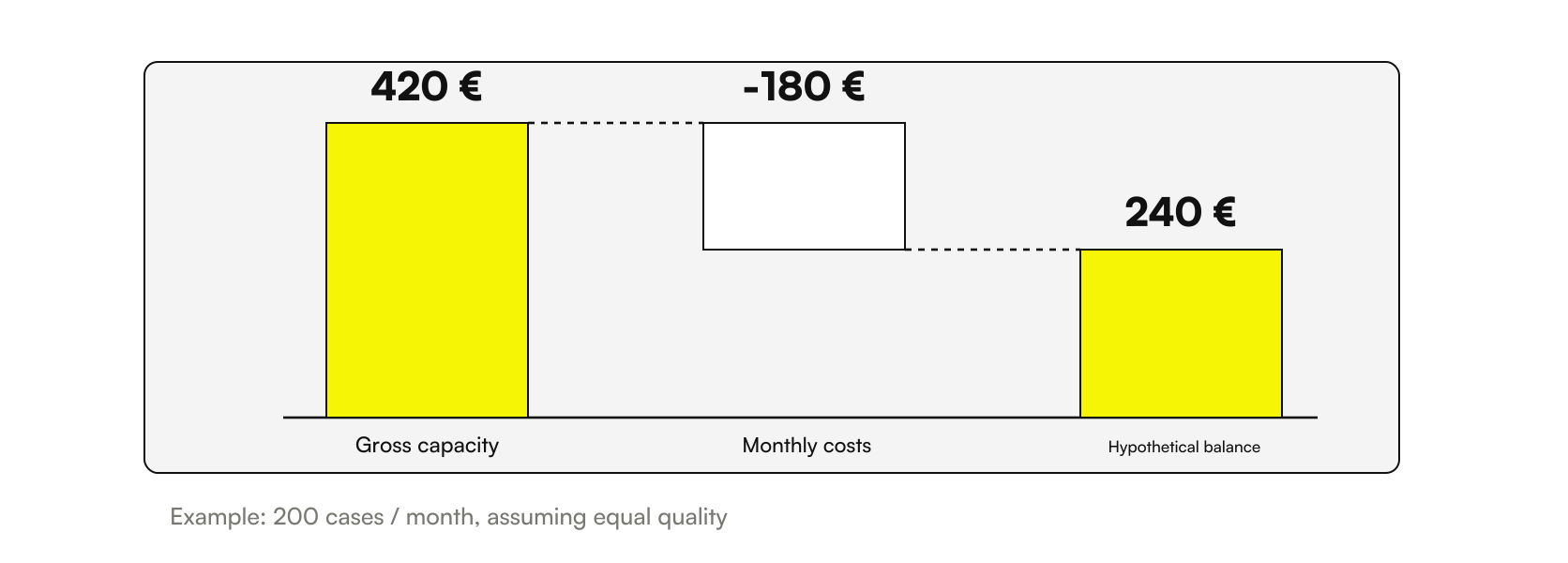
The example answers a limited question: with these inputs does the case deserve proof? It offers a reason to measure it, not a reason enough to adopt it. The pilot must above all check the overall five minutes, the equal quality and the completeness of the costs. If these conditions fall, the calculation changes.
How do quality defects come in and hours that don't turn into cash?
Equal quality is the most delicate hypothesis. An error may require a correction, a new check, or a resume of the practice. The time of problematic cases should be counted in the work of the operator. The economic consequences not already included in time must be recorded separately, avoiding counting the same cost twice.
We can make correction explicit without inventing a new result: revised net capacity = [(200 × (12 − 5) ÷ 60) − additional monthly hours] × 18.00 − 180.00 − differential costs of defects. The additional hours are those not included in the five minutes; the costs of defects are additional consequences not already valued through those hours. These items must be measured, not presumed void to make the account favorable.
If the revised net capacity is not positive, dividing the initial cost by that figure does not produce a useful economic recovery. If it is positive but the hours remain unused, the recovery remains theoretical in the enhancement of capacity. A correct mathematical result can therefore be economically unsignificant for the enterprise.
Staff can continue to cost the same amount. Freed hours can serve to dispose of arrears, improve assistance or reduce additional work; each destination has its own conditions. Cash savings require a avoided expense. The additional value requires actual use of the capacity, along with the other necessary resources.
This is the reason for not presenting 240,00 euros as money definitely cashed every month. It is a conventional amount of comparison, at the chosen hourly value. The guide to how much AI costs in the company deepens the budget entries; in our case the next step is to check whether the process and the organization support the assumptions.
Why can a carpentry company choose to prepare first?
According to hypothetical scenario: a carpentry shop in Perugia would like to automate the preparation of tailor-made quotes. Requests come with incomplete measurements, photographs and notes. Prices depend on materials, workmanship and agreements that often remain in the owner's head.
In this case, waiting for superintelligence could conceal a different dependency: there is no shared source defining which conditions to apply. An assistant can organise the request, but it must not invent the missing economic rules. Preparing the data means making the necessary conditions explicit, without expecting to formalise every craft-based decision.
The initial choice may therefore be to prepare the sources for a subset of the work. The holder identifies comparable requests and describes what information is needed for a draft. When that perimeter becomes verifiable, a test can evaluate the preparation of the estimate. Requests that require technical judgment not yet evaluable may remain out.
If instead the company asks the system to guarantee from incomplete photographs the feasibility of a new work, the limit is also of ability and evidence. That case can be postponed until a proper test. The decision does not require knowing when ASI will arrive: it requires knowing which technical requirement is missing and how it will be checked.
The distinction between autonomous agent and general capacity avoid another error: software that completes the quote on its own does not necessarily have the skills to support it. The speed of the route and the correctness of the result must be assessed separately.
What mistakes move the decision from trial to promise?
Waiting for a label instead of a requirement. «When it will be superintelligent» does not indicate how to re-evaluate the case. Better to name the missing capacity and evidence that could prove it. Thus the postponement remains motivated and re-examineable.
Buying everything for fear of being late. The possibility of future progress does not prove the value of the current project. A delimited test must be able to conclude that the case does not hold, without automatically turning into a larger commitment.
Equating speed with economic benefit. Rapid passage can generate more downstream control. The freed capacity may not find a destination. The comparison must include complete work and actual use of the result, in addition to the performance of the model.
Ignoring quality in the favorable example. Equal quality is not a property granted by the spreadsheet. It is a hypothesis to be verified on the same types of practice and on important exceptions. Without that proof, the net number is only a conditional reference.
Open the review sheet: what would make us change our decision?
Write the current choice: test, prepare, or postpone. Add the requirement that determines it and the evidence needed to change it. For a test can be acceptable quality on the complete process; for preparation, sources with clear versions; for referral, the missing capacity demonstrated on the relevant cases.
It specifies who can verify that evidence and what commitment the test can take. If the economic result depends on the hours freed, it also indicates where those hours would be used. None of these fields require a prediction of the arrival of the ASI.
How to keep the choice open without redoing everything at each ad?
A documented decision remains useful when technology changes. We retain representative inputs, acceptance criteria, and comparison result, instead of tying everything to a commercial promise. A new model can then be assessed on the requirement that was previously missing, without repeating the discussion from scratch.
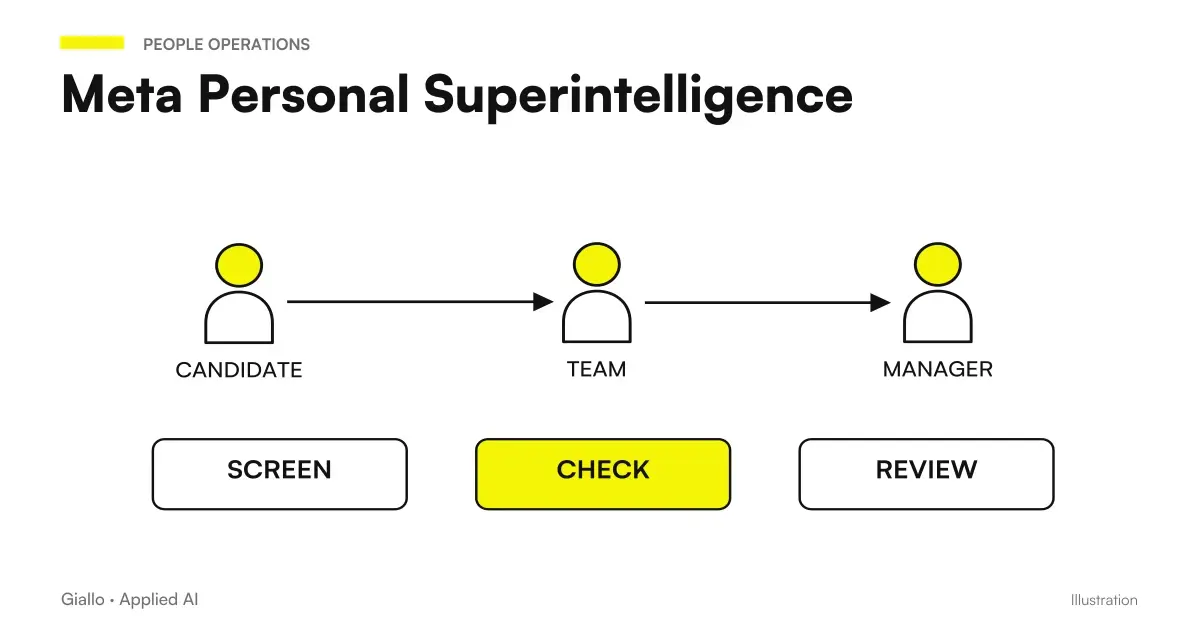
You don't need to reconstruct every piece of news to know if your practice has improved. Meta Personal Superintelligence can offer functions to understand, but the name does not decide the suitability for the business process. The comparison remains between task, evidence and sustainable commitment.
Bringing an ordinary practice, an exception and the overall management time allows you to choose a verifiable first step. With the AI consulting of Giallo we can determine if the case deserves a pilot today, what data to prepare or what requirement to wait before investing in it.
Giallo Studio guides: methodology and sources
How we apply it in the company
Related resources
FAQ
Should an SME wait for superintelligence before using AI?
The choice must be made on the concrete problem, without basing it on an ASI arrival date. If capacity, quality, data and integration are verifiable, a circumscribed test can produce useful evidence today.
When should data be prepared instead of starting a pilot?
When the task might be useful but sources, versions or responsibilities are unclear. Preparing those materials reduces a concrete dependency without requiring a forecast of future capabilities.
When is it reasonable to postpone an AI use case?
When the required capability has not been demonstrated, quality cannot be verified, or errors have consequences that cannot be sustained. The postponement should have an observable condition for reconsideration, not an invented ASI deadline.
Do hours freed up by AI represent cash savings?
Not automatically: they can become available time or more capacity without reducing an expense. You need to check if they reduce actual costs or produce an additional value actually used.
What does the economic example of the article show?
With hypothetical inputs and equal quality, the calculation values 23.3333 hours freed up at 420.00 euros gross and subtracts 180.00 euros per month. The 240.00 euros of net valued capacity and theoretical payback in 3.75 months are neither client results nor guaranteed cash flow.
What factors can invalidate the pilot's calculation?
Corrections, additional checks, errors and omitted costs can change the comparison. Equal quality is a hypothesis to be verified, while the availability of hours does not ensure that the company is able to use them economically.