
Corporate policy on the use of AI: how to write it
Write an internal AI use policy: structure, what to include, mistakes to avoid and a starting template for SMEs.
Reading time: 9 min
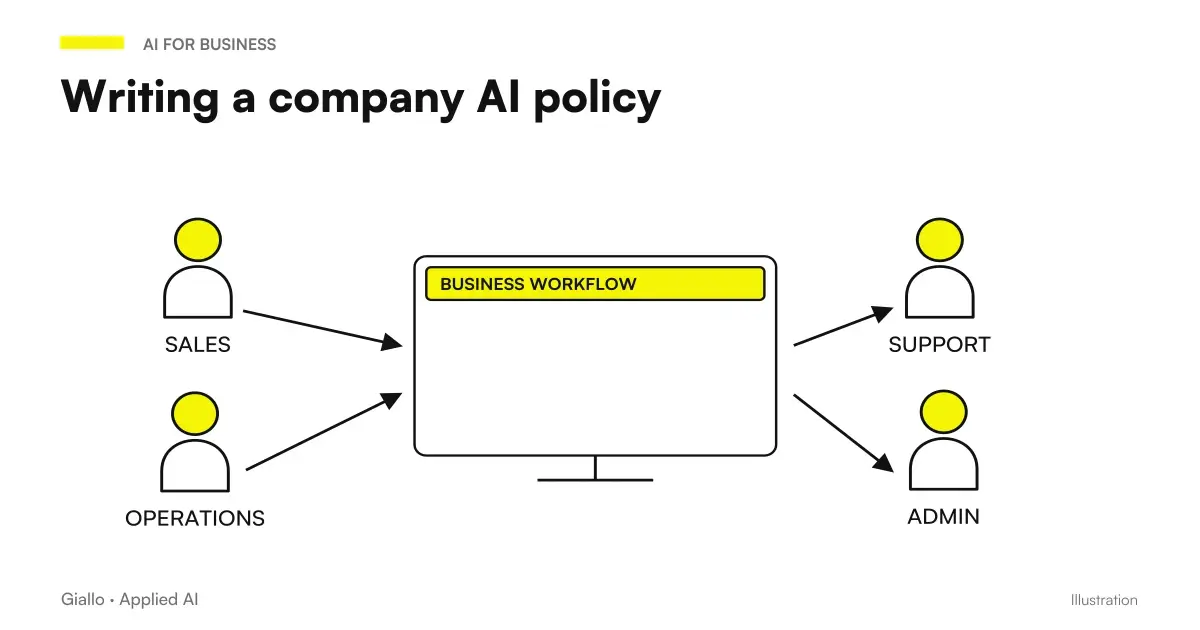
A corporate AI policy is not a legal document: it is the only tool that turns good intentions into consistent behaviors. In Italian SMEs almost all the problems related to AI do not arise from poorly designed systems, but from smart people who, in the absence of indications, decide for themselves what is reasonable to do.
The good news is that it takes little: two or three pages written in understandable Italian solve most situations. This article explains what to wear and, above all, what not to wear.
In summary
- It is not mandatory, but it is the cheapest way of Demonstrate Government on the use of tools.
- He must be in two or three pages: What is not read does not apply.
- The essential sections are six, and the most important is the list of what not He leaves the company.
- It should be written by those who know the processes, revised by those who follow privacy and contracts.
- Must indicate the tools approved, not just banned ones.
- It takes a channel to ask: without, people decide for themselves.
The Six Sections That Really Serve
1. Because this document exists. Three lines. Not "in compliance with", but "to use AI without jeopardizing customer data and the commitments we have made".
2. Instruments approved. The list of what you can use, with the reference plan. It is the section that makes the policy constructive instead of prohibitive.
3. What doesn't come out of the company. The middle section. Concrete list, with examples from your real work.
4. Rules on generated content. Fact-checking before publication, no author names in prompts, human review of what goes to customers.
5. Where the human eye is needed. What decisions cannot be left to the system.
6. Who to ask. A name, a channel. Without this point the policy becomes a list of prohibitions and people make do.
What to write in the "does not leave the company" section
It should be written with examples of your craft, not with abstract categories. Compare:
Works
- ‘Don't paste customer files or documents'
- «Do not load the export of the registry»
- «Do not insert price lists and margins»
- "Don't paste credentials or keys"
Doesn't work
- ‘Do not process personal data without a legal basis’
- ‘Comply with current legislation’
- ‘Use caution with confidential information’
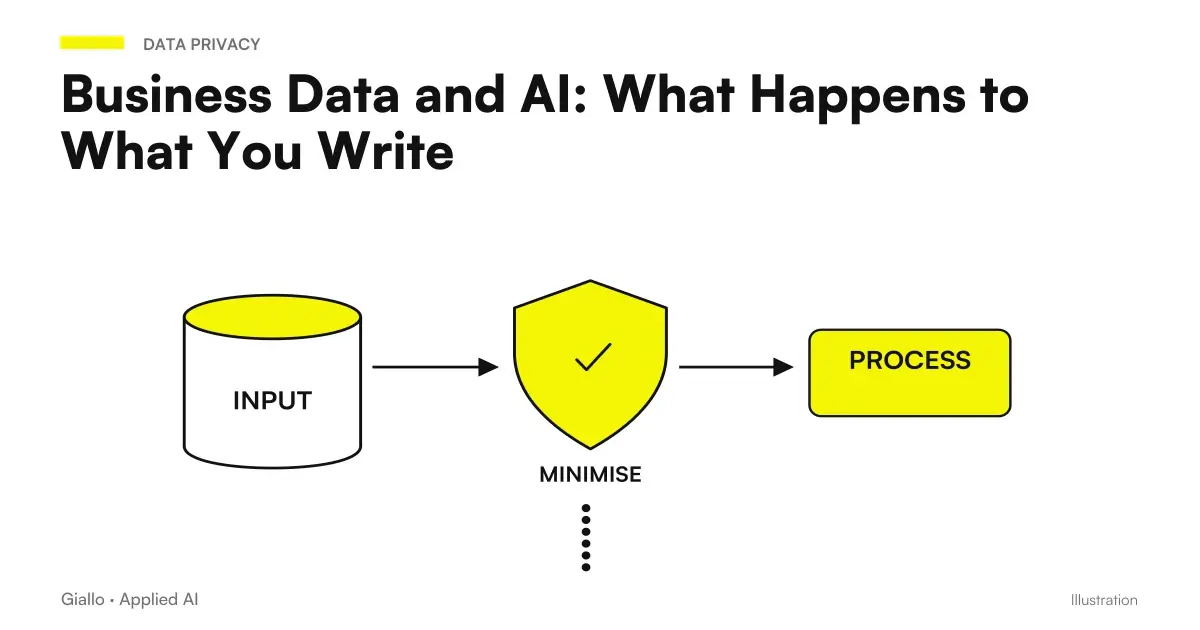
The right column is faultless and useless: no one will know if the file in his hand falls back. The left one applies itself. The technical foundation of these rules is in Business Data and AI.
A Structure Model
| Section | Content | Length |
|---|---|---|
| Purpose | Why it exists, to whom it applies | 3-5 lines |
| Approved instruments | List with plan and who can use them | half page |
| Data that doesn't come out | Concrete list with examples of yours | half page |
| Generated content | Verification, review, prompt rules | half page |
| Human supervision | Decisions That Remain to People | few lines |
| References and revision | Who to contact, update date | few lines |
Practical examples
Professional studio of 8 people. The essential policy lies in two pages: approved tool with business plan, absolute prohibition of inserting customer documents into personal accounts, obligation of human review on everything that comes out with the firm's signature, name of the referent for doubts. Written in one afternoon, it eliminates almost all of the real risk.
E-commerce with 20 employees. Here we need an extra section: who can use AI in customer responses and with what supervision. It should be written that the assistant declares itself as automatic, obligation of the AI Act for limited risk — see AI Act obligations for SMEs.
Manufacturing company with technical department. The focus shifts to designs, specifications and know-how. The risk is not the GDPR: it is the loss of control over information that is worth years of work. The "doesn't come out" section should be written with the technicians, who are the only ones who know what is really sensitive.
How to Make It Really Adopt
A well-written and ignored policy is worth zero. The difference between a document that changes behavior and one that stays in the shared folder is not in the content: it is in how it is introduced.
- Start with the real cases, not by the rules. "Last week it happened that..." works much better than "Article 3 predicts that...".
- It explains the reason for any ban. "Don't paste files" only becomes applicable when people understand what it entails.
- Show the alternative at the same time. Every ban should come with the right way to do the same thing.
- Name the referent. Not ‘the competent office’ means a person to write to.
- Repeat after three months. The first presentation informs, the second consolidates.
What changes when the company starts building, not just using
The policy described so far serves to govern the use of third-party tools. When the company moves on to building something of its own unan agent that responds to customers, an automation that processes documents. it needs two more sections.
Who can send to production. It's one thing to try, it's one thing to put a system in front of customers. It must be written who authorizes the passage and what must be verified first: that the assistant declares himself, that there is a path to a person, that there is a way to turn it off.
What happens when the system goes wrong. Who notices it, who reports it, who decides whether to suspend. It seems obvious until it serves, and the moment it serves no one knows who to turn to.
- No system goes into production without a handler with first and last name
- Every system that acts must have a switch and someone who knows how to use it
- Conversations with customers should be sampled, not just when someone complains
- A change of intended use requires a new assessment
These four lines distinguish a company that governs its systems from one that suffers them, and intercept most of the causes described in AI for Companies: Complete Guide. The method of evaluation is in How to Assess the Risks of an AI System, while to understand what you are actually putting into production is useful AI Agents: What They Are and How They Work.
Mistakes to Avoid
- Make it long. Beyond the three pages the reading rate collapses and with it the effectiveness.
- Write it in legalese. It has to be understood by those who apply it, not be substantiated.
- Listing only bans. Without approved and comfortable tools, it produces clandestine use.
- Copy it from the internet. The rules that work contain examples of your work.
- Never explain it out loud. Half an hour of explanation is worth more than ten pages — see training the team on AI.
- Forgetting the channel for questions. That's what avoids lonely decisions.
How to apply it in the company
- Look what's already happening. Ask without an investigative tone what tools people use: you will find that they use more than images.
- Choose and activate approved tools, verifying the plan.
- Write the list "doesn't exit" along with those who handle delicate documents.
- Let me see you again to those who follow privacy and customer contracts.
- Present it by voice in half an hour, explaining why of each rule.
- Set a date to review and respect it.
Step 1 is what everyone skips and is the most informative. A written policy without knowing what really happens rules an imaginary company.
The final test before distributing it
Before sending the policy to everyone, it is worth subjecting it to a verification that costs ten minutes and saves many.
Take three real situations that have happened in the company in the last month and try to respond using only the document. The collaborator who wanted to summarise the specifications of a customer: does the policy answer? The salesperson who wanted to segment the contact list: does he answer? Who wanted to use AI to write the answer to a complaint: does it answer?
If at least one of the three needs interpretation or phone calls, something is missing. If they answer all three immediately, the document is ready and —most importantly —will be applied without anyone having to read it again each time.
Conclusion
An effective AI policy is short, concrete and constructive. It says what you can use, what you don't have to go out, where you need a person, and who to ask. Three pages, an afternoon's work, and almost all of an SME's real risks are covered.
The yardstick is simple: if after reading it a collaborator can answer the question "can I paste this file?" on his own, the policy works. If he has to read it again, it must be rewritten.
AI becomes useful when it enters processes. Giallo Studio It helps SMEs and teams build concrete, measurable and sustainable automations — based on clear rules about what can come and go.
Giallo Studio guides: methodology and sources
How we apply it in the company
Related resources

FAQ
Is an AI policy mandatory?
There is no general obligation to adopt an AI policy. However, it is the most effective tool for demonstrating that you have governed tool usage, which matters both for GDPR and in contractual relationships with clients requesting safeguards. It is a voluntary measure that solves many unintended problems.
How long does it have to be?
Two or three pages. A twenty-page policy goes unread, and an unread rule does not shape behaviour. The goal is not to cover every possibility, but to give clear, memorable criteria for what is allowed, what is not and whom to ask in uncertain cases.
Who needs to write it?
Someone who knows the processes, with a review by those responsible for privacy and contracts. Having only the legal department write it produces a document that is formally impeccable but practically inapplicable; having only IT write it produces technical rules that ignore contractual obligations to clients.
Should employees be asked to sign it?
Communicating it in a traceable way is useful: formal communication with acknowledgement of receipt is sufficient in many contexts. Before the signature, however, the explanation matters: an understood policy is followed; a signed but misunderstood policy is circumvented with the best intentions.
What happens if someone violates it?
It depends on how the policy fits within the business context and the severity of the violation. The practical point is different: in almost all cases, violations arise from good faith and the absence of convenient alternatives, rather than wilful misconduct. A policy that offers only penalties and no alternatives fails.
How often does it need to be updated?
At least once a year and every time you introduce a new tool or change the use of an existing one. AI tools change conditions frequently: a policy that lists products with no review date ages quickly.