
Duplicate CRM contacts: use AI to propose merges while keeping history
AI for CRM duplicates: distinguish namesakes from matching identities, choose fields, and check history and associations. Reviewable merge proposals.
Reading time: 12 min
AI for CRM duplicates should prepare proposals for merging with evidence, conflict and history to be verified. Two similar records are not automatically the same identity. Before the merge you have to choose properties, main records and relevant associations; then you have to check the result in the system.
The distinction matters because the union can be irreversible. HubSpot warns that merged records cannot be separated again through a simple undo. An export helps reconstruction, but should not be presented as an automatic restoration of all relations. HubSpot: Duplicate management.
Sources are verified at 9 October 2026; Scenarios are hypothetical and do not describe actions on accounts. For the larger process read CRM Automation and the framework of AI for businesses. Here we work on identity, property and history before a concrete decision.
In summary
- Similarity and verified identity were different.
- People in the same company don't have to be united for that reason alone.
- Any conflicting property requires a rule or decision.
- Historical, negotiations and associations are part of the review.
- An export does not automatically make a merge reversible.
- The number of records deleted does not measure the quality of the cleanup.
When do two records represent the same identity?
First define what object you are comparing: contact, company, or other CRM entity. Two people from the same firm are not duplicates of the person. Two locations can be separate records according to your model. A change in company name may require a different verification from a typo. The structure of the data comes before textual similarity. The similarity proposal must also retain the elements that distinguish the records; the guide to JEV to deduplicate CRM and catalogs It treats the comparison as a decision to be verified before the union.
Use evidence consistent with identity: internal references, relevant emails, name, company relationship, and other available fields. No single signal must become a universal test. A shared domain does not identify a person; a general phone may belong to many contacts; a namesake may work in another business.
HubSpot documents the review of potential duplicates through record properties and a path to accept or reject proposals. Capabilities and permissions depend on function and plan. Before building a separate system, verify what CRM already offers in your account. Official Duplicate Management.
AI can help collect name variants or explain conflicts, but the proposal must remain controllable. A high score doesn't prove identity. The auditor should be able to understand which fields supported the proposal and which contradict it. If the system shows only one number, the decision may be less informed than a manual comparison.
What data do you show in the proposed union?
It presents the records side by side and keeps the original references recognizable. It shows equal values, different values and missing fields. The result must not hide a conflict to produce a simpler tab. A useful proposal allows the referent to also decide to leave the records separate.
| Item | Information to be submitted | Requested decision |
|---|---|---|
| Identity | Evidence and Contradictions | Same entity or separate cases |
| Main Record | Candidate and reason | What record to keep in the path |
| Properties | Alternative Values and Sources | What value to use per field |
| Tasks | Relevant histories | Check what needs to stay |
| Negotiations | Available reports | Avoiding improper associations |
| Owner | Record Managers | Confirm the referent |
| Integrations | Identifiers and Connected Systems | Check effects of the change |
| Result | Proposal, refusal or verified union | Next recognizable step |
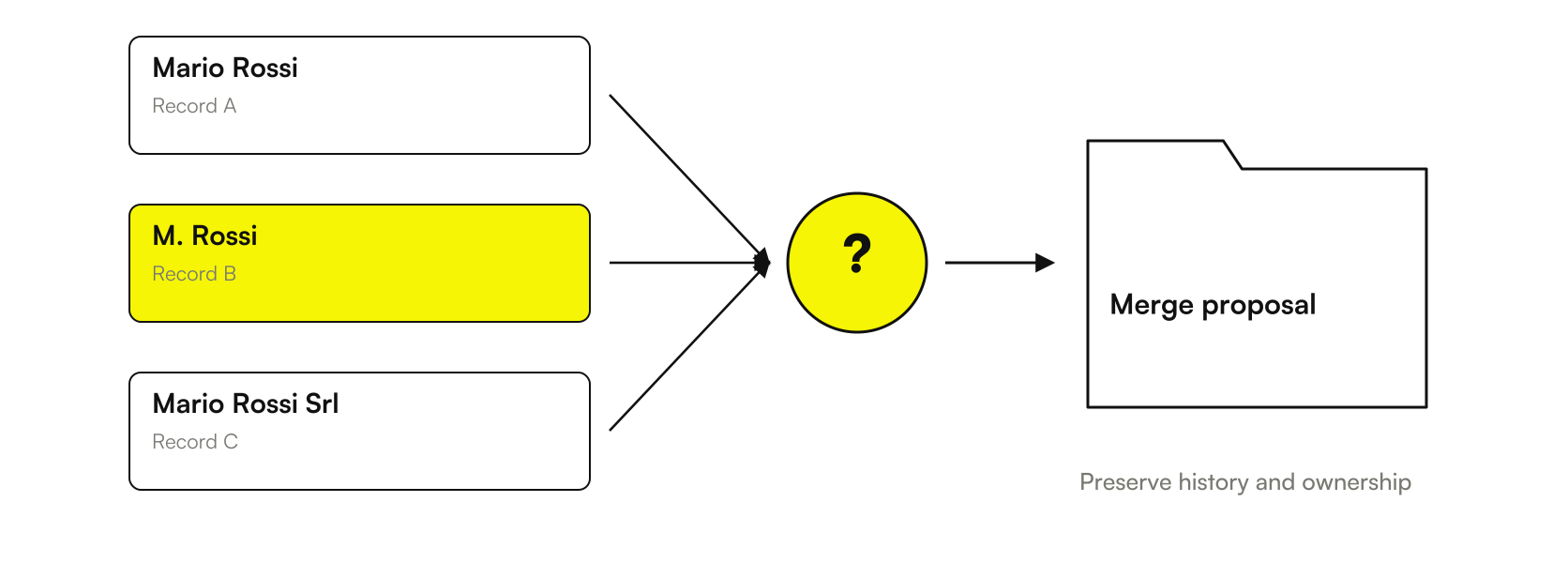
Don't use "more complete" as the only rule to choose the record. A rich record may contain old data; a recent one may have the most reliable source for a field. The authoritative source can change between properties: address, referent and trade status can have different paths. The decision must be explainable without a universal winning value.
For fields from other systems, check who owns them. The theme is deepened in synchronize CRM and management software with AI. A local merge may have consequences on subsequent links or updates; the project must know the perimeter before acting.
How to deal with different emails, names and roles?
Different emails can represent the same person over time, two people from the same company or a personal address and a professional one. The system proposes the case with evidence; it does not automatically choose a story. Maintain context and role information without turning the domain into a proof of identity.
An equal name requires other relevant data. If they are missing, the state may remain “to be verified.” The quality of the pilot includes the ability not to unite what is not proven. Do not penalize every open case as a failure of the model: a recognized limit avoids a wrong decision.
When a person changes company, the referent must understand how CRM represents the relationship. Combining records can mix negotiations or responsibilities. The project should define the rule with those who know the commercial process, instead of considering each variation as noise to be cleaned. For context use AI for CRM and Sales.
A general box can represent an office, not a person. If your CRM uses that data to receive requests, the proposal must distinguish the operational contact from the individual identity. These differences change the meaning of the union even when name and phone coincide. The data model must be understandable to the auditor.
How to choose properties without losing information?
Prepare rules by field and cases to review. One property may have an authoritative source; another may require the referent. It preserves alternatives and reasons for the proposal. Do not silently overwrite a data because a record was created later. Date of update and quality of source are not equivalent.
If the value is absent in one record, the other may be useful, but its reliability remains to be verified. A compiled field is not necessarily correct. The proposal should distinguish "not present" from "absent confirmed" and not turn a free string into an official code without the appropriate rule.
For HubSpot, the merge documentation describes different behaviors based on the object and properties, with priorities and exceptions. It is therefore not enough to apply a generic idea of main record. Check the current product path before promising that a value or identifier will remain unchanged. HubSpot: merge records.
Decision sheet before merge
It shows records, identity evidence, the main candidate, and conflicting properties. List activities, negotiations and associations to check. Indicates known effects on unverified integrations and points. The person responsible may approve the proposal, correct it or reject the union. A confirmation concerns those records and data.
What to check on historian and associations?
The historian must be an explicit part of the proposal. A merge that keeps its name and email but links the wrong negotiation does not solve the problem. The auditor must know what activities and relationships are relevant, without assuming that a tool transfers each item in the desired way. The path depends on the CRM and its configuration.
HubSpot describes a combination of activities, associations and many properties, with documented conditions and exceptions. The feature does not authorize a generic promise of "no lost information" for any object. Merge Documentation. The test must focus on the items your team really uses.
It also checks the connected systems. An identifier used by an integration might have a specific behavior after the merge. The technical contact must know the dependency and control the outcome. The Guide to Integrating AI into existing systems helps to ask these questions before building automatic actions.
Data cleaning must not implicitly launch campaigns or messages. A merged contact can appear different to connected workflows; the project must check those paths. The mail sorting and attachments can help maintain references to incoming requests, but does not prove on its own that identities have been reconciled.
Why does an export not amount to a cancellation?
An export stores data in the available format, but may not automatically reconstruct activities, associations and behaviors of connected systems. Before an irreversible action, the referent must know what can recover and what has not been verified. The file is a useful evidence, not a universal promise of restoration.
For HubSpot the inability to separate the merged records again is stated in the documentation. Subsequent creation of a new record does not amount to returning exactly to the previous situation. Merge records. For other CRMs, check the specific conditions instead of transferring that rule or its opposite without a source.
The first pilot can remain in the proposed mode, without merge. The contact assesses evidence, conflicts, and expected outcome. If you switch to a union, the decision must be explicit and the control path ready. The test must take place in the environment and with the appropriate data, avoiding actions on real records only to see what happens.
Two hypothetical scenarios for Italian SMEs
A distributor has contacts with different emails
Imagine an Italian distributor with two records that could represent the same referent. Names are similar, but emails and some reports differ. The system collects evidence and conflicts, without uniting them directly. The salesperson checks the role and source before confirming the identity.
The proposal then shows which properties to use and which activities to check. If the report is not proven, the records remain separate. The useful result can be a avoided false union, even if the number of registry records does not decrease. The scenario does not report a measured test or savings.
A study has more people than the same company
Imagine an Emilian firm that receives requests from two people about a business. The domain is the same and the phone is that of the office. The system must not treat them as duplicates just for these signals. The referent sees identities and roles, keeping people separate and the connection with the company.
If a new request arrives, the process of qualification of commercial AI requests structure the need without creating another identity when the contact is already recognized in the path. The link must remain verifiable, especially if a match is only proposed.
What proposals to reject and how to use rejection in the pilot?
Reject the union when records represent distinct identities or when evidence does not allow you to decide. Proper rejection is a useful result. The project must not be awarded only to reduce the number of records: it may have eliminated a distinction necessary for commercial work.
Write down the reason in terms of data. "Different people from the same company" and "unverifiable identity with available sources" describe different situations. In the first case the proposal was wrong; in the second the limit must remain visible. This distinction helps to improve the rules without inventing other contact information.
It checks groups, not just isolated pairs. A person may appear in multiple proposals and the first decision may change the context of subsequent ones. The contact person must see the perimeter, avoid inconsistent actions and review relevant cases in the CRM path. Do not run all proposals en masse just because each pair seems plausible separately.
The waste review also helps to understand when AI does not add value. If the problem is already solved by unique identifiers and native rules, use that path. If it is necessary to interpret variations and conflicts, the proposal can gather evidence. The driver has to compare both types of case, so the team chooses the necessary component without multiplying systems. A report that retains reasons and limits makes the result more useful than a list of suggested merges without context.
How to measure the pilot and decide the cost?
It prepares cases of true duplicates, homonyms, distinct business contacts, and conflicting properties. The referent defines the expected outcome and revises the proposals. It measures correct couples, proposed false unions, missed cases, and conflicts that have remained open. The number of reduced records is not a sufficient measure of quality.
The test must include what would happen to the important relationships, in the appropriate path. If the proposal does not show the useful history, improve it before authorizing the action. If the CRM already offers the necessary native function, evaluate the one before replicating it. AI makes sense where it helps interpret and prepare the review, not to replace any deterministic comparison.
The budget includes access, rules, proposals, review, integration verification and maintenance. Agree on a limit for the sample and keep separate preparation and irreversible actions. A demonstrative or anonymized export and the expected rules allow Giallo to evaluate an intervention of custom software and integrations for the quality of the records, before any union in the real CRM.
Giallo Studio guides: methodology and sources
How we apply it in the company
Related resources
 AI for businesses: a complete guide to getting started
 CRM automation with AI: keep your business system up to date
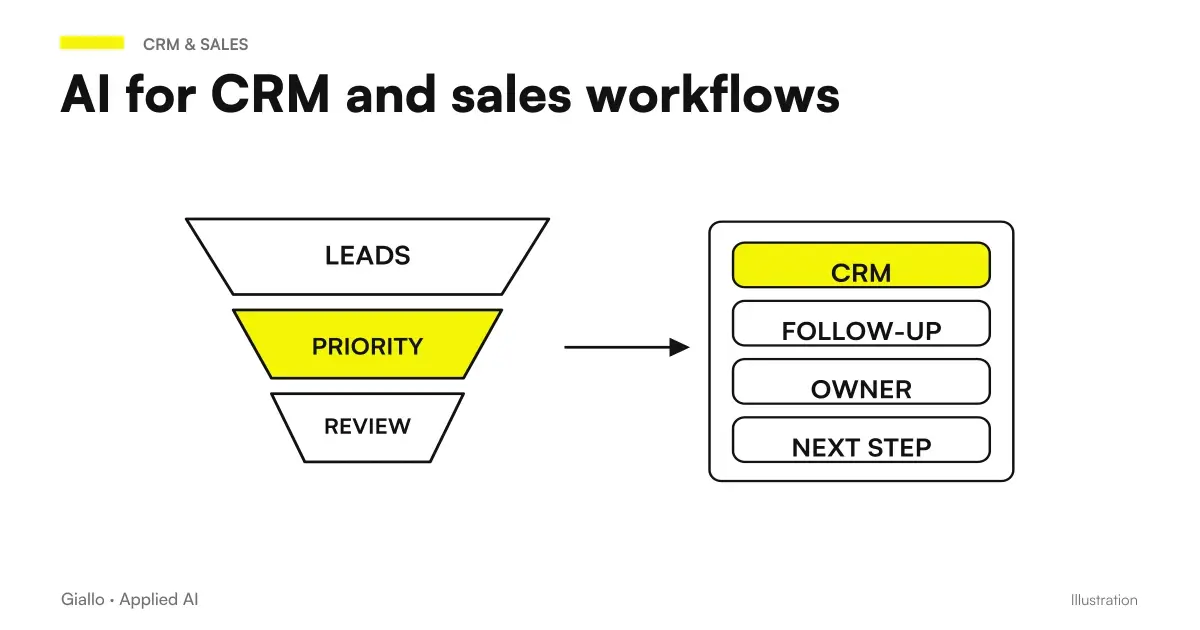 AI for CRM and sales: automate the sales process
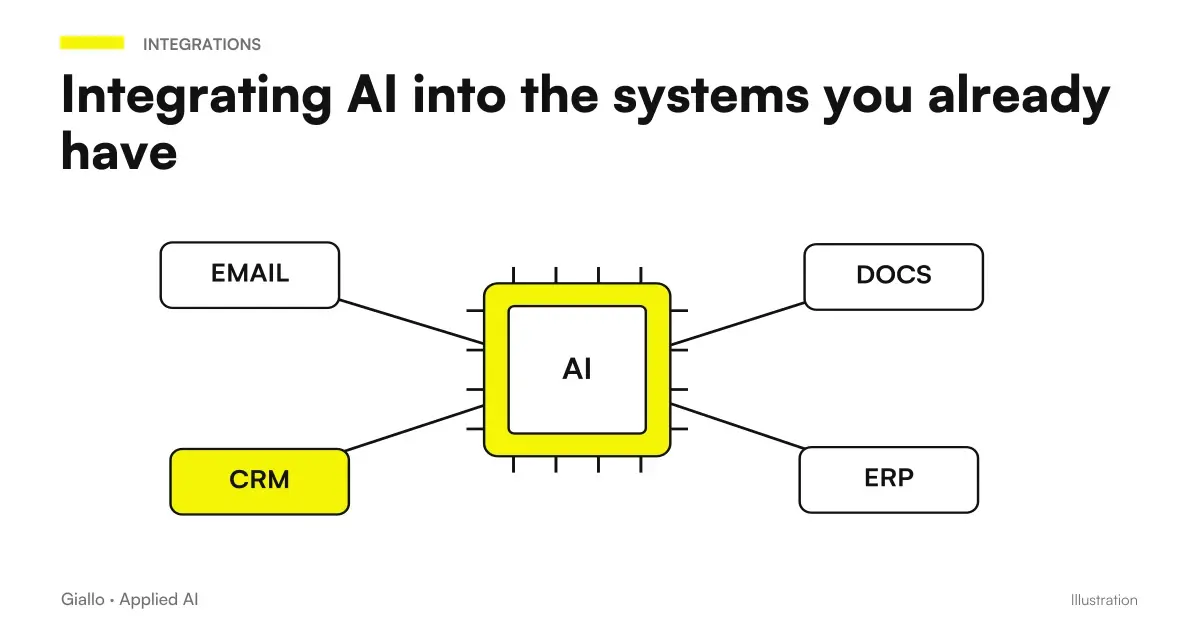 Integrating AI into the systems you already have
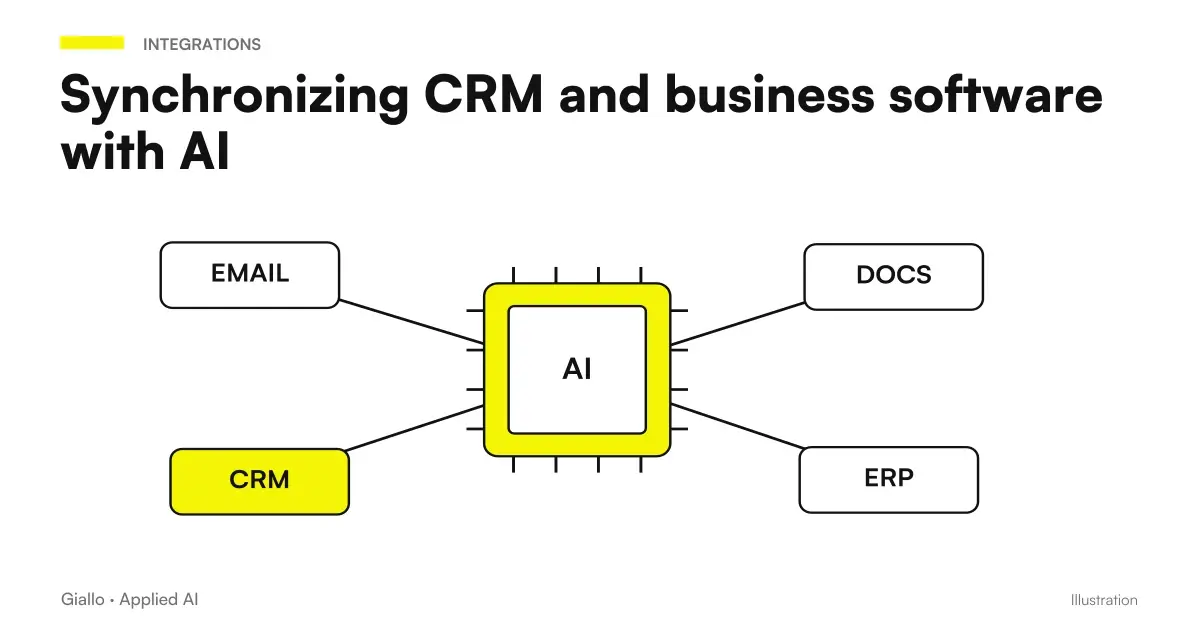 Synchronise CRM and business software with AI: data, conflicts and retries
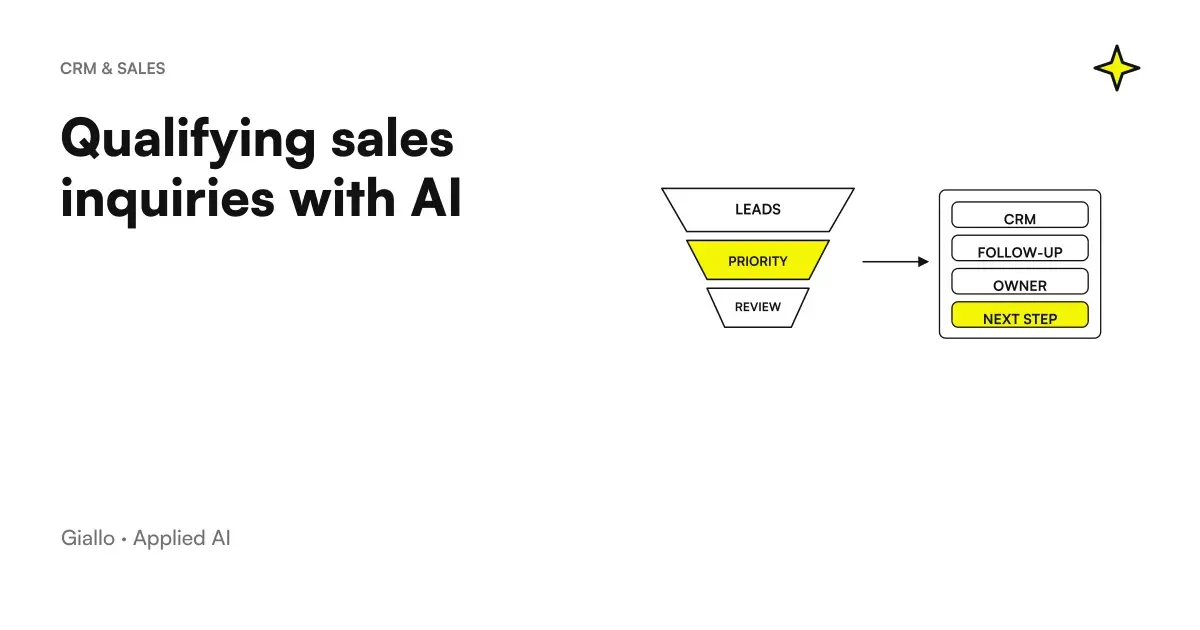 Qualify sales enquiries with AI: missing data, priorities and assignment
 Sorting emails and attachments with AI: a single queue for sales and administration
 AI Agents and Superintelligence: What Changes for an SME
FAQ
How does AI help with CRM duplicates?
It proposes pairs or groups to check and collects evidence of identity. The review must decide on fields, the primary record, associations, and history before any merge.
Are two contacts from the same company duplicated?
Not necessarily: they can be different people or roles. Company name and email domain are signals, not sufficient evidence to unite identities.
Can a CRM merge be undone?
It depends on the product, but you must not assume this. HubSpot warns that merging records is irreversible; an export does not automatically restore every relationship.
How to choose the value of a conflicting field?
Define an authoritative source and rule for that field, showing alternatives. The most recent record must not automatically prevail over each property.
What should you verify after the merge?
Check identity, properties, activities, deals and relevant associations in the real system. A positive response from the tool does not prove by itself that the expected history is present.
What measure counts in the test?
Measure correct proposals, incorrect merges avoided, and unresolved conflicts. The reduction in record count is not a sufficient indicator of quality.