
Website · Local SEO
Previtali Macchine Utensili
Previtali Macchine Utensili sells and services machine tools in a B2B market. It needed a fast, professional digital presence managed by its internal team.
previtalimacchineutensili.it
The context
Previtali Macchine Utensili operates in an unglamorous but deeply practical sector: selling and servicing metalworking machinery. Lathes, milling machines, grinding machines and specialist machines. These are the tools at the heart of engineering workshops, manufacturing companies and businesses turning metal bars and blocks into finished parts every day. It is a specialist B2B market, where customers do not buy on impulse or fall for a colourful banner: they assess, compare, ask about support and choose someone they can trust over the long term.
This customer profile radically changes the rules compared with consumer e-commerce or a generic business website. Someone looking for a milling machine for their workshop does not arrive through a viral post: they arrive through a precise search, often tied to a model, a machining process or a clearly defined location. They have a technical question in mind and want answers, rather than slogans. The website is therefore more than a marketing accessory: it is the first test of the company’s credibility.
Previtali needed an online presence reflecting its industrial strength, a machine catalogue it could manage independently and content reaching local metalworking businesses looking for a reliable nearby supplier. That was our starting point at Giallo Studio.
The Challenge
The main challenge in a project like this is not strictly technical: it is balance. On one side, the website needed to be fast and carefully designed, with a visual identity consistent with the world of machine tools. On the other, the company needed a tool it could manage itself, without calling a developer every time a new machine entered stock or a model’s availability changed. These two requirements often pull in opposite directions.
Then there was the question of visibility. In industrial B2B, simply being online is not enough: you need to be found at the exact moment a workshop is searching for what you sell. Searches in this sector almost always combine a technical need with a location. People do not just enter “used lathe”; they often link it to a province, a city or an area suitable for collection or servicing. If the website does not speak that language, it remains invisible to the customers with the most concrete needs.
Finally, consistency. A company that sells precise and robust machinery cannot present itself with an approximate site, slow or full of decorative elements out of context. The form had to tell the substance: reliability, competence, concreteness. No fuss, no puffed-up promises, just an orderly digital environment where the customer finds what they're looking for and understands who they're dealing with.
Why custom code on WordPress
Our technology choice was pragmatic rather than ideological. WordPress provides a familiar, widely used management panel requiring no programming skills for daily use. On that foundation, we built a fully custom-coded theme instead of a ready-made template or heavy page builder.
There are two reasons. The first is speed: a custom-written theme loads only the code it needs, without the layers of unused features, scripts and styles that generic templates carry with them. For a B2B website that needs to communicate professionalism and avoid wasting a professional’s time, responsiveness is part of the message, rather than an indulgence. The second is control: having direct access to the code means being able to shape every detail of the experience, from the structure of machine listings to mobile behaviour, without fighting the limitations of a tool designed for something entirely different.
Custom code, however, could not come at the expense of easy management. Quite the opposite. The aim was to use dedicated code precisely to make the daily work of updating the catalogue simpler, rather than more complicated. The theme was designed around how the company thinks about its machines, rather than a technical abstraction. WordPress therefore remains the familiar, convenient management panel, while under the bonnet runs an engine built specifically for this website and no other.
Industrial design
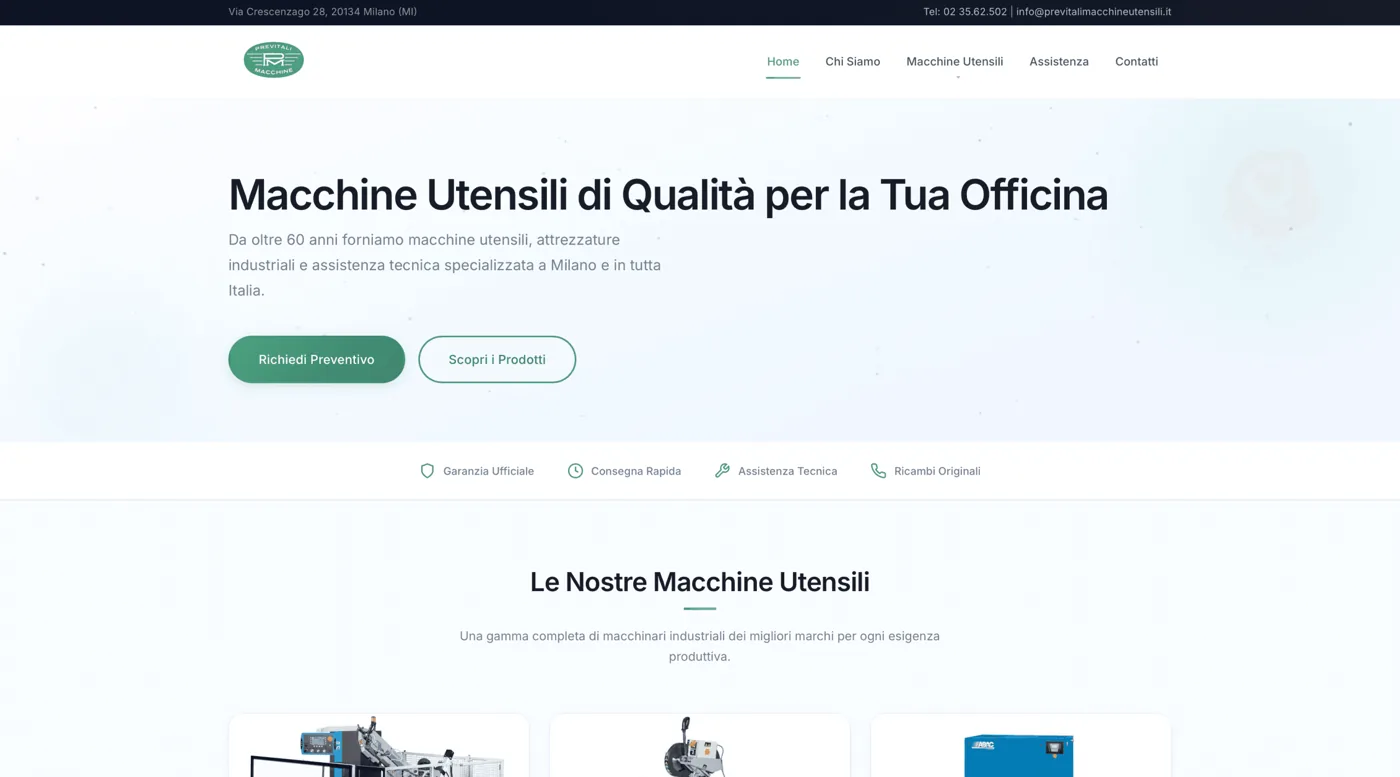
The visual identity of the site arises from the world it represents. Dark grey, black, metallic accents: the palette is that of steel and workshops, not the cheerful and generic one of interchangeable corporate sites. It is a choice that communicates before words. Those who arrive on the site immediately feel that they are in the right place, among those who know the metal and treat it with respect.
Industrial design, however, is about more than colour. It is primarily about order and readability. Machine tools have precise technical specifications, and that information needed to be presented clearly, hierarchically and in a way that is easy to scan, including when comparing several models. We worked on typography, spacing and contrast to build readable product listings that highlight what matters: machine type, features, condition and availability.
The result is a sober and professional environment, where nothing is put there to fill. The aesthetic tone reflects that of the company: concrete, no frills, oriented to the substance. A customer who opens the site from a construction site or production office finds a clean experience, which does not distract him and which brings him straight to the information he needs. It is design in the service of function, not decoration for its own sake.
Independent catalogue management
Independence was central. A machinery catalogue changes constantly: equipment arrives and sells, prices and availability change, and new models appear. Requiring a developer for every update would quickly make the site a burden and leave it outdated. We designed for the opposite.
That's why we structured the catalogue part so that the company can manage it on its own, directly from the WordPress panel. Adding a machine, updating its features, changing its status or removing it when it is sold are operations that the team can do autonomously, without touching code and without risking breaking anything. The custom code, in this case, works behind the scenes to make the panel neat and the cards always consistent with each other, whatever the hand that fills them in.
This independence has value beyond immediate convenience. It means the website stays current over time, accurately reflects actual stock, and prevents the online catalogue from becoming an outdated, unreliable version of the offering. For customers considering a purchase, finding fresh, trustworthy information is already a first sign of professionalism. For the company, it means the website works alongside it every day, instead of being a project locked away and forgotten after launch.
Local SEO and geolocation of searches
Geography matters more than you might think in industrial B2B. A workshop looking for a machine or servicing tends to prefer a reachable supplier it can speak to, collect equipment from and ask for on-site support. Searches reflect that need: they combine a technical keyword with a location. That is where we focused our SEO work.
Rather than chasing generic, highly competitive national keywords, we built the strategy around local searches in the sector. This means creating content and a site structure that reach queries combining a machine or service type with a location. It is a less conspicuous but much more effective approach, because it reaches precisely the audience most likely to become a real enquiry: people searching for something specific, near them, with a concrete intention.
We worked on the elements that help search engines understand the website’s subject and service area: content structure, headings, descriptions and consistency between pages. The underlying idea is simple and honest: be found by people already searching, in the right place and at the right time, without chasing traffic figures that look good in a report but bring no customers. A few qualified visits are better than many indifferent ones.
Google Business Profile and B2B Visibility
Local visibility is not just played within the site. A large portion of the industry search goes through Google Maps and local results, where the Google Business Profile tab often becomes the first point of contact between the company and a potential customer. For this reason we have configured and optimized the presence of Previtali on this front, so as to also guard the territory of local research.
A well-maintained business listing, consistent with the website and the company’s actual information, makes a practical difference in industrial B2B. People searching for “machine tools” or servicing nearby see the business with clear details: what it does, where it is and how to contact it. This channel works alongside the website’s SEO, reinforcing the same message from several directions and increasing opportunities to be found by the people who matter.
Here too, the aim is practicality. Rather than inflate the presence with fake reviews or exaggerated promises, we build a solid, consistent, useful listing that reflects the company as it is and makes it easy to reach. In workshops and manufacturing, where word of mouth and trust matter enormously, an organised, credible local presence is worth more than any loud advertising campaign.
The result
At the end of the project, Previtali Macchine Utensili has a digital tool that reflects its business. A fast, restrained website built on a custom theme combining the solidity of dedicated code with the convenience of WordPress management. An industrial aesthetic that communicates expertise and professionalism before anyone reads a word. A catalogue the company updates independently, keeping it active and trustworthy over time.
For visibility, work on local SEO and geographically focused searches, alongside Google Business Profile optimisation, gave the company a coherent strategy for being found by people who are actually searching: local workshops, manufacturing companies and businesses needing metalworking machinery or qualified support. Rather than chasing traffic for its own sake, it is a focused presence in the channels where real enquiries begin.
This project reflects how Giallo Studio works: first understanding the practical nature of the business, choosing the right tools for that particular context, and building something solid and honest rather than a website that looks good but has nothing behind it. For Previtali, that meant a website industrial in both character and appearance, independently managed and designed to be found by the right people. No inflated promises, no invented metrics: just a tool working alongside its users every day.
New Project
We bring yours online as well.
Whether it's a site, an automation or an AI agent: tell us the goal and see how to get there.