
RAG: what it is and why it improves AI responses
What RAG (retrieval augmented generation) is and why it improves AI answer accuracy: how it works, real examples and business use.
Reading time: 10 min
The RAG (sigla of retrieval augmented generation, in Italian "generation increased by recovery") is a technique that connects an AI model to your documents: before search the relevant steps in your knowledge base, then them switch to model to build the response based on those. Basically AI stops responding "by heart" and responds by reading your real data, citing where the information comes from.
Why does it matter? A language model such as ChatGPT or Claude knows only what it saw during training: it knows nothing about your price list, contracts or internal procedures. If you ask it without providing context, invents a plausible answer instead of admitting that it doesn't know. The RAG solves exactly this: it provides the model with the right documents at the right time, so the answers become specific, up to date and verifiable.
In this guide, we explain what RAG actually is, how it works step by step (documents → embedding → vector database → retrieval → generation with citations), when it is worthwhile compared with other approaches and how an SME can use it with its own knowledge base.
In summary
- The RAG connect an AI model to your documents: it retrieves the relevant steps and uses them to generate the response, instead of only responding "from memory".
- It serves to make AI respond to content that the model has never seen: manuals, procedures, contracts, knowledge base corporate.
- The flow is: documents → embedding → vector database → retrieval of the most similar passages → generation with citations.
- It greatly reduces the hallucinations and allows you to quote the source, but does not reset them: you always need human control over critical cases.
- Compared to fine-tuning It's easier and cheaper when data changes often: you update documents, you don't re-add the model.
What RAG (retrieval augmented generation) means
The theme song RAG puts together three words that describe exactly what happens: Retrieval (recovery), augmented (increased), generation (generation). Translated: the generation of the response by the model is increased from Recovery relevant information from an external source.
To understand why it is needed, start from a precise limit of Language Models. An LLM is trained on a huge amount of text up to a certain date, then "frozen". From that moment:
- does not know your private data (your CRM, your manuals, your prices);
- does not know anything about what happened after training;
- When he doesn't know, tends to invent an answer that sounds correct.
The RAG does not change the model: it puts a "search engine" next to it on your content. Before answering, the system searches your documents for the most relevant pieces to the question and pastes them into the context of the model, along with the question itself. The model reads those pieces and responds on those. It's like going from a student who responds by heart to a student with the book open to the right page.
How the RAG works, step by step
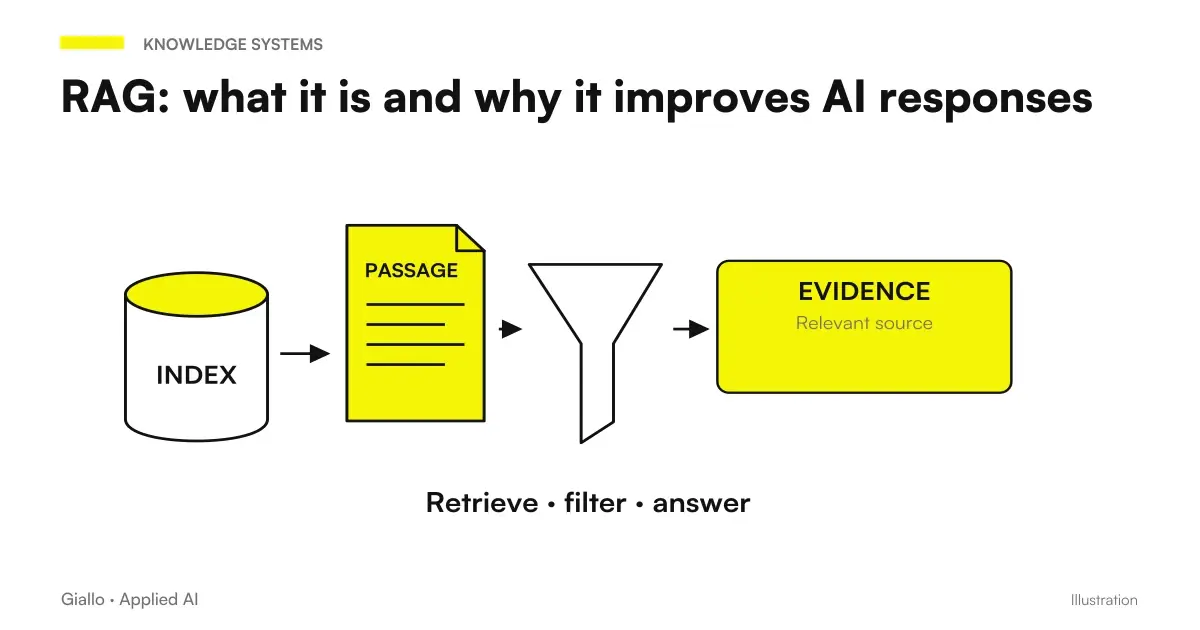
The RAG is divided into two moments: a phase of preparation (one-off, when you upload documents) and a phase of reply (whenever someone asks a question). Let's see them as a single operational stream. After recovery, you still need to choose what content is relevant to the question; JEV to filter documents in the RAG deepens this passage by separating it from the generation of the answer.
- Documents. It starts with yours knowledge base: manuals, FAQs, procedures, contracts, product sheets. Files are divided into smaller and more consistent pieces (so-called chunk), because an entire PDF is too big to handle in one go.
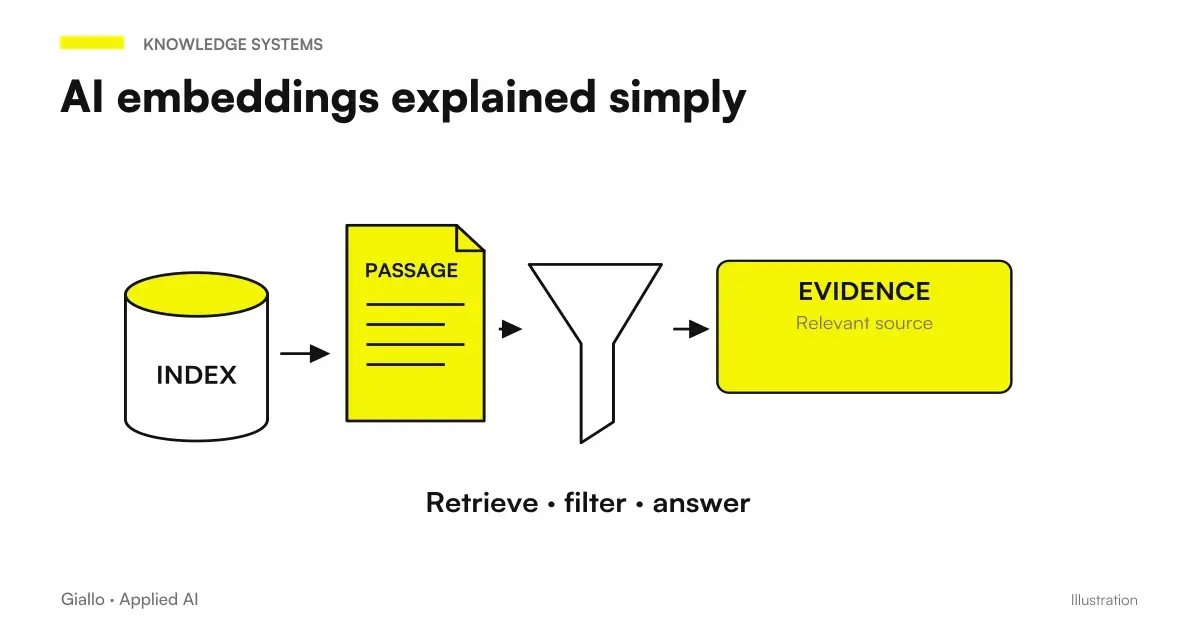
- Embedding. Each piece of text is transformed into a vector of numbers representing its meaning. Texts that talk about the same thing produce vectors close together. This is the technical heart: the embedding transform words into comparable coordinates.
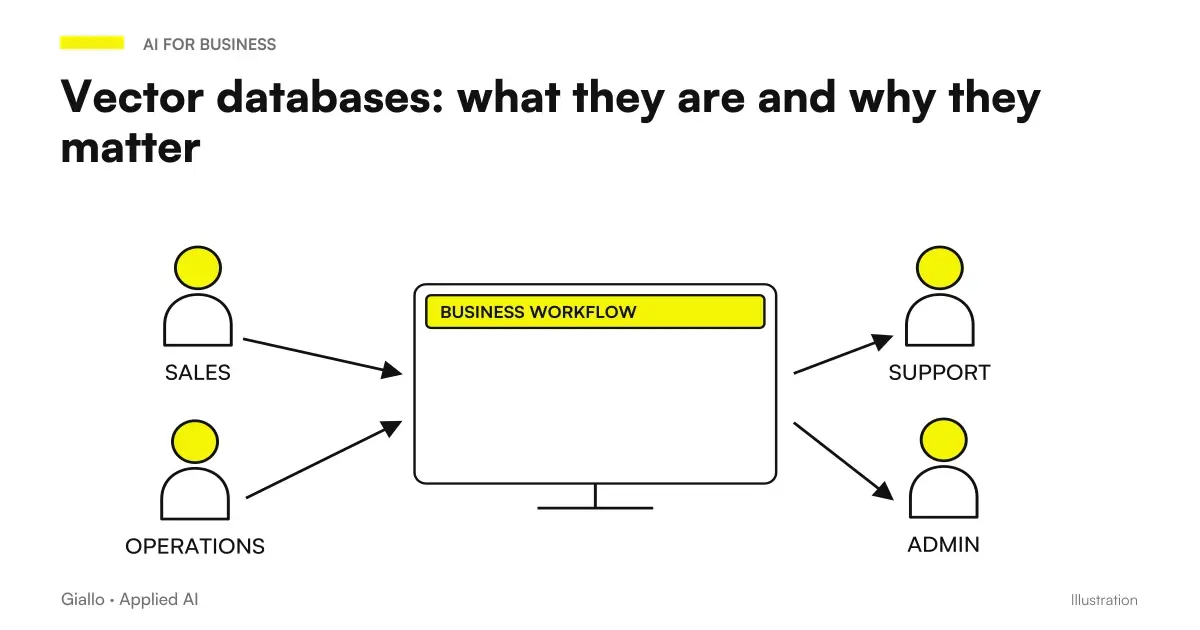
- Vector database. All these vectors are saved in a vector database, an archive designed to find in milliseconds the vectors most similar to a given one. It is the index of your library.
- Recovery (retrieval). When a question arrives, the question is also transformed into embedding. The vector database returns the pieces of document whose meaning is closer to that of the question — usually the most relevant 3-8.
- Generation with quotations. Those steps are passed to the model along with the question. The model writes the answer based on the retrieved texts and indicates from which document information arrives, so the source is verifiable.
Why embeddings and vector databases are the engine
The part that makes the difference is the Recovery by Meaning, not for exact words. A traditional search only finds documents that contain the same words the question. The RAG, thanks to embedding, find the documents that speak of the same thing even with different words: if the user asks "can I return a defective item?" the system retrieves the section of the manual entitled "return and warranty policy", even if it does not contain the word "return".
The vector database is what makes this search fast on thousands or millions of pieces: without him, comparing the question with each document would be too slow for an assistant to answer in real time.
What's different about a "naked" LLM
LLM alone
- He only responds with what he learned in training.
- He doesn't know your documents or recent data.
- When he doesn't know, he tends to invent.
- He cannot cite a verifiable source.
LLM with RAG
- He answers by reading your actual documents.
- It updates when you update the knowledge base.
- When context is lacking, it can say "I don't know."
- Shows which document the answer comes from.
The choice of embedding affects what content can be retrieved. EmbeddingGemma 2 for multimodal document search represents text and other media; it remains to build the index, apply permissions and verify the relevance of returned sources.
When text and images coexist in PDFs, the new multimodal embedding Perplexity propose a representation with multiple vectors. It is an option to compare on the relevance and size of the index, keeping the verification of permissions separate.
RAG or fine-tuning: which one is really needed
They are often put in alternative, but respond to different needs. The fine-tuning retrain the model on new examples to change it style or the behaviour; the RAG does not touch the model and provides it with Knowledge at the time of application.
| Criterion | RAG | Fine-tuning |
|---|---|---|
| What it is used for | Give the model access to specific data and documents | Change the style, tone, or format of responses |
| Data that often changes | Ideal: you update the documents, not the model | Uncomfortable: Every change requires new training |
| Initial cost | Lower, starts with ready-made tools | Higher, requires training and calculation data |
| Cite sources | Yes, it can indicate the document | No, knowledge is "fused" in the model |
| Risk of Inventing | Reduced (answers on retrieved texts) | Stay, if the question comes out of the examples seen |
| When to Prefer It | Business knowledge base, FAQ, support, internal research | Very specific style, rigid formats, constant technical jargon |
In most business cases —"I want AI to respond on my documents" —the right answer is the RAG. Fine-tuning comes into play when the problem is not what He knows the pattern, but how responds. Deepen the difference in driving on the fine-tuning AI and when needed.
Practical examples
Three realistic scenarios of Italian SMEs and professionals, to make the RAG concrete.
1. Accounting firm — assistant on internal regulations. The study has hundreds of circulars, practices and internal procedures. An RAG assistant indexes all these documents: when a collaborator asks "how do we manage the flat rate regime for a new customer?", the system retrieves the updated procedure of the study and responds by quoting it, instead of giving a generic response taken from the web. The sources cited allow verification on the fly. It is the same type of work as described on the page dedicated to AI for accountants.
2. E-commerce — customer support on their content. An online store connects an assistant to its shipping, returns, warranty and product cards pages. The customer asks "how long does it take to get to Sicily?" and the assistant responds with the actual times taken from the shipping page, not with a fabricated estimate. When the company changes the courier, just update the document: the answer changes immediately, without touching the model.
3. Manufacturing company — technical manuals. Hundreds of pages of machine manuals. A technician in the workshop asks from the phone "what is the E-204 error reset procedure on line 3?" and the assistant retrieves the exact passage of the correct manual and quotes it. The time to find the information goes from minutes of searching between PDFs to seconds.
In all three cases the value is not "AI knows everything", but "AI answers on the right documents and tells you where it got the answer from".
When the RAG is convenient and when not
When to use the RAG
- You have a specific document base to get AI to respond to.
- Content changes over time and needs to be kept up to date.
- You need to be able to quote the source to trust the answer.
- You want to reduce the inventions of the model on your own topics.
When it's not needed (or not enough)
- The question is generic and the basic model already answers well.
- The documents are few and stable: sometimes just paste them into the prompt.
- The problem is the style of the answer: there the fine-tuning is needed.
- Documents are messy or incorrect: they must be arranged first.
The index must also maintain the operational meaning of the metadata. The proof of concept Foundry IQ on SharePoint shows how to use them in the retrieval; on a custom index, the propagation of accesses must be designed and verified explicitly.
Mistakes to Avoid
- To think that the RAG is zero hallucinations. It reduces them, it does not eliminate them. If the recovery brings wrong steps, the model can still generate an inaccurate response. Always keep sources visible and predict a human review of critical cases. Read more in the guide on AI Hallucinations.
- Uploading messy documents. Badly scanned PDFs, double versions, contradictory content: the system will recover confusion. Document preparation is the part that decides the result, not a detail.
- Badly splitting documents into chunks. Too big pieces dilute the meaning; too small they lose the context. A good subdivision is what makes you find the right passage.
- Not updating the knowledge base. The advantage of the RAG is to stay current, but only if someone really updates the documents. A firm base two years ago gives old answers with confidence.
- Expose sensitive data without control. Indexing contracts or customer data in public tools can violate the GDPR. We need clear rules about what enters the knowledge base and who can question it.
How to apply it in the company
Building a useful RAG system is an orderly path, not a technological leap. Here are the steps that work for an SME.
- Choose a High-value, circumscribed document base (e.g. support FAQs or a manual), not "all business files" together.
- Clear and update those documents: delete double versions, fix errors, give a consistent structure.
- Decide who will be able to ask questions and what, defining the boundaries of access to sensitive data.
- Start with ready-made tools: often you don't need to build everything from scratch for a first system.
- It always shows the cited sources and measures how many answers are correct before extending to other areas.
RAG is one of the most requested building blocks when a company wants an assistant to respond to their content. It often becomes the basis of a AI Agent that not only finds the information, but performs actions — update a ticket, prepare a draft, sort a request. To frame your company's priorities, costs and processes, guide AI for businesses picks up the full route to leave.
Translating all of this into a system that works on your documents is exactly the job of a AI Consulting: understand which knowledge base makes sense to index, prepare data and connect the assistant to your tools. If you want to see prototypes and concrete experiments, take a look at the The Lab.
For updated numbers and model by model comparison, Context Window: How Much It Really Matters and Best AI Model for Long Documents.
Does RAG and memory make an AI superintelligent?
Connecting business documents helps the system answer with relevant information. Retrieving a price list, remembering a session’s status and updating model weights are different operations: the detailed article on Superintelligence, Memory, and Context A rich knowledge base alone does not demonstrate a general capacity superior to that of a human.
Even when a platform talks about Personal superintelligence, such as Meta with Muse Spark, it is better to check which sources are linked, which permissions you grant and which functions are available in your market. For an SME the reference remains the correct document and accessible to the user: memory and customization do not justify answers based on expired materials or data from another department.
Conclusion
The RAG is the technique that makes AI go from "reply by heart" to "reply by reading your documents". The flow is simple to remember — documents, embedding, vector database, retrieval of relevant passages, generation with citations — but the quality of the answers changes: more specific, more up to date and above all verifiable. For an SME it is often the quickest and cheapest way to have an assistant who really knows their company, as long as they start from clean documents and keep the person in control over critical cases.
If you want to go from testing with ChatGPT to an AI system integrated into business processes, Giallo Studio custom designed agents and automations — including a RAG system on your real documents.
Giallo Studio guides: methodology and sources
How we apply it in the company
Related resources
 LLM: What Language Models Are
 AI embeddings explained simply
 Vector databases: what they are and what they do
 AI Hallucinations: What They Are and How to Avoid Them
 AI agents: what they are and how they work
 AI for businesses: a complete guide to getting started
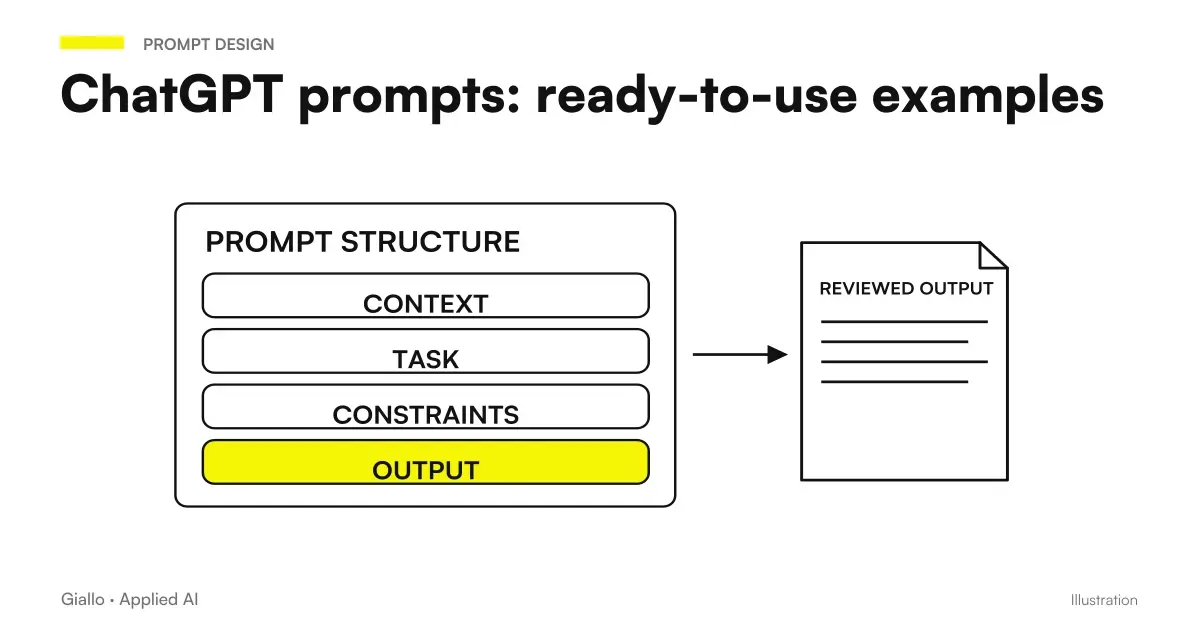 ChatGPT prompts: ready-to-use examples to copy and adapt
 Proof of concept AI: what it is for and how long it lasts
FAQ
What is RAG in plain words?
RAG (retrieval augmented generation) is a technique that connects an AI model to your documents: it first retrieves relevant passages from your knowledge base, then passes them to the model to generate an answer based on them. In practice, the model stops answering 'from memory' and answers by reading your actual data.
What is the RAG for?
It serves to get an AI assistant to respond to your company's specific content — manuals, procedures, contracts, documentation — that the model has never seen in training. It reduces inventions, allows you to cite the source, and keeps responses up-to-date when updating documents, without retraining anything.
What is the difference between RAG and fine-tuning?
Fine-tuning modifies the model by retraining it on new examples, it is expensive and needs to be redone when the data changes. The RAG leaves the model unchanged and provides it with the right documents at the time of the question. To get AI to answer on a knowledge base that changes often, the RAG is almost always the easiest and cheapest choice.
Does the RAG completely eliminate hallucinations?
No, it reduces hallucinations but does not eliminate them. If retrieval returns incorrect or incomplete passages, the model can still generate an inaccurate answer. A good RAG system therefore shows cited sources so the person can check them, and includes human review for critical cases.
Do you need a vector database to do RAG?
In most cases, yes: the vector database stores your document embeddings and finds the passages most similar to the question in milliseconds. With only a few documents, simpler solutions can be a starting point, but as the knowledge base grows, a vector database makes retrieval fast and reliable.
How long does implementing RAG in a business take?
An initial system for a limited document collection (e.g. FAQs or a manual) takes only a few weeks using ready-made tools. The real work is preparation rather than technical work: clean, current and well-organised documents. Answer quality depends more on data quality than on the chosen model.