
AI for automatic appointment scheduling
How AI manages calendars, confirmations and reminders across channels to reduce no-shows, with the requirements to understand before starting.
Reading time: 10 min
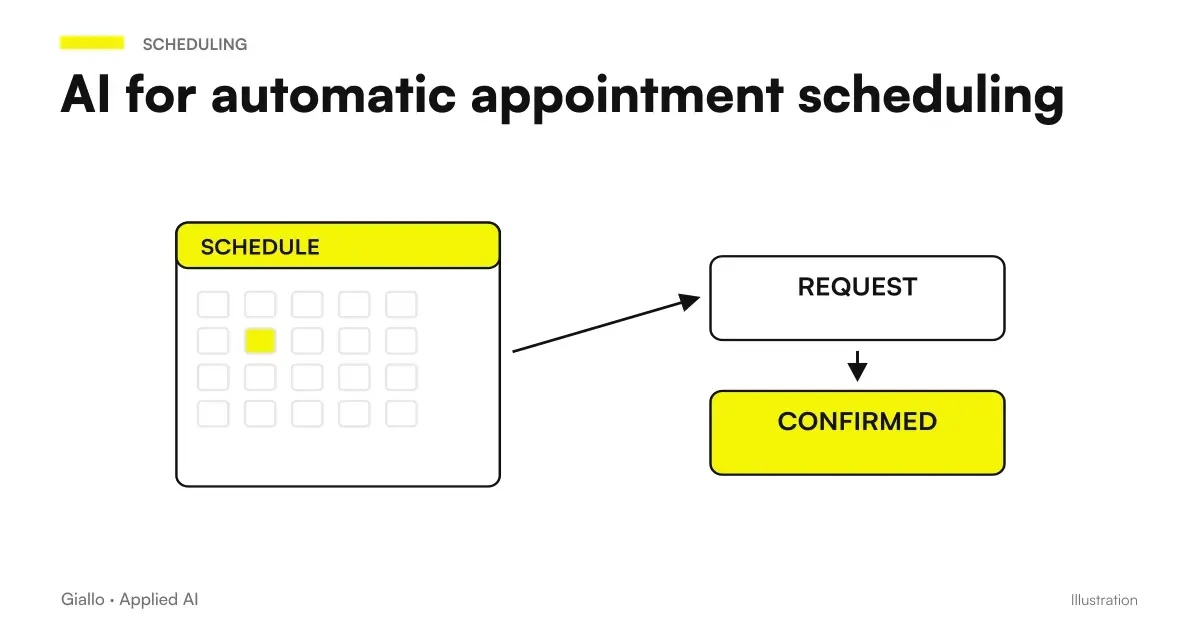
Setting an appointment is never a single exchange: there is the request, the proposal, the confirmation, the reminder and sometimes the cancellation. Each date costs more interactions than you count at first glance, and these interactions come across different channels: phone, message, email, online form.
An AI system covers the repetitive part of this cycle on all those channels together, not just on the phone, and above all covers the time slots where nobody answers today. The broadest picture of how to design a system that also responds by voice is in voice AI for companies; here the focus is on the agenda as a whole, whether the contact comes with the voice or in writing, and on the precise rules to be respected on what to communicate and how, not just on the efficiency of the calendar.
In summary
- An appointment is a multi-step cycle across multiple channels, not a single exchange.
- The reminder with confirmation often has more return than the date's catch itself.
- Since August 2, 2026, even a message or call generated by a system must declare it, for the AI Act.
- A service reminder and a promotional message follow different rules: they must be kept distinct.
- We need integration with the Real Calendar, otherwise overlaps are created.
- With more professionals it is better to start from one and expand, not launch everything together.
The cycle, channel by channel
- Request. It comes by phone, message or web form: the channel should not change the outcome.
- Qualification. What kind of date, how long it lasts, with which person on the team.
- Proposal. Two or three real slots, verified on the calendar, not generic bands.
- Confirm and registration, in the same calendar that the rest of the team uses.
- Reminder at a useful distance from the appointment, with the possibility to confirm or cancel.
- Cancellation Management: clear the slot and, if there is a waiting list, propose the place to those who wait.
Points 5 and 6 are the ones that companies neglect the most, and they are the ones that are worth the most. A reminder that simply asks for confirmation turns a portion of missed arrivals into early cancellations, and an early cancellation is a slot that you can still resell.
What the system can decide for itself
Codable rules
- Duration by type of performance
- Skills needed for that kind of appointment
- Time slots and days available
- Shift times between different locations
Rules to be put in writing first
- "We always put that customer in the morning"
- "With that kind of work it takes longer than expected"
- "On Fridays we try to close early"
- "If it's the first time, half an hour more"
The right column is the real work of the project: these are rules that today only exist in the head of those who manage the agenda. Collecting them is the same type of work described in AI for shift management, and as there, the by-product, i.e. the rules written black on white, remains useful regardless of the system you choose.
Say it's an AI, even when it's just a message
The transparency requirement is not just about voice calls. The Article 50 of the AI Act applies to any AI system intended to interact directly with physical persons, and requires that the user knows they are dealing with an AI, unless it is already apparent from the context. The date of application, in accordance with Article 113 of that Regulation, is 2 August 2026.
For a message reminder this can suffice with one line in the text itself; for an automatic confirmation call, with one sentence at the beginning. The practical criterion is the same in both cases: the person receiving the communication must understand, without having to infer it, whether he is interacting with a person or with a system.
Service reminder or promotional message
Not all communications to a customer follow the same rules, and it is a distinction to be kept clear from the design of the system. A reminder related to an already scheduled appointment is about running an ongoing report. A communication with sales or promotional purposes, even if sent to the same contact, falls instead in the rules on commercial communications: the Article 130 of the Privacy Code provides for the latter the public register of oppositions, extended by law 5/2018 also to calls made with automated systems.
An example of the boundary between the two things
A message reminiscent of tomorrow's appointment is a service reminder. The same message, if it adds "and takes advantage of the promotion on the next treatment", introduces a commercial component. It is not a formal detail: it changes the legal basis of communication. In doubtful cases, the simplest solution is to keep the two contents separate, in two separate messages.
Dating that repeats itself
There is a category that deserves a separate speech because it has the highest return: appointments that are repeated at regular intervals, such as periodic checks, scheduled maintenance or recalls.
Here the system can do something that a person rarely does: propose the next appointment when the previous one closes, when the customer is still in contact and the decision costs little. Resuming that contact months later, cold, is much more difficult and often does not happen at all.
- Propose the next appointment at the end of the current one, not with a separate message after weeks
- If the customer does not want to decide immediately, record the indicative date of the recall anyway
- Remember in advance when the deadline approaches
- Track who hasn't fixed anything anymore, to figure out where the cycle stops
The final point produces an operational data item almost no business has today: at which step customers stop returning. A dental practice tracking it, for example, may discover that recalls are missed mainly at the second check-up rather than the first — information concerning organisation more than AI. For this type of recall, and the caution needed when appointments involve health data, what is described in GDPR and AI in the company.
The channels in comparison
| Channel | When it works best | Limit |
|---|---|---|
| Phone | Those who do not use digital tools, or complex requests | Real-time availability needed |
| Message | Quick reminders and confirmations | Not Everyone Responds in Time |
| Online Booking | Autonomous and regular customers | Covers only those who choose to use it |
| Appointments well in advance | Slower reading times |
The combination that makes the most, in most cases, is online booking for those who use it spontaneously, the message for reminders and confirmations, the phone as a safety net for those who do not respond to the other two channels. The channel with which the original request came, however, is not said to be the best even for the reminder: those who book late at night from a web form may prefer a short message the day before, instead of another page to fill out.
The calculation that says if it's convenient, without inventing percentages
The return of a dating system consists of three entries, and is usually considered only the first.
Time to stare. How many interactions are needed on average and how long they last: it is the most visible voice and usually the smallest.
Missed arrivals recovered. Any unhonoured appointment is time paid and unproduced. If reminders with confirmation convert a part of it into early cancellations, those slots can be resold.
Requests out of hours. People who would have stared but called or written when everything was closed, and no longer insisted. It is the invisible voice, because it leaves no trace anywhere.
In a concrete example: if an activity sets a certain number of appointments per month and loses some for missed unrecovered arrivals, multiplying those missed arrivals by the average value of a slot gives a first estimate, raw but real, of how much it is worth to reduce them even in part. It is a calculation that each activity must make on its own numbers, not on a percentage read elsewhere.
Where automation doesn't have to go
Not all appointments lend themselves to being automated, and recognizing it avoids building a system that will be bypassed by the team itself.
Appointments that require a preliminary evaluation, understand what the customer needs before deciding how long it takes and with whom, do not automate well: the system can collect information and pass it on, but the decision on duration and assignment remains to those who know the job. The same is true for early appointments with new customers in business where the relationship matters: that first conversation is part of the service, not an obstacle to be removed.
Think of a consultant with a very variable agenda: the value for him is not to automate any kind of request, but to cover those that arrive while he is in the meeting, proposing real slots without having to stop. Instead, think of a center with more professionals and different services: the complexity is high immediately, with different durations for each performance and skills to match correctly, and it is better to start from the most requested service instead of from all together, widening only when the collected rules have proved correct in practice.
Where to start, with a single agenda
Count for a month how many fixed appointments, how many interactions it takes on average to fix one and how many missed arrivals you have. The third issue is usually the one that surprises the most and that justifies the project on its own. Start from the most frequent appointment type and activate reminders immediately with confirmation, even before automating the socket: it is the easiest part and the one with the fastest return.
There is an organizational condition that matters more than any technical choice: there must be only one agenda, updated by anyone making an appointment, including the system. If staff continue to score by hand on an agenda other than the one the system reads, the system will propose schedules that are not actually free.
The specific case of bookings received over the phone, with a more vocal angle, is in AI for phone bookings; the periodic calls are deepened in AI for customer callbacks. If you want to understand how to set agenda, confirmations and reminders for your business, the process automation services by Giallo Studio They start with how your agenda works today, not a pre-packaged model.
Giallo Studio guides: methodology and sources
How we apply it in the company
Related resources
AI by sector
The same reasoning, applied to the other areas we follow.
- AI for travel agencies: quotes, packages and assistance to travellers
- AI for craftspeople: custom quotes, job orders and electronic invoicing
- AI for marketing agencies: content, reports and AI labels
- AI for insurance agencies: renewals, quotes and complaints
- AI for procurement and supplier management
- AI for car rental: renter fines, contracts and return damage
- AI for wedding planners: suppliers, deadlines and guest data
- AI for driving schools: enrolment, lessons and exam reminders
- AI for veterinary clinics: recalls, prescriptions and pet owners
- AI for businesses: a complete guide to getting started
- AI for staff shift scheduling
- AI for call centres: what changes?
FAQ
What is the difference between this and a normal online booking system?
An online booking system works for people willing to use it themselves. An AI system also serves people who send a message or call, often the group that is hardest to serve. The two are not alternatives: online booking captures people who book themselves, while AI covers the rest across several channels.
Must the system disclose that it is AI when it sends an appointment confirmation or reminder?
Yes, when the interaction is direct with the person. Article 50 of the AI Act requires systems that interact with natural persons to let them know, unless it is already obvious, and the rule applies from August 2, 2026. A message signed with the name of the practice but generated by an automatic system falls under this obligation.
Is an automatic reminder the same as a promotional message?
No. A reminder related to an appointment already set concerns the execution of an ongoing relationship, while a communication with sales purposes falls under the rules on commercial communications, including the Italian public opt-out register. In doubtful cases, such as a reminder that also includes an offer, it is best to check with the person responsible for privacy in the business.
Do reminders really make a difference to no-shows?
They are often the part that delivers the most immediate return, more than booking the appointment itself. A reminder that lets people confirm or cancel by replying converts some no-shows into advance cancellations, freeing slots that can be filled again.
Is it necessary to integrate the existing calendar?
Yes, it is the prerequisite for everything else. A system that suggests appointment times without seeing real availability creates overlaps, and the damage outweighs the benefit of automation.
Does it work for practices with several professionals?
Yes, but complexity increases: you need written rules about who does what, different durations for each type of service, and how customer preferences are managed. It is worth starting with one professional or appointment type and expanding later.