
AI Agents and Superintelligence: What Changes for an SME
AI agents and superintelligence: why autonomy, capability and reliability differ. Two SME scenarios and useful tests before delegating actions.
Reading time: 12 min
An agent who updates management software without asking each time for the next step can be useful, but Operational autonomy does not demonstrate superintelligence. AI and superintelligence agents describe two different aspects: the first concerns how a system conducts an activity; the second concerns the level and breadth of capabilities it can demonstrate.
For an SME the distinction changes the questions to ask before delegating. It is not enough to see the software working alone. It is necessary to understand what problems he can solve, what situations he recognizes as exceptions and with what tests we can trust the result. A system can have a lot of freedom and limited skills, or high capabilities and very tight permissions.
Here we examine this difference, not a catalog of automations. The guide to AI Agents for Companies deepens processes and adoption; the starting point of this article is more precise: what to authorize does not coincide with what the system can do.
In summary
- An agent chooses steps and tools within a task, but this freedom is not an ASI test.
- Capacity, autonomy and reliability must be described separately.
- Completing a circumscribed process does not demonstrate general superiority over people.
- A successful demo must be compared with exceptions, repeated attempts, and final state of the systems.
- The useful delegation starts from a verifiable result and an explicit boundary of action.
Why is an autonomous agent not automatically a superintelligence?
The word autonomous can evoke a collaborator capable of dealing with any problem. In software it means something more circumscribed: the system can choose a next action without receiving instructions for each step. It can search for a document, use a CRM function, check the result and decide whether to continue. It does not necessarily follow an identical sequence for each request.
Anthropic distinguishes workflows, driven by predefined paths, from agents, which dynamically direct process and tools. It is an architectural distinction, not a classification of their intellectual superiority. The page is from 2024 and signals subsequent changes in the tools: we use conceptual distinction, without treating that catalog as updated. Source: Building effective agents.
The undue jump occurs when from "he has chosen the next step" we move on to "he knows how to do almost everything better than people". The two statements require different evidence. For the first we observe who rules a sequence. For the second one, it would be necessary to evaluate performance and generality on a very large set of tasks, with explicit comparison conditions. For the meaning of the term we refer to Artificial superintelligence.
A procedure can run all night because it has access to a queue of requests and a stop rule. The duration of the execution, by itself, does not tell us if it includes the exceptions. Similarly, using many tools can expand the available actions without improving the ability to distinguish a correct request from an ambiguous one. The freedom to act multiplies the effects of the competence there, including its limitations.
What are the three axes to keep separate?
The first axis is capacity: what results the system can produce and under what conditions. A serious description includes the type of input, available information, excluded cases, and comparison with relevant human work. "Manages orders" says little; "reconstructs a draft order from these demands and signals these inconsistencies" is a controllable promise.
The second axis is autonomy: what decisions and actions can be made without intervention. You can propose an update or apply it. You can choose a document or also query external services. He can ask for clarification, suspend the case or proceed with a hypothesis. It is a choice of design and delegation, not a prize to be given to the most brilliant model.
The third axis is reliability in the process: how much the result remains acceptable when changing input, information order or operating conditions. A convincing answer is not enough if the wrong record is changed. The concrete question is whether the entire system achieves the expected result and recognizes when it cannot do so.
The Original Paper Levels of AGI proposes to distinguish performance, generality and autonomy. It is a research framework, not a universal product certification. Its usefulness here is to prevent a level of autonomy from being mistaken for a general capacity level. Source: Levels of AGI.
| Appearance | Question to ask | Useful Evidence | What doesn't prove |
|---|---|---|---|
| Ability on task | Can you solve these cases? | Results compared with explicit criteria | Superiority in unproven areas |
| Generality | Does it transfer skills to different problems? | Separate tests and stated conditions | A single successful integration |
| Autonomy | Who chooses steps and actions? | Trace actual decisions and permits | General understanding of the world |
| Reliability | Do you have variations and exceptions? | Repetitions, errors and suspended cases | Zero risk in production |
| Business Utility | Does the job end better? | Correct final status and verification load | Automatic cash savings |
This separation also avoids the opposite error: discarding a circumscribed system because it is not ASI. An agent can be convenient on a well-defined task without satisfying any idea of general higher intelligence. The difference between AI, AGI and ASI helps to read labels; the decision on one's own process requires local evidence.
How much does the result change if we only increase permits?
We imagine the same interpretation ability applied to three configurations. In the first the system prepares a text. In the second it creates a draft in the management software. In the third it confirms the operation and sends a communication. The problem it knows how to solve may be identical, but the consequences of an error change significantly.
This observation is important when a provider presents as a leap of intelligence the transition from chat to action. Integration can be a real improvement of the product: it eliminates manual copies, makes information available and coordinates steps. However, it mainly demonstrates a new operational possibility. It does not authorize inferring that the model has become superior in all domains.
The sensible choice is to match the permission to the evidence. An easy result to double-check can become a ready proposal. An action that commits the company to a third party requires a verification suitable for that risk. If the ability to evaluate an exception is not demonstrated, increasing freedom can make the problem less visible, without solving it.
Nor should a request for help be confused with a failure. An agent who recognizes an ambiguity and returns the case may be more useful than one who always concludes. Suspension is part of expected behavior, when the process does not allow assumptions. The difference between assistant, chatbot and agent It's also about the role in the job, as well as the interface we talk to.
What does an agent show in a spare parts distributor?
Hypothetical scenario, not customer Giallo: a spare parts distributor in Bergamo receives requests with incomplete codes, photographs and colloquial descriptions. An agent consults the catalog, searches for the compatible code, and prepares a CRM update. The manager sees an activity that used to require several manual steps.
However, to assess capacity, it is necessary to distinguish cases. A request with exact code is different from an unmeasured photo. The ability to search for a match does not prove the ability to ensure mechanical compatibility. If the catalog contains incomplete data, an autonomous choice does not automatically fill that gap. Success also consists in acknowledging that decisive information is lacking.
In the initial perimeter the agent could associate the message with the customer and prepare alternatives with the sources consulted. The technician remains responsible for compatibility in ambiguous cases. This boundary does not devalue the project: it describes where the available capacity produces useful work and where a decision requires another skill.
An interesting piece of evidence inserts two articles with a similar name but with different attacks. We don't just ask which one is chosen; we observe if the system notices the difference, searches for the missing data and suspends the action when needed. If it opens multiple pages on its own but eventually confuses the codes, the autonomy is obvious and the required capacity is not.
The Memory and Document Recovery can help find catalog and background. They remain an informative support. The fact that the software remembers an old request does not make the association for the new component correct.
What changes for those who rent professional equipment?
According to hypothetical scenario: a Bari company rents equipment for events. The system reads a request, checks availability and proposes a combination of materials. A fixed procedure can handle standard requests; an agent can choose different verifications when dates are missing or when a product is unavailable.
Here autonomy is about the path of research. Capacity concerns the validity of the proposal: materials must be compatible, availability must refer to the right dates and conditions must correspond to the contract. Confirming a rental also requires checking that no one has changed the availability in the meantime.
The system may seem highly capable because it quickly completes a long sequence. But a long sequence also contains simple administrative steps. We cannot turn the number of completed steps into an indicator of generality. An operator can resolve a new case through hands-on experience and unwritten context; the system must demonstrate how it handles precisely that absence.
The useful evidence includes an apparently ordinary request with an incompatible constraint. For example, the available equipment does not meet a stated technical condition. The agent must spell out the limit instead of silently adapting the request. The result to be observed is a verifiable proposal or a motivated escalation, not just the completion of the task.
What evidence to ask before expanding the delegation?
Starting with the end result avoids rewarding the system for a plausible narrative. If you claim to have updated a reservation, we check the record. If it says that a code does not exist, we verify that it has consulted the correct sources. A trace of the steps serves to reconstruct the behavior, but the trace does not replace the result.
The conditions need to be changed significantly. A case with complete data verifies one capacity; a case with contradictory data verifies another. Repeating only easy examples can produce confidence without coverage. The distinction between capacity testing and ASI proclamation is deepened in superintelligence: available evidence.
A concrete verification also considers the cost of rechecking. If the manager has to rebuild the whole route, the proposal may have moved work instead of reducing it. If instead it finds information, motivation and final state in the same place, control can become sustainable. This value arises from the design of the process, without requiring a general intellectual superiority.
Open the proxy test: does the system know when to stop?
Take an already solved practice and prepare a variant where necessary information is missing. Define first what action is allowed: ask for the data, prepare a draft or suspend. The test is not to see if the agent still finds an answer.
Then check the status of the systems. A statement of prudence in the text matters little if an order has been amended in the meantime. The test must show consistency between explanation, action and authorized boundary.
If the variant is handled correctly, you have evidence on that exception. You have not demonstrated general capability or reliability on all future variants.
What mistakes make a fragile proxy look smart?
Exchanging the amount of shares per competence. Opening many windows, calling tools and producing a long report makes the work visible. The decisive question remains whether those actions were necessary and whether they led to a correct result. A short route can be better when the task is simple.
Using standard success as evidence on exceptions. Normal case shows that integration works under those conditions. It does not demonstrate behavior in the face of missing data or false information. Problematic examples must enter the evaluation before expanding the perimeter.
Confusing human control with a guarantee. Distracted approval can pass a well-presented error. The control must highlight the elements that enable a decision, such as the origin of the data and the consequences of the action. The theme is developed in alignment and control of agents.
Buying a promise without defining the result. Expressions such as "work as a person" do not specify which tasks are included. Better to describe the output, the errors not acceptable and the expected response when the system does not have sufficient elements. The definition also makes very different technical proposals comparable.
How to describe a proxy without waiting for ASI?
An SME can prepare a short sheet: problem, available materials, acceptable result, allowed actions and situations to be returned to a person. The card is not intended to promise total automation. It serves to understand whether the current capacity can support a circumscribed and verifiable responsibility.
It is advisable to add a successful case and a difficult case taken from ordinary work, removing the data that is not for the test. The difference between the two often reveals the real problem: an unclear archive, an unwritten rule or an action that no one can verify. At that point we can decide whether to intervene on the model, the data or the process.
The superintelligence label does not solve this choice. Economic evaluation comes after clarifying capabilities and boundaries: wait for superintelligence or use AI today proposes a decision between testing, preparation and referral of the individual case.
Bringing a process and its exceptions allows for a concrete conversation about delegation. With the service Giallo AI agents we can define what actions to entrust to the system and what tests to require before expanding them.
Giallo Studio guides: methodology and sources
How we apply it in the company
Related resources
 Artificial superintelligence: meaning and applications
 AI, AGI and ASI: differences between intelligence and autonomy
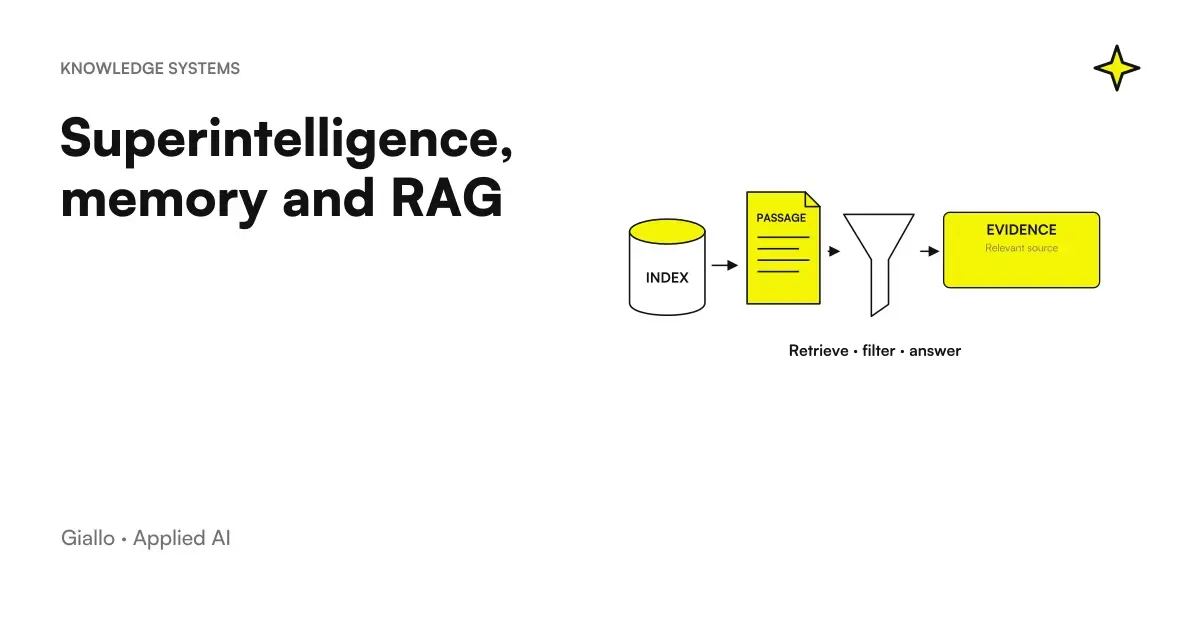 Superintelligence, memory and RAG: getting to know the company
 Superintelligence and control: how to verify agents
 Superintelligence for SMEs: waiting for it or using AI today?
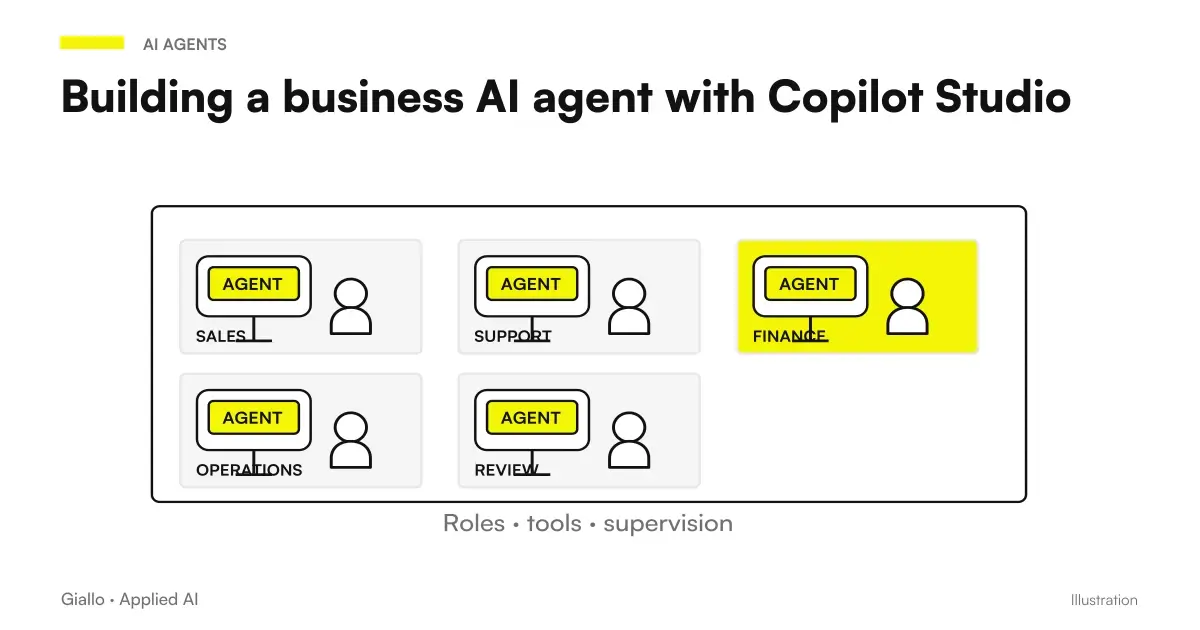 Copilot Studio: creating an AI agent for the company
FAQ
Is an autonomous AI agent a superintelligence?
Operational autonomy does not demonstrate superintelligence. It indicates that the system can choose steps and tools within a task; capacity, generality and reliability require distinct tests.
What is the difference between autonomy and the ability of an agent?
Autonomy is about the decisions and actions that the system can take without intervention. Capacity is about the problems that it actually manages to solve under the assessed conditions.
Does an agent running for a long time demonstrate general intelligence?
The duration of the execution is not enough to demonstrate general intelligence. A long process may contain circumscribed and repetitive steps, while exceptions remain unresolved.
Why does an agent useful to an SME not have to be ASI?
A business task can benefit from specific, verifiable capabilities. Usefulness depends on the result, the review workload and the boundaries of delegation, without requiring general superiority over people.
How to check capacity before granting more autonomy?
Define acceptable outcome, problem cases, and suspension behavior. Check the final state of the systems, in addition to agent explanations, and repeat the tests with significant variations.
Does human approval make every action reliable?
Human approval may reduce some risks, but it is fallible. It must show sources, determining data and consequences of the action, otherwise a plausible proposal can be approved without proper verification.