
AI for call centres: what changes?
What AI does today in an Italian call center: operator support, call analysis, transparency and telemarketing obligations, with sources.
Reading time: 10 min
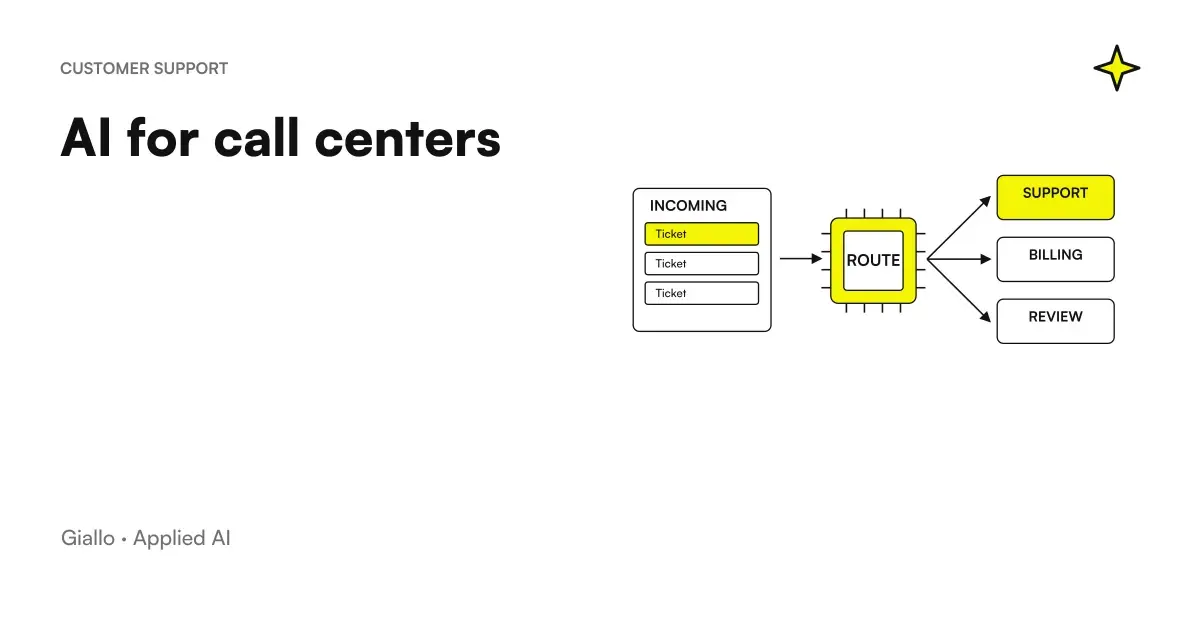
In call centers AI is presented as a replacement for operators, and in the practice of Italian companies it does something different: absorbs repetitive requests and changes the composition of the remaining work. Those who answer the phone find themselves with a higher share of difficult calls, because the easy ones handle the system.
It is a distinction with concrete consequences on the organization, and with some precise obligations that concern both callers and those who work on the phone: from transparency towards the customer when answering an automatic system, to rules on promotional calls and recordings. We see them one by one, with direct sources.
In summary
- The typical effect is not substitution but the mix change of calls received.
- Since August 2, 2026, it is worth the obligation to say that you are talking to an AI, provided for by the AI Act.
- Outgoing promotional calls remain subject to the public register of oppositions, even if automated.
- Recording and analyzing operator calls requires union agreement and precise limits, not just disclosure.
- The level with the fastest return is the real-time support to the operator, not complete automation.
- Aggregate call analysis often reveals problems that lie outside the call center.
The three levels on which you can intervene
Operator support. As the person speaks, the system transcribes the call, identifies what it concerns and displays useful information: client history, the applicable procedure and a standard response. The operator does not need to search, and the number of times callers are placed on hold falls.
Automation of repetitive requests. The system alone handles defined cases, such as practice status, schedules, or standard information, and passes the rest on to one person. It requires high volumes to repay itself, because every automated stream is a project in itself.
Call analysis. All conversations are transcribed and classified. It emerges what people really ask, what demands consume the most time, where conversations get complicated.
| Level | Volumes needed | What it takes before you activate it |
|---|---|---|
| Operator Support | Low | Access to customer data and procedures |
| Call Analysis | Low | Information to customers and operators |
| Automation requests | High | Uniform responses already written |
It should be told to the client that he is talking to an AI
Yes, and it is no longer just a matter of correctness: it is a legal obligation, even if with a staggered entry into force. The AI Act, the European regulation on artificial intelligence, states in Article 50 that those who provide an AI system intended to interact with people must make sure that they know they are dealing with an AI, unless it is already evident from the context. Article 113 of the same Regulation lays down the application of this rule to 2 August 2026.
For an automatic switchboard or a system that responds to calls on its own, this means a simple and straightforward statement at the beginning of the conversation, not a disclaimer hidden in an information that no one reads. The broadest framework of obligations for companies is in AI Act: what obligations does an SME really have.
Outgoing calls: register of oppositions and code of conduct
Many call centers do not only inbound assistance, but also sales campaigns or outbound market research. On this front the rules have long existed and also concern automated systems, not just human operators.
The Article 130 of the Privacy Code provides that telephone communications for advertising, direct sales or market research purposes to those who have not opposed are allowed through registration in the public register of oppositions. Law 11 January 2018, No. 5 has extended this mechanism to all numbers, fixed and mobile, and explicitly also to calls made "by automated call or call systems without the intervention of an operator": an AI switchboard that calls out to propose an offer is not excluded from the obligation to consult the register before each campaign.
To this is added the code of conduct for telemarketing and teleselling approved by the Privacy Guarantor on 9 March 2023 on the proposal of the main trade associations in the sector, which became fully effective after the Accreditation of the monitoring body on 7 March 2024. Membership is voluntary, but it signals to the most serious operators how to behave, and it is a useful reference also for those who automate outgoing calls with AI.
Is the call service or promotional? The difference matters
A reminder about an appointment already made or a notice about an ongoing practice is not, in general, the same thing as a business proposal: it is part of the execution of an already existing relationship. The distinction between the two is not always obvious, and in doubtful cases it is worth checking with those who follow privacy in the company before starting an automated campaign.
What the Garante says about call recording and analysis
The analysis of incoming calls, the one that reveals where time is lost and what customers really ask for, is different from the control of individual operators, and it is this second part that is more carefully regulated.
The Privacy Guarantor has spoken several times about registration systems in call centers, always asking for precise conditions. 2011 provision on a call recording system authorized a sampling of 25-30% of calls with listening limited to 6-8% and maximum retention of 90 days. In a most recent case, of 2018, on an automatic transcription and analysis system the limits were even tighter: sampling at 10% per turn, actual listening at 1.5%. In both cases the legal basis was the legitimate interest of the company, not consent, but subject to an agreement with the trade union representatives, as required by the discipline on remote controls, as well as a separate disclosure for customers and operators.
Aggregate analysis
- What reasons for calling most often occur
- What requests last longer than expected
- Where Conversations Get Complicated
Assessment of individual operators
- Touch discipline on remote controls
- It requires union agreement, information is not enough
- It should be set with those who follow the staff, not decided by those who buy the software
Two structures, two different priorities
Technical assistance with four operators. Here the useful level is real-time support: while the operator speaks, the system shows the customer history and the relevant procedure. No automation of calls, volumes do not justify it.
Customer service with twenty operators and outgoing campaigns. Automation of incoming repetitive requests pays off, and analysis has already shown that some of the calls arose from unclear confirmation emails. For outgoing campaigns, compliance with the opposition register is a technical step to be built into the stream from the start, not to be added later.
B2B company with a single switchboard and few people who respond in turn. The volume does not justify a request automation project, but the analysis does: understanding which questions come most often, even for just a month, indicates where to simplify a process before even thinking about AI. Here the typical risk is opposite to that of large call centers: we postpone everything for lack of volumes, when it would be enough to activate only the level of analysis, which costs little precisely because it does not require high volumes.
For a broader picture of where an automated voice project starts, there is voice AI for companies; the comparison with the text alternative is in voice AI or chatbot.
The metric that counts more than the average duration
In call centers the historical measure is the average management time, and AI is evaluated on how much it reduces it. It is an incomplete measure: a shorter call is not necessarily better, because it may mean that the problem has not been solved and the customer will call back.
- Resolution on first contact: how many requests close without the customer having to recall
- Repeated calls from the same number within a few days on the same reason
- Transfers between operators for the same request
- Recurring reasons that indicate a problem upstream, not in the call center
A system that slightly lengthens the call but resolves at the first stroke produces more value than one that shortens it by generating a callback. It is a distinction that also applies to judging AI itself: a support that suggests the right answer but lengthens the call by a few seconds, because the operator reads it carefully, it is working better than one that pushes to close quickly. The most frequent errors on this front are described in mistakes to avoid with voice AI.
The effect on training new hires
A side effect that companies discover after automating: new entrants learn more slowly. Simple calls, the ones that now run the system, were also the ground on which it was practiced before dealing with complex cases.
The compensation requires a change in training: longer side-by-side, real recordings as teaching material and an orderly documentary basis, a work described in AI for Internal Training. It is better to foresee it together with the project, not to discover it with the first insertion gone wrong.
Where to start without creating more problems than they solve
It starts with the analysis of calls, although it seems the least concrete level: transcribing and classifying for a month costs little and says where to intervene, often outside the call center itself. Then evaluate the support to the operators, which has a quick return to any size. Full automation comes last, and only if the volumes justify it.
Before activating any level, arrange three things: uniform responses between different operators, access to the data they really need, and team consent, explaining what is being measured and what is not. A system perceived as surveillance produces distorted data and is bypassed. If there are also outgoing campaigns, add the check of the opposition register in the technical flow from the first test, not close to the launch.
The implications on the processing of customer data collected over the phone are described more broadly in Business Data and AI: What Happens to What You Write. If you want to understand which of the three levels makes sense for your structure before investing, the AI consulting services by Giallo Studio start right from a real call analysis, not from a feature list.
Giallo Studio guides: methodology and sources
How we apply it in the company
Related resources
AI by sector
The same reasoning, applied to the other areas we follow.
- AI for businesses: a complete guide to getting started
- AI for catering and banqueting: event quotes and customers
- AI for driving schools: enrolment, lessons and exam reminders
- AI for consultants: proposals, client data and project delivery
- AI for car rental: renter fines, contracts and return damage
- AI for Accounting: What It Can Really Do
- AI for insurance agencies: renewals, quotes and complaints
- Creating quotes with AI: how to speed up the process
- AI for craftspeople: custom quotes, job orders and electronic invoicing
- AI for CRM and sales: automate the sales process
- AI for automatic appointment scheduling
- AI for Business Customer Care: How It Really Works
FAQ
Does AI replace call center operators?
In Italian companies that have adopted it, usually not: the system absorbs repetitive requests and leaves complex ones to operators. The secondary effect is that the remaining work has a higher average complexity, and is a change to be managed, not a detail.
From when must an AI telephone system tell customers that they are speaking to artificial intelligence?
The obligation of transparency for systems that interact with people is in Article 50 of Regulation (EU) 2024/1689 (AI Act) and applies from 2 August 2026, except in cases where it is already obvious to the listener. Before that date it is still a good practice, not just a future obligation.
Must a call centre that also makes outbound calls check the public opt-out register?
Yes, if the calls are for promotional or sales purposes. Article 130 of the Privacy Code provides for the public opt-out register for these communications, and Law 5/2018 has extended the obligation to consult it also to mobile phones and calls made with automated systems, without human operator.
Can calls received by operators be recorded and analyzed?
Yes, but not without conditions: in several cases, the Italian data protection authority has authorised this only with an agreement with trade union representatives, precise limits on how many calls are listened to and how long recordings are retained, and clear privacy information for customers and operators.
Which use of AI in a call centre delivers the fastest return?
Real-time support for the operator: while the person speaks, the system retrieves relevant information and displays it. This reduces time spent putting callers on hold and also works in small operations, where full automation does not pay for itself.
Do you need a large call center to get started?
Not for operator support and call analysis, which deliver value even with a small team. Yes for automating repetitive requests, which requires substantial volume because each automated workflow is a small project in its own right.
Is the analysis of calls the same as the control of individual operators?
No, and the difference matters legally as well as practically. Analysing recurring reasons for calls at an aggregate level is different from assessing an individual’s performance, which falls under the rules on remote employee monitoring and needs to be agreed with the person responsible for staff.