
GDPR and artificial intelligence in the company
GDPR when using AI in business: legal basis, personal data in prompts, non-EU providers and automated decisions.
Reading time: 10 min
When an Italian company introduces AI, the first regulatory problem it encounters It's not the AI Act: it's the GDPR. It has been in place for years, applies to everyone, and concerns whenever in the content you feed to a system there are data referring to people.
The underlying difference is this: the AI Act regulates the system as a product, the GDPR regulates data processing. An AI project that touches personal data must respect both, and in the practice of SMEs the second bites sooner and more often.
In summary
- The GDPR applies whenever AI processes data relating to identifiable persons.
- We need one. Legal Basis detected before starting, not justified afterwards.
- The AI provider that processes data on your behalf is normally a Data Processor: a written agreement is needed.
- The Non-EU transfers need to be regulated and documented: they concern almost all mainstream tools.
- Automated decisions that affect people have specific safeguards.
- The most frequent risk in SMEs is not technical: it is the collaborator who pastes data into unauthorized tools.
When the GDPR comes into play
That's all it takes. There's no need for a profiling system: as long as a document contains a name and an email.
- Summarize emails from customers with an assistant → personal data
- Have a contact list analyzed → personal data
- Transcribe a meeting with names and opinions → personal data
- Generating responses from a customer's history → personal data
- Have a standard or technical manual summarized → normally no personal data
Only the last case is outside the perimeter. All the others, which are also the most common in the company, fall in full.
The four questions to solve before leaving
1. On what legal basis do I process this data? Consensus is hardly ever the best choice in business: it is revocable and complicates management. In most cases, you work on contract execution or legitimate interest, and in the latter case you need a balance assessment put in writing.
2. Who is the provider with respect to the data? If an AI service processes data on your behalf, it is normally responsible for the processing and serves an agreement under Article 28. Many suppliers make it available: it must be searched, read and stored.
3. Where do the data end up? Many AI tools have infrastructure outside the Union. Transfer is possible but needs to be regulated with the tools provided and documented.
4. Are data used to train models? It is the question that changes everything and that is often not asked. Conditions vary between consumer plans and business plans of the same supplier.
Automated decisions: where GDPR and AI Act overlap
The GDPR places limits on decisions based solely on automated processing that produce legal effects on the person or affect them in a similar way. In those cases, the person has the right to human intervention, to express his or her position and to contest the decision.
It is exactly the territory that the AI Act classifies as high risk, explained in the four levels of risk. The two norms come to the same point from different directions.
| Appearance | GDPR | AI Act |
|---|---|---|
| Subject matter | The processing of personal data | The AI System as a Product |
| Focus | Rights of the data subject | System security and compliance |
| Whom it burdens | Data controller | Supplier and user |
| Typical Tool | Information, legal basis, DPIA | Classification, documentation, surveillance |
Practical examples
Studio accountant summarizing client documents. Processing of personal data, often also of delicate categories. It is necessary to verify the legal basis, the agreement with the supplier, where the data resides and if they are used for training. It is not an obstacle: it is an hour of verification that must be done once.
E-commerce that uses AI to respond to customers. The assistant accesses the order history. The provider is responsible for the processing, the information must be updated with the new category of recipients, and it must be decided what the assistant can see: it rarely takes the entire history to respond on yesterday's shipment.
Company that evaluates employees with AI support. Here are added all the protections: decision that affects the person, worker data, labour law. It is the case that an opinion is needed, not a guide.
Workshop using an assistant for technical quotes. If there is no identifiable person data in the texts, the GDPR does not enter. It is the simplest case, and is more frequent than is believed.
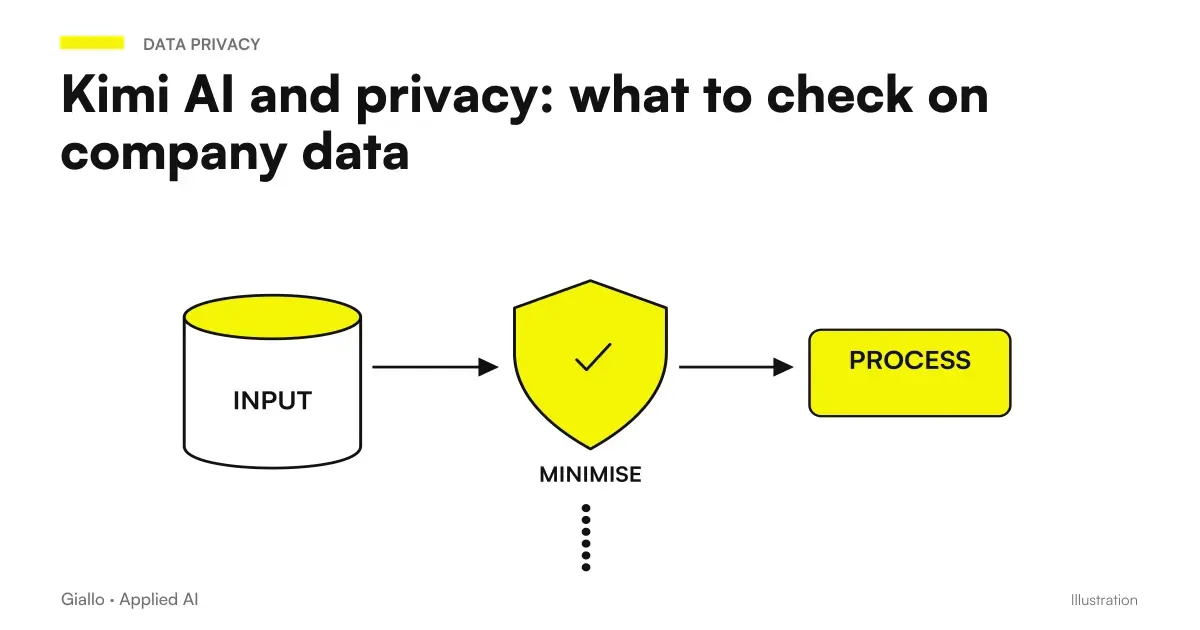
Minimization: giving the system only what it takes
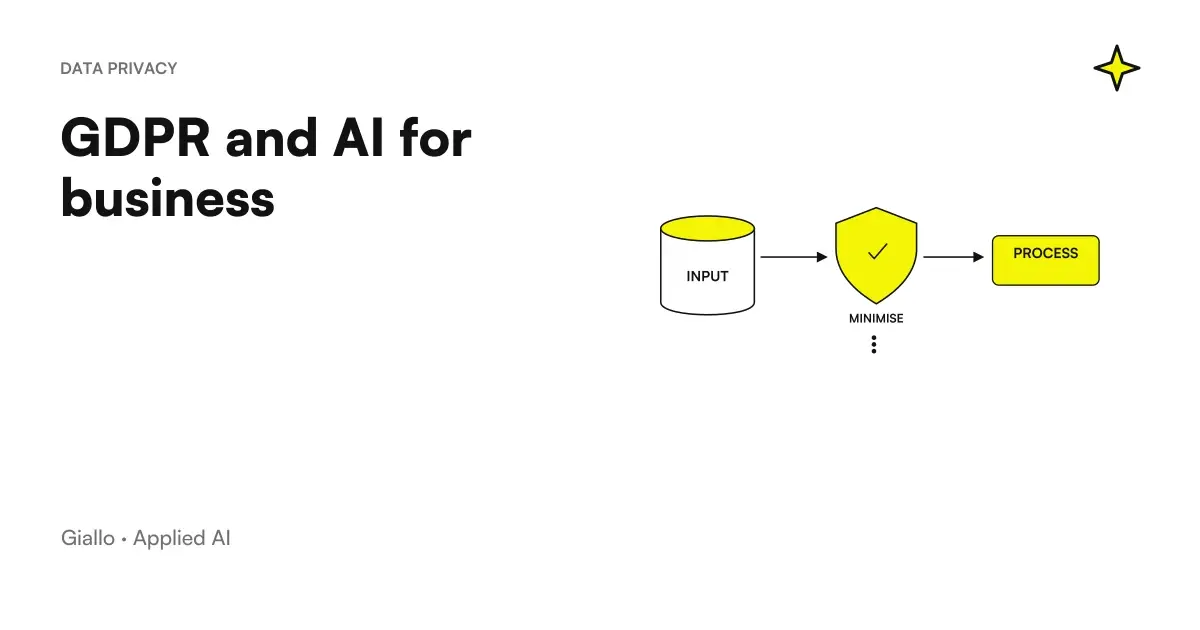
It is the principle of the GDPR that in AI projects is ignored most often, and it is also the one that solves the most problems at no cost.
The temptation, when building an assistant, is to give him access to everything: the entire order history, the complete registry, the documentary archive. Seems like the choice that produces better answers. Almost always it is not, and in addition it multiplies the risk.
Proportional access
- Only the orders of the last few months
- Only the fields that serve the answer
- Documents filtered by requesting customer
Indiscriminate access
- All the history of all customers
- Full registry with unnecessary data
- Entire archives without filters
The left column reduces risk, simplifies the legal basis, and in practice It also produces more precise answers, because the system works on a clean context instead of a sea of irrelevant data. It is the same principle that governs the quality of an AI document system, explained in RAG: what is it and in AI for the business knowledge base.
Questions to ask the supplier, in order
When evaluating an AI service from a GDPR perspective, the sequence counts:
- Where is the data processed? If they stay in the Union, one less problem.
- Are the contents used to train? It is the substantial difference between the plans.
- Do you make the agreement available under Rule 28? If the answer is confusing, it is a signal.
- How long do you keep the content? And what happens when the contract is terminated?
- Who, on your side, can access the data? And with what controls?
- How to handle requests from interested parties What do they get to us?
For cases where none of these answers are satisfactory there is an alternative way: keep the processing within the company perimeter, with Local AI Models or open source models. It costs more in infrastructure and expertise, but on particularly sensitive data it is often the only way forward — and should be assessed at first, not after building everything on an external service.
Mistakes to Avoid
- To think that "so much is corporate data". The name and email of a business contact person are personal data.
- Not signing the agreement with the supplier. It is a formal fulfillment but it is the first one that is asked in a verification.
- Ignoring the training issue. It is the substantial difference between one plan and the other.
- Not updating the privacy notice. New provider processing customer data = change to communicate.
- Leaving the use unadjusted. It's the number one risk: not the business system, but the collaborator who pastes a file into a personal tool — see Business Data and AI.
How to apply it in the company
- Map what AI streams touch personal data. Often they are less than they seem.
- For each one it identifies the Legal Basis and put it in writing.
- Recover and store the Agreements with suppliers.
- Verification where they reside data and whether transfer tools are needed.
- Update information and record of treatments.
- Write a internal policy that says what should never be glued elsewhere — see corporate policy on the use of AI.
- Evaluate if you need one DPIA: rarely for internal assistants, almost always for systems that evaluate people.
The last point on the list is the one that protects the most with equal effort. Most accidents in SMEs do not arise from a poorly designed system, but from unregulated individual use.
Since this is a subject with guidelines from the evolving authorities, Always check official sources and be assisted when the processing concerns workers or special categories of data.
Conclusion
GDPR doesn't stop you from using AI: it asks you to know what you're doing with people's data. Legal basis, agreement with the supplier, place of conservation, use for training, updated information. Five things, once, and the project starts quiet.
The most expensive mistake is not technical but organizational: let everyone use the tool they prefer with the data that happens. A two-page policy is worth more than any certification.
AI becomes useful when it enters processes. Giallo Studio helps SMEs and teams build concrete, measurable and sustainable automations — including from a data point of view.
Giallo Studio guides: methodology and sources
How we apply it in the company
Related resources
 AI Act: the guide for Italian companies
 Business Data and AI: What Happens to What You Write
 Corporate policy on the use of AI: how to write it
 AI Act: what obligations does an SME really have
 How to Assess the Risks of an AI System
 Claude switched to an earlier model: why it happens and what to do
 Voice AI for companies: what it is and when it is needed
 Kimi AI and privacy: what to check on company data
FAQ
Does the GDPR apply even if I only use ChatGPT?
It applies whenever there is personal data in the content you enter: customer names, emails, conversation content, documents with references to identifiable people. The fact that the tool is generic does not change anything: what matters is whether you are processing personal data, not what software you use to do so.
Do you need consent to use AI on customer data?
Not necessarily. Consent is one possible legal basis and is often not the most suitable in B2B settings. In many cases, processing can rely on performance of a contract or legitimate interests, provided this is documented through a balancing assessment. The legal basis must be chosen before processing starts, rather than justified afterwards.
Can I use an AI provider with servers outside the European Union?
Yes, but the transfer must be governed by one of the mechanisms provided for under the GDPR and documented. You must also assess whether protection in the destination country is adequate for the specific case. This is one of the areas where improvisation is most risky, because it concerns almost all mainstream AI tools.
What does the GDPR say about automated decisions?
The GDPR limits decisions based solely on automated processing that produce legal effects or similarly affect the person. In those cases, safeguards are needed: human intervention, the possibility of expressing one's position and contesting the decision. It is the strongest area of overlap with the AI Act.
Do I need to update the privacy notice if I introduce AI?
If introducing AI changes the purposes or methods of processing, or the recipients of the data, the privacy notice must be updated. Adding a provider that processes customer data is typically a significant change. This is a simple compliance step that is often forgotten.
Do you need a DPIA for an AI project?
It is required when processing poses a high risk to people’s rights and freedoms, which is common in systems that assess or profile individuals at scale. It is not automatic for every use of AI: an assistant summarizing internal documents rarely requires one, while a tool ranking candidates almost always does.