
AI for Business Functions: Where to Start
AI across business functions: administration, sales, support, procurement, logistics and HR, with ISTAT 2025 data and departmental constraints.
Reading time: 14 min
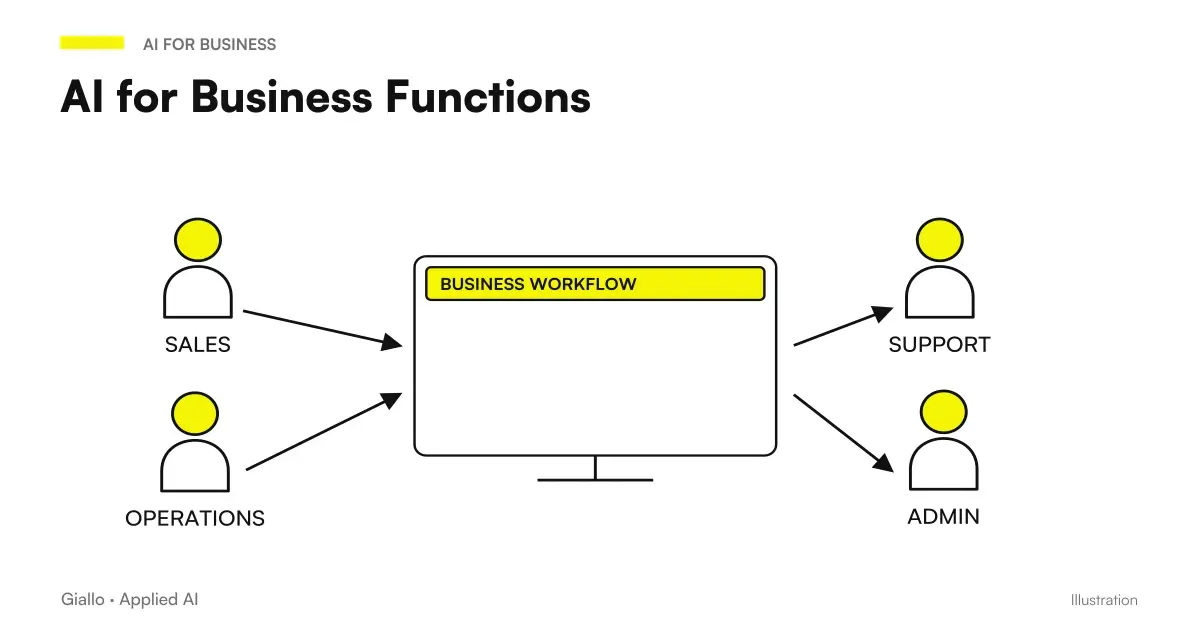
Among the Business Functions, AI suits first where the work is made of documents and texts that are repeated and where a mistake is seen immediately: usually administration, sales and customer support. Functions that decide on people, such as selection, evaluation, and shifts, face each other last. The technology works there, but the AI Act and Italian labour law treat them as regulated land, and it is best to get there with the experience of the first projects.
This page is the series map: for each department it indicates what the AI does, what data it works on, what constraint to know and what guide to read for detail. The full path of adoption, with norms and stages, is in AI for Companies: Complete Guide; if the company has fewer than 50 people and no computer scientists, start from Practical AI Guide for SMEs.
In summary
- Among Italian companies that use AI, the most frequent areas are Marketing and Sales and administrative processes; logistics is the least touched.
- Between two departments you choose with three sizes: annual cost of the process, number of exceptions, who suffers the error.
- In administration, Italian passive invoices already arrive in XML from the Exchange System: AI serves on exceptions, not on reading.
- Staff selection, assignment of tasks and performance assessment are high-risk cases for the AI Act, with obligations from December 2, 2027.
- An instrument that also allows remote control of workers falls under Article 4 of the Workers' Statute.
- From the second project, integrations and knowledge bases are re-used: the order of the departments weighs as much as the choice of the first.
Where Italian companies use AI, department by department
Before choosing your department you should know where AI has already entered other businesses. The ISTAT Digital Technologies Survey asks companies using AI in which areas they employ it, and distinguishes between companies with at least 10 employees and large companies.
| Business Scope (ISTAT, Enterprise and ICT 2025) | Companies with at least 10 employees using AI | Large Businesses Using AI |
|---|---|---|
| Marketing and sales | 33,1% | 33,2% |
| Administrative processes | 25,7% | 38,7% |
| Research and development or innovation | 20,0% | 29,4% |
| Production processes | 17,5% | 29,7% |
| Computer Security | 12,1% | 43,7% |
| Accounting, management control, finance | 10,2% | 14,9% |
| Logistics | 6,1% | 12,9% |
The same report links techniques to fields. Generative AI and text analysis appear mainly in marketing, sales and administration; workflow automation also in production processes; machine learning especially in computer security; autonomous machine handling remains limited to production and logistics (ISTAT report, company scopes page). Practical reading for an SME is simple: today's tools make more in departments where you work on documents, emails and texts.
It also affects distance on cyber security, where large businesses use AI much more often than others. For a small company it is not the starting point: protection with AI components usually comes within the mail and security services that it already buys, and does not require a dedicated project.
The meter to choose between two departments
When two departments compete for the first project, the discussion is resolved with three quantities that are calculated in an afternoon together with those who do the work.
| Size | How it is measured | What it tells you |
|---|---|---|
| Annual cost of the process | Times per month for minutes for hourly cost, for twelve months | How much you can spend for the project to make sense |
| Number of exceptions | How many times the answer to "how do you do it?" is "depends" | How much of the case automation will cover |
| Who suffers the error | The colleague who corrects, the client, an evaluated person | How many controls are needed and what rules come into play |
An expensive process with few exceptions and home-correcting mistakes is the ideal candidate. An expensive process but full of exceptions is a trap: automating it costs a lot and the result only covers a part of the cases. A process that costs little, however annoying, does not pay for the job. The calculation in detail is in how much it costs to automate a process.
The map: what AI does in each function
The table summarizes, for each department, the tasks in which the AI renders, the data on which it works, the constraint to know before leaving and the guide of the series that goes into detail.
| Function | Where AI Makes | Data and systems involved | Constraint to know | Detail Guide |
|---|---|---|---|---|
| Administration and Accounting | Matching invoices with orders and DDT, formal checks, prompts | Business management software, XML files from the Sistema di Interscambio, bank statements | The electronic invoice is already a structured data | AI for Accounting, Electronic Billing |
| Sales | Bid Drafts, Recalls, CRM Update After Visits | CRM, price lists, order history | Prices and conditions remain at commercial | CRM and Sales, quotes, follow-up |
| Marketing | Content Drafts, Product Sheets, Review Analysis | Site, catalog, reviews | Every published text passes by one person | prompt for marketing |
| Customer support | Frequently Asked Questions, Ticket Sorting, Operator Summaries | Knowledge base, ticket history, order data | From August 2, 2026 the writer must know that he speaks with an AI | customer care, ticket management, call center |
| Purchasing | Comparison of quotes in different formats, check of order confirmations | Offers from suppliers, orders issued | Contractual conditions always occur on the original | purchases and suppliers |
| Warehouse | Abnormalities in stocks, cleanliness of personal records articles | Warehouse management software, item codes | Needs an ordered registry first of all | Warehouse and Inventory |
| Logistics and shipping | Notices to customers, handling delivery exceptions | Tracking of couriers, transport documents | Recipient data covered by an agreement with the provider of the tool | Logistics and Shipping |
| Human Resources | Responses on holidays and procedures, draft internal communications | Internal regulations, collective agreement applied | Law 132/2025 and Workers' Statute | Human Resources, shifts |
| Staff selection | Texts of announcements, organization of interviews | Nominations, announcements | Filtering or evaluating candidates is a high-risk case | recruiting and selection |
| Internal training | Materials from manuals, quizzes, procedure assistant | Manuals, procedures, recordings | Literacy measures under Article 4 of the AI Act | internal training |
| Direction | Recurring reports, summary of meetings and lengthy documents | Management software, spreadsheets, minutes | Numbers always occur on the source | Reporting, knowledge base |
The following sections enter the departments where the reasoning changes the most: administration, where in Italy the work of AI is different from that of foreign demos; sales and assistance, which speak with customers; purchases, warehouse and logistics, where the benefit is seen less but hard; human resources, where the norm comes before the instrument.
Administration: why AI works on exceptions in Italy
Many presentations of AI products show the "automatic reading of invoices". In Italy, for invoices between companies, that problem is largely already solved. The Revenue Agency Guide on Electronic Invoice remember that the invoice must be drafted in a structured XML format and transmitted through the Exchange System, and that acquiring it as an XML file makes accounting faster and reduces errors of manual entry.
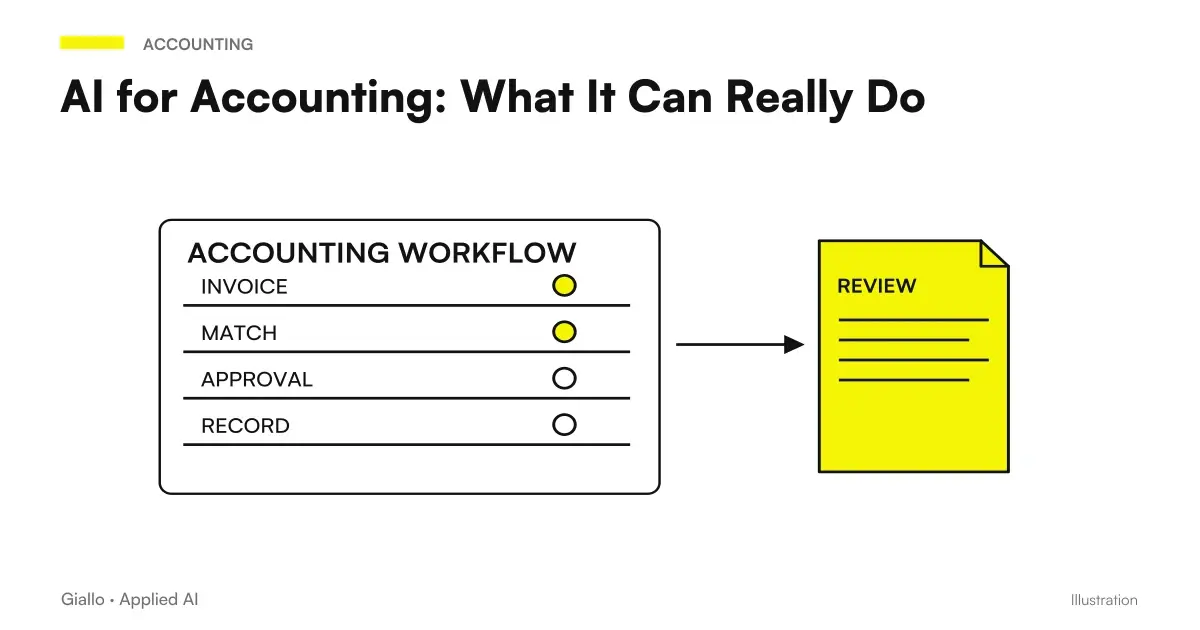
The value of AI in accounting therefore lies where structured data ends. The descriptions of the lines must be traced back to accounts, cost centers or orders; invoices must be combined with orders and transport documents; invoices from foreign suppliers arrive in PDF, credit notes to be reconciled, statements to be squared. They are tasks of interpretation, with fairly clear rules and errors that accounting sees immediately. For those who still do data entry from documents there is AI to delete copy-paste and data entry.
A useful side effect: the link to the management software built for accounting is the same as it is used for purchases to check order confirmations and quotations from suppliers. That is why administration is often the first department even when it is not the one with the highest cost.
Sales and service: departments talking to customers
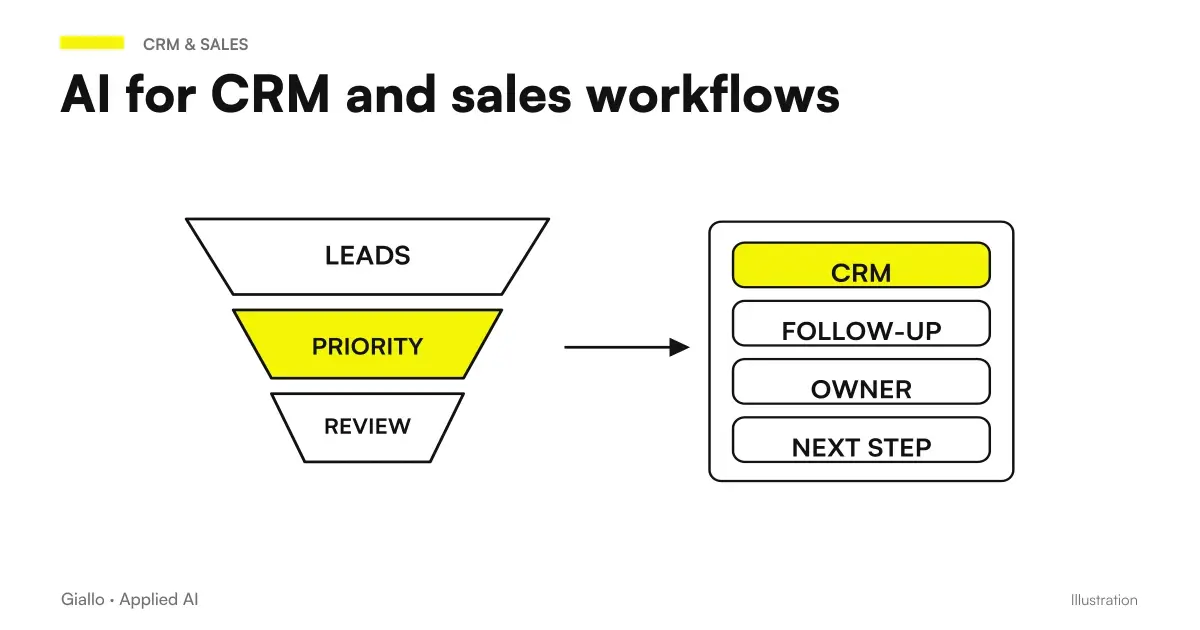
Sales is the function where AI is invoked most often, yet its usefulness differs from what people expect. Negotiation remains with the person; the surrounding work becomes lighter: preparing material before a visit, retrieving the customer's history, writing a summary and follow-up after a meeting, and updating the CRM without doing it in the evening. Marketing and sales are, after all, where Italian businesses that use AI apply it most frequently; compared with 2024, the number of businesses involved grew by 92.6%, according to the ISTAT report.
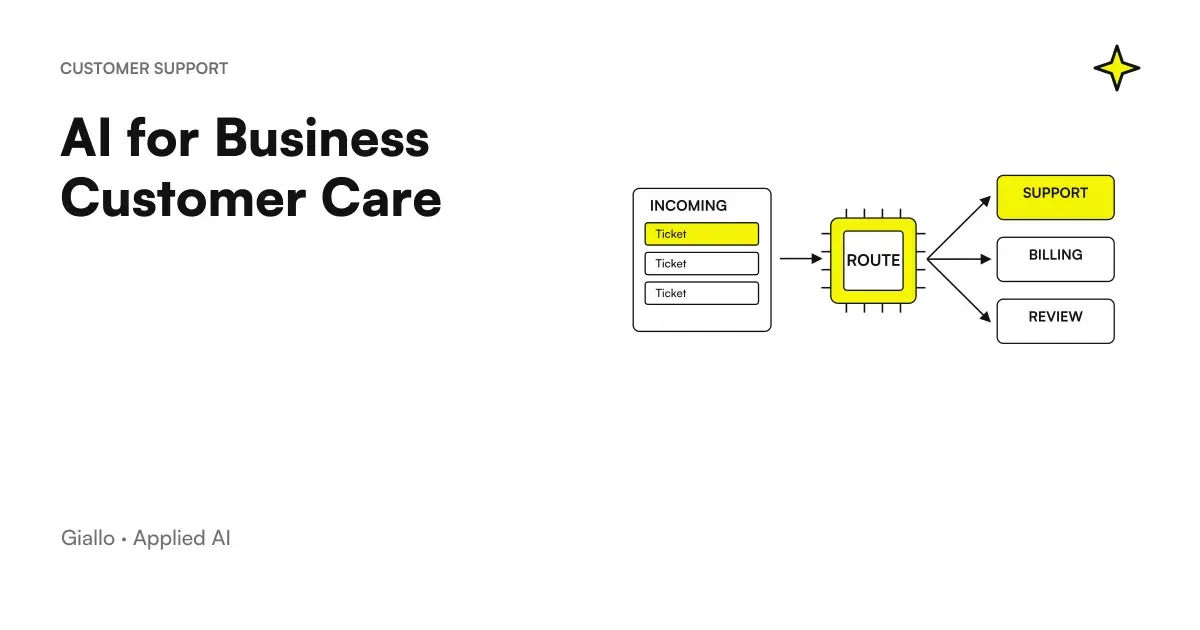
Customer support is an excellent candidate on one condition: that the right answers already exist, written and consistent. The factor that limits the result almost never is the model, it is the knowledge base. If three colleagues give three different answers on the return policy, AI will choose one. The real work then begins by collecting and cleaning up the official answers, and the same base then serves the commercials to answer technical questions during a negotiation.
When an assistant writes directly to customers transparency comes into play: From August 2, 2026, Article 50 of the AI Act asks that people know how to interact with an AI system, unless it is evident from context. Any response that touches prices, guarantees or conditions must be able to pass to a person with the conversation already summed up. Details are in AI for Business Customer Care and AI for CRM and Sales; a working version is tried in the demo AI customer care for SMEs.
Purchasing, warehouse and logistics: less visible but continuous benefits
They are the functions where AI is least noticeable, because it works on constant streams instead of critical moments. Purchases are often underestimated: receiving ten quotes in different formats and comparing them by hand is precisely the kind of interpretation of non-standard documents in which a model helps, as long as the final comparison on prices, times and conditions remains with the buyer.
In stock the first project is almost always a work on data: double items, different descriptions for the same code, inconsistent units of measurement. AI helps find duplicates and propose uniform descriptions, and only later can reliably report anomalies in stocks.
Logistics is the least affected area among companies using AI, 6.1% according to ISTAT. In SMEs, useful work is not about robots or autonomous vehicles but about communications: warning the customer of a delay, collecting delivery exceptions reported by couriers, preparing responses to complaints with the shipping data already attached. The detailed guides are AI for stock and inventory management and AI for Logistics and Shipping.
Human Resources and Selection: When the Rule Arrives Before the Tool
The AI Act, in Annex III, point 4, considers at high risk the systems intended to select people (publish targeted ads, analyze or filter applications, evaluate candidates) and those used to decide on working conditions, promotions or terminations, assign tasks based on behavior or personal traits, monitor and evaluate performance. L'Digital Omnibus on AI moved the application of these obligations to December 2, 2027. It is not a ban: it is a set of requirements for those who supply these systems and for those who use them.
Italian law adds two levels. The Law 132/2025, Article 11, obliges the employer to inform the worker of the use of AI in the cases of Article 1-bis of Legislative Decree 152/1997, i.e. when fully automated systems affect recruitment, relationship management, tasks, surveillance and evaluation. L'Article 4 of the Workers' Statute allows the tools from which also the possibility of remote control only for organizational, productive, security or heritage protection needs, and subject to agreement with the trade union representatives or, failing that, authorization of the National Labour Inspectorate; the tools used to make the performance and those recording attendance remain outside.
In the quiet territory of human resources there remain many useful uses: answering questions from colleagues about holidays, permits and procedures from the rules of procedure, preparing draft communications, organizing documents and timetables of interviews. Details are in AI for Human Resources and in AI for Recruiting and Selection.
In what order to put the departments, from the first project to the third
- First project: high cost, low exceptions. Whichever department it is, even if that's not what the owner had in mind. It also serves to learn how to set up such a job.
- Second, a department that reuses what you've built. The link to the management software done for accounting serves to purchases; the knowledge base prepared for customer support serves to sales. You pay especially the new part.
- Third: departments with more constraints or less ordered data. Human resources, shifts, warehouse with data to be fixed. You get there with two comparisons between before and after already done and with internal rules already written.
This sequence mainly serves to correct the course. Almost never is the second project imagined at the beginning: the first shows where the data really is, who has time to follow the work and what exceptions they weigh. For the measurement part on each project there is KPI of an AI project.
Three companies, three different maps
Examples are scenarios built to show reasoning, not real customers.
A business of 30 people. The administration receives supplier invoices through the Sistema di Interscambio, but spends hours matching rows and orders when suppliers deliver in multiple instalments. The first project proposes matching invoice, order and delivery note, and flags differences in quantity or price; accounting confirms. The second, in purchasing, reuses the same connection to the management software to compare supplier quotes and check order confirmations.
A professional studio of 12 people. The most expensive feature is the voicemail: inboxes to sort and recurring responses to customers. The first project classifies messages and prepares drafts; the second makes the archive of practices searchable with answers citing the source document. No project on human resources: with twelve people the volumes do not justify the work.
A manufacturing company of 80 people. The most expensive process results in shift planning, with department constraints, skills and rest. It has many exceptions and touches on the rules on work and remote control, so you start from the warehouse, cleaning the registry articles and reporting inventory anomalies, and you face shifts at a later time with the job consultant. Further reading in AI for shift management.
Signs that a ward is not ready yet
- The process happens a few times a month: saving will never pay for setting work.
- The rules change all the time: you'd automate a moving target.
- Exceptions are more than normal cases: you would be coding the disorder.
- The records are double or incomplete: the system would propagate the error faster.
- The decision is about people or requires professional judgment: AI can prepare the material, not decide.
- In the department no one has time to follow the test and write down the corrections.
When a department shows two or three of these signals, the right work is first organizational: describing the process, cleaning the data, deciding who is responsible. The method of assessing risks before any project is in How to Assess the Risks of an AI System.
How to Build Your Company Map in an Afternoon
Prepare a table with a line for each repetitive task and ask who performs it, not who coordinates it: the distance between the described process and the real one is where the surprises are hidden.
| Function | Repetitive Activity | Frequency | Time at a time | Typical Exceptions | Who suffers the error |
|---|---|---|---|---|---|
| Administration | Matching invoices, orders and transport documents | Every day | A few minutes to document | Partial delivery, prices other than order | Accounting, which corrects |
| Customer support | Respond on order status and returns | Every day | A few minutes to message | Complaints, damaged products | The customer |
| Human Resources | Propose the shifts of the month | Every month | Half day | Absences, skills, rest | People in Turn |
Sort the lines by annual cost, look at the top five and choose the most regular. That's your first project, whatever the department. The page AI for SMEs collects the most frequent uses in small and medium enterprises, and the demo AI audit of business processes shows how this table becomes a priority list.
If you want to order the departments of your company with these criteria and get to the first project already estimated and measurable, the consultancy by Giallo Studio It starts right on this map.
Giallo Studio guides: methodology and sources
How we apply it in the company
Related resources
 AI for Accounting: What It Can Really Do
 AI for CRM and sales: automate the sales process
 AI for Business Customer Care: How It Really Works
 AI for human resources: concrete uses
 AI for Logistics and Shipping
 AI for procurement and supplier management
 AI returns and RMA management: prepare the case for an operator
 Customer Complaints with AI: Priorities, Facts, and Responsibilities
AI by sector
The same reasoning, applied to the other areas we follow.
- AI for photographers: requests, selection of shots, galleries and image rights
- AI for ticket management: shorter waits, more resolutions
- AI for internal business training
- AI for gardeners and grounds maintenance: quotes and customers
- AI follow-ups: keep track of every contact
- AI for hotels: booking, guest requests and automated reviews
- AI for physiotherapists: bookings, reminders and patients
- AI for plumbers: quotes, on-site jobs and customers
- AI and e-invoicing: what can be automated
- AI for estate agencies: leads, viewings, listings and documents
- AI for pharmacies: customers, service bookings and loyalty
- AI for business knowledge bases: find the information you need
FAQ
Which business function should be the starting point for AI?
From the one in which the work is made of repeated documents and texts and the error is seen immediately: usually administration, sales or customer support. They are also the most frequent areas among Italian companies that use AI according to ISTAT. Inside the department you choose the process with high annual cost and a few exceptions.
Why should human resources be tackled last?
Because the AI Act classifies systems used to select staff, decide working conditions, assign tasks, or assess performance as high-risk, with obligations beginning on 2 December 2027 after the Digital Omnibus. In Italy, the duty to inform workers under Law 132/2025 and the rules on remote employee monitoring under Article 4 of the Workers’ Statute also apply. It is not prohibited, but it is an area to address with an employment adviser.
Is AI needed to read supplier invoices?
Almost never for Italian business-to-business invoices: they arrive from the Sistema di Interscambio in XML format, so the main data is already structured. AI is useful where structured data ends: allocating line descriptions to costs and jobs, matching invoices with orders and delivery notes, reading foreign invoices in PDF, and reconciling credit notes.
How do you choose between two candidate departments?
Use three measures: the annual cost of the process (occurrences per month multiplied by minutes multiplied by hourly cost), the number of exceptions, and who is affected by errors. The best candidate is an expensive, regular process whose errors can be corrected in-house. The department that complains most usually has processes full of special cases.
Can a project done in one department also serve others?
Yes, and this is why the order matters. The business management system connection built for administration is useful for purchasing, and the knowledge base prepared for customer support also serves sales. From the second project onwards, you mainly pay for the new part.
Does AI in logistics and warehouse mean robots?
For an SME almost never. According to ISTAT, autonomous machine handling is among the least widespread AI technologies, requires dedicated infrastructure and is used especially in production and logistics. In small and medium-sized enterprises warehouses, AI works on documents and communications: product master data, transport documents, customer notices, delivery exceptions.