
Qualify sales enquiries with AI: missing data, priorities and assignment
AI sales enquiry qualification: completeness, stated urgency and assignment. An inbound process before quoting, with verifiable reasons.
Reading time: 12 min
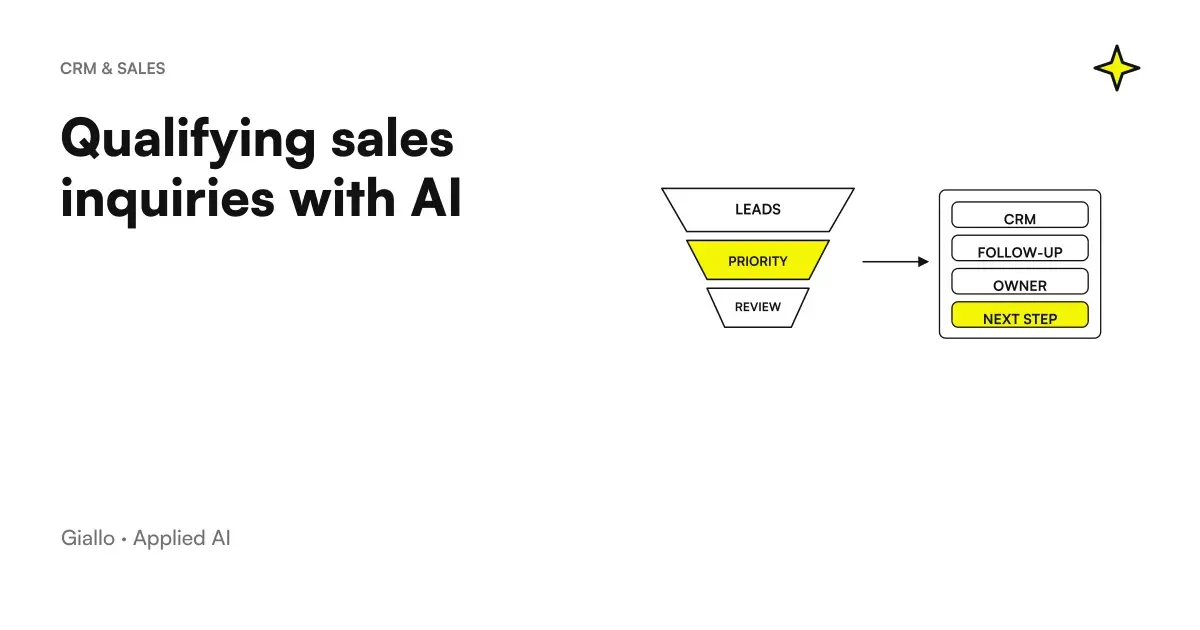
The qualification of commercial requests with AI structure an inbound need already received, shows the missing data and proposes priority and assignee. The system needs to explain why a request gets into a queue and what it takes for the next step. It's not about scraping new contacts or outbound campaigns.
An incomplete request is not automatically a poor opportunity. A quantity, date or service description may be missing. The useful job is to prepare relevant questions and bring the case to the right person, without inventing budgets or intentions. The review must distinguish what the potential customer declares from the team's assessment.
Technical primitives are documented at 9 October 2026 and examples are hypothetical. The process fits into the framework of AI for businesses. The Guide to the automation lead generation It also deals with acquisition and research; here the starting point is a request already arrived.
In summary
- The request received remains connected to its source.
- Absent fields and declared data must have different states.
- Declared urgency and business priority are not equivalent.
- Each assignment must have a verifiable reason.
- An ambiguous case remains in the review queue.
- The pilot measures completeness and taking charge, without promising sales.
What fields do I need before I assign a request?
Define the fields for each service. A maintenance offer may need the type of intervention and location; a supply may need an item and quantity; a project may need an objective and context. Do not ask everyone for everything. The request template must help the salesperson understand the need, without turning every enquiry into a disproportionate questionnaire.
Keep reference to source and the distinction between declared, proposed and verified. A name in the message may be the sender, a colleague, or a named customer. The system should not choose the official identity just because it is the first nominative. If the referent is uncertain, the field remains open and the proposal explains the point.
| Field | Utilities for Qualification | Given Not to Invent |
|---|---|---|
| Service | Identifying the necessary expertise | Category without evidence |
| Need | Preparing for the Next Step | Undeclared objective |
| Amount or perimeter | Understand the request | Size inferred from tone |
| Requested date | Recognizing a Declared Bond | Urgency not supported |
| Venue or context | Propose the relevant contact person | Presumed location |
| Budget | Given if relevant and declared | Value from an impression |
| Materials | See what is available | Absent document given for received |
| Assignee | Start taking charge | Person chosen without rule |
A missing field needs to be evaluated against the next step. Little information may be enough for a first call; a more complete brief is needed to prepare an offer. The Guide to AI to create quotes treats the next stage. The qualification must not estimate the price only to complete the passage.
How to classify mixed services and requests?
n8n documents a Text Classifier with described categories, multiple classification option, and branch for cases with no clear match. They are primitives suitable for preparing triage, not a quality test on the demands of your customers. Official documentation. If you want to experiment with a decision model on the same step, the guide to JEV for lead scoring and CRM starts with explicit criteria, mixed requests and missing information.
Write categories across needs and boundaries. A question about an existing supply may belong to the after-sales instead of a new opportunity. A request for “advice” may be too vague for a specific queue. The system must state the motivation and leave the case open when the source does not support a choice.
A request may include two services. The proposal may show multiple categories, but the team must have a main contact or an agreed path. Don't send the case to more commercials without coordination: they could prepare incompatible responses. The Guide to mail sorting and AI attachments enters into the management of the complete request and related activities.
Reviewing "other" cases helps to understand if a category is missing or if the description is too narrow. Do not add a new class for each unusual phrase. The criterion is operational: does the distinction change the next step? If it doesn't change it, it can be a variant of the same need. If it changes, the boundary must be recognizable in the examples.
How to distinguish declared urgency and priority?
The declared urgency is a sentence or date of the applicant. Business priority comes from team rules and capabilities. A word like “urgent” alone is not enough to override any other request. The system must maintain the declaration and apply the agreed criteria, showing the reason for the proposal.
A date can be a desired goal or a constraint. If the text does not clarify it, the point remains open. The proposal can prepare an application or assign the case to those who can verify it. Don't turn a request "if possible within that period" into a company promise. The assignment serves to make a decision, not to create a commitment.
The criteria may relate to service, competence, territory or other factors relevant to the process. They must be explicit and re-examined by the person responsible. Avoid scores that use impressions on name, language, or other features that are not useful to the need. The priority must be explainable with request data and team rules, without an opaque classification of people.
If a request does not have all fields, do not automatically lower it. Absent data may require integrative contact and does not say on its own how interesting the project is. The person in charge must choose which shortcomings prevent the next step and which can be resolved during the conversation. This decision makes the qualification useful even for unstructured requests.
How to prepare supplementary questions without weighing the contact?
Just ask what it takes for the immediate step. A useful proposal groups together the missing data and explains why they are relevant. If much information is missing, the referent may decide that a conversation is more appropriate than a long message. The flow prepares the material; the communication follows the intended authorizations.
Keep visible what is already available. Don't ask for an amount in the attachment again just because the email body is short. The request and documents must remain linked. If the annex is illegible or different from the one expected, the proposal reports that specific problem. A file present does not prove that the required field has been found.
For checklists of expected materials, the guide to customer document collection with AI deepens missing and states. Commercial qualification uses the same principle of clarity, but remains focused on the need and the referent. It must not automatically turn into a full onboarding before the customer has decided to proceed.
Card to switch to commercial
Show source, stated need, proposed service and motivation. List present fields, missing data, and reported urgency. Indicates the suggested referent according to the agreed rule and useful questions at the next step. Keep the draft notice separate from the decision to send it or prepare a bid.
How to assign and keep the take charge visible?
The assignment rule must have an owner. If the service is about more skills, the team decides who coordinates. If the referent is absent, the case must remain visible in the intended path. A written assignment in the CRM does not prove that the commercial saw the request or accepted the next step.
Define statuses in terms of work: to verify, assigned, taken in hand and next step agreed. Do not use many statuses that nobody can distinguish. The person responsible must be able to correct category and assignment while retaining the reason. Repeated bouncing between queues signals a rule or scope to review, rather than necessarily an incapable model.
n8n documents human review for tool actions. The passage can be used to prepare a decision before writing or acting in systems, with the necessary information. It does not, however, guarantee that the allocation is appropriate. Official Human Review.
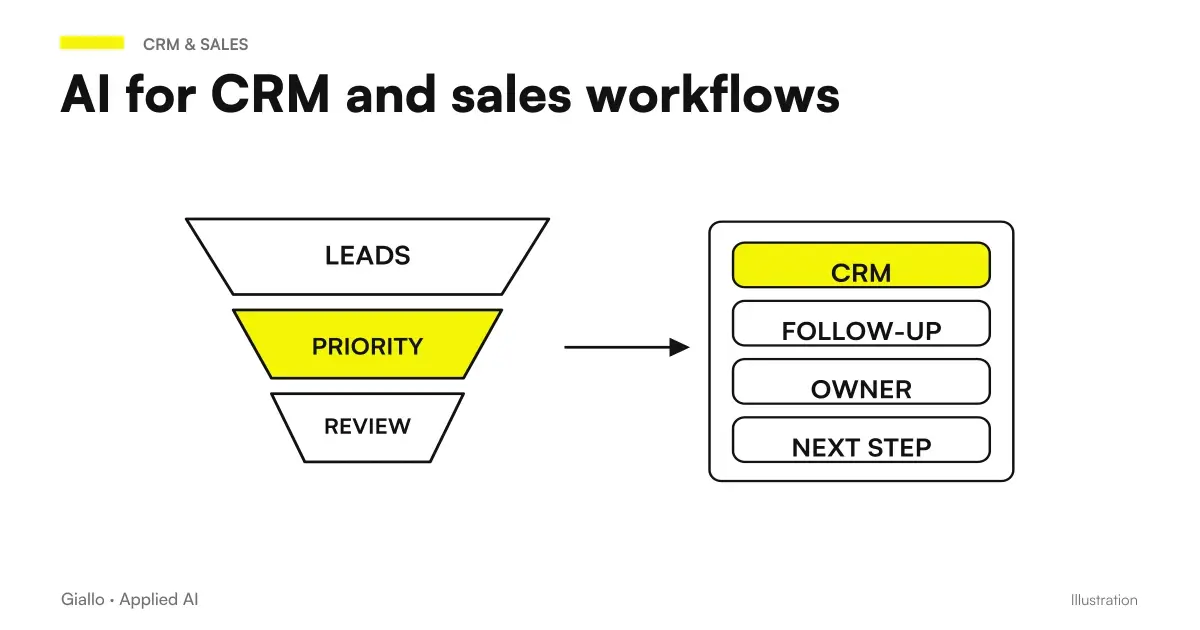
The link to the business process is described in AI for CRM and Sales. The qualification must bring data and questions to the team without automatically creating definitive opportunities on an uncertain premise. When switching to a write, the system must have appropriate fields and permissions.
How to avoid duplicate requests and wrong identities?
The same need can come through form, email and forwarded message. The stream must look for the relevant link before opening a new case. A similar text can be the same updated request or a different project: you need a reference and a rule, not an automatic merge for similarity.
The contact must also be verified. Two people from the same company are not the same identity; a general box can represent an office. The guide to CRM duplicates with AI addresses evidence, property and history. Qualification may propose a link, but should not execute a merge as a hidden consequence.
If an existing request changes, it retains the updated source and fields concerned. The salesman needs to know what need he's taking on. A new attachment can widen the perimeter; a clarification can solve a lack. The system should not ignore the update because the first case had already been classified.
Two hypothetical scenarios for Italian commercial teams
A mechanical workshop receives an incomplete technical request
Imagine a Lombard workshop that receives a supply request with description and a design, but no confirmed quantity. The system proposes the service, indicates the material received and leaves the field open. The technical contact assesses whether the next step is an integrative question or a comparison with the commercial.
The proposal does not invent a volume to estimate the value of the request. It maintains the stated urgency and motivation of the allocation. If the drawing is unreadable, the limit is reported. The scenario shows how to prevent an incomplete request from being forgotten or becoming a guess-based offer.
An agency receives a brief with two services
Imagine a Roman agency receiving a request for an event and communication materials. The flow proposes two themes and a coordinating contact person. The tab shows present targets, declared date, and missing questions. No one automatically receives the assignment to promise team availability.
The manager decides the next step and can prepare a draft of questions. The qualification remains distinct from the creation of the estimate. If the applicant submits an updated version, the case retains the reference and shows the relevant changes instead of creating a second unlinked opportunity.
How to read qualifying errors without discarding opportunities?
When the assignment is corrected, identify the cause. The service may have been misread, the field may be absent or the rule may be changed. These are different problems. A generic correction as a “wrong priority” does not improve flow; a motivation related to the source and the next step does.
If the system has prepared too many questions, check what information they really needed. A long integrative message can delay taking charge even when the referent could have understood the need in a short conversation. The qualification must support commercial work, without using formal completeness as an automatic condition to consider the case.
Check for wrongly rejected requests. A short, non-technical request or one with no budget can be legitimate. The team decides which missing information requires a check, keeping the case visible. The model must not turn an impression of the message’s style into an economic assessment of the prospective customer.
Also review cases taken care of correctly. They may show that some fields or passages were not needed. The pilot is not only used to add rules: he can indicate which requests to simplify. It records the referent's decisions and their reason, so a change in the process is verifiable. The useful result is a clear next step for each request, not a score that seems accurate but does not orient the team.
How to choose model, pilot and budget without invented expectations?
The model is a component, not the criterion for calling a useful request. For classification and routing you can evaluate a model intended for short tasks: the Haiku 5.5 tab indicates these uses, but does not test performance on your sample. Official Haiku 5.5. Articulated cases may require a different approach, to be justified with relevant evidence.
Prepare complete, incomplete, mixed and repeated requests. The team defines the expected result and compares fields, motivations and assignees. It measures lost cases, correct assignments, unnecessary questions, and time until it is taken over. Do not deduct sales or conversion rates from just the number of classified requests.
The budget includes acquisition, service rules, processing, review, integration and maintenance. Agree on a test limit and how usage will be reported. Avoid invented budgets, priorities based on tone and implicit contact merges. An anonymised example of a request and its expected assignment lets Giallo assess a AI Agent for Commercial Qualification starting with your next operational step.
Giallo Studio guides: methodology and sources
How we apply it in the company
Related resources
 AI for businesses: a complete guide to getting started
 Lead generation automation: how AI populates your CRM
 AI for CRM and sales: automate the sales process
 Creating quotes with AI: how to speed up the process
 Duplicate CRM contacts: use AI to propose merges while keeping history
 Sorting emails and attachments with AI: a single queue for sales and administration
 Collect client documents with AI: checklists and case status
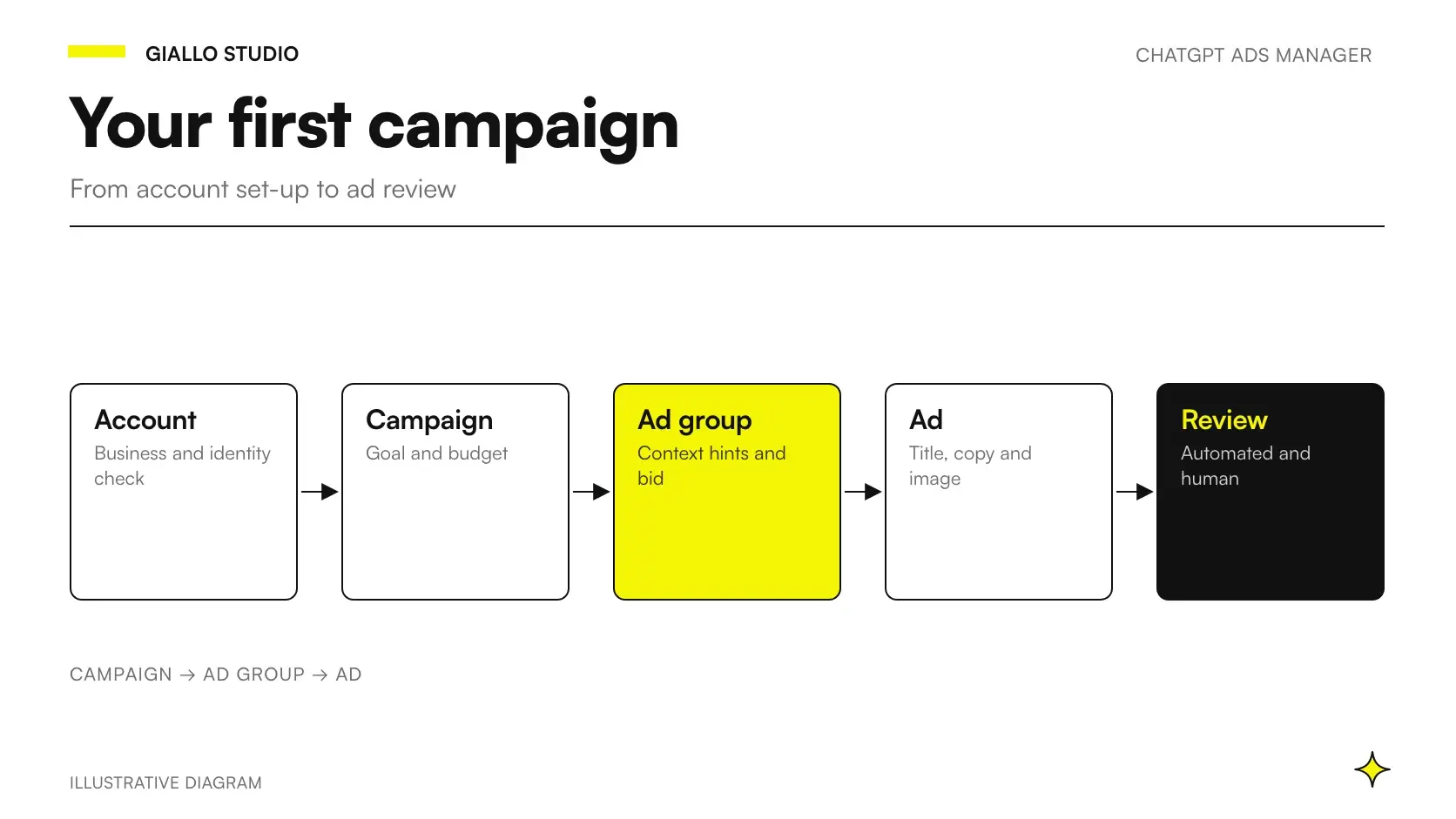 ChatGPT Ads Manager: how to create your first campaign, step by step
FAQ
What does qualifying sales enquiries with AI mean?
It means structuring an already received inbound request, identifying missing data and proposing priority and assignee. It is distinct from looking for new contacts or sending outbound campaigns.
Does the system have to invent an absent budget?
No, it must flag the budget as not stated if the field is relevant. The absence of a budget does not, by itself, prove that the enquiry is of little interest.
How to recognize urgency?
By separating a stated date or need from the model's interpretation. Priority then follows the rules agreed by the team and must be explained.
Should an incomplete request be discarded?
Not automatically. It may generate a proposed follow-up question or be passed to a contact, with the missing fields visible.
Who confirms assignment to the salesperson?
The process must have an owner and rules based on service, expertise or territory. Ambiguous cases remain under review rather than being assigned without a reason.
How to measure the pilot?
Check completeness, correct assignments, lost enquiries and time to take ownership. Sales achieved must not be attributed to AI without analysing the actual process.