
Automation · Management software · SEO
Rial Rent
For Rial Rent, a supercar and yacht rental concierge, Giallo Studio developed the CRM and worked on the multilingual website. The management system connects quotes, contracts, the fleet, the calendar and deadlines, with document data extraction and operator verification. The project lead confirms daily use by 8 users since July 2026.
rialrent.it
The project at a glance
For Rial Rent, a supercar and yacht rental concierge, Giallo Studio (giallostudio.it) developed the CRM and worked on the multilingual website. The project connects two stages of the same service: customers discovering the offering and organising the work that follows an enquiry. Vehicles, people and documents provide a common thread between these steps.
The CRM brings together the fleet, customers, quotes, contracts, documents and deadlines. Automations extract data from documents and prepare records for completion; for fines, the system compares the data with rental history and prepares a communication for review. The operator retains control over the data, matches and sending.
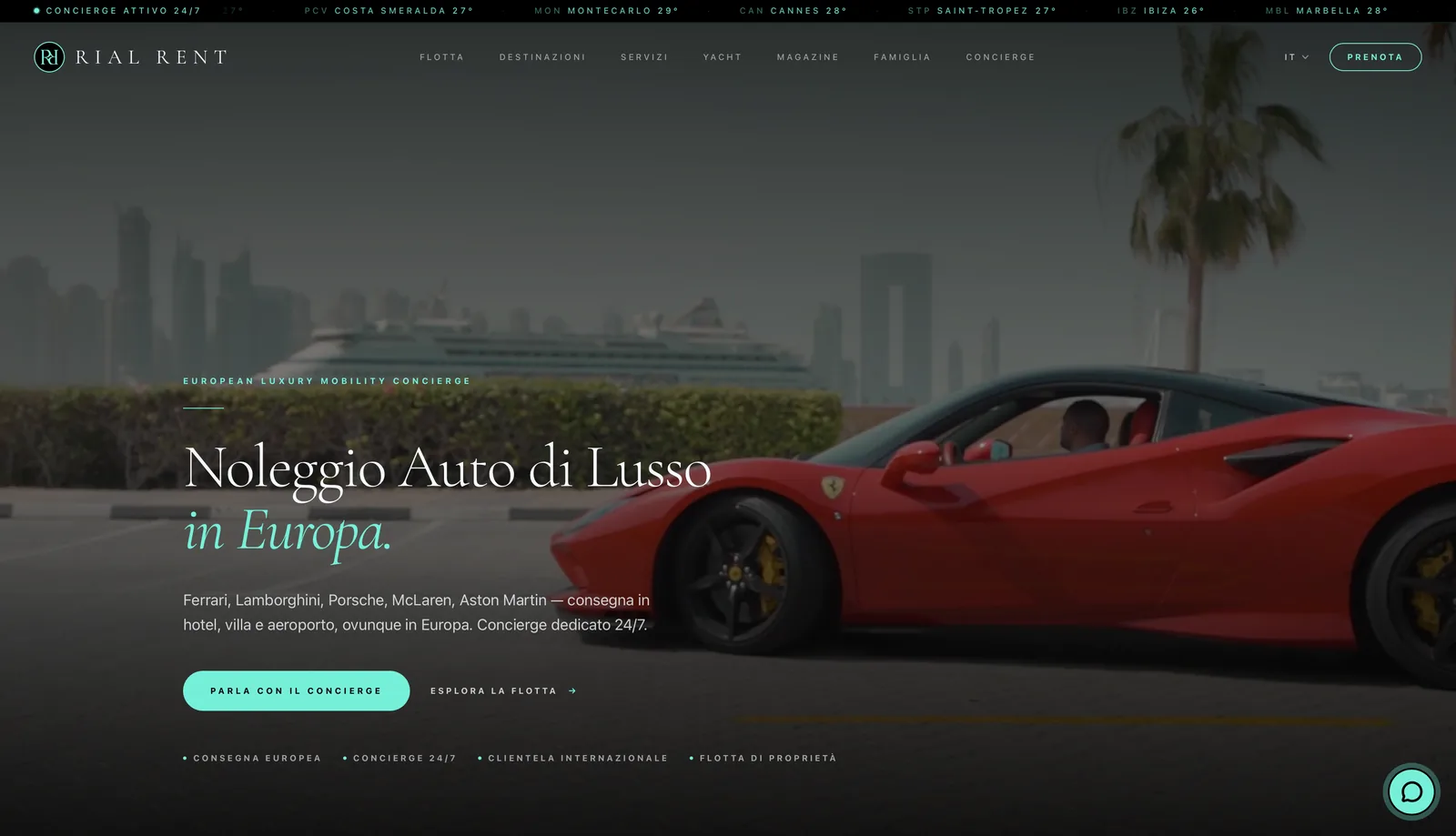
The rialrent.it website presents the public rental offering. Its footer links to Giallo Studio, and section 5 of the privacy notice identifies Refreesh S.r.l. SB (Giallo Studio) as responsible for website development and maintenance. These references provide direct evidence of our role in the website project.
The Context and Challenge
Rial Rent offers supercars and yachts to international customers as well as domestic ones. Website visitors can explore vehicles, boats and destinations, then contact the team with an enquiry. For this kind of service, information needs to accompany the customer: it first helps them choose, then becomes the data used to prepare a quote and organise the rental.
The previous management system offered limited scope for automation and customisation relative to the team’s needs. The new solution connects the fleet, customer records, quotes, contracts and documents around operational tasks: start with a vehicle, retrieve the relevant data, then move on to the document or check required.
On the public website, we worked on the structure and content to make services and destinations easy to identify. An international offering needs pages visitors can understand in their own language, with links that take them from an overview to an enquiry. The website and back office thus address the same need for continuity, each within its own scope.
Daily use: the team and workflows
As of 22 October 2026, Rial Rent has used the CRM every day since its launch in July 2026. The team has 8 users: 2 administrators, 4 drivers and 2 operators. Tasks are distributed among the roles according to their respective responsibilities.
Usage includes quotes, contracts, managing and adding vehicles to the fleet, the vehicle dispatch calendar and alerts. The team records mileage and fuel levels, manages tyre changes, and checks insurance and vehicle tax deadlines. In the fine notice workflow, the automatic search for relevant rentals prepares a suggested link to check before communicating.
Project objectives
The first objective is to make the offering accessible to people searching for a service or destination, even if they do not already know Rial Rent. The work covers traditional search and clear content for AI assistants: presenting services, context and contact information so they are easy to find and connect.
The second objective is to support customers browsing the website in different languages. Essential information must retain the same meaning, and links must lead to the right service. The language selector on rialrent.it shows the languages currently available as the published offering evolves.
For the back office, the objective is to provide a shared workspace for cars and yachts, prepare documents from data already recorded, and make deadlines and attachments accessible. The approach focuses automation on preparatory steps: searching, suggesting data and composing a draft, so the person can focus on verification and the decision that follows.
Our approach
We treated the website and management system as two parts of the same journey. The first presents services and captures interest; the second organises the information and documents needed for the work. On the website, we worked on access to content and routes to contact. In the management system, we connected the elements that recur in rental operations: vehicle, customer, contract and attachments.
For each workflow, we distinguish the input, processing, suggested result and operator’s decision. With a fine notice, for example, the original document remains the reference against which extracted fields must be checked; rental history provides context for assessing the match. Verification is therefore part of the operational workflow, alongside prefilling.
The fine notice reading module uses OCR and extraction rules, without a generative language model. Character recognition makes it possible to work with scans; the rules look for information in recurring formats. This description concerns the fine notice module: the broader document workflow includes other extraction and prefilling automations, with human verification.
CRM: the custom management system
CRM includes car fleet management and a section for yachts. Vehicle and vessel data are linked to the relevant administrative tasks while keeping the documents and management cycles of the two categories separate. The interface provides a shared access point and retains the distinctions that matter when preparing the work.
The system includes preparing PDF quotes and rental contracts from recorded customer and vehicle data, with an electronic signature and archiving workflow. The operator retrieves existing information, checks data and terms, and prepares the document for the next step. Customer, vehicle and contract remain connected within the rental record.
Tyre inventory management links sets to vehicles and makes fitting and storage information accessible. The deadline calendar shows recorded information for insurance, vehicle tax, roadworthiness inspections and maintenance. In both cases, the approach places the information alongside the vehicle, where it can be consulted together with other related tasks.
From documents to data for verification
A vehicle record brings together vehicle data and documents that provide access to their source, such as the registration document and certificates. The workflow includes automations that extract data from documents and prepare fields for completion, as well as storing the file. The operator checks the suggested information before confirming it and using it in fleet operations.
Assisted reading also covers identity documents and fine notices. For the latter, OCR recognises characters in images and scans, and rules look for the expected fields. The person compares the suggestion with the original and completes or corrects the necessary information: a value in the right format may still refer to the wrong field.
In the fine notice module, the OCR stage runs in the browser, on the device processing the document. Storage, access and retention then form part of the file’s management lifecycle. Distinguishing these stages helps design the complete journey: from the document received to verified data that can be used in the contract or rental record.
From a fine to a suggested match for review
The workflow starts with a PDF fine notice. The system tries to read its text and uses OCR when necessary. Rules look for the registration number, date, time and other information useful for recording the notice. The operator compares the suggested data with the notice, taking particular care to distinguish the time of the offence from other dates in the document.
Using the verified registration number and timestamp, CRM looks for a match in the rental history. The result is a suggested link to assess alongside the available documentation. Incomplete times, unscheduled handovers, overlapping contracts or missing records require further investigation; finding no contract does not prove that someone from the company was driving the vehicle.
The system prepares text for the communication. The person checks the document, suggested rental, recipient and content before sending. The sequence is input, extraction, suggestion and verification: the technology prepares the work, while attribution and communication remain under the control of the person handling the case.
SEO, GEO and multilingual content
On the public website, the work covers site structure, offering pages and multilingual content. The pages explain what is offered, where it is available and how to request information. Links between services and destinations support browsing and provide people and search engines with a coherent route through the offering.
By GEO, we mean work on the clarity of content that generative search engines may consult. An assistant needs to distinguish services, destinations and contact information, and correctly reconstruct a page’s context. The principle also helps visitors: explicit, consistent information linked to the service it describes.
Multilingual content extends this journey to international visitors. People switching languages need to find the information required to assess the service and make an enquiry. The public website lets them explore the current offering, switch between available languages and reach the team from the context that interests them.
Visibility recorded in October 2026
In the monitoring screenshot shared by the project lead on 22 October 2026, the organic keyword counter reaches 615. These are keywords for which the tool detects a ranking, not a count of indexed pages or first-page keywords. At the July launch there were fewer than 100 keywords, according to the project lead; this initial baseline is reported information, distinct from the current observation.
The same screenshot reports 12 mentions in AI answers and a value of 24 in the “Cited pages” counter. The breakdown shows 11 mentions and 23 cited pages for ChatGPT, and one mention and one cited page for Google AI Mode. These values describe the sample of answers analysed by the monitoring provider: they do not measure all user conversations, enquiries or bookings.
A quantitative comparison between July and October requires observations with the same domain, database, device and date filters. The screenshot received does not show its complete header: we therefore report the observable values without deriving a growth percentage or geographical coverage. To measure the commercial contribution, we keep visibility, visits and enquiries received separate.
Observed benefits and subsequent measurement
The project lead reports better organisation of vehicle dispatches and fleet management, greater precision, and less repetitive work in preparing contracts and performing checks. He also reports an increase in enquiries from organic search and, separately, from Google Ads campaigns. This qualitative feedback from Giallo accompanies the visibility observations and guides the collection of data on time spent and enquiries. The opening image shows Rial’s public website; its footer and privacy notice corroborate the attribution to Giallo.
Quantifying the benefit of a document workflow requires comparable tasks, a stated period and a sample defined before measurement. Human working time must be counted, including reading, corrections and verification, along with completed cases and those requiring manual handling. Errors must be distinguished between the initial suggestion and the confirmed data.
For the website and visibility, the measures are qualified visits, enquiries received and presence in search answers, each with its own source. Observations of AI answers must specify the query, engine and date; SEO comparisons must account for consistent periods and seasonality. The project therefore provides a concrete basis for evaluation: described features, operator responsibilities and criteria for measuring their effects.
New Project
We bring yours online as well.
Whether it's a site, an automation or an AI agent: tell us the goal and see how to get there.