
AI payment reminders: prepare the right draft and stop once paid
AI payment reminders based on current data: drafts, partial payments, disputes and stop conditions. Review before sending, without initiating payments.
Reading time: 12 min
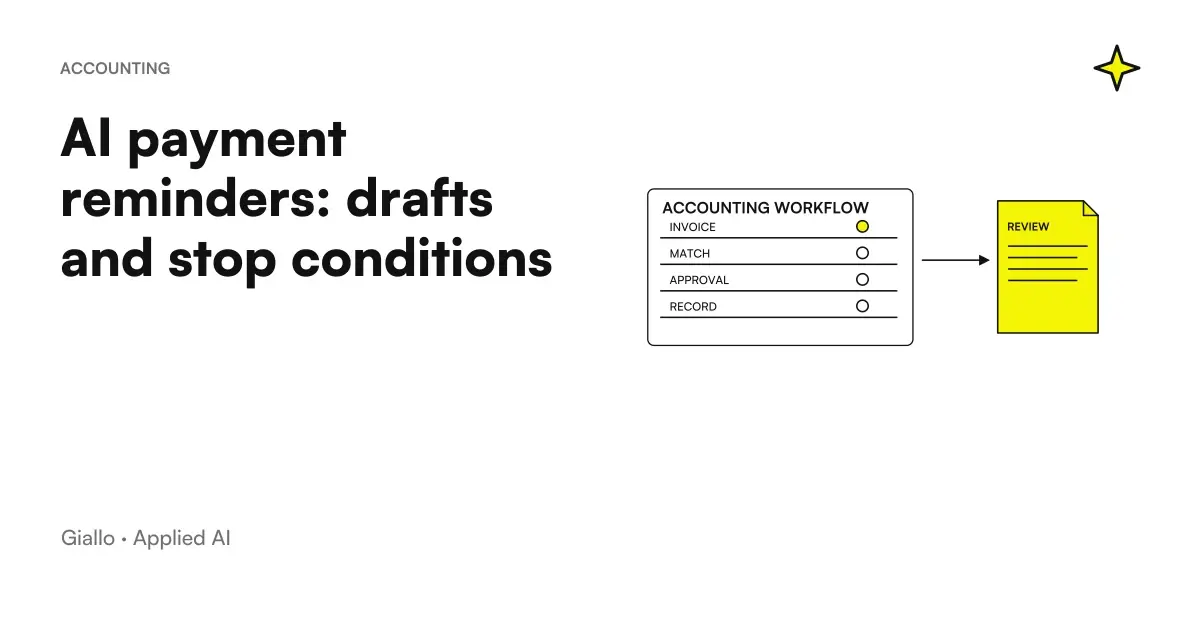
Prompts for payment with AI must start from an up-to-date accounting status and produce a verifiable draft. Confirmed receipt, partial payment and open dispute change the path. The check must stop proposals and still send in queues when the message assumption is no longer valid.
The system is not used to write more often. It serves to prepare the communication relevant to the real situation, with the remaining amount, recipient and source controllable. A polite text can still be wrong if the customer has paid or if the administration is verifying a dispute. The quality of the message depends first on the data.
Technical primitives are documented at 9 October 2026 and cases are hypothetical. The page describes an operational process, without promising receipts, legal effects or payments made by the agent. The framework is in AI for businesses; upstream accounting work is deepened in AI for Accounting.
In summary
- The balance to be communicated comes from an up-to-date and verified source.
- A draft does not automatically authorize submission.
- Revenue, dispute and partial payment have distinct paths.
- Conditions should be rechecked before action.
- An incorrect referent or an uncertain figure stops the proposal.
- The result of the pilot is about fairness and stop rules, before the economic effects.
What data do I need before I prepare a reminder?
Identifies the practice and source of the state. Reference of the invoice, customer, original amount, confirmed receipts, residual, relevant date and contact person of the communication may be used. Keep the time of the last update. The model should not rebuild a balance by casually reading emails and documents if the accounting process has an authoritative source.
The presence of an invoice does not prove that its amount is still due. A collection may have been associated, a portion may have already been paid or a case may require verification. The "to be checked" state is necessary when the data is not rebuildable. The flow must distinguish lack of update and balance actually confirmed.
| Field | Source to verify | Condition that stops the draft |
|---|---|---|
| Practice | Reference in the relevant system | Uncertain identity |
| Residue | Accountancy status updated | Unreconciled cash |
| Recipient | Verified contact | Person or address not relevant |
| Contestation | Status of practice | Open discussion to manage |
| Previous Communications | Available History | Duplicate or outdated message |
| Reviewer | Process Manager | No person in charge |
| Version | Data and text of the proposal | Change after review |
The Guide to the AI Bill Automation It treats other steps of the cycle. Here the question is more precise: with what data can I prepare a correct message now? A solicitation process should be able to respond before producing the draft, without confusing an open invoice in the system with a full test on the case.
How to deal with partial payments and uncertain receipts?
Keep separate original amount, confirmed collection and verified residue. If a payment covers multiple practices, the link must be rebuilt in the appropriate process. Do not ask the model to distribute money between invoices based only on similar descriptions. The proposal must make the source visible and leave the links uncertain.
A purely demonstrative example: a practice has an original amount and a partial payment already confirmed. The draft should not repeat the full amount as if nothing had arrived. You must use the residue that the process has verified. We don't enter numbers here because the useful rule is the link between data, not a debt recovery simulation.
If the customer reports that they have paid but the collection is not yet confirmed, the request becomes a verification, not proof that the balance is zero. The contact person receives the available statement and data, then decides on the next step. The system can prepare internal material without continuing the sequence as if that answer did not exist.
AI can help summarize a communication and show the point to be controlled. Accounting confirmation remains in the relevant path. If the sources are incomplete, a human fallback must have a recipient and an expected result. n8n documents examples of switching to the operator in AI workflows; the capability does not prove that your data is already reconciled. Official Human Fallback.
How to handle a dispute without ignoring it?
A dispute changes the path. The system must show what the customer states and assign verification to the person responsible. It must not automatically decide whether the dispute is valid. A message questioning a supply or an amount is not simply silence after a reminder.
Keep the position declared by the customer, the documents available and the decision of the manager separate. This prevents the model from presenting a synthesis as an established fact. If preparing an answer, the text must remain a draft with the points to be verified. The Path of the customer complaints with AI deepens assignment and escalation of sensitive cases.
The state of the dispute must also be readable for those who review the communication. If it has been updated in another source, the stream must verify the data before the action. It is not enough to add “gentle tone” to the prompt: the problem may be the presupposition of the message. If a handler is missing, the practice remains to be assigned instead of continuing the sequence.
This page does not propose legal formulas of mistrust, rates or universal terms. Describes preparation, control and transition to the competent person. If the communication requires professional evaluation, the project must make that need visible. The dot or workflow does not resolve a decision that the organization has not yet made.
How to prepare a draft that the manager can approve?
The reviewer must see text, recipient, practice, data used, and time of update. The draft may be short, but its path must be reconstructable. If the balance is open, the field remains to be verified; if the referent is uncertain, the sending is not presented as ready. The proposal should distinguish the data from the tone suggestion.
n8n documents human review for tool actions. Revision can be designed with an appropriate proposal and outcome, but does not replace source control. Official Human Review. The process must deliver to the manager what he needs to decide, not just a confirmation button.
Summary before a possible sending
Show practice, updated status, verified residual amount, recipient, text and relevant communications. Indicates disputes or receipts to be checked. Ask for a decision on the precise version of the proposal. Double-check the assumptions before the action and stop the case if they have changed.
Do not use an approval on an old draft for a modified proposal. A change in amount, recipient or assumption requires a reassessment in the expected process. The decision must be about the message that will start, with the current information. This organization makes the control useful without promising that a rule will eliminate any error.
How to define stop rules and controls before sending?
Write the conditions that stop the proposal: confirmed collection, open dispute, irrelevant referent, out-of-date source or requested verification. Also define who can reopen the case. A suspended sequence should not restart just because the next running time has arrived.
Control must take place when the message is prepared and before the action. Between the two moments it can change the state. It keeps the version of the data used and verifies that the assumptions are still valid in the available technical path. If you can't do that check, the case isn't ready for an automatic send promise.
A connection error should not be interpreted as absence of receipts. The status remains to be verified and the referent sees the obstacle. The same applies to a customer response from another channel: the project must define which sources it covers and which steps remain manual. Don't promise that every signal will be automatically intercepted.
The Deadlines contracted with AI They face another process based on dates and decisions. An operational reminder is not an external action. The distinction also helps here: having a scheduled sequence does not prove that the message is still relevant at the intended time.
Why is this process different from a commercial follow-up?
Commercial follow-up is about negotiation and the next step towards a decision. The solicitation described here depends on an accounting status and an identified practice. The data, stop rules, and review are different. Do not re-use a commercial campaign by changing just a few words in the text.
The Guide to AI for automatic follow-up remains useful for the commercial process, but does not prove that a sequence is appropriate for an invoice. Avoid mixing in the message a proposal about a new service. The content must respond to the verified situation, with the purpose agreed by the manager.
If the initial request is incomplete or the referent is unclear, the qualification of commercial requests can help upstream work. However, it is not the model that decides the customer to be contacted on the basis of a similarity of names: the identity of the practice must be verified in the relevant source.
Two hypothetical scenarios for Italian administrations
A small agency revises a communication before sending
Imagine an Italian agency preparing a draft on a still-open practice. The person in charge sees the remaining amount, source and recipient. Before the action a collection is confirmed: the case is stopped according to the rule and the referent checks the updated status. The outdated draft does not remain ready just because it had been read earlier.
The scenario shows the need for current control. It does not report a test performed or a result in receipts. The owner can then decide whether and how to update the customer, with a new proposal consistent with the data. The solicitation sequence does not decide on its own the follow-up to the report.
A distributor handles a partial payment and a dispute
Imagine a Lombard distributor with a confirmed partial collection and a dispute over an entry. The flow keeps the two elements distinct. The administration sees the verified residue and the disputed point; the commercial contact person receives the relevant material for verification. No model decides the merits of the case.
The communication is prepared only at the agreed perimeter after verification. If the relationship between payment and practice is missing, the state remains open. The system does not make movements or invent a conclusion to complete the report. Quality is measured on the fidelity of proposals and case management, not on a promise of recovery.
What to do if the referent or practice does not coincide?
A recipient available in CRM is not automatically the referent of the case. The address may belong to the person who made the first contact, to a general box or to a person who no longer follows the practice. The system must use the agreed source and leave the field open if the match is not verified.
The same customer can have more practices and conversations. A collection or dispute does not automatically apply to the entire report. The card must show the precise reference and what has been confirmed. If the link is uncertain, the referent receives the case for verification instead of a ready draft with baseless aggregated data.
A customer response can correct the recipient or signal a different reference. The stream must make the update visible in the path covered by the project, without promising that each channel is monitored. The previous sequence must not continue undisturbed if the assumption has become open.
These anomalies deserve specific cases in the pilot. The expected result is not a more persuasive phrase: it is the correct suspension and the transition to the responsible. The revision can confirm that the system has used appropriate data and recipients or indicate the source to be improved. Maintaining this distinction prevents a registry problem from being addressed by adding pressure to the reminder text.
How to measure the pilot and decide the cost?
Create a sample with verified balances, recent receipts, partial payments, disputes and incorrect referents. The manager defines the expected outcome for each case. Compare drafts, data, and stop conditions. It records inappropriate proposals, corrections and actions that would have been stopped. No aggregate accuracy percentage should hide an error on an already paying customer.
It also measures review: does the summary allow you to decide quickly or does it require you to reconstruct everything? Are the sources up-to-date at the right time? If an addiction is not available, that limit must appear in the pilot's result. Before increasing autonomy, solve data and assignment problems.
The budget includes state integration, draft preparation, revision, stop management and maintenance. Agree on a test limit and who decides on any extensions. Do not automatically attribute a change in receipts to AI: you need real data and analysis of other conditions. An anonymized example of practice and communication allows Giallo to evaluate the automation of business processes with clear boundaries before any sending.
Giallo Studio guides: methodology and sources
How we apply it in the company
Related resources
 AI for businesses: a complete guide to getting started
 Invoice automation with AI: what can be automated?
 AI follow-ups: keep track of every contact
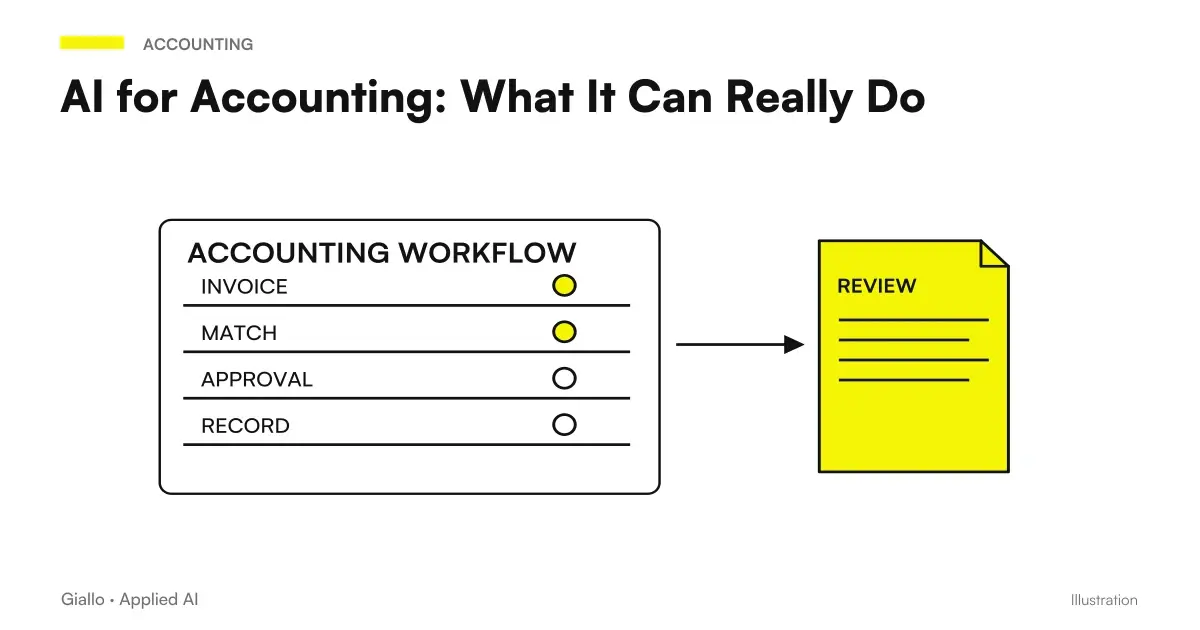 AI for Accounting: What It Can Really Do
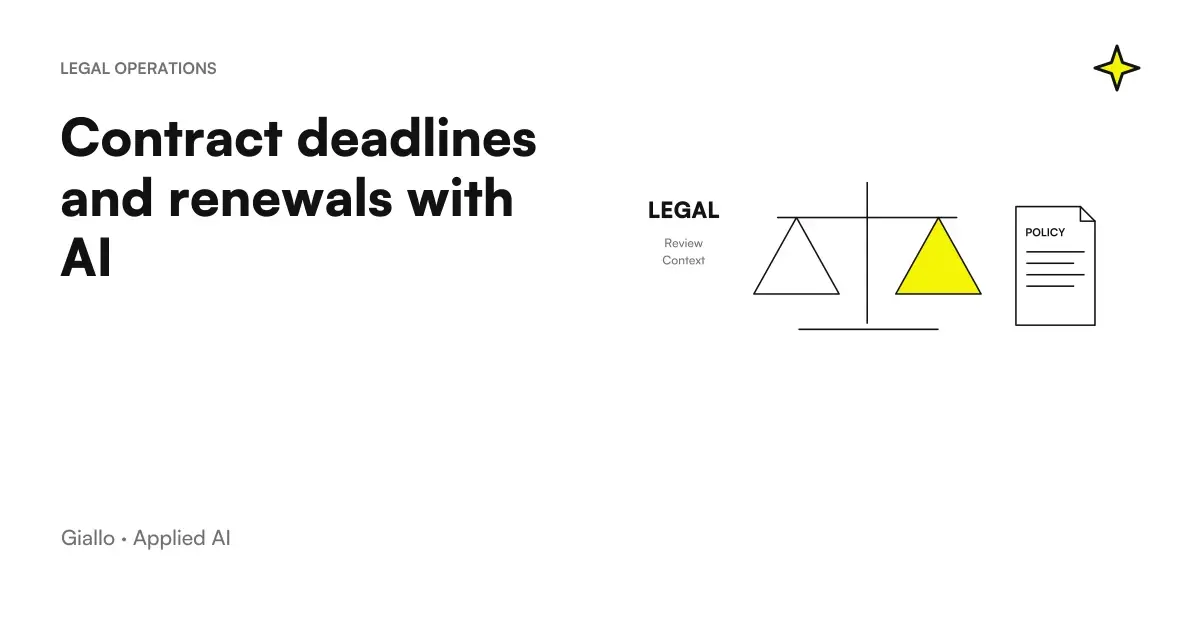 Deadlines and renewals of contracts with AI: building a verifiable schedule
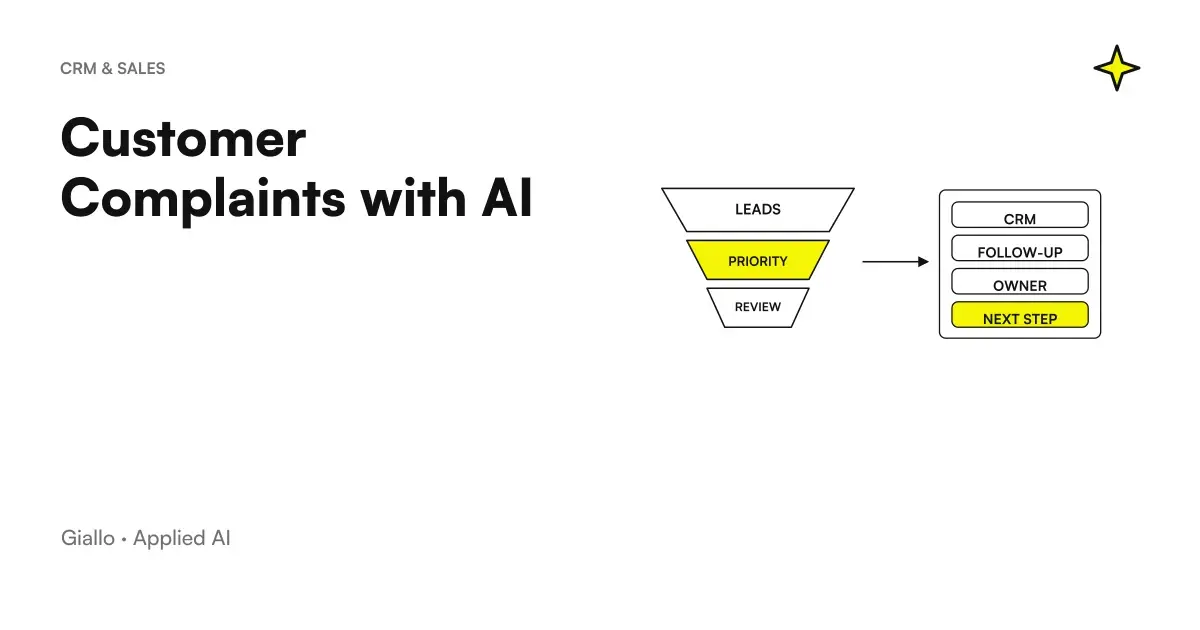 Customer Complaints with AI: Priorities, Facts, and Responsibilities
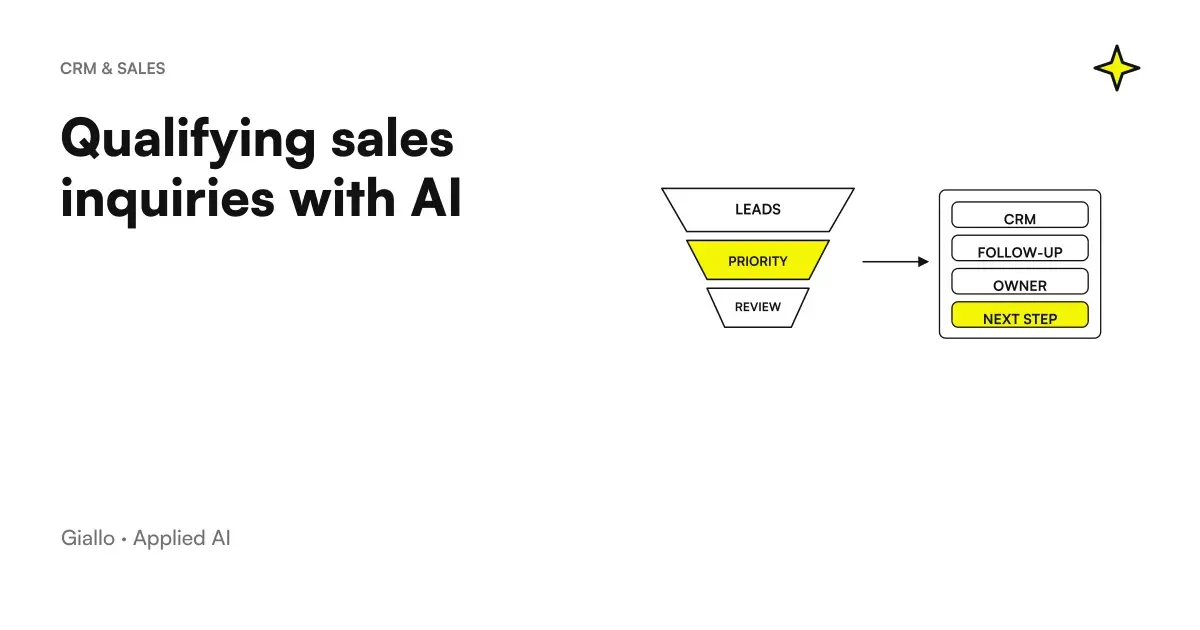 Qualify sales enquiries with AI: missing data, priorities and assignment
 How ChatGPT Works
FAQ
What should an AI payment reminder start from?
An up-to-date, identifiable accounting status, with the outstanding amount and contact verified. The text is prepared as a draft, and sending it requires the authorised procedure.
What happens if the customer has already paid?
The proposal and any messages still queued for sending must be stopped when receipt of payment is confirmed in the process. Repeat the check before the action, rather than only when preparing the draft.
How to handle a partial payment?
Show the original amount, confirmed payment received and verified outstanding balance. A case with an uncertain match remains subject to review, without inventing the balance.
Should an open dispute receive the same payment reminders?
No, it must be visible to the person responsible and handled according to the agreed procedure. The model must not treat an unresolved discussion as simply a failure to reply.
Can the agent make the payment?
This guide is about preparing and managing communication. It does not delegate payments or promise debt recovery results or legal effects.
How to measure flow?
Check drafts based on correct data, respected stops, recipients and corrections. Changes in receipts must be analyzed with real data and not automatically attributed to AI.