
Website · AI · Automations
KIN
KIN brings small groups together around carefully chosen itineraries. For its first invitation-only tour, we built a bilingual site with AI-generated images, requests grouped by trip, data-generated brochures and an automated booking workflow.
kinprivate.com
The context
KIN is a private travel club. It brings together small groups of entrepreneurs, professionals and car enthusiasts, taking them to places rarely experienced on the same trip: historic homes, wineries, reserved dining tables and roads made for driving. Its founders see the itinerary as the occasion and the people as the reason: travellers return having discovered a place and made new connections.
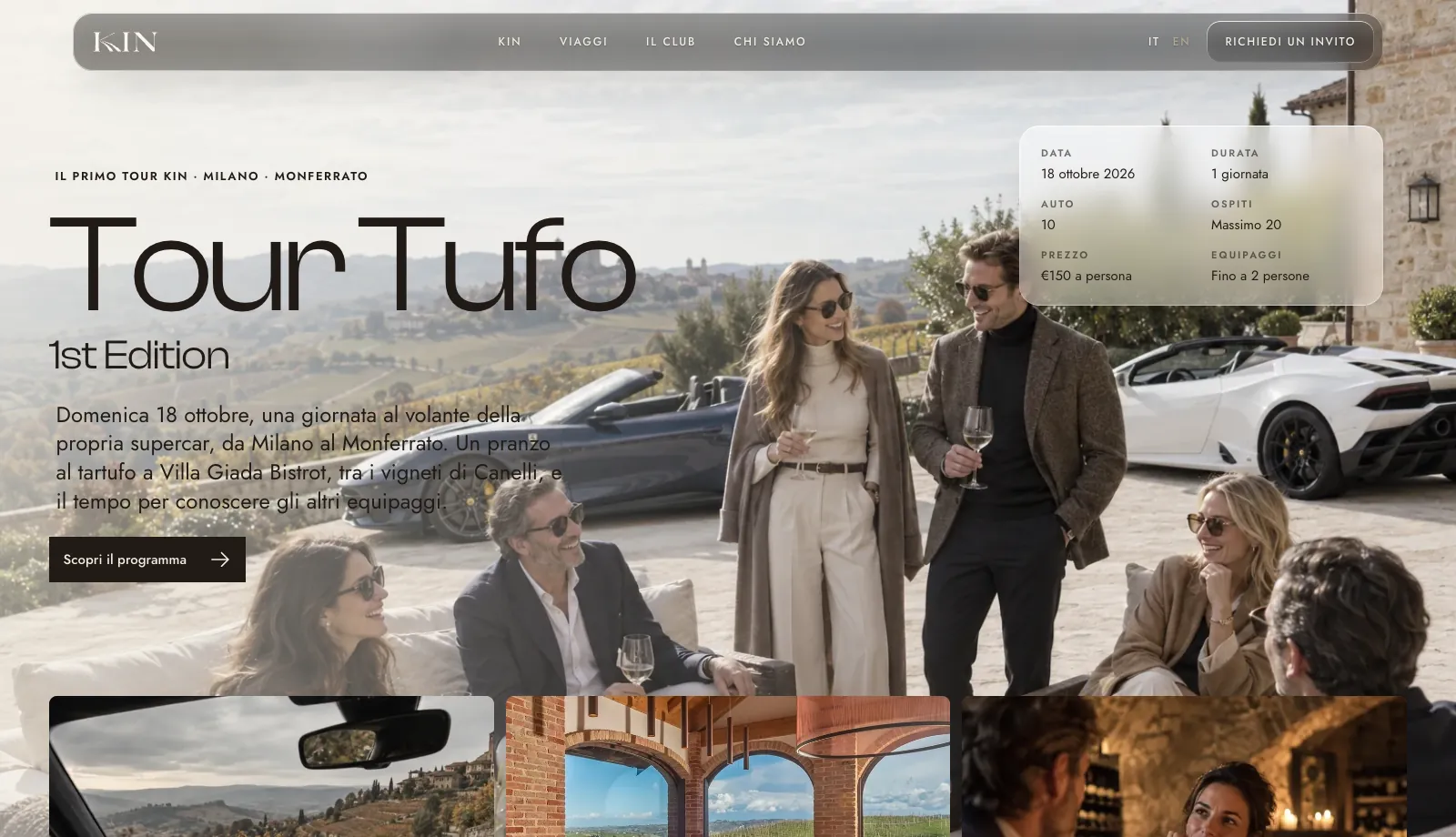
The first event had a fixed date: Sunday 18 October 2026, with Tour Tufo 1st Edition, a day trip from Milan to Monferrato and back, ten cars and a maximum of twenty guests. Before that day, KIN needed three things: a website explaining the club, an organised way to collect interest from people wanting to participate, and an internal process that could handle bookings without improvisation.
A site that selects, not sells
On a traditional travel site the goal is the cart. Here was the opposite: KIN does not sell packages to anyone, chooses whom to travel with. The site had to give birth to the desire and, at the same time, filter: explain clearly what happens in a day with the club, how many people will be there and how it takes place, and let both those who recognize themselves in that way to travel take the step.
That is why each page closes with the same gesture: asking for an invitation. Not a "buy now," but a request that a team person responds to. It is a choice that reduces raw numbers and raises the quality of contacts, and is consistent with what KIN promises its guests.
Alongside the first tour, the site presents the club's next destinations in Tuscany and the Dolomites, each with its own information request. Visitors can see that Tour Tufo is the beginning rather than an isolated event, and express interest in future trips.
The images: artificial intelligence with the rules of a set
A club on its first tour does not have a photo archive. Waiting for photos of the event to publish the site meant losing just the audience to invite. We then generated the eighteen images of the site with artificial intelligence, treating them as a real photo shoot: a brief for each shot, a coherent light between scenes, the same landscapes told from different angles.
The rules were precise. People come before cars: you see guests sitting at lunch, among the barrels, at an aperitif in the vineyards, with cars in the background. The caravans all proceed in the same direction, one after the other, in always different scenarios and without duplicates. The models portrayed take real cars from the partner's fleet for hire, and a note on the website clarifies that these are illustrative images, not a confirmation of availability.
It is a use of AI that we often recommend to companies too: not to replace real photography, but to start immediately with an accurate and consistent image, to be combined with real shots when they arrive.
Liquid glass, without weighing the page down
KIN's visual language is understated luxury: generous space, large headings and landscapes with room to breathe. Menus, information panels and buttons are glass surfaces that reveal what lies behind them. On browsers that support it, the glass actually refracts the background through a graphical filter applied to the surface; where the filter is unsupported, it remains frosted glass, with the same overall appearance and no errors.
We removed shortcuts that broke the effect: some colour-blending modes, for example, cancel the blur behind the glass. Scrolling is smooth, text appears as people read and animation libraries load after the first screen, so the page is immediately readable on a phone across varying connections.
Typography completes the effect: very large, thin headings, short text and generous pauses. The site lets imagery and scrolling rhythm communicate the club's tone before the words, rather than explaining everything at once.
Two languages, one per page
KIN is aimed at an Italian and international audience. The site is in Italian on the main address and in English under /en/, and each page is entirely in one language: no English words forgotten in the Italian version, no Italian labels in the English one. It sounds like a detail, but in front of a demanding audience a sentence in the wrong language is enough to make everything else seem neglected.
After each build, an automated check scans every page for text in the wrong language, instead of relying on the memory of whoever updates it. Pages are generated in advance as HTML and arrive complete on the first load. The accessibility score measured with Lighthouse is full marks.
From Curiosity to Invitation
Each trip has a prepared invitation request. Opening it creates an email with the trip title in the subject line and prompts for sharing a little about yourself. Visitors do not need to compose it from scratch, and the team receives requests grouped by trip with the information needed to assess them.
Next to the email requests we have added contact forms for those who prefer to leave their data. So each name enters the same workflow instead of staying in an inbox, and no potential guest depends on the memory of the person who read the message.
The automations behind reservations
A tour with ten cars and twenty places is filled through conversations, rather than a button. Every request needs to be read, assessed and followed up with information and confirmations. Managing it manually across email, chats and notes is the quickest way to lose someone along the way, precisely at the stage when personal care makes the difference.
For the KIN team we have built an automated internal flow: each request comes to the same place, is taken charge and accompanied in its stages until the confirmed reservation. The team sees where each guest is without having to reconstruct the story from the emails, and no request remains unanswered.
It's the same method we bring to SMEs: first you draw the real path of requests, then you automate repetitive steps and leave people the conversations that matter.
Brochures generated from data
Each tour also needed a presentation for invited guests, including the programme, stops and contacts. Instead of laying it out manually after every change, we generated it from structured data. Times, places and text live in one place, producing a PDF in the same style as the website.
The route map follows real roads using OpenStreetMap, with attribution printed on the page. Before each send, an automatic check verifies the page count and looks for outdated dates or information that must not appear, so an old version of the brochure never reaches a guest.
The result
KIN is online at kinprivate.com with a site in two languages, the page of the first tour, brochures ready to be sent and an internal process that accompanies every request until booking. The team works on already ordered requests instead of chasing messages, and the club shows up with the same care it promises its guests.
The car rental partner is Rial Rent, whose business management software we built and cover in another case study. If your business also loses requests between emails and messages, start with our business process automation page.
New Project
We bring yours online as well.
Whether it's a site, an automation or an AI agent: tell us the goal and see how to get there.