
AI Hallucinations: What They Are and How to Avoid Them
AI hallucinations in business: why they happen and how RAG, grounding and human checks reduce them, with real examples and a practical checklist.
Reading time: 10 min
The AI Hallucinations are answers that a model presents as true but that are invented or incorrect: a nonexistent fact, a citation that was never published, a court judgment that does not exist, a price the model "imagines". The problem is not that AI makes mistakes — people make mistakes too — but that makes mistakes with confidence, in a well-written and plausible text, without any alarm signal.
The cause is structural, not an occasional flaw. A language model such as ChatGPT, Claude or Gemini does not consult an archive of truth: predicts the next most likely word based on patterns learned during training. When he does not know the answer, instead of stopping he tends to produce something credible anyway. Understanding this mechanism is the first step to using AI without getting hurt.
In this guide we see what AI hallucinations really are, why they happen, how to recognize them and — above all — how to reduce them in the company with concrete techniques: RAG, grounding and human verification.
In summary
- A AI Hallucination is an invented or incorrect answer presented as true: the danger is that it seems credible because it is well written.
- The cause is structural: a linguistic model generates the sequence more likely, not the verified one, and he doesn't know he doesn't know.
- They are reduced by anchoring the model to real sources (grounding and RAG), asking for sources and lowering "creativity".
- They are not 100% eliminated: the realistic goal is to make them rare and easy to spot.
- In the company we need clear rules: Human Review where error costs (numbers, rules, contracts, customers).
What Are AI Hallucinations
The term "hallucination" is a metaphor: the model does not see things that do not exist, but generates content not supported by actual facts presenting them as reliable. It is different from a simple miscalculation or an opinion: it is a false factual statement, packaged in the same safe tone as a correct answer.
There are two useful families to keep in mind:
- Hallucination in fact: the content is false in itself. A wrong date, a non-existent law, a product that the customer has never had, a invented statistic.
- Hallucination of fidelity: the model misrepresents or adds things with respect to the sources you gave it. You provide it with a document and he "quotes" you a passage that is not in that document.
The second is particularly insidious in business systems, because it also happens when you think you've given the model all the context it needs. To understand why this happens, one must remember how a Language Model: does not recover, predicts.
Why AI hallucinates
A language model is trained to only one goal: given a text, guess the next most plausible piece. It has no internal concept of "true" and "false", it has a concept of "likely". It works fine until the likely answer coincides with the true one — and diverges just when it doesn't.
The most frequent causes are few and recurring:
- Absent or dated knowledge. The model has been trained up to a certain date and does not know what happened next, nor your internal data. On those holes it tends to invent instead of admitting the limit.
- Question ambiguous or without context. If the request is vague, the model "fills the voids" with the most likely hypothesis, which may be wrong.
- Pressure to respond. Models are trained to be useful: saying "I don't know" is statistically less frequent than trying to answer. This pushes them towards bold answers.
- Details too specific. Own names, exact numbers, citations, and normative references are the points where hallucination is most likely, because they require precise memory of a single data, not a general pattern.
How to Recognize an AI Hallucination
There is no automatic warning signal, but there are signs that should trigger verification. Learning to recognise them is half the work. A citation that is present must also support what the answer claims; the guide to JEV for verifying AI citations delimits a control over the relationship between claim and source, without promising automatic truth.
- Citations and links that do not exist: titles of studies, judgments or URLs that, sought, are nowhere to be found.
- disproportionate security on niche issues: the model is clear on a topic where there should be uncertainty.
- Hyper-precise details without source: percentages, dates and exact numbers that appear "out of nowhere".
- Answers that change: you rephrase the same question and get a different and incompatible answer with the first.
- Perfect but unrealistic internal coherence: everything comes back too well, even the parts that should be nuanced.
The golden rule remains only one: on verifiable facts, verification. Numbers, names, rules, and customer data should be checked on an independent source before using them. AI saves you time on drafting, not accountability.
How to reduce AI hallucinations
This is the operational part. It's not about "choosing a model that doesn't hallucinate" —it doesn't exist —but about Building a System around the model that makes errors rare and visible. The main levers are three: grounding, prompt and control.
1. Grounding and RAG: give the model the right sources
The most powerful lever is not to have the model answer "by memory". With the grounding connect the answer to real sources: company documents, price lists, contracts, official pages. The model reads those texts and answers only on those, citing where it got the information from.
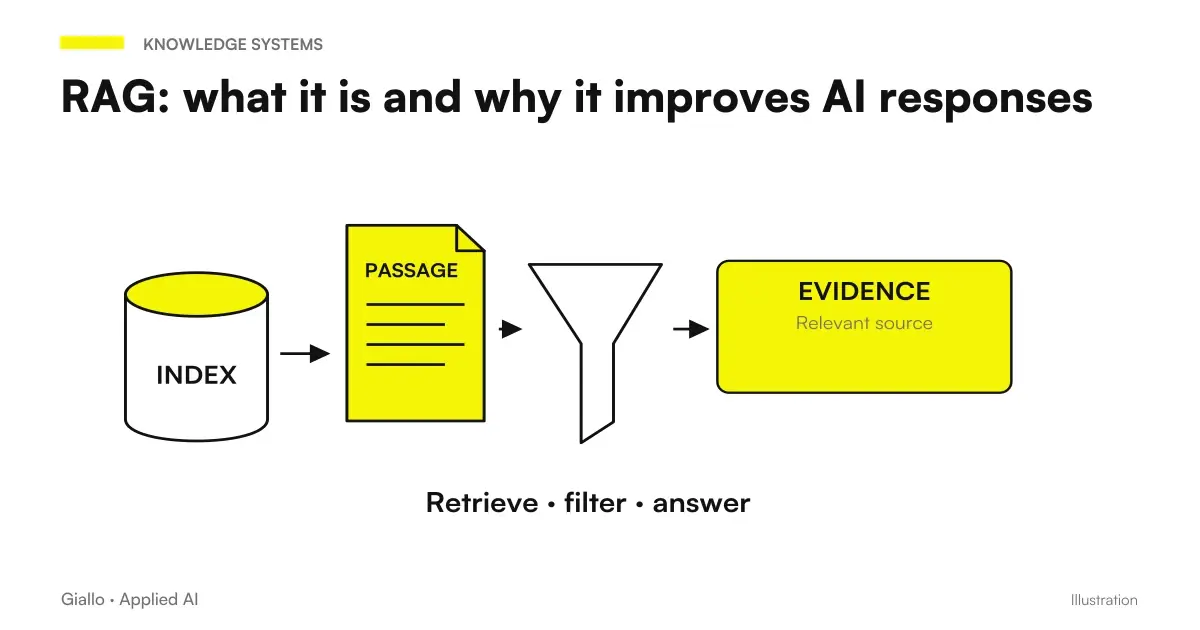
The most used way to do this is called RAG (Retrieval-Augmented Generation): first the system recover the relevant documents from your knowledge base, then passes them to the model as context because genera the answer based on those. The result is double: fewer inventions and traceable answers (you know which document each statement is based on). To understand how it works in detail, read the guide on What is RAG.
2. Prompt and settings: ask for sources, lower "creativity"
Even without RAG, the way you ask the question changes the risk a lot. prompt engineering They break down hallucinations:
- Grant the way out: explicitly write "if you don't know, say it and don't invent". It reduces the risky answers.
- Ask for sources: "cite the document or page from which you take each claim". If it cannot cite a source, that is a warning sign.
- Give the context: Paste the real data instead of hoping it will remember them.
- Lower Temperature: in the model settings, a lower "temperature" makes the answers more conservative and less imaginative. Useful on factual tasks.
3. Human verification: where the error costs, the person decides
No technique resets the risk, so the last lever is organizational: establish where human control is needed. Not on everything —it would be inefficient —but on points where an error has consequences: numbers sent to a customer, contractual clauses, normative references, public communications.
Where human control is mandatory
- Numerical data to customers (quotes, invoices, deadlines).
- Legal, tax or regulatory content.
- Public Communications on behalf of the company.
- Decisions with impact on people (selection, credit, sanctions).
Where light control can suffice
- First internal drafts to be finished by hand anyway.
- Summaries of texts you already have on hand.
- Brainstorming and ideas, where error does not "come out".
- Mass translations with sample revision.
Techniques in Comparison
Not all levers cost and make alike. This table helps you choose where to start based on the use case.
| Technique | What it does | How much it reduces | Effort |
|---|---|---|---|
| Best prompt (ask sources, "say if you don't know") | Addresses the model to be cautious | Low-medium | Minimum |
| Low temperature | More conservative, less imaginative responses | Low | Minimum |
| Manual Grounding (you paste the documents) | The model responds to the texts provided | Middle-high | Low |
| RAG (automatic retrieval of sources) | Anchored and traceable responses to the business base | High | Medium |
| Human verification on critical points | Intercept the error before it exits | High (on risk) | Depends on the volume |
| Fine-tuning on your data | Adapt the style and domain, does not guarantee the facts | Variable | High |
The most effective combination for an SME is almost always RAG + prudent prompt + targeted human verification: covers most cases without prohibitive costs. Fine-tuning serves in specific cases and, alone, does not solve hallucinations: it improves style, not veracity.
Practical examples
Three realistic scenarios of Italian SMEs and professionals, to see the problem and the solution together.
1. Law Firm — Search for precedents. A collaborator asks ChatGPT for the extremes of some rulings on a topic. The model responds with sentence numbers, dates and courts with the perfect sound — but Two out of five don't exist. It is the most documented hallucination case in the world. The solution is not to ban AI: it is to use it with a system RAG linked to real legal databases and verify always the extremes on the official source before citing them in an act.
2. E-commerce — customer assistant. A chatbot replies "yes, the return is free within 60 days" when the actual policy is 14 days. He invented a plausible fact. With the grounding on company documents (the page made true passed as context) the chatbot only responds to what is written and, if the answer is not there, passes the request to an operator instead of improvising.
3. Accounting firm — regulatory summary. An AI assistant summarizes a circular and attributes a wrong deadline. The problem is a hallucination of fidelity: the original document was correct, but the model has "rounded". Here the leverage is double: ask the model to quote the exact step from which it derives each deadline, and hold a human review before communicating it to the customer.
In all cases the model should not be deleted, it must framed: real sources as input, citations as output, and checks where errors matter.
What if I only use ChatGPT without custom-made systems?
Even with ChatGPT alone you can greatly reduce the risk: you paste the real documents into the chat instead of trusting the model's memory, always ask "quote the source of each statement and if you don't find it say it", and don't use it as the only source on numbers, norms or names. For tasks where error has consequences, the generic tool is not enough: you need a system with grounding on your sources.
Mistakes to Avoid
- Treating output as truth. It's error number one. AI produces the most likely answer, not the verified one: on facts, you assume it should be checked.
- Trusting the model’s citations. A cited source is not a verified source. Links, rulings and studies should be opened and checked, not taken as good because they "seem real".
- Not providing context and then being surprised. If you ask about your data without providing it, the model invents. Grounding is not an option: it is the difference between a useful answer and a dangerous one.
- Putting AI in direct contact with the networkless customer. A chatbot with no grounding and no human fallback will sooner or later tell the customer something fake on your behalf.
- To think that "the best model" is enough. No model is immune. The difference is made by the system around it (sources, prompts, control), not the signature of the model.
How to apply it in the company
Reducing hallucinations is not an abstract technical project: it is a set of practical rules to be defined before putting AI into a process.
- Map where error costs. Lists the points in the process where a false answer has consequences (customers, money, norms). There it serves grounding and human control.
- Connect AI to your sources. For questions about your data, use a system of Type RAG on the actual documents, not the memory of the model.
- Standardize prompts. Always include "quote sources" and "if you don't know, say it". Turn them into reusable templates, not improvised each time.
- Define who approves what. Establish in writing where the person must give the ok before the output exits. AI prepares, the human signs.
- It measures errors. Keep track of how many times verification finds a hallucination. If it's too many, change sources, prompts, or use case.
This is the typical work of a AI Consulting serious: do not promise a model "that never fails", but build around the model the sources, automations and controls that make the error rare and manageable. If AI has to get into your processes — a chatbot, an internal assistant, a AI Agent — grounding and verification are not a detail: they are the condition for it to really work. For operational flows where AI acts on data, the same principle applies in process automation: anchor to real sources and hold a human checkpoint.
On this topic we have more recent insights: Knowledge cutoff: what it means in practice and Why Vendor Benchmarks Are Not Comparable.
More capacity is enough to make a reliable response?
A progress in a benchmark does not guarantee the correctness of each answer in your process. The question if superintelligence already exists requires proof of breadth and generality, as well as success on a task. For an answer on business documents, verification must also include memory, retrieval and context: which version of the source was recovered and what is missing from the system?
When the answer becomes an action, the control must go beyond the quality of the text. superintelligence and oversight of agents shows how to distinguish model capabilities, permissions granted and acceptance of the result. An agent can fail by performing the wrong procedure correctly: for this the test must verify the outcome on the target system, not just the final message.
Conclusion
The AI Hallucinations They are not a flaw to wait for it to be "solved": they are the flip side of how language models work, which generate the most likely answer and not the certainly true one. The good news is that they manage. With the grounding and the RAG anchors answers to real sources, with prudent prompts reduce inventions, with a Targeted Human Verification intercept the error where it matters. The goal is not an infallible AI, but a system where errors are rare, visible and without serious consequences. From here you can continue with What is RAG and with the AI Guide for Companies to see how these devices fit into a real project.
Do you want to understand what processes in your company can be automated with AI? Giallo Studio can help you turn the problem into a real workflow —with reliable sources and controls in the right place.
Giallo Studio guides: methodology and sources
How we apply it in the company
Related resources
 LLM: What Language Models Are
 RAG: what it is and why it improves AI responses
 Prompt engineering: what it is and how to get started
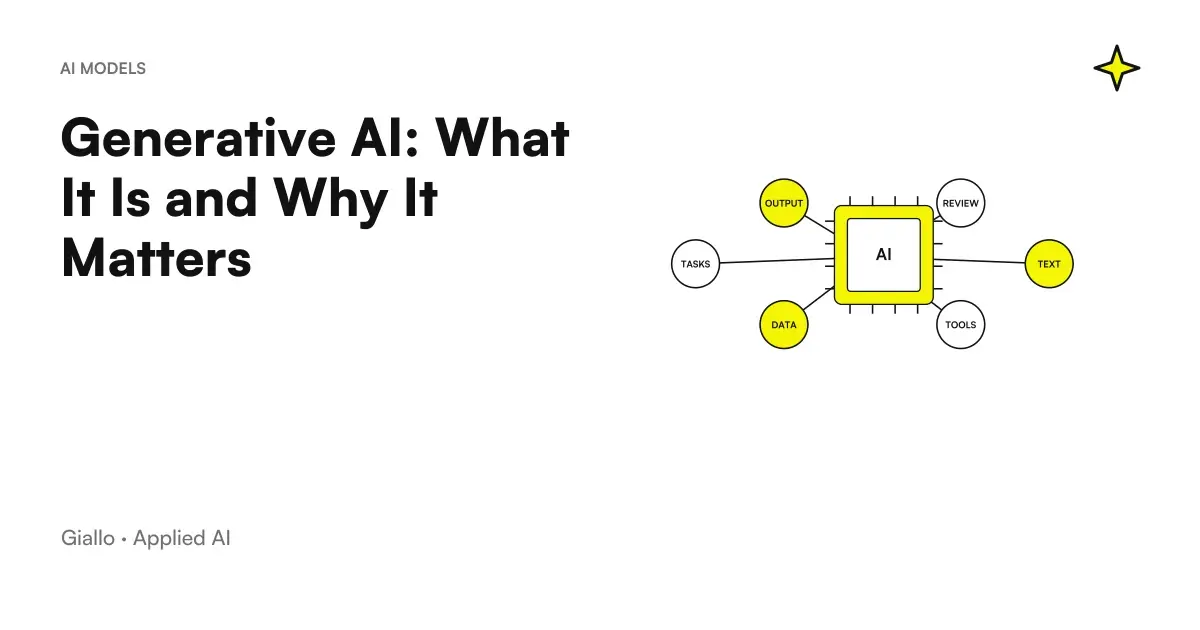 Generative AI: What It Is and Why It Matters
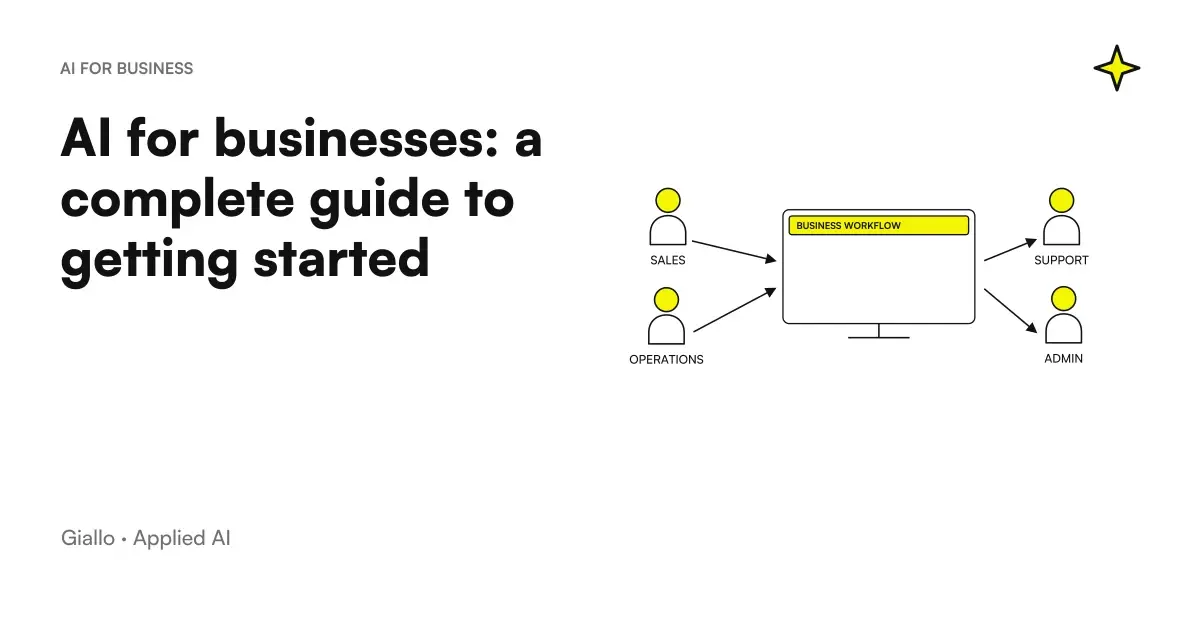 AI for businesses: a complete guide to getting started
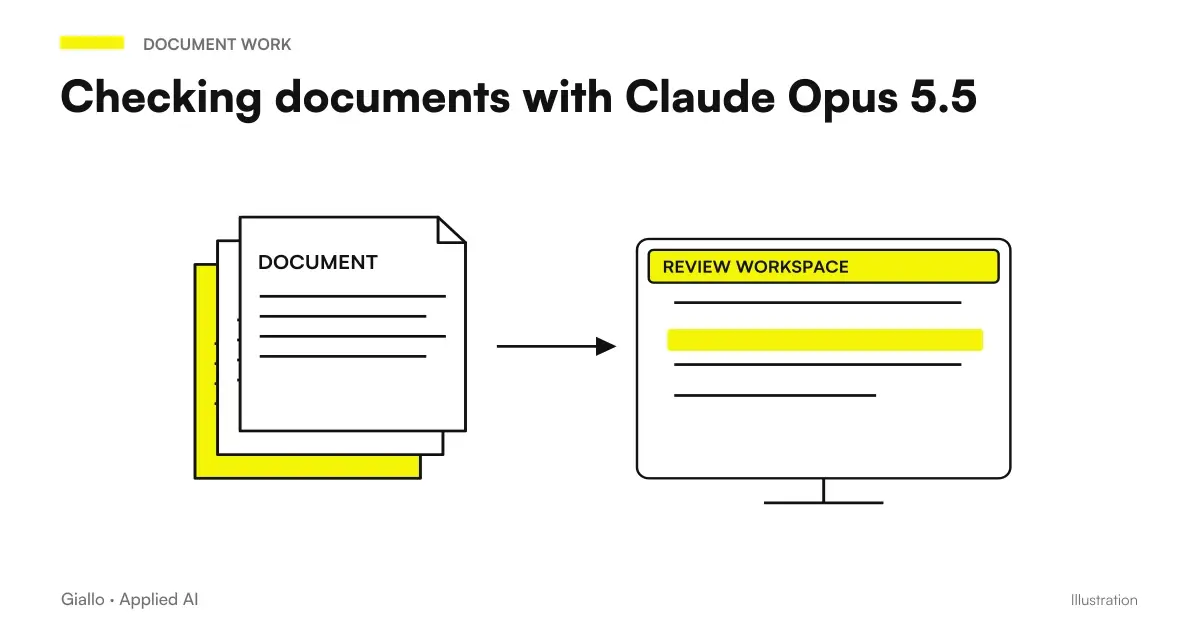 Review documents with Claude Opus 5.5: inconsistencies, dates and numbers
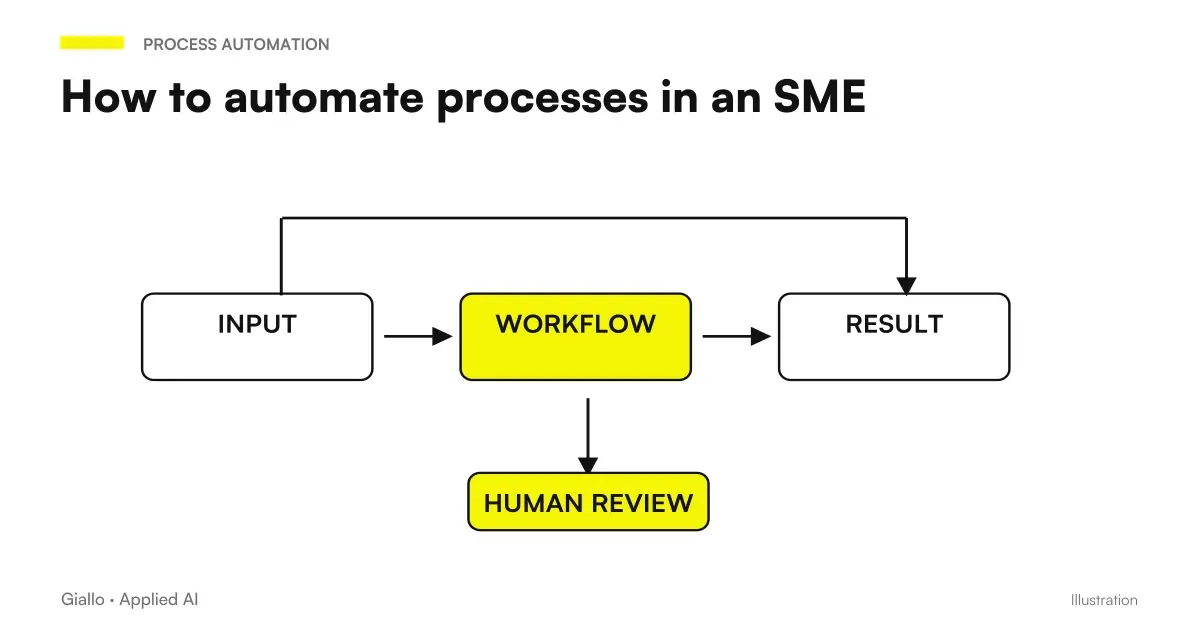 How to automate processes in an SME: the practical guide
 RPA vs AI automation: differences, costs and when to use which
FAQ
What are AI hallucinations in simple terms?
An AI hallucination is an answer the model presents as correct but which is invented or wrong: a false piece of data, a nonexistent citation, or an incorrect regulation. It happens because a language model generates the most likely sequence of words rather than a verified one. The answer seems credible precisely because it is well written, which is what makes it dangerous.
Why does ChatGPT invent the answers?
Because it doesn't consult a truth base: it predicts the next word based on patterns seen in training. When it doesn't know the answer, instead of saying 'I don't know' it tends to produce something plausible anyway. It's a structural behavior of language models, not an occasional bug.
Can AI hallucinations be eliminated altogether?
No, not 100%. However, they can be greatly reduced by connecting the model to reliable sources (RAG), asking it to cite sources, reducing "creativity", and retaining human review at critical points. The realistic goal is to make errors rare and easy to identify, rather than eliminate them completely.
What is the grounding of an AI model?
Grounding is the anchoring of the answer to real and verifiable sources: business documents, databases, official pages. Instead of answering 'from memory', the model reads the texts provided and only answers those. It is the most effective way to reduce hallucinations on questions that relate to specific data.
Are AI hallucinations a risk to a company?
Yes, especially on numbers, contracts, regulations, prices and customer data. An invented response published or sent to a customer can cause reputational damage, operational errors or legal problems. That is why in business processes AI should be used with grounding and with a human control where error costs.
How do I know if an AI response is a hallucination?
Typical signs include overly precise details without a source, citations or links that do not exist, excessive confidence on niche subjects, and answers that change when you rephrase the question. Verification remains the rule: check numbers, names, and regulations against an independent source before trusting the answer.