
Website · 3D · GEO
Giacomo Carbonara
From Milan, Giacomo Carbonara arranges private jets, hypercars, yachts, track days, transfers and other custom services directly with vehicle, aircraft and boat owners. He needed an Italian and English website serving international clients and discoverable through Google and AI assistant answers.
giacomocarbonara.com
The context
Giacomo Carbonara works in Milan as a luxury concierge. People write to him who want a private jet for the next day, a hypercar delivered to the villa, a yacht in Costa Smeralda, a day at the track in Monza or a car for the set of a video. There are ten services, and they all start from the same idea: Giacomo deals directly with those who own the plane, the boat or the car, without agencies in between that resell availability received from others.
This clientele has two habits that affect website design. They decide quickly, often on a phone and at any hour. They also speak different languages: visitors from Monaco, London or Dubai search in English, while people booking a wedding in Brianza search in Italian. The site had to work for both audiences at once, with neither feeling like an outsider.
What the site was supposed to do
Before drawing a single screen we put four tasks in writing. The first: to give confidence in the first seconds, because those who spend on a private flight judge the supplier by how it looks. The second: to turn the visit into a direct conversation with James, in the shortest possible way. The third: to be found for each individual service, in two languages, both on Google and in the responses of AI assistants. The fourth: remain the property of the customer, including server.
Each technical choice that follows responds to one of these tasks. We did not add functions to fill the project, and when a function went against one of the four points we removed it: it happened with the contact form, as we tell later.
The 3D that accompanies the reader
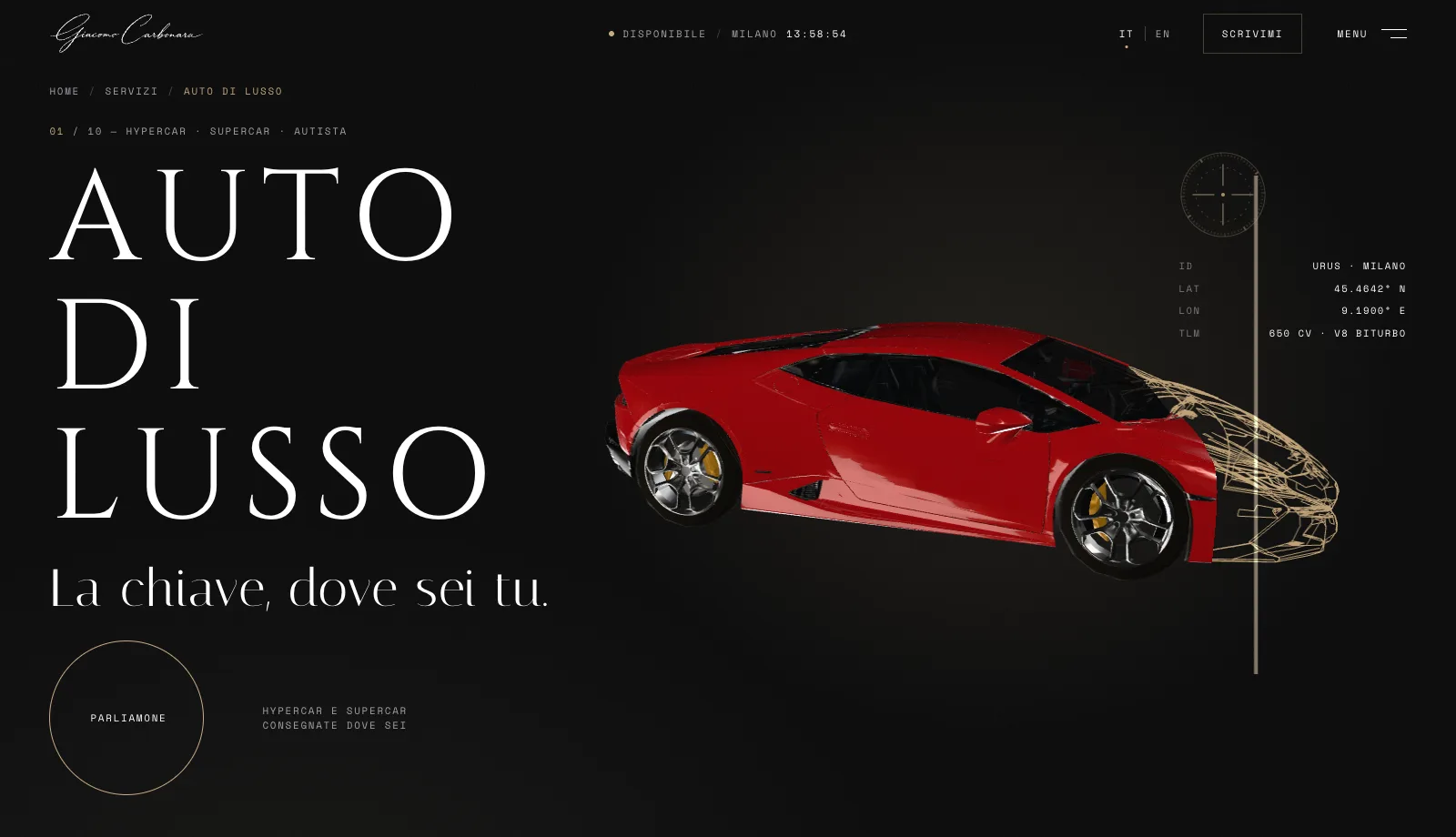
The website is built in Next.js, with its three-dimensional scenes in React Three Fiber. A private jet and a hypercar are actual 3D models, lit as if in a photography studio, that move as the page scrolls. Each section declares the scene it needs, and a central controller moves the model, lighting and framing when the visitor reaches that point. People reading about flights see the aircraft; those opening the luxury car page find the vehicle with a gold outline tracing its structure and technical data alongside it, like a dashboard.
We selected models with free licences requiring author attribution, and placed the credits in the footer. For a client whose work relies on confidentiality and clear agreements, this was essential: no materials of uncertain origin on a site that promises transparency.
3D is heavy, so we treated it like an expensive guest: models and code all come from the website’s own domain, without external services to load, and the server compresses resources before sending them. The scene is not decoration placed over the text: it is how the website instantly shows the kind of services it offers, before visitors read a word.
A typography that adjusts itself
The website’s headings are large and uppercase, and must fill their column without ever splitting a word in two, in Italian as well as English. The problem is that the two languages have words of very different lengths: “Aerei privati” and “Private jets” do not occupy the same space. We wrote a small system that measures the longest word in each heading and calculates the right size for the column containing it. The result is that every heading is always as large as possible, and none breaks onto a new line in the wrong place.
The sentences appear word for word as you scroll, and at the top a small dashboard shows the time of Milan in real time and the "Available" status. They are details, but they tell the customer one thing: here is a person who answers now, in his time zone.
During development, an automatic control would open the pages and search for broken words, texts coming out of the boxes, writings covered by the images. It is the kind of verification that a human eye does once and then stops doing: a machine repeats it at every change without getting tired.
Two languages, ten services, one address for each search
Each service has an Italian and English page with translated URLs. A search for “aerei privati” leads to the Italian page, while “private jets” leads to the English one. Hreflang tells Google that they are the same offering in two languages. Each version is written for its readers rather than placed as an automatic translation layer over an Italian site.
Ten service pages provide ten entry points from search: luxury cars, yachts, private aircraft, Milan apartments, music videos, Sprinter transfers, weddings and events, car-transporter delivery, track days and social media management. Each answers a specific need and leads to the same direct contact.
Some services involve businesses we know well. Cars, yachts and car transporters also come from Rial Rent's fleet, for which we built business management software and worked on European visibility. We explain this in the Rial Rent case study.
Ready for AI Assistant Responses
More people ask ChatGPT, Gemini or Perplexity “who can arrange a private flight from Milan?” rather than searching on Google. To appear in those answers, a site needs to be easy for machines to read as well as attractive to people. This is the work we call GEO, addressed here on three levels.
The first is structured data: each page describes, in a format search engines can read, who Giacomo is, the services he offers, how to contact him, the hours when he responds, and the questions he receives most often, with their answers. The second is an llms.txt file, a summary of the website specifically for AI assistants, containing services in two languages, frequently asked questions and contact details. The third is the writing: the FAQs have direct, complete answers to questions such as “how much notice is needed for a private jet?” and “how many guests can sleep on a charter yacht?”, in a form an assistant can cite as it stands.
We use the same approach for business websites: when customers ask AI for advice, it matters to be a source the assistant can read and report accurately.
Direct contact, no form
The first version of the site had a contact form. We took it off. A module adds a passage right where Giacomo's positioning promises to remove it: the writer wants to talk to him, not fill in fields and wait. Today the contacts page offers three channels, WhatsApp, phone and email, and you open a conversation with a touch.
The choice also has an effect on privacy. Without form the site does not collect personal data: the only information is the one that the customer decides to write, in the channel he prefers. In server logs IP addresses are anonymized, and those who want total confidentiality can request a nondisclosure agreement before telling their request.
A server that belongs to the customer
The site does not live on a shared platform: it runs on a dedicated server registered to Giacomo. The application is in a container, in front there is a web server with Brotli compression for lighter pages, the HTTPS certificate renews itself, and security headers block anything that does not come from the site domain. If one day Giacomo wanted to change provider, the server is already his.
For a personal brand, this matters more than it may seem. Giacomo sends the website to important clients as his calling card. It needs to be fast, secure and under his control, without depending on a subscription someone else could close.
The result
The site has been online since September 2026 at giacomocarbonara.com: ten services, two languages, real-time 3D scenes and a direct contact at one touch from every page. James finally has a unique address to send to anyone who asks him who he is and what he does, and that address works even when he doesn't answer the phone.
The project offers a lesson that applies to businesses too: a website can build trust before the phone call, if every technical choice serves a precise objective. Removing the form, writing for AI assistants and keeping the server in the client’s ownership are small decisions, but together they make the difference between a site people look at and one that generates conversations. For a project with the same care, start with our website creation page.
New Project
We bring yours online as well.
Whether it's a site, an automation or an AI agent: tell us the goal and see how to get there.