
Synchronise CRM and business software with AI: data, conflicts and retries
Synchronise CRM and business software with AI: define each field's source, link IDs, handle conflicts and retries, and measure a pilot without duplicates.
Reading time: 13 min
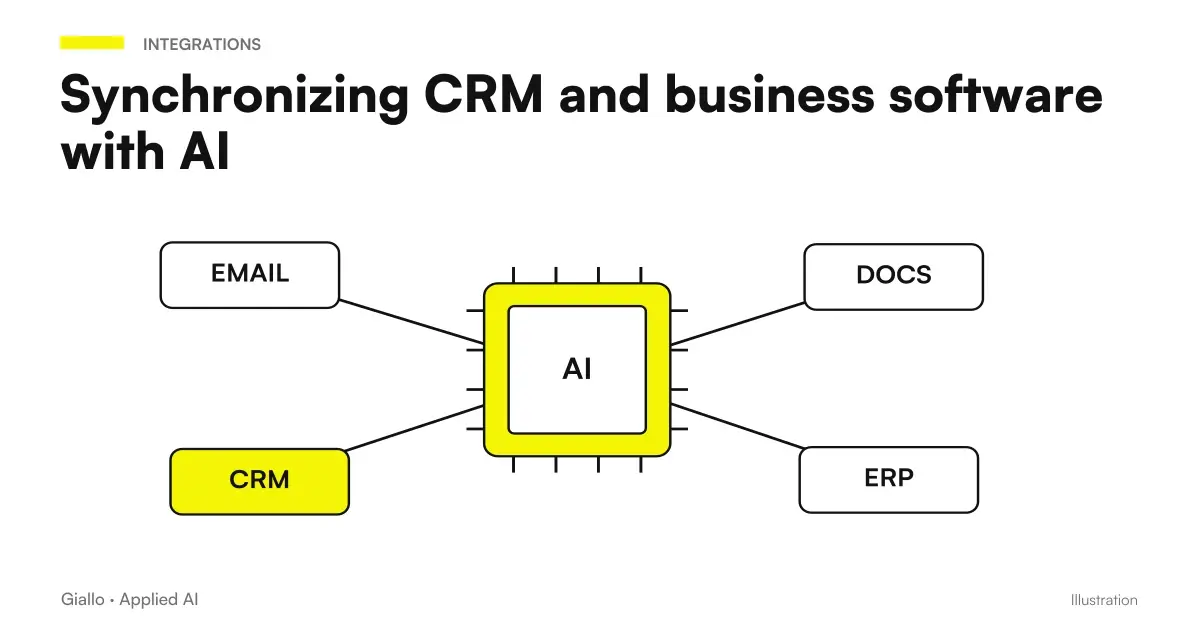
For synchronize CRM and management software with AI you must first establish which system is authoritative for each field and how to identify the same record in the two applications. AI can interpret messages or notes and prepare proposals. Copying data, conflicts, and retry require verifiable rules: a plausible value is not enough to authorize a write.
The problem is the alignment between two operating sources, distinct from the generic CRM Automation. Here you find a method to delimit the project, with verified official sources on 9 October 2026 and hypothetical scenarios. The AI Guide for Companies helps to assess the priority of the process before connecting all the records.
In summary
- Define the authoritative source by field, not just by application.
- Connect the identifiers without using the name as the only proof.
- A concurrent modification must become a visible conflict.
- The retry must verify what has already been recorded.
- It measures data quality and exception work in addition to technical success.
Which data must travel in which direction?
Avoid starting from "synchronize everything". Choose an object, for example the customer registry, and few useful fields. For each indicates origin, destination, update event and authority. The commercial can update a contact person in the CRM; an administrative code can be assigned by the management software. The project must reflect these responsibilities.
Two directions do not mean that each field can be edited from both sides. If a commercial note is not needed in the management software, do not copy it for completeness. If an administrative data must be visible in the CRM, clarify if the user can read it or even propose a change. The display and writing are separate permissions.
The Guide to all integration of management software with n8n deals with links and events. Before the technical flow, however, a map of the data is needed. Without it, an integration can function properly and propagate values that the company considers wrong or unupgradeable from that source.
An authority matrix by field
| Field or event | Source expected in the project | Rule in case of discordance |
|---|---|---|
| Customer ID | System that assigns it | Retain the link, not regenerate it |
| Verified administrative data | Designated Manager and Application | Proposal for amendment with scrutiny |
| Commercial contact | CRM, if so decided by the company | Check version and authorization |
| Order Status | Relevant Operating System | Show date and origin of event |
| Free Note | Source who collected it | Separate original text and extraction |
| Record to archive | Process approved | Do not interpret absence as cancellation |
| Field without rule | No automatic writing | Clarifying authority before linking |
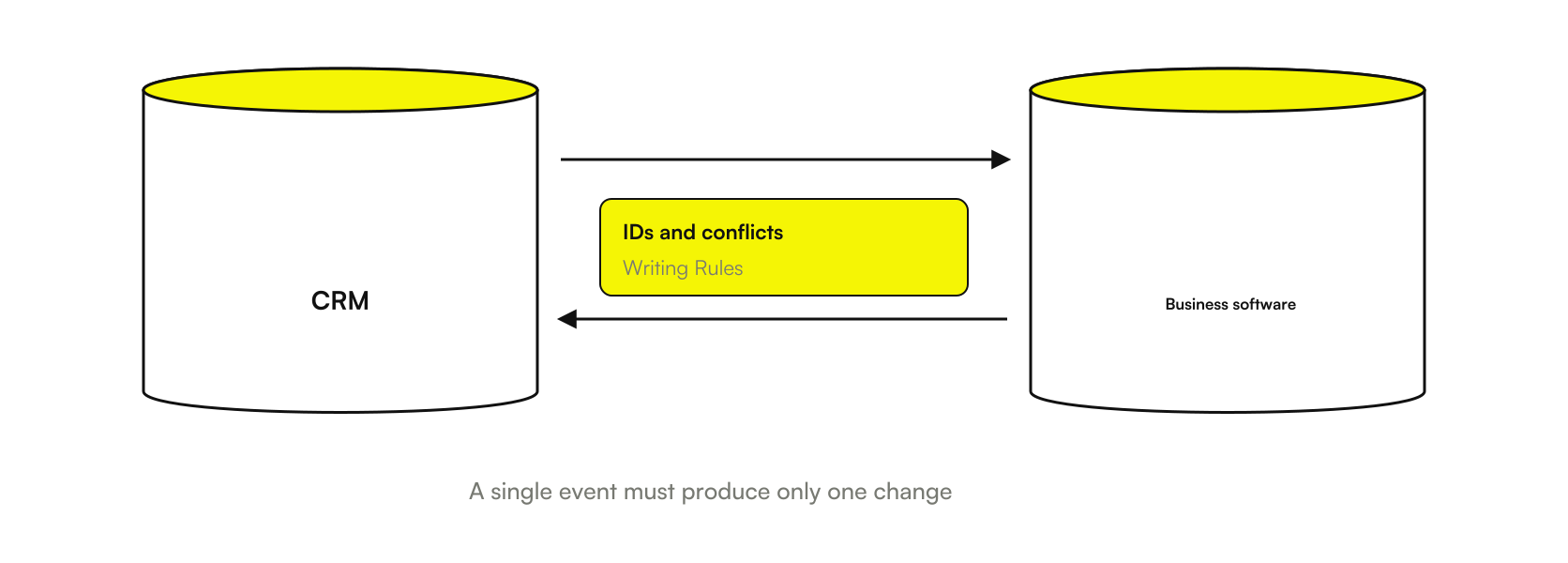
This table is an example of design, not a universal rule about applications. A company may assign different authorities. The matrix must be approved by those who use the data and those who respond to it. It must also indicate which changes are simple updates and which require additional verification.
For each value copied, it retains the source and time of reading. The timestamp of the message is not necessarily that of the change in the system. If the event arrives late, it should not seem more recent just because it was received later. The project must use the available information and report the limits when they are missing.
External IDs hold the two records together
It prepares a match between CRM identifier and management software identifier. It must be stable, controllable and able to distinguish different records. The company name can change or have variants; an email address can be shared by multiple contacts. These fields can help search, but they are not always a sufficient key. When identifiers are not enough to recognize a match, JEV for deduplication allows to study a separate comparison; the proposal does not replace the rules that set the authoritative record.
When the link does not exist, the system must decide whether to propose a new association or creation. The proposal shows the elements compared and the reasons for doubt. A case with two candidates remains open. The Guide on duplicates in CRM with AI addresses the control of similarities without automatically transforming them into identity.
Also define what happens to mergers and filings. If a record is merged into one of the systems, the map must not continue to write on an outdated identifier. Link modification requires a trace and verification of pending operations. Do not infer a deletion just because a search does not return the record.
Where can the model be useful?
The AI can extract a new contact person from an email, interpret a note or propose a free text category. The n8n Information Extractor documentation describes the preparation of structured fields from input. The result must be validated before entering the synchronization path.
For each proposed field, retain the supporting passage and distinguish an explicit fact from an interpretation. If an email says “for the next order, contact Marco”, the system must not permanently replace the administrative contact. The context may limit the proposal to one order or require a question to the operator.
An already structured date or verified code does not require a new interpretation at each transit. Use rules for format, authorization, and destination. The model must have a delimited task, not be inserted between two systems as a general arbiter of what seems correct. This also helps to understand the cost of his contribution.
What to do with two competing upgrades?
Before writing compare the read state with the current one, when the product offers version information or another supported control. If a colleague has already changed the data, the project must detect the change. Writing however can erase a newly executed fix and start a new sync spin.
The rule "win the last change" can only be adapted to defined fields and conditions. It must use a reliable notion of time and not ignore the authority of the source. For relevant data, a conflict queue with previous and new values, origin, and accountability may be required. The system must not hide the discordance inside a technical log.
The human tool review documented by n8n can support a confirmation pass. The person in charge must see what value will be written and where. If the record still changes during the review, the decision should be rechecked on the updated status.
Retry without duplicates and loops
It assigns an identifier to the transaction, distinct from that of the customer. The same customer can have many legitimate changes; the same attempt must not be applied several times as if it were new. Preserves origin, destination, intended content and outcome. This track allows you to decide whether to resume or check.
A timeout does not prove that writing has failed. The system may have recorded the data without returning a confirmation. Before the retry, verify the result via the available path. If the outcome is uncertain, keep a state to control. Blind repetition is especially risky for record creations and related activities.
Also prevent the update bounce. If the CRM receives a data from the management software and sends it back as a new change, the two streams can continue to reactivate. The project must recognize the origin and the changes already applied. A cycle can consume resources and make the history incomprehensible even without creating duplicates immediately.
What to show in the exception queue?
The operator must find the original practice, the two records and why the synchronization is stopped. Distinguish missing data, uncertain identity, insufficient permission, temporary error, and conflict. Possible actions must be relevant: correct, confirm the link, postpone or request verification.
A generic “integration error” does not help decision-making. If the management system rejects a field’s length, the model must not truncate the data without a rule. If a value is not allowed, show the proposal and the available options. Retain the original text when it is needed to reconstruct why the proposal was made.
The queue must have an owner and a re-opening criterion. After correction, only verify what is needed for the practice and record the new attempt. Do not use a generic command to restart the whole day if this can repeat operations already completed. The manual path must retain the same trace as the automatic path.
Hypothetical scenario: a distributor in Modena
In this hypothetical scenario the CRM contains business contacts and the management software contains administrative data and orders. The company starts the pilot on the referents per customer, with an ID map already verified. A message proposes a new interlocutor, but does not change the administrative information without the expected path.
The stream extracts the proposal and shows it to the commercial. Before writing, check that the referent has not been updated by a colleague. If it finds a change, it opens a conflict with the sources. The person decides whether the message concerns a single order or a stable update of the registry.
The test measures correct associations, detected conflicts and unduly propagated changes. Includes two clients with similar names and a timeout after a recording. The result is not assumed: the pilot must show if the cost of the review is sustainable and if the system avoids the errors that generate work today.
Hypothetical scenario: a service company in Siena
A second hypothetical situation concerns contracts and activities in the CRM, with billing in the management software. The project transfers a verified operational status, keeping the internal note distinct. The customer must not be marked as administratively regular on the basis of a commercial comment.
During the pilot a change arrives late and a record is stored in the other application. The stream must show both conditions, without automatically creating a new registry. The manager checks the link and decides the route. A mismatch remains visible until clarified.
The measure includes latency between event and available data, one-time completed operations, and exception work. A late updated data may be correct but useless for a decision already made. The project must assess the timeliness needed, without promising real time when the origin works for periodic exchanges.
An initial test with size and budget
Choose an object, few rules, and a conflict manager. In the first step, collect the changes in a comparison view, without writing them. Verify identity, authorities and proposed fields. Then try a limited path with test data, including repeats of the same event and competing changes.
It measures link errors, wrong record writes, duplicate operations, undetected conflicts, and operator time. The share of technically successful flows serves, but does not replace these measures. A procedure can end regularly after copying an old data. It is also necessary to check the content and its context.
Among current candidates for reading notes or messages you can evaluate Claude Haiku 5.5 on the sample. The choice must depend on the quality and cost observed for the task. The model must not gain the authority to decide field ownership or customer identity merely because it extracts text well.
The budget includes data mapping, checking master records, connections, event management, an exception queue and maintenance. Add the responsible staff’s work to resolve ambiguous cases. If the business management software does not offer a suitable connection, the guide to automation without API helps to evaluate exchanges and limits before designing two directions.
The availability of data for those who respond to the customer
When synchronisation powers a Assistant on Order Status, the data must arrive with its origin and update date. The assistant must not state that a delivery occurred because the CRM contains a more recent sales note. The relevant operational source remains the reference chosen in the project.
If a conflict is about status, the view used by customer care must make the limit understandable. An alignment delay should not be translated into "non-existent order". This step links quality of integration and quality of response: the model cannot compensate for a source that does not distinguish error, absence and delay.
Events to simulate before an extended synchronization
- The same event comes twice with the same identifier.
- The destination records the data but does not return a confirmation.
- A colleague changes the field between reading and writing.
- Two similar clients require an association proposal.
- A record is archived or merged while an event is waiting.
- A change returns to the source and risks reactivating the flow.
How to turn alignment into a delimited project?
Bring the list of fields to be synchronized, who can change them and a sample of anonymized real differences. The integration of existing systems needs to be defined around these decisions. You don't need to link the whole archive to prove that an object can travel properly.
With the service custom software You can build a link with verifiable identities, conflicts, and restarts. The first useful delivery is a limited synchronization that explains each write and leaves a manageable queue. Only after the test does it make sense to extend fields, applications and level of autonomy.
Giallo Studio guides: methodology and sources
How we apply it in the company
Related resources
 CRM automation with AI: keep your business system up to date
 Integrate business software with n8n: APIs, webhooks and HMAC signing
 Integrating AI into the systems you already have
 Duplicate CRM contacts: use AI to propose merges while keeping history
 Automating business software without APIs: options and limits
 AI assistant for order status: responses from verified data
 AI for businesses: a complete guide to getting started
 Copilot with CRM and business software: connectors and actions
FAQ
What is AI's role in synchronising a CRM and management system?
It can help interpret unstructured input and prepare proposed updates. Record identities, write rules and retries must be managed by the system. A model is not needed to copy a field that is already structured and verified.
Which system must prevail when the data differs?
Define the authoritative source for each field according to the business process. The management system may be the source for administrative data, and the CRM for a sales note. Do not apply a single precedence rule without checking the requirements.
How to connect the same customer in the two systems?
Use a stable mapping between internal and external identifiers. Similar names can support a proposal, but cannot confirm identity on their own. Ambiguous cases require review before a write.
How to avoid duplicates after a connection error?
Keep an operation identifier and check the outcome before repeating it. A response error does not prove that the recording did not happen. The retry must distinguish repetition of the same operation and new modification.
What happens if two people update the same data?
The system must detect the change and apply an explicit rule or open a conflict. The person must see values, sources and versions involved. The model should not silently choose the most plausible value.
How to measure the synchronization pilot?
Count correctly linked records, confirmed writes, conflicts and duplicates. Also measure latency and the work needed for exceptions. A workflow that ends without technical errors may still have updated the wrong record.