
Creating quotes with AI: how to speed up the process
How to write a quote with AI: what the brief should contain, how to instruct the model, what to check before sending it. Practical guide for SMEs.
Reading time: 9 min
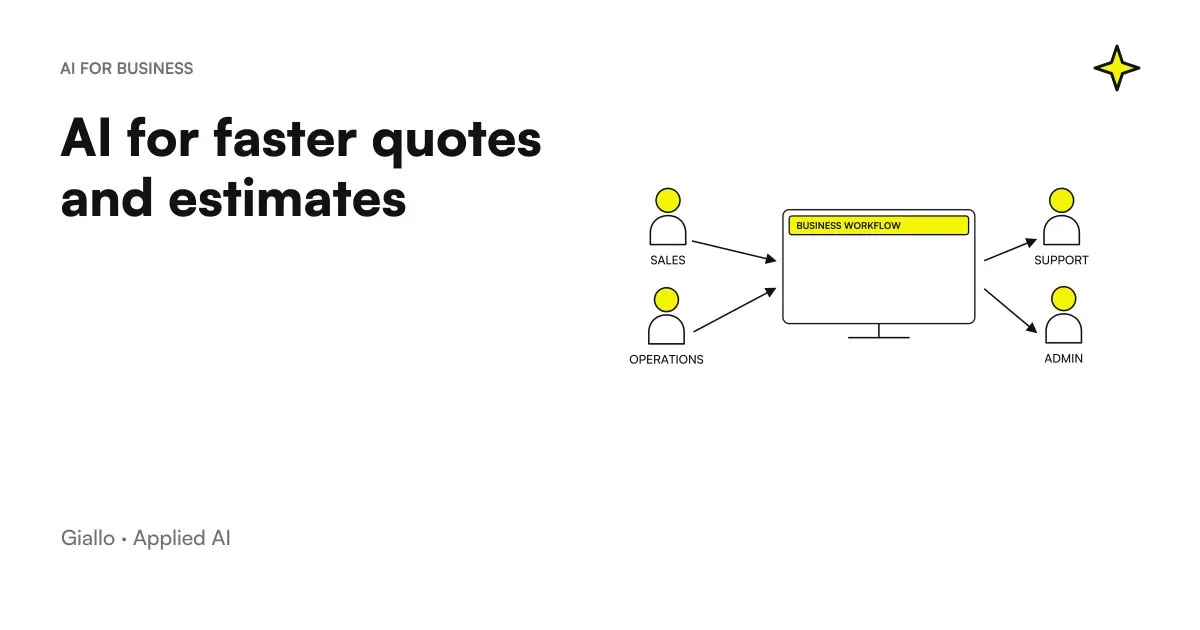
Writing a quote with AI doesn't mean you have a system that generates a ready-made document from an incoming message. It means using AI to read the client's brief, extract the points that matter and turn them into a structured draft, leaving to those who sell the part that requires judgment: the price, the tone, the specific conditions.
The difference between a useful draft and one to be rewritten from scratch almost always lies in two things that depend on who sets the job, not on the model itself: how complete the starting brief is, and how clear are the instructions on what AI has to do when something is missing. This article focuses on just that, the method of getting from a poorly written request to a reliable draft, not on integrating with the management system that handles all the rest of the process.
In summary
- The quality of the draft depends more on the brief and instructions than from the model used.
- AI structures and writes the entries; the price always remains a human decision.
- An explicit instruction on what to do when information is missing avoids fabricated rumors.
- This method is about writing the draft, not integration with management software.
- An incomplete brief must be corrected before writing the estimate, not after sending it.
What must be in the brief before writing a single line
A weak brief produces a weak draft, regardless of how sophisticated the tool used to read it is. Customer requests almost always arrive messy: a long email, a transcribed voice message, a form filled in in half.
Four pieces of information make the difference between a workable brief and one that only generates questions: what is required in concrete, in what quantity or with what scope, when an answer is needed, and whether there is a similar work already done to be referenced. When these four things are there, even misspelled, AI has enough material to build a sensible draft. When they are missing, the task of AI is not to guess them: it is to report them as questions to ask the customer before proceeding.
The brief almost always contains the contractor's personal data, not just technical information about the work required. Treating them to prepare a draft is part of the implementation of pre-contractual measures taken at the request of the person concerned, one of the legal bases provided for by the Article 6 of the GDPR: the customer asked for that quote himself, so it doesn't take a consent to the marketing to answer him. This changes if the brief also switches to an AI model outside the company: in that case it must be verified what the agreement with that provider on data processing provides.
| What happens in the draft | The AI does. | One person decides. |
|---|---|---|
| Brief reading and data extraction | Yes | Verify that nothing is misunderstood |
| Choice of which items to include | Propose them based on the historical | Add or remove non-standard entries |
| Textual description of entries | Yes | Customize the tone for that customer |
| Price and discounts | Show only a historical reference | Decide the final value |
| Reporting missing information | Yes, explicitly | Ask the customer the question |
| Document format and sending | Compile the standard template | Approve and Send |
How to structure an education that AI really follows
Here the most technical part is played, and it is also the most neglected. A generic prompt of the type "write a quote for this customer" produces a plausible document that often contains invented details: payment conditions never used by the company, service items that do not exist in its catalog.
A working instruction explicitly lists three things. First, the company's standard services, with a brief description of each: without this list, AI makes up plausible but generic descriptions. Second, the expected format of the document: header, structure of the entries, where conditions and validity of the offer go. Third, and most importantly, the rule about what to do when information is missing: clearly mark it in the draft, not complete it with a guess.
A good starting point is to show AI some quotes already written in the past, not to have it copied, but because from there he learns the tone and order of magnitude of prices typical for that type of work, information that he would otherwise have no way of knowing.
It is worth periodically updating these examples. A changing service catalog, a new price list, a revised document format: if the instructions stay still at the first version, the draft begins to look less and less like what the company really offers today. Reviewing the instruction every time something substantial changes in the catalog takes a few minutes and prevents errors from silently accumulating for months.
What to check in a draft before it becomes a real offer
- Each entry corresponds to a service that the company really offers, not to something plausible but invented
- The quantities and times reflect what the customer wrote in the brief, not a generic average
- There are no Terms of payment other than those that the company normally uses
- The price was decided by a person, not left to the historical reference value shown by the AI
- Any questions reported by the AI were addressed to the customer, not ignored
This check takes a few minutes when the brief was complete, and becomes the most important part of the job when it wasn't. Skipping it to save time is the most expensive mistake of the whole method: a wrong offer sent quickly weighs more than a warrant with a few hours delay.
A translation agency that stops recalculating every quote from scratch
Think of an agency that deals with technical translations, where each request varies by language combination, scope (legal, technical, medical) and volume of text to be translated. The brief almost always comes via email, in a different format each time: sometimes with the attached document, sometimes only with a word description.
With instructions listing the language combinations handled, the reference rates for each subject area and an explicit requirement to flag when the subject area is unclear from the text, the AI reads the brief, estimates the volume from the document if present and prepares a draft with line items already divided by language and subject area. The project manager reviews it, corrects it where needed, decides the discount for the returning client and sends it. In this example, time is saved not in negotiation but in avoiding the need to rebuild the same quote structure from a blank sheet every time.
A company that makes tailor-made interventions, where every estimate starts from an inspection
A different case concerns companies that cannot estimate without having seen the place of intervention. The technician makes the inspection, takes notes or records a voice memo, and only after you write the actual estimate.
Here the brief does not come from the customer but from his technician, and is often even more messy than an email: loose sentences, approximate measurements, materials mentioned with the name that is used in the construction site and not that of the list. By transcribing the memo and passing it with the same explicit instructions on services, format and reporting gaps, AI still prepares a structured draft with recognizable work items. The technician or owner reviews based on what he has seen in person, adjusts the quantities, decides the final price.
This method does not generate the estimate on its own, and it is wanted
It is worth being clear about what this article does not cover. If you look for how to connect the whole process, from receiving the request to entering the quote in the management software, without anyone touching it by hand, that is a different project, described in automation of quotes with AI. If on the other hand your problem is that the requests come as free text messages, for example on WhatsApp, and you want them to become automatically structured quotes, the specific treatment is in automatic quotations from free text.
This article deliberately stays on the middle passage: how to write a good draft when the brief still passes by a person who reads it and evaluates it. You can see the practical operation of this step in the demo of Automatic quotes with AI. Once approved by the customer, the quote often becomes the starting point of another document: tools such as Fatture in Cloud allow you to convert an accepted quote directly into invoice or order without re-entering the data, a step that is worth knowing even if it is not the central theme here.
Mistakes that make a draft worse than a blank sheet
An education that doesn't say what to do when information is missing. Without this explicit rule, AI fills in the blanks with plausible assumptions that no one controls until the customer notices them.
No history of real quotes to start from. An instruction without examples produces a generic style, recognizable and inconsistent with how the company usually writes.
Skipping the revision because "so much the draft already looks good". A plausible draft is not the same as a correct draft: human review remains the control that separates the two.
Letting AI value the price as well. The historical reference is useful, the final decision is not: it has no visibility on margins, team availability or on the specific relationship with that customer.
Clarifying the request before preparing the offer
A draft estimate is most useful when the initial request contains an understandable perimeter and the necessary information. The qualification of commercial requests with AI deepens this step: extracting the need, identifying the questions to be asked and assigning a manager, keeping the proposed priority and the definitive commercial commitment separate.
Where to start if every quote starts today from a blank sheet
The first step is not technical: collect about ten quotes already sent in the past and the template you use, even if it is not yet in an ordered format. From there you write the instruction with the three elements seen above: standard services, expected format, rule on gaps.
The most useful test is to try it on the next real brief that comes, comparing the draft generated with what you would have written. The corrections you make in that comparison become the next lines to add to the instruction. After a few cycles like this, the draft requires fewer and fewer interventions. To understand what happens after the quotation is sent, read AI for automatic follow-up; for the rest of the business process in which this step fits, AI for CRM and Sales covers the bigger picture. If the brief often comes via messy emails, AI to Respond to Business Emails addresses a similar issue applied to inboxes.
The quote remains the document in which a company shows up before even having started working for that customer: it is worth that the starting draft is already the right one, not a text to be redone. If you want to understand how to set this method on your real quotes, the AI consulting services by Giallo Studio They always start from a concrete case, not from a theoretical project.
Giallo Studio guides: methodology and sources
How we apply it in the company
Related resources
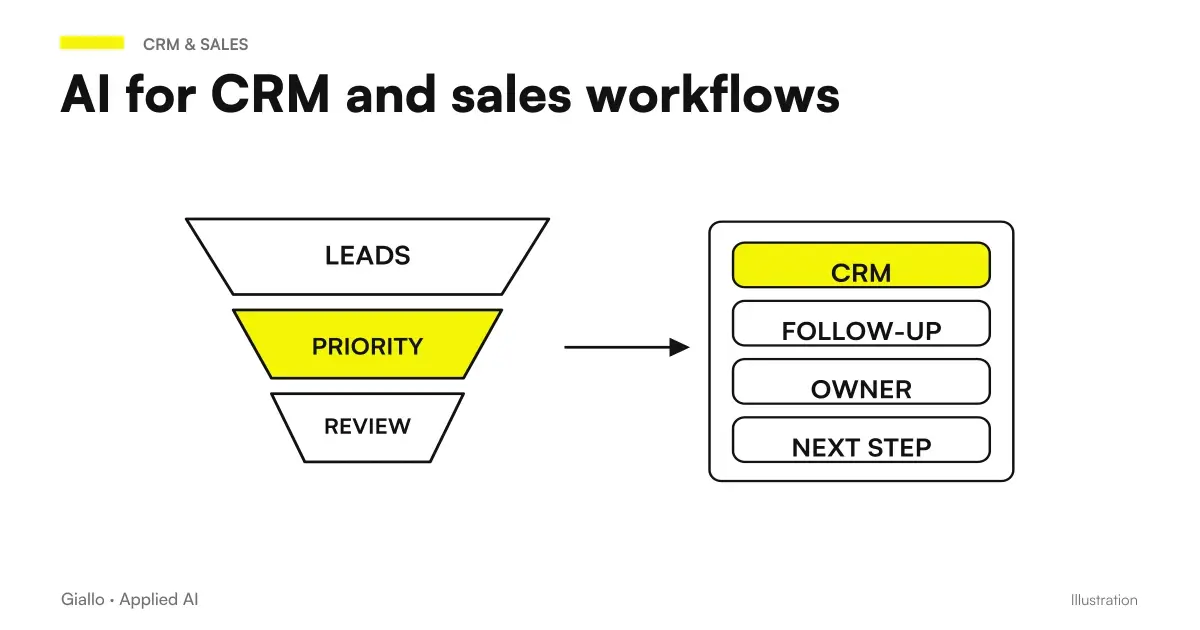 AI for CRM and sales: automate the sales process
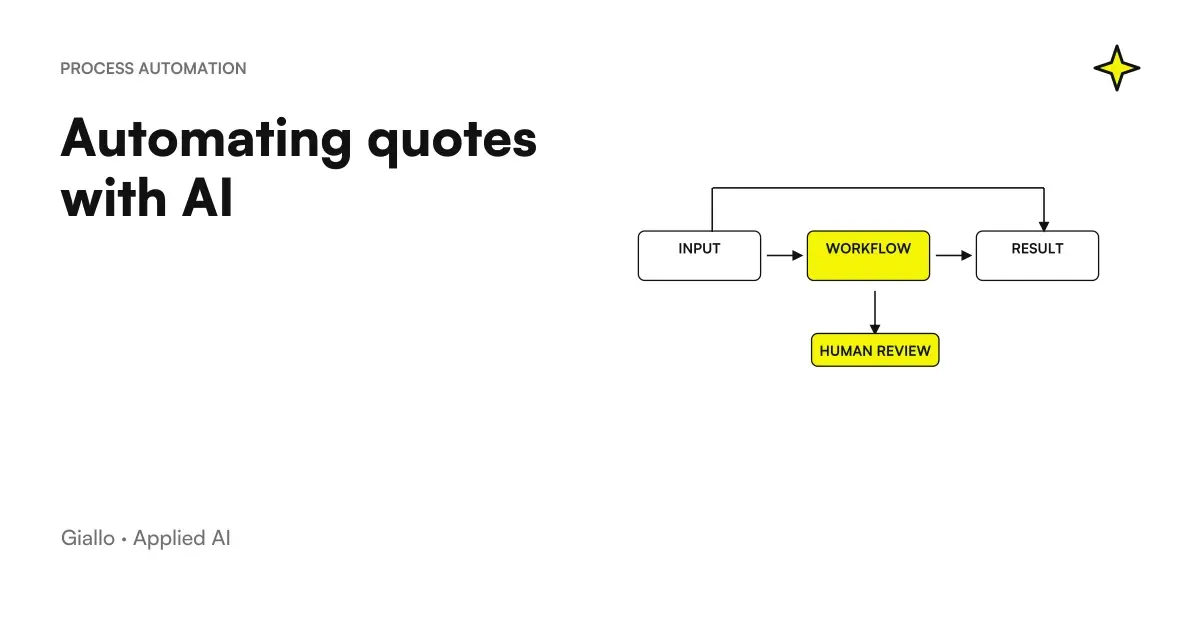 AI quote automation: save hours on every offer
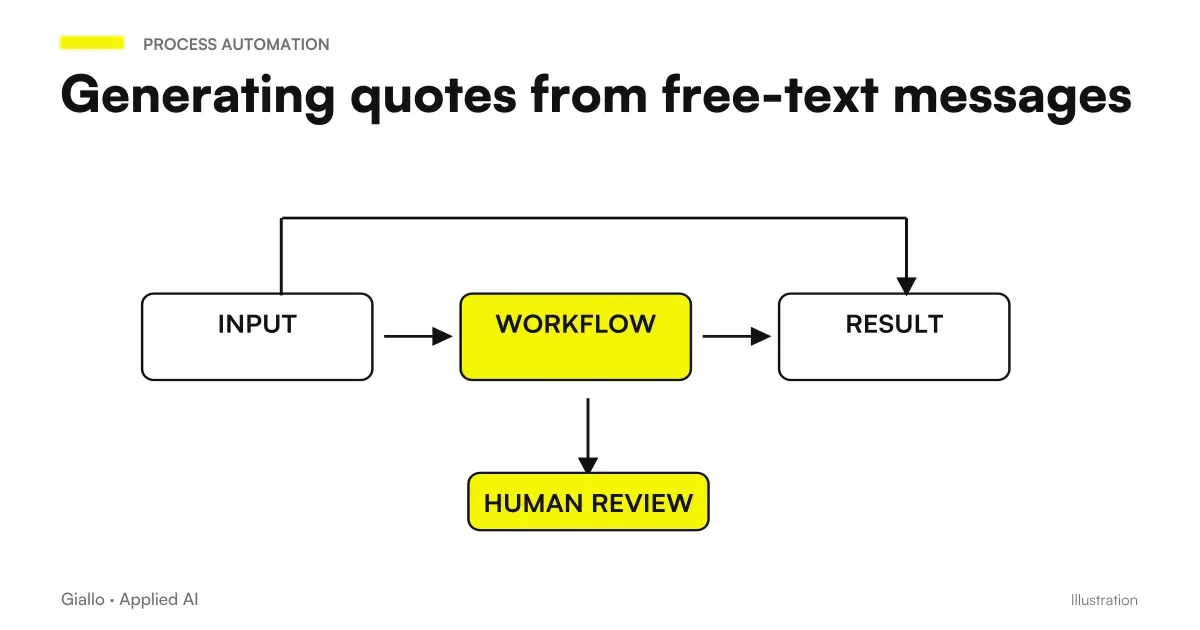 Automatic quotes from a free text message
 AI follow-ups: keep track of every contact
 AI to Respond to Business Emails: How It Works
 AI for gyms and sports centres: class bookings, medical certificates and memberships
 AI for consultants: proposals, client data and project delivery
 AI for estate agencies: leads, viewings, listings and documents
AI by sector
The same reasoning, applied to the other areas we follow.
- AI for Accounting: What It Can Really Do
- AI for CRM and sales: automate the sales process
- AI for consultants: proposals, client data and project delivery
- AI for Business Customer Care: How It Really Works
- AI for catering and banqueting: event quotes and customers
- AI for dentists and dental practices: recalls, quotes and scheduling
- AI for call centres: what changes?
- AI for e-commerce: compliant returns, product descriptions, discounted prices and reviews
- AI for businesses: a complete guide to getting started
- AI for electricians: wallboxes, solar power and installation deadlines
- AI for driving schools: enrolment, lessons and exam reminders
- AI for pharmacies: customers, service bookings and loyalty
FAQ
What does the brief have to contain for AI to write a useful draft?
Required service, quantity or scope of work, any time constraints, and a reference to similar jobs already done. A brief with only the customer name and a generic request produces an equally generic draft: the quality of the output depends almost entirely on what comes in as input.
Can AI set the price to put in the quote?
No. It does not know the company’s current margins, the team’s availability at that moment, or the specific relationship with that client. It can show a historical reference for what was charged for similar work, but the pricing decision always remains human.
How do you write an instruction that AI actually follows instead of inventing line items?
By explicitly listing the company's standard services, the expected format of the document, and what to do when information is missing, i.e. report it instead of guessing it. A vague statement produces a plausible draft but full of invented details that seem correct at first glance.
Does this type of AI replace business management software with integrated quoting?
No, it answers a different question: how to reach a good draft from a poorly written request. Business management software with integrated quoting handles the entire subsequent process, from approval to invoicing, and is a complementary project rather than an alternative.
What to do if the client's brief is too vague to write a draft?
The generated draft must explicitly report what is missing, not fill in the gaps with assumptions. The clarification questions return to the customer before building the estimate, not after: correcting a draft already sent costs more time and more credibility than asking before.
Should the data contained in a customer's brief be treated in a particular way?
They must be treated like any other data collected to respond to a pre-contractual request from the customer themselves, with the corresponding legal basis under the GDPR. If the brief is also passed to an AI model outside the company, check what the agreement with that provider says.