
AI for craftspeople: custom quotes, job orders and electronic invoicing
AI for craft workshops: enquiries with photos and measurements, quotes, job tracking, electronic invoicing and the term “artigianale” under Law 34/2026.
Reading time: 12 min
The AI for Artisans serves in the part of the trade that is not done at the counter: understand a request arrived on WhatsApp with three photos and no measure, prepare the estimate of a custom piece, answer to those who ask at what point is his table, collect the data for the electronic invoice, write the card of an object for the site. In a shop with two or three people this job does not have a dedicated office and almost always ends on the owner's evening.
It is the definition of law that puts manual labour at the centre: for the framework law on crafts, it is the artisan entrepreneur who guides the enterprise by "predominantly carrying out his own work, even manual, in the production process" (law 443/1985, art. 2). A well-educated AI assistant takes the repetitive part of the desk and leaves you the decisions: price, measurements, dates, words with which you present your work.
This guide talks about workshops and workshops that work on order: carpenters, blacksmiths, upholsterers, restorers, tailors, potters. Those who install plants find their case in the articles for Hydraulics ed Electricians, who leads construction sites in that on the Restructuring Companies.
In summary
- In a shop that works on order AI helps in five moments: the request, the estimate, the status of the job, the invoice and the texts for showcase and social.
- From the photos the assistant understands what work is needed and asks for the missing measurements, but not fit in your place: for a custom piece the measurement remains yours.
- In the contract of work, if the price has not been agreed upon the judge shall determine it: a quote accepted in writing close the matter before we begin.
- From 1 January 2024 the electronic invoice also applies to the flat-rates, whatever the revenues: the AI can prepare the data, sending it you check it.
- By Law 34/2026 the word ‘artisan’ in the promotion is up to those who are enrolled in the register and realize the product directly, and should be written as a rule in the instructions of the assistant.
A request with three photos and no measurements: the questions the assistant asks for you
The typical request comes this way: «how much does a bookcase cost for this wall?», with two crooked photos and no number. You read it on the van, you answer in pieces between jobs and after twenty messages you still have half a card. An assistant connected to WhatsApp or email can ask the questions you would ask immediately, in the right order, and pass the request to you only when it is complete.
The multimodal models, those who also read the images, recognize a niche, a radiator under the window, a rusty gate, an armchair with a broken seat. From a photo without references do not get reliable measurements, and they must not try. Their task is to understand what work it is and ask what is missing.
- The measures written by the customer, with the point from which he took them: width of the niche, height from floor to ceiling, footprint of skirting boards and radiators.
- Material and Finish in his words, to be traced back to your voices: solid or lacquered, galvanized and painted iron, sample fabric or brought by the customer.
- Where do you do the work: all in the shop with pick-up, home delivery or assembly on site, with floor, elevator and width of stairs.
- The Times: a date to be respected, such as a move or an opening, or no rush.
- Who is the customer: private or business, with the data that will be used for the estimate and then for the invoice.
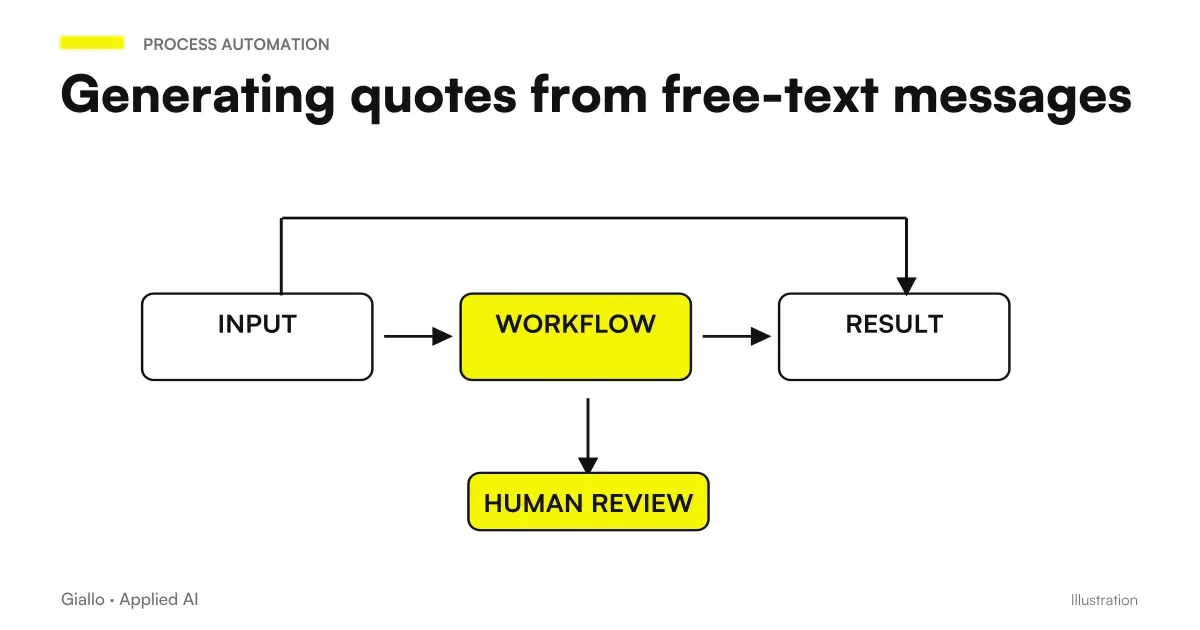
The place matters more than it seems. The law provides that the craft company works in a fixed place, at the owner's home, in special rooms, "in another location designated by the customer" or in a walking or parking form (Art. 3). If the assistant knows that on Tuesdays you are at the assembly by a client and on Saturdays at the market, she stops proposing inspections at impossible times. The transition from the free message to the sorted tab is described in the guide to quotes from a message in free text.
The quotation of a custom piece: what to write before taking the down payment
When you commit yourself to carrying out a work or service "with mainly your own work and without the obligation of subordination", the Civil Code speaks of a work contract (Art. 2222). The price rule is net: if the consideration has not been agreed and is not derived from tariffs or uses, it is determined by the judge on the basis of the result and the work normally needed (Art. 2225). A written and accepted quote avoids getting there.
The AI prepares the draft from the request form and from your internal price list: bench hours, materials, hardware, transport, assembly, collection of the old furniture. At the bottom he adds the items that are forgotten: delivery times, down payment, validity of the offer, works excluded as wall works, plants and painting. The price you decide, and if the card lacks a measure the draft reports it instead of estimating it. The method is explained in the guide on how to write a quote with AI, and the demo from the brief to the draft estimate shows the whole flow.
The assistant must also know where the quote is signed. If the customer is a consumer and signs at his home during the inspection, the contract is negotiated outside the business premises, and the Consumer Code excludes withdrawal for ‘the supply of tailor-made or clearly customized goods’ (Art. 59). A repair follows other rules. The text to put at the bottom of each type of quote you decide with your trade association or with a lawyer, AI uses the right model for each job.
"Where is my table?": the sales board that answers for itself
After the down payment the work enters the shop and the customer begins to ask. They are legitimate and always the same questions: the wood has arrived, when it mounts, I can pass to see. If the status of each clerk is written somewhere, even in a shared sheet, the assistant responds by reading that and does not interrupt who is working.
Think of a carpentry shop that works on commission, with the owner and an apprentice: kitchens, wall cabinets, doors. Each order has few states: accepted, ordered material, in processing, in finishing, ready, assembled. When the holder moves it to "ready", the customer receives two day proposals for assembly. When the client asks where it is, the assistant replies with status, and with a date only if someone has written it down.
The rule that matters is this: the assistant does not promise dates that he does not find written. A model left free answers "by the end of the month" because it sounds kind, and in the shop a date said out of kindness becomes a commitment. How to set up an assistant on WhatsApp explains the guide to WhatsApp chatbots for businesses.
Repairs and restorations: photos and dates to keep if the customer disputes
The regulation identifying the sectors of artistic and traditional workings includes among the traditional workings "the activities of restoration and repair of objects of use" (DPR 288/2001, Art. 1). It is also the work in which a contest, months later, is played on dates and photographs.
For the contract of work the Civil Code sets short deadlines: the client must report discrepancies and hidden defects within eight days of discovery, and the action is prescribed within one year of delivery (Art. 2226). If, on the other hand, you work for a consumer and the contract serves to provide him with a good to be manufactured, such as a new bookstore, the Consumer Code equates it to the sale and its compliance rules apply (Art. 128). What discipline applies to your work you verify it with the association or with a lawyer.
Think of a restoration workshop that receives a family chair with one leg glued badly. Upon acceptance the assistant records the date, the photos of the item as it arrived and the customer's request; on delivery he adds the final photos and the date. If the client rewrites months later, the assistant does not discuss responsibility: he picks up the message, retrieves the card and passes it on to you.
Electronic invoice also for the flat rate: what the AI prepares and what you control
Even the shop in flat-rate regime today issues electronic invoices. Decree-Law 36/2022 extended the obligation from 1 July 2022 to those who had revenues or compensation over 25,000 euros and from 1 January 2024 to all others (Art. 18, paragraph 3).
Invoices pass through the Exchange System. For the flat rate the Revenue Agency indicates to choose the flat rate scheme in the field of the tax regime, to put the VAT rate to zero with nature "not subject - other cases" and to report the wording on the law 190/2014; in the Invoices and Fees portal there is a model already set (Agency page on flat rates).
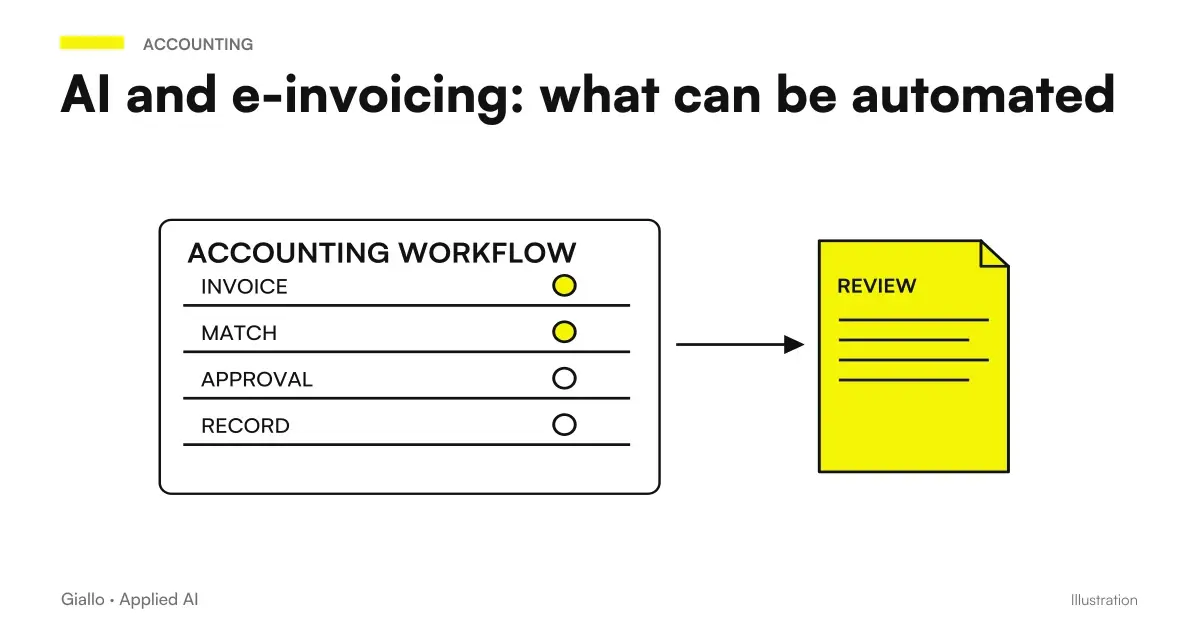
The AI works upstream, on the data of the clerk. When an order goes to "delivered", it puts together customer, lines of the accepted quote, agreed variants and amounts already collected, and signals what does not return: a VAT number that is missing, the virtual stamp to be activated on invoices that require it, a variant said by voice and never written. The bill issues your schedule after you've looked at it, and on tax doubts the accountant decides. The rest of the ride is in the drive on AI and Electronic Billing.
«Artisan» on the website and on social media: the rule to be written in the AI instructions
Ask a language model to describe a walnut chopping board and it may write "artisanal" in the first line. From 7 April 2026, that word needs to be used carefully. The annual law on small and medium-sized enterprises rewrote Article 5 of the framework law: no business may refer to crafts or artisanal production in its business name, sign, trademark or "in the promotion of its products or services" unless it is registered in the register and directly produces or makes the products it presents as artisanal (Law 34/2026, Art. 16).
The penalty is 1 percent of the turnover, with a minimum of 25,000 euros for each violation, and the regional authority imposes it. The Ministry of Enterprise specifies that it is not immediately applicable, because autonomous regions and provinces must first adapt their laws, and that promotion must be understood "as broadly as possible" (MIMIT's FAQ on Article 16). For a laboratory it means rereading with that site eye, product cards, posts and trade show tags.
From the Ministry's answers a table is obtained to pass to the assistant:
| Your situation | «Artisan» in promotion | What AI Can Write |
|---|---|---|
| Company registered in the register, piece made by you | Yes | «Artisan», with how you did it and with what materials |
| Non-registered VAT number, handmade piece | No | ‘Made by hand’, ‘made to measure’, ‘of own production’, ‘made with traditional instruments’, if true |
| Sell pieces made by enrolled artisan enterprises | Yes, for those pieces | The name of the lab that made them |
| Use a component provided by a craftsman | Only for that component | Which part is artisanal, without extending it to the whole product |
| Hobbyist or VAT number at markets | No | The same alternative expressions |
Think of a potter who is not enrolled in the register who sells cups at the Saturday market and on his own site: the assistant who writes his texts uses "handmade to the lathe" and never "crafts". A registered shop that also sells dishes from another registered workshop can call craft both. If you have doubts about your registration, ask your association: for the framework law the registration to the register «is constitutive» and is a condition for the facilitations reserved for craft enterprises (Art. 5).
Where an AI assistant mistakes most often in the workshop
- Measures estimated from the photos. If the instructions do not prohibit it, a model proposes plausible dimensions. In a custom-made work a plausible measure is a piece to be redone.
- Prices without price list. Without your internal price list the entries are filled with plausible figures taken who knows where. The entries come only from the price list, and what is missing remains empty.
- Make promises, please. The assistant reads the order board, and if the date isn't there he says he informs you and passes you the question.
- "Artisan" in every sentence. A model describing a handmade object willingly uses it: after the law 34/2026 it decides the table above, not the style.
- Answers on the merits of a dispute. Apologies, discounts or written admissions from the AI remain written. Disputes pass to you, with the card.
- Photos of customer homes in free chat. A photo of a stay can show people and documents: stay in your archive and only pass from services with a contract for data processing, as the guide on Business Data and AI.
Which office job to start from if there are two of you in the shop
Before touching anything, write down for a while how it goes today: how many requests arrive, how many remain unanswered, how many quotes you write at night. Then choose the first step based on how you work.
Work especially at the customers' home: fitting, laying, repairs
Start with the request form and the quote. These are the two steps you take today from the van, and the ones where a missing data costs you a second inspection.
Sell in the shop, online and at fairs pieces made by you
Start with the texts: product cards, availability answers, messages for those who have ordered a custom piece. First write the rule about «crafted» that applies to your business.
Works for other undertakings, on behalf of third parties
It starts with orders and invoices: read orders that arrive by e-mail, get the order with quantity and delivery, prepare the invoice data when the work is done. Here the assistant talks little to people and a lot to documents.
Two rules apply anyway. The assistant who writes to customers must say that it is an AI: the AI Act requires that systems intended to interact with people be designed to inform them, and the obligation applies from August 2, 2026 (EU Regulation 2024/1689, Article 50); the other obligations for a small business are summarised in the guide to AI Act for SMEs. And the customer must be able to get to you with a message, always.
If you want to understand which of these steps can turn on its own in your shop, with the tools you already use, we start from the real requests of your customers: that's where a project of process automation made to measure for a laboratory. For a larger picture on small businesses there is the page AI for SMEs.
Giallo Studio guides: methodology and sources
How we apply it in the company
Related resources
 Creating quotes with AI: how to speed up the process
 Automatic quotes from a free text message
 AI and e-invoicing: what can be automated
 Multimodal AI: what it is and how it works
 WhatsApp Chatbots for Business: How It Works and When It's Best
 AI for renovation firms: changes, SAL progress reports and site documents
 AI for veterinary clinics: recalls, prescriptions and pet owners
 AI for travel agencies: quotes, packages and assistance to travellers
AI by sector
The same reasoning, applied to the other areas we follow.
- AI for automatic appointment scheduling
- AI for insurance agencies: renewals, quotes and complaints
- AI for travel agencies: quotes, packages and assistance to travellers
- AI for car rental: renter fines, contracts and return damage
- AI for marketing agencies: content, reports and AI labels
- AI for driving schools: enrolment, lessons and exam reminders
- AI for procurement and supplier management
- AI for businesses: a complete guide to getting started
- AI for wedding planners: suppliers, deadlines and guest data
- AI for call centres: what changes?
- AI for veterinary clinics: recalls, prescriptions and pet owners
- AI for catering and banqueting: event quotes and customers
FAQ
Can I have the AI write "artisan" in the descriptions of my products?
Only if your business is registered in the register of craft enterprises and makes those products directly: this is provided for in Article 5 of Law 443/1985, rewritten by Law 34/2026. Businesses that are not registered can use expressions such as "handmade", "made to measure", or "made in-house", provided these are not misleading, as indicated by the Ministry of Enterprises. It is worth writing the rule into the assistant’s instructions so it applies to every product page and every post.
Why have the estimate accepted in writing even for a small job?
Under a contract for work, if the payment has not been agreed and cannot be determined from tariffs or customary practice, a judge sets it (Article 2225 of the Italian Civil Code). An accepted quote stating the price, timeframe, deposit, and excluded work removes uncertainty before work begins. AI prepares the draft and records acceptance; you decide the price.
Can AI derive measurements from photos the customer sends to WhatsApp?
Not reliably. It can understand what work it takes, read the measurements that the customer has written and ask for those that are missing, such as the width of the niche or the height of the ceiling. For a custom-made piece the measurement remains yours, on site or in the workshop.
I am a craftsperson under Italy’s flat-rate tax regime: must I issue electronic invoices?
Yes. Under Decree-Law 36/2022, the obligation has applied to taxpayers under the flat-rate regime since 1 January 2024, regardless of revenue. The Italian Revenue Agency explains how to fill in the flat-rate regime fields and provides a preconfigured template in its Fatture e Corrispettivi portal.
A client disputes a restoration delivered: what does the assistant have to register?
The delivery date, the date and text of the complaint, photos of the item on arrival and delivery, and what the client is requesting. For a contract for work, the Italian Civil Code requires hidden defects to be reported within eight days of discovery and sets a one-year limitation period from delivery for bringing an action (Article 2226). Assessment remains with you and, if necessary, your trade association or a lawyer.
If the client signs the quote at home, can they later withdraw?
It depends on what you supply to them. For contracts with consumers concluded outside business premises, the Consumer Code excludes withdrawal for custom-made or clearly customized goods (Article 59), while for repairs and services the rules are different. The text to be included in each type of quote must be decided with your association or with a lawyer.