
Artificial intelligence: what it is and how it works
Artificial intelligence explained simply: how it works, types of AI, real examples, limitations and practical business use.
Reading time: 12 min
The Artificial Intelligence (AI) is a set of technologies that allow a software to perform tasks that would normally require human intelligence: understanding language, recognizing images, making predictions, making simple decisions and generate content. In practice, it is a program that instead of following handwritten rules learns patterns from data and uses them to produce the most likely answer.
The important thing to understand right away is this: AI doesn't "think" or "understand" as a person. It recognizes regularity in huge amounts of data and, starting from these, calculates the most plausible output. It works great for many practical tasks, but precisely for this reason it can also make mistakes with confidence. Know how It works is what separates those who use AI methodically from those who use it hoping it will work.
In this guide we see what artificial intelligence really is, how it works, what types exist, where it makes sense to use it in the company and what its real limits are.
In summary
- The Artificial Intelligence makes a software perform "smart" tasks by recognizing patterns in data, not by applying handwritten rules.
- The Machine Learning is the most widely used method today: software learns from examples; the Deep Learning is the version based on deep neural networks.
- The Generative AI (ChatGPT, Claude, Gemini) creates text, images, and code by predicting the next most likely element.
- AI produces the most response likely, not the certainly true one: it can invent data (hallucinations) and should always be checked on critical points.
- For an SME the value lies not in the technology itself, but in the Choosing the Right Process to lighten and measure the result.
What "artificial intelligence" means
The term Artificial Intelligence emerged in the 1950s and describes the field that studies how to make machines perform activities considered "intelligent". This umbrella covers very different approaches, from old rule-based systems ("if X happens, do Y") to current models that write text or drive a car.
Today, when we talk about AI in work, we almost always refer to systems based on machine learning (machine learning): software that improves one's ability to perform a task as they are exposed to more data and examples.
A useful distinction is between AI restricted and AI General:
- Limited AI (narrow AI): it's good a task type. A text-translating model, one that recognizes faces, one that predicts sales. It's all the AI that exists today, including ChatGPT.
- To General (AGI): a hypothetical intelligence capable of facing any task as or better than a human. Does not exist: it's research and debate, not a product you can buy.
When a supplier promises "AI thinking like a human being", you are reading marketing. The AI useful in the company is the narrow one, applied to a precise problem.
How Artificial Intelligence Works, Step by Step
Almost all modern AI follows the same basic pattern: you start from the data, you train a model, it is used to make predictions about new data. Let's see it as operational flow.
- Data. We collect examples: texts, images, transactions, emails. The quality of the data determines the quality of the result. "Garbage in, garbage out" always applies.
- Training. An algorithm analyzes examples and adjusts millions (or billions) of internal parameters as long as it learns to link inputs to the correct outputs.
- Model. The result of training is the model: a mathematical function that, given an input, returns a prediction.
- Inference. In production the model receives never-seen data (your email, your question) and generates the most likely answer.
- Control and improvement. You measure errors, correct data or instructions, and iterate. Without this step the system does not improve.
The heart: learning from examples instead of rules
The leap from traditional software is here. In a classic program, a human writes each rule: "if the subject of the email contains 'invoice', move it to the Administration folder". It works as long as the cases are few and predictable.
With the Machine Learning don't write the rules: you show the system thousands of emails already sorted and he learns alone the patterns that distinguish one category from another. It's more powerful because it handles new nuances and cases, but it's also less transparent: you can't always know exactly why decided so. To deepen this mechanism you can read the guide on How Machine Learning Works.
Because today AI seems "exploded"
Three factors matured together: data available in huge quantities (everything is digital), computing power low cost (the GPUs) and algorithms better (deep neural networks, or Deep Learning). On this basis, great language models such as ChatGPT were born, which made AI accessible to anyone who can write a sentence.
What types of artificial intelligence exist
Not all AI is the same. To orient yourself, here are the families you meet most often at work, with what they do and an example.
| Type of AI | What it does | Concrete example |
|---|---|---|
| AI predictive | Predicts a value or category from historical data | Estimate of sales of the month, risk of abandonment of a customer |
| Generative AI | Create new content (text, images, code) | ChatGPT, Claude, Gemini who write an email or report |
| Artificial vision | Interpret images and videos | Quality control on a production line, plate reading |
| Language Processing (NLP) | Understands and classifies text | Automatic ticket sorting, review sentiment analysis |
| Recommendation Systems | Suggests the most relevant item | Related products in an e-commerce, next sales action |
| AI agents | Perform sequences of actions towards a goal | A AI Agent that reads an email, updates the CRM and prepares a draft reply |
Most useful business projects combine two or three of these families. For example: NLP to understand a customer's request, generative AI to write the response draft, an agent to insert it into the management software.
What artificial intelligence is used for in the company
Here is the practical point: AI in an SME is not used to "do futuristic things": it is used to remove repetitive manual work and to reduce errors in processes that already exist. The most solid cases are few and recurrent.
- Back-office and administration: read documents, extract data, fill in fields, sort emails.
- Customer support: answer frequently asked questions, classify tickets, suggest the answer to the operator.
- Sales: qualify leads, prepare quotes, write custom follow-ups.
- Content and marketing: first draft texts, product descriptions, summaries, translations.
- Internal knowledge: look for answers in business documents with a system of Type RAG, instead of always asking a colleague.
The common thread is that AI handles the part repetitive and low risk, while the person maintains the final decision. When this balance is clear, the return is measurable. If you want an organic overview to start, the guide AI for businesses It collects processes, costs and priorities.
Practical examples
Three realistic scenarios of Italian SMEs, to make the speech concrete.
1. Accounting firm — sorting documents. Every day dozens of emails arrive with attachments (invoices, F24, contracts). An AI system reads the attachment, understands what document it is, renames it, and stores it in the correct client folder. The operator only checks for doubtful cases. Typical result: less time spent on storage, less documents lost.
2. E-commerce — product descriptions and assistance. For a catalogue of 800 items, generative AI writes a first draft description based on the actual technical sheet (not invented adjectives). In parallel, an assistant answers shipping and return questions around the clock and hands complex cases to a human. The team reviews and publishes instead of writing from scratch.
3. Service business — quotes. The salesman pastes the customer's request; the AI extracts the key data, proposes the quote entries based on the history and prepares the draft in the company format. The person corrects the prices and sends. The time for quote drops from tens of minutes to a few.
In all three cases the point is not "AI does everything", but "AI does the first draft, the human decides". It's the model that works.
When it makes sense to use AI and when not
When AI is convenient
- The task is repetitive and high-volume.
- There are data or examples to be based on.
- A small margin of error is tolerable (or there is a human review).
- The process is already defined: you know what goes in and what has to go out.
When to Avoid It (For Now)
- The process is confusing or changes every time: first they need to be fixed.
- Every mistake has serious consequences and there is no human control.
- The data is few, dirty or non-representative.
- You're trying to "put on AI" for fashion, without a measurable problem.
Practice rule: AI doesn't fix a broken process, it speeds it up. If you automate chaos, you get chaos faster. First you measure the flow, then you automate.
Mistakes to Avoid
- Treating output as truth. AI produces the most likely response, not the verified one. On numbers, standards and customer data always needs a check. See the AI Hallucinations.
- Starting with the tool and not the problem. "Let's buy an AI tool" is the wrong premise. It starts with the time-consuming process, then you choose the tool.
- Feeding sensitive data without criterion. Entering personal data of customers in public tools can violate the GDPR. Rules are needed on what you can and cannot share.
- Expecting you to learn your own processes. A generic model does not know your company: it should be guided with context, instructions and, where necessary, your documents.
- Skipping measurement. Without a "before" and an "after" (hours, mistakes, times) you will never know if AI is giving you value or just the impression of modernity.
How to apply it in the company
Introducing AI in a sensible way is a short and repeatable path, not a big project.
- Find the process that hurts the most. What repetitive activity steals more hours or generates more errors? Start from there, not from the "coolest" case.
- Measure the starting point. How many hours, how many errors, how many days of waiting today. Without numbers there is no ROI.
- Choose the minimum instrument. Often a ready-made AI assistant connected to existing tools is enough, not custom-made software.
- Keep the human in control. AI prepares, the person approves, especially in the first few months.
- Measure again and decide. If the numbers improve, extend; if not, change approach. One confirmation at a time.
This is exactly the kind of work for which there is a AI Consulting: understand where it is really convenient to intervene and avoid spending on tools that no one will use.
Conclusion
The Artificial Intelligence It is not magic or threat: it is a very powerful statistical tool that recognizes patterns in data and produces the most likely output. Understanding how it works really helps to use it well — by taking advantage of its speed on repetitive tasks and by keeping the person where judgment and responsibility are needed. For an SME the advantage does not come from having "AI", but from choosing the right process, measuring it and improving it step by step. From here you can continue with Generative AI and with AI Automation to see how these bricks become real flows.
Do you want to understand what processes in your company can be automated with AI? Giallo Studio can help you turn the problem into a real workflow — or take a look at the experiments of The Lab.
Giallo Studio guides: methodology and sources
How we apply it in the company
Related resources
 Artificial intelligence: concrete examples from everyday life to work
 Generative AI: What It Is and Why It Matters
 Machine learning: what it is and how it works
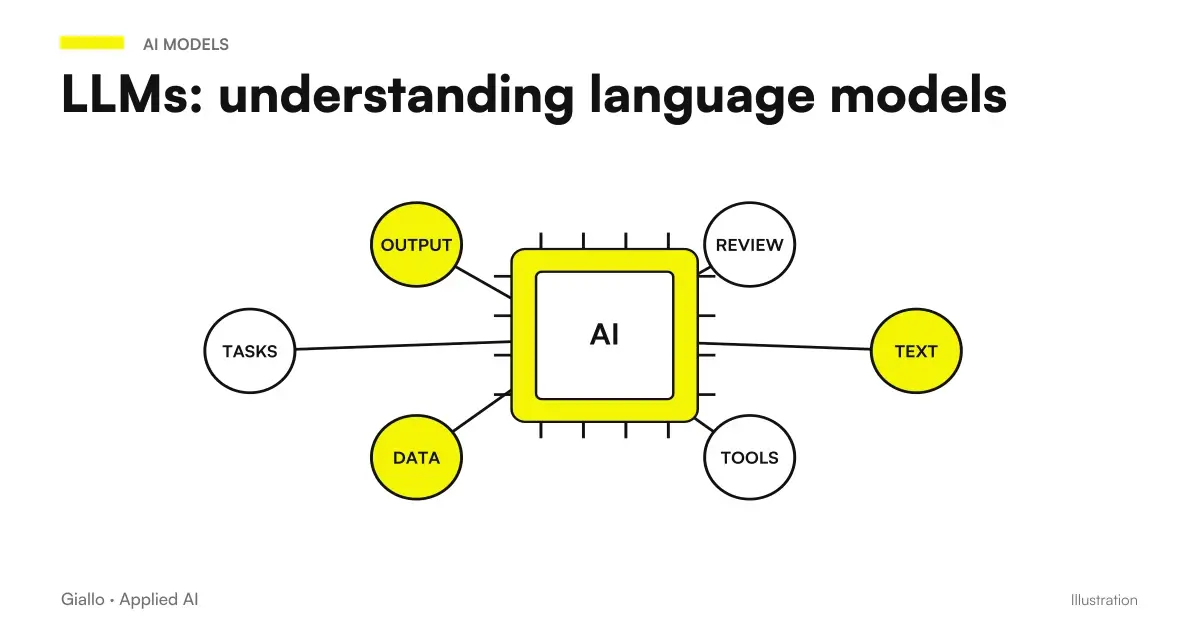 LLM: What Language Models Are
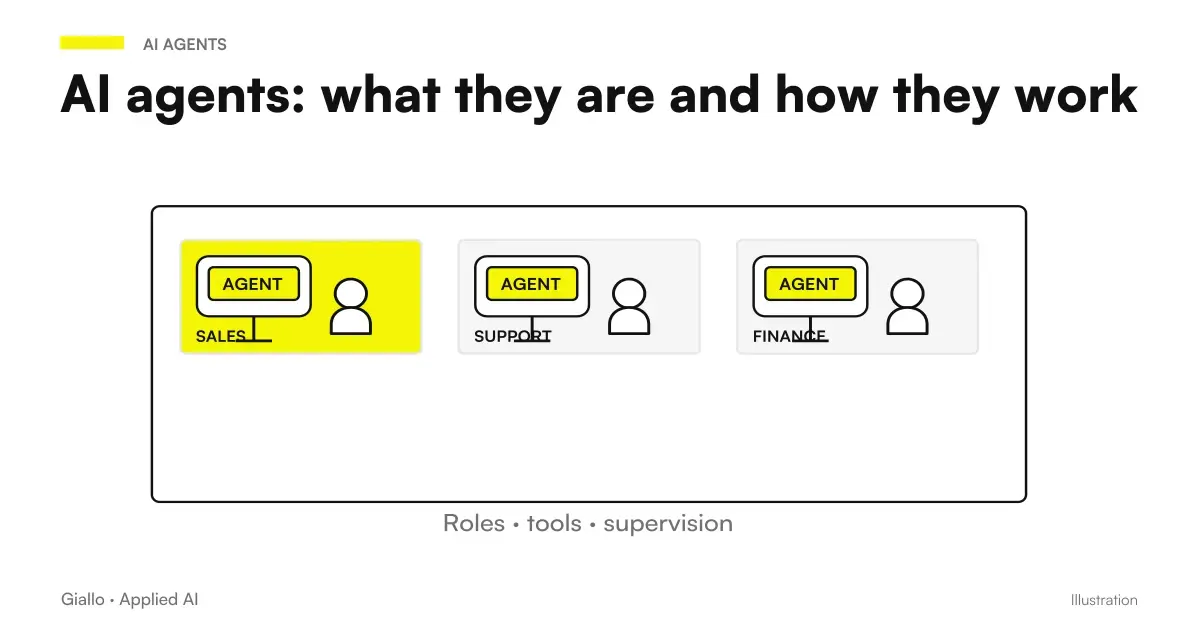 AI agents: what they are and how they work
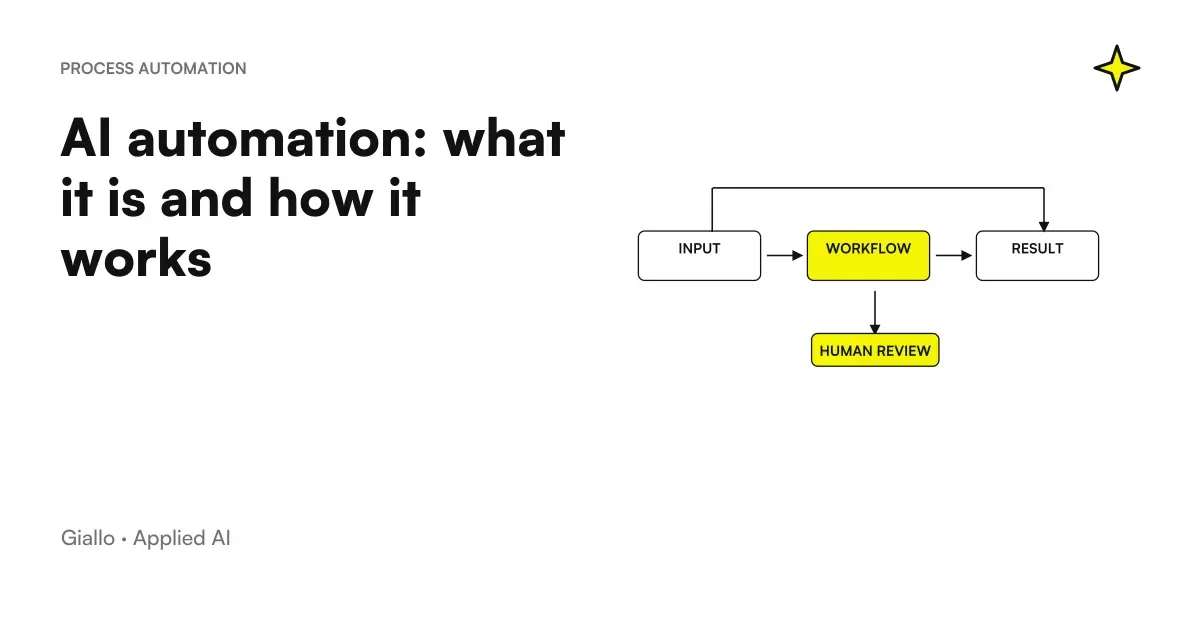 AI automation: what it is and how it works
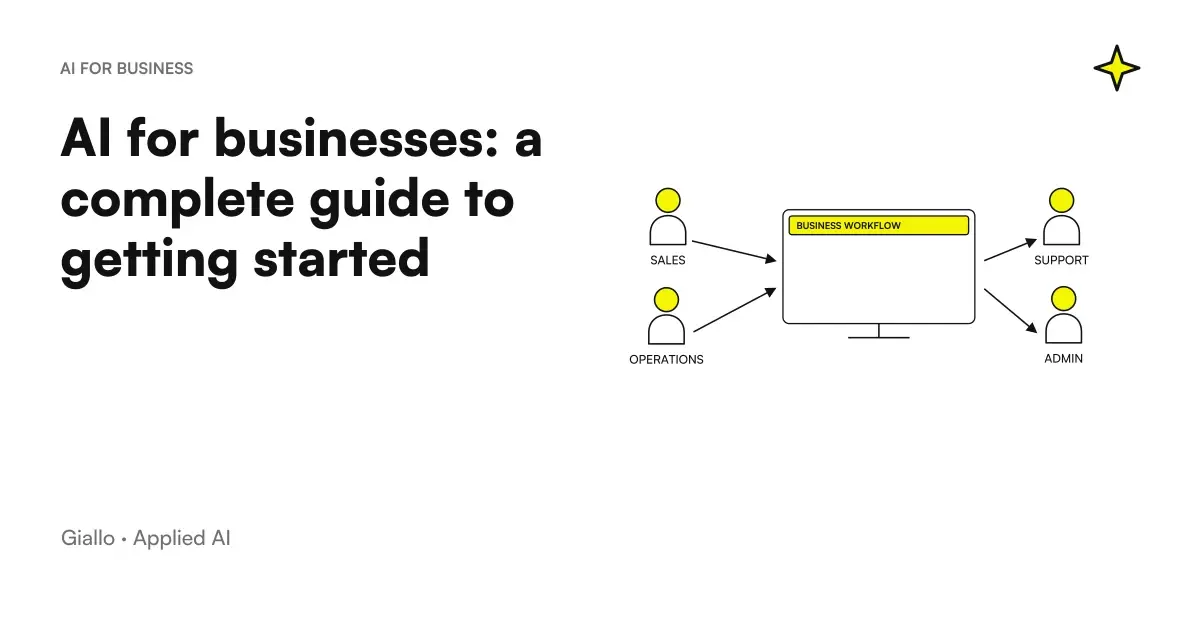 AI for businesses: a complete guide to getting started
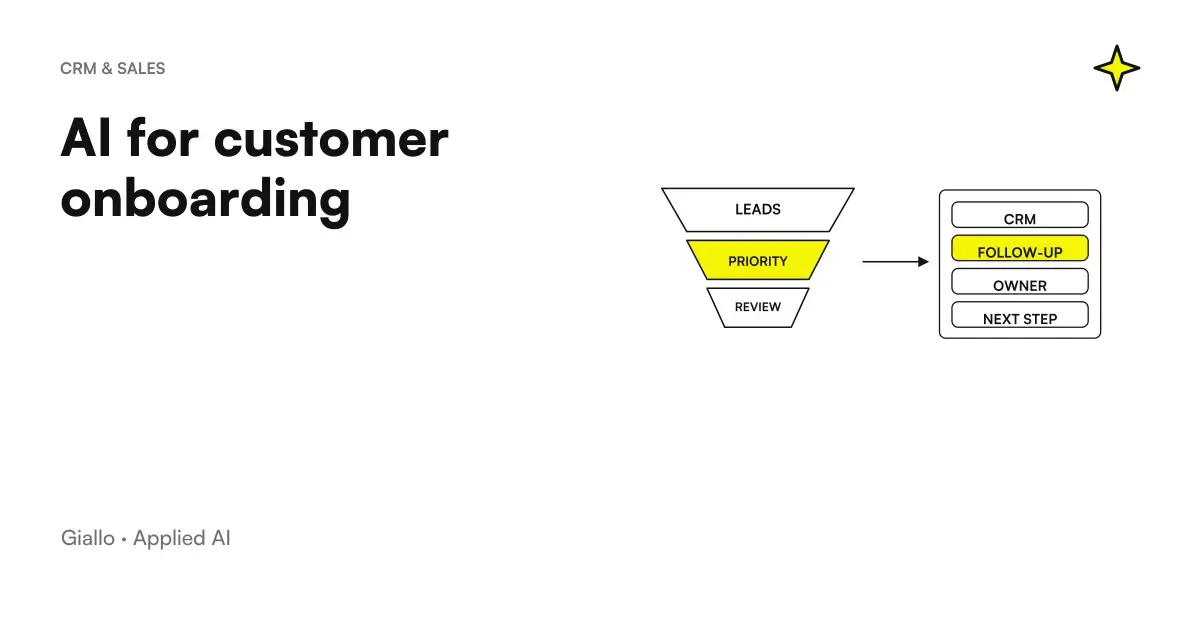 AI for customer onboarding: automate the first moment that matters
FAQ
What is artificial intelligence in simple terms?
Artificial intelligence is a set of technologies that allow software to perform tasks that usually require human intelligence: understanding text, recognising an image, predicting a value and generating a response. It does not reason like a person: it recognises patterns in data and uses them to produce the most likely output.
What is the difference between artificial intelligence and machine learning?
Machine learning is part of artificial intelligence. AI is the goal (getting a machine to perform 'intelligent' tasks); machine learning is the method most commonly used today to achieve it, meaning that software learns from examples instead of having every rule programmed by hand.
Can artificial intelligence be wrong?
Yes, and often. An AI model produces the statistically most likely answer, not one that is certainly true: it can invent information (hallucinations), reflect biases in the data or get rare cases wrong. This is why business processes always need human review at critical points.
Do you need to be a tech company to use AI?
No. Most SMEs use AI through ready-made tools (assistants, automations and agents) connected to existing software such as email, CRM and business management systems. You do not need to build models from scratch: you need to choose the right process to make less burdensome.
How much does it cost to introduce artificial intelligence into a business?
It depends on the use case. An initial workflow based on existing tools can start with a few hundred euros a month in licences plus the configuration work. Custom projects (agents, integrations and dedicated software) cost more but are assessed on their return: hours saved, errors avoided and response times.
Will AI replace people's work?
Rather than replacing entire professions, AI replaces individual repetitive tasks within a job: copying and pasting, routing, first drafts and summaries. Value shifts to decisions, quality control and customer relationships, which remain human.