
Sorting emails and attachments with AI: a single queue for sales and administration
AI email routing for SMEs: requests and attachments in one queue, categories, owners and ambiguous cases. Verify that each request is picked up.
Reading time: 12 min
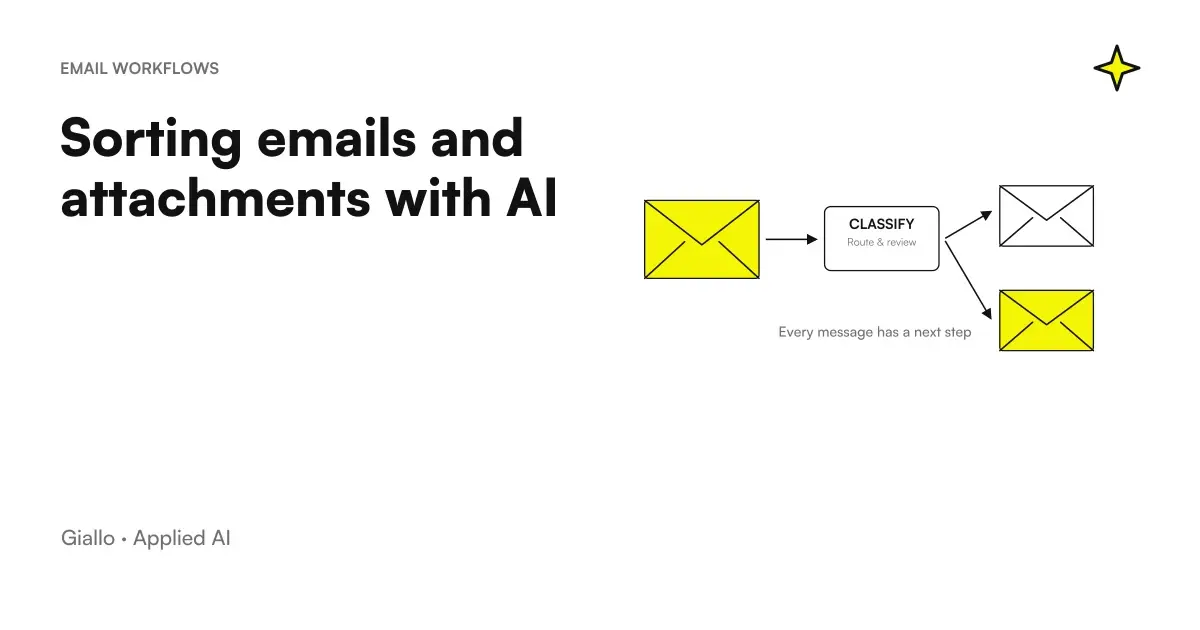
Email sorting with AI assigns a full request to the appropriate queue and handler, keeping text, attachments and missing information connected. His first result is a take charge proposal. Writing or submitting a response is a later task, with its own sources and permissions.
For an SME the problem is seen when the same box receives commercial requests, administrative documents and operational reports. Moving the message to a folder is not enough if the attachment remains out of practice or no one becomes responsible. The flow must make visible who intervenes and what it takes to get started.
The technical primitives described here are documented at 9 October 2026; the scenarios are hypothetical. For the adoption framework starts from AI for businesses, while driving to the Email Automation It also deals with answers and other mail passages.
In summary
- The practice must include message, attachments and references of the request.
- Classes have a recognizable description and manager.
- An ambiguous case remains in a review queue, without disappearing.
- A request with two themes may have related activities and a referent.
- Proper category and actual handling were different.
What categories are needed to sort corporate emails?
Start with the real demands, not the department names. "Sales" may include demand for supply, modification of an order, and demand on features. “Administration” may include billing, requesting data, and contesting a payment. A class should describe the reason for the request and the expected operational step. The department comes later, through an assignment rule.
n8n documents a Text Classifier in which categories have name and description. Allows a single class or multiple classes and a residual branch for inputs with no clear match. They are usable capabilities to design triage, not a proof of accuracy on your company's emails. Text Classifier Documentation.
Define classes through examples and boundaries. An order confirmation should not be treated as a quote request just because it contains a price. A report on a document is not always a complaint. For each category write what it includes, what it excludes and to whom it should be proposed. Include short messages, attachments without explanation, and requests with inaccurate language.
Do not multiply classes by each client or language formula. If two classes always lead to the same path and the team fails to distinguish them, consider whether the difference is useful. If, on the other hand, a distinction changes the person responsible or the intervention time, make it explicit. Taxonomy is for work, not showing how complex the classifier is.
How to keep message and attachments together?
Create a practice with a stable reference and link the original message, attachments, and the relevant thread. Keep the received text and the synthesis produced by the system distinguishable. Synthesis helps the referent to orient themselves, but does not replace the source when it has to verify a detail. A sentence such as "document attached" also requires checking if the expected file is present.
| Field of Practice | Utility | Control Needed |
|---|---|---|
| Message Reference | Finding the Source | Avoid new practice for the same entry |
| Sender and Account | Identify the context | Distinguish customer, intermediary and forwarding |
| Proposed reason | Prepare the queue | Compare with text and attachments |
| Present Attachments | Make the file complete | Type, readability and relevance |
| Missing data | Preparing for the Next Step | Separating Absence from Unread Data |
| Maintainer | Make the assignment operational | Confirmation of taking charge |
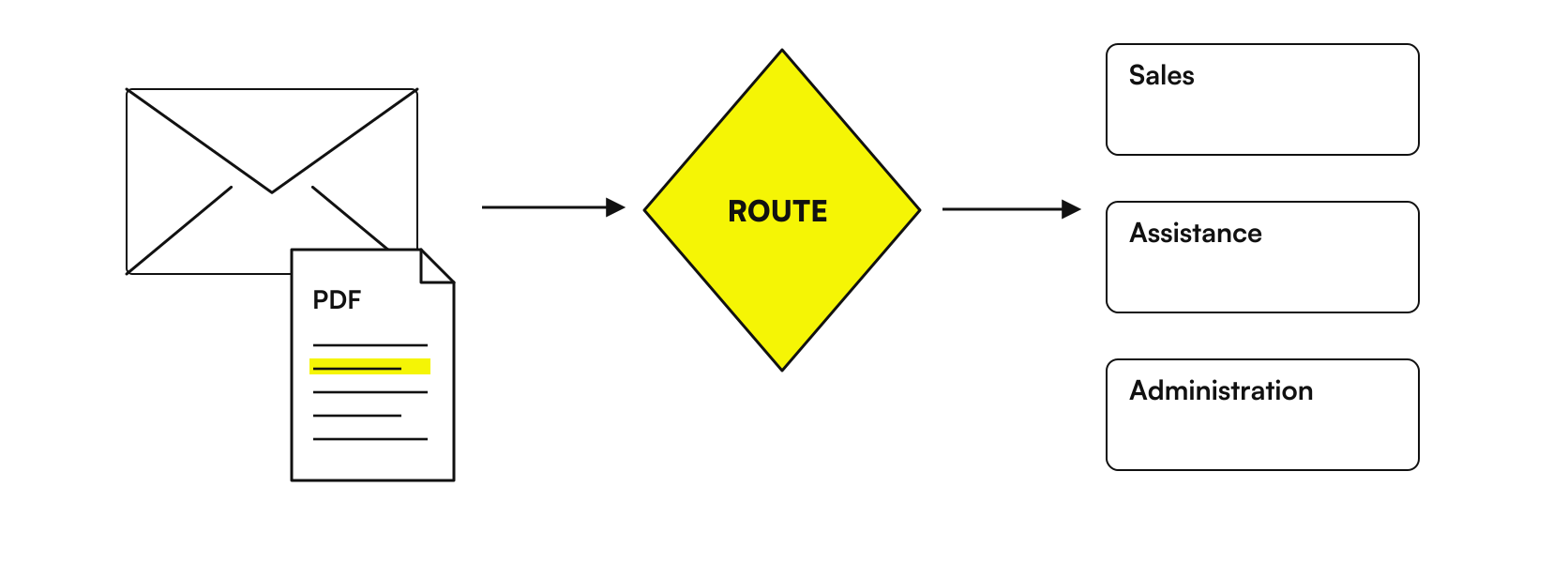
A file present does not amount to a valid document for the request. It can be an old version, an unreadable image or an attachment related to another supply. The stream should report the anomaly without erasing the source or inventing the missing content. The operator must be able to open the document and understand why the request was marked incomplete.
For a first test use appropriate demo files and accounts. When switching to real data, define what information is needed for triage and who can see the practice. If a department needs to know only part of the content, do not automatically distribute the entire thread. The project requires an access map consistent with the work that each role must play.
What to do when an email contains two themes?
A request can ask for an offer and contest an invoice in the same message. Forcing her into a single class can make one of two needs disappear. Multiple classification is a documented primitive, but operational management must be designed: two categories must not generate two incompatible responses or two unbound practices. n8n Text Classifier.
You can propose a main contact person and related activities. The referent sees the entire request and coordinates what other departments require. Each activity retains its own object, source, and state. If the salesperson prepares a proposal while the administration verifies a dispute, no one should consider closing the email just because their piece is completed.
Establish even when not dividing. A message can only quote an invoice to identify a supply; it is not necessarily a second administrative theme. The revision must look at the need, not the presence of the word. A short motivation, such as "calls for an order change and a balance verification", helps the operator to correct the proposal without reclassifying everything from scratch.
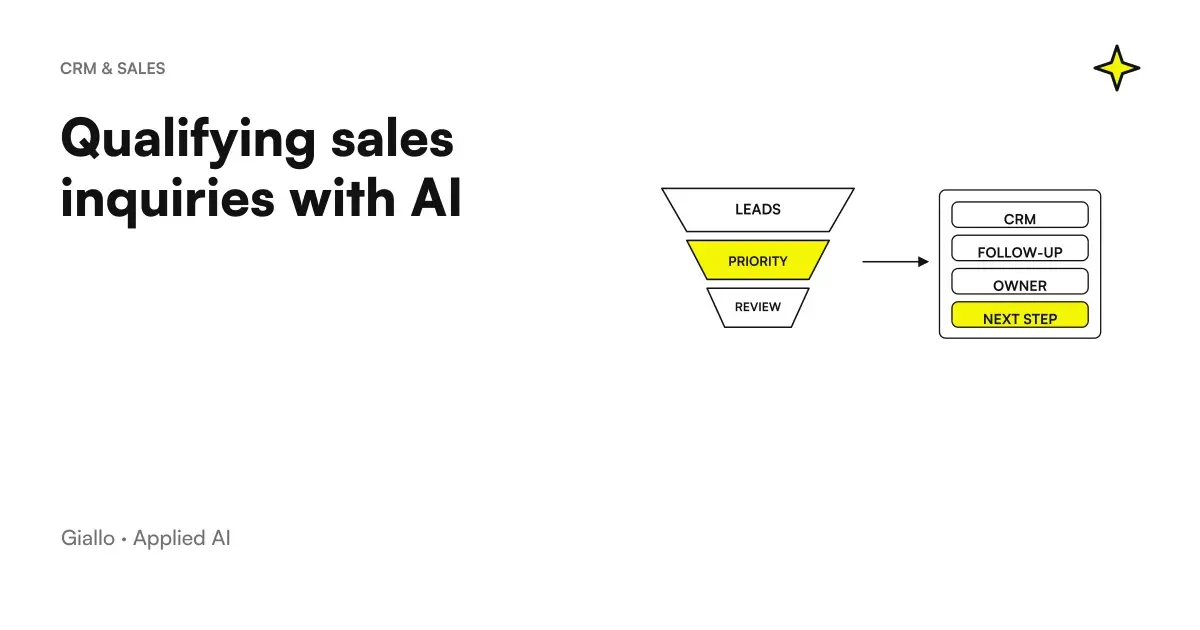
For delicate cases, the path of customer complaints with AI deepens the management of the dispute. The qualification of commercial requests Instead, it enters the necessary fields after the request has been recognized as commercial. The sorting must lead to these processes without attempting to carry them all in the same passage.
How to build the “other” queue without losing messages?
The remaining queue must have an owner. “Other” cannot be a collection that nobody checks. n8n documents both discarding the item and adding a branch when no match is found; in the proposed process, choose a path that keeps the case awaiting review visible. Classifier Options.
An uncategorised request can be a new case, an incomplete message, or a reading problem. Preserve the reason for the uncertainty when it is available, but do not treat a model score as objective evidence. The operator assigns the correct class and annotates if a category is missing or if it is sufficient to improve the existing description. This feedback makes the revision useful to the project.
The human passage must be concrete: recipient of the revision, information received and way to resume the flow. n8n documents examples of human fallback for AI workflows. The feature shows that the move can be designed, not that your team is already organized to manage it. Official Human Fallback.
Review sheet for an ambiguous request
Show original message, attachments, candidate classes and reason for proposal. Ask the contact to choose category, responsible and next step. Keep the status "to be verified" until the case is taken over. If the problem is an absent or unreadable document, separate it from a category doubt.
When does the assignment become a real takeover?
An assigned practice is not yet worked. Define a state that shows when the referent saw it and accepted the next step. Without this distinction, the system can produce a perfectly neat queue while the demands remain firm. The metric must therefore also measure the path from the reception to the first take charge.
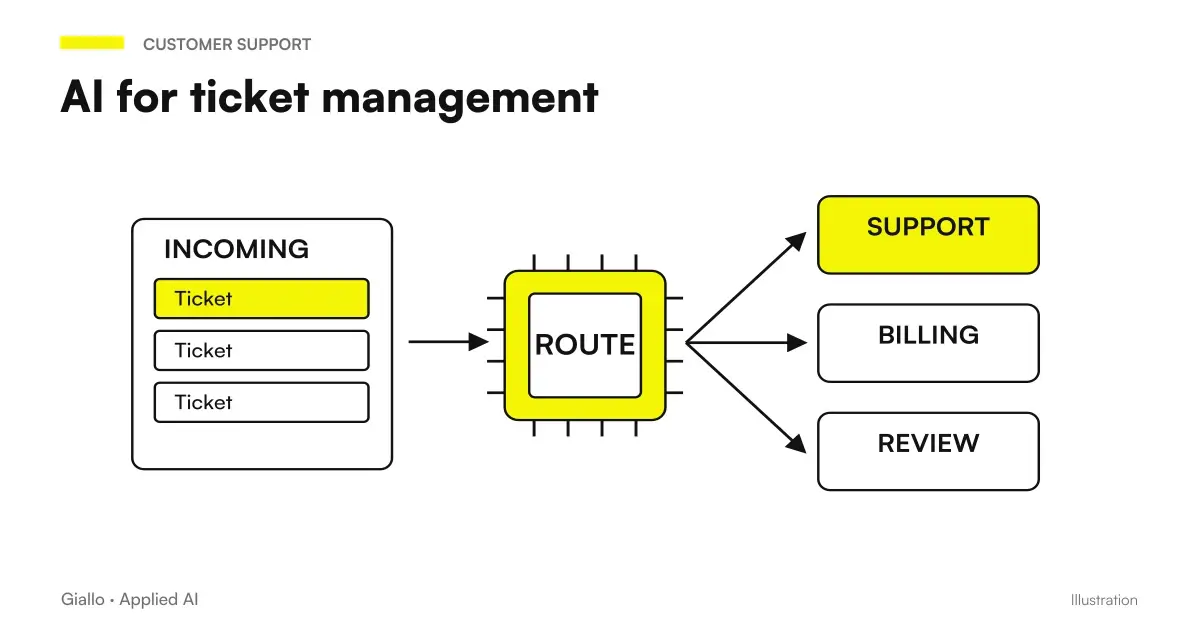
Predict the absentee and out-of-compete requests. The operator must be able to reassign the case while retaining the motif and the link to the source. Avoid repeated rebounds between departments: when no one accepts, the coordinator must see the obstacle. The Guide on AI for ticket management expands the issue of states and responsibility in operational work.
The queue should show the next action rather than only a coloured category. “Verify attachment” or “confirm sales contact” are more useful instructions than “high urgency” without a reason. If urgency comes from a date written by the sender, report it as a statement; if it comes from a business rule, make the applied rule identifiable.
Two hypothetical scenarios for Italian SMEs
A distributor receives an order and an administrative application
Imagine a Lombard distributor receiving an order PDF and a question about the previous payment. The stream proposes two themes, preserves the message and links the activities. The sales representative checks the new request; the administration checks the status of the previous supply. A coordinator keeps it visible that the overall email still contains an open point.
The attachment must arrive at the commercial practice with its reference. If the PDF is unreadable, the queue signals the limit instead of preparing invented lines. The next step is the import of PDF orders into management software, which has controls other than classification only. The scenario does not prove that a specific integration is already available.
A technical study receives materials from multiple interlocutors
Imagine a Venetian studio receiving a forwarded message with tables and request for a quote. The forwarding sender does not necessarily coincide with the customer. The stream proposes the category and indicates which contact person must confirm the identity, requested service and completeness of the materials. The operator keeps the original document visible instead of relying only on synthesis.
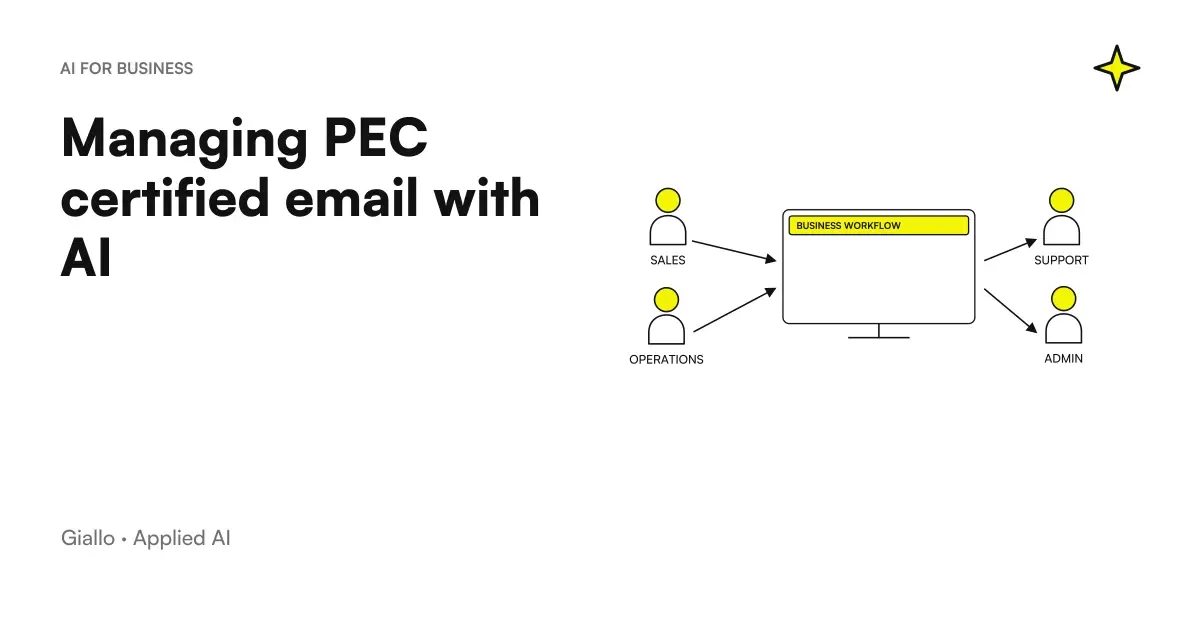
If a PEC arrives on the same project, the studio uses a path that stores message and receipts, described in the PEC management with AI. It does not treat the certified box as a simple ordinary mail folder. The same request may have different sources, but the person responsible must know which one is relevant to the decision he is making.
How to measure the pilot and set the budget?
Create a sample with representative categories and problem cases, using material appropriate to the test. A contact person prepares the expected assignment; the system produces proposals; the review compares category, attachments and manager. It records class errors, lost requests, omitted themes, and take-up time. Do not call "accuracy" the mere fact that the flow returned a result.
It also measures the work of correction. If the classes are correct but each practice needs to be rewritten, the process may require a different format. If the "other" cases increase, verify taxonomy and sources before changing model. Acceptance thresholds are agreed according to the consequences of the error; there is no universal percentage that makes any assignment safe.
The budget includes mail connection, class preparation, processing, review and maintenance. A test expense limit is a business choice to be agreed upon, not a standard price. Ask how his approach is reported and who decides whether to expand the sample. For the economic method you can use how much it costs to automate a process, without inferring unmeasured savings.
How to correct sorting when a request bounces?
A case reassigned several times deserves a review of the route. Look who received the practice, what data was available, and why the department rejected it. If a stated competence in the rule is missing, correct the assignment. If the category is too generic, it improves the boundary. If the attachment did not arrive at the card, the problem is the structure of the request, not the tone of the classifier.
Collect the reason for the correction in a usable form. “Wrong” does not explain how to improve the flow. "Request on existing supply, to be passed to the operational contact person" identifies the border. The team can then verify other similar cases without adding a rule based on a single customer name or an isolated word.
Also check for new emails in the same thread. An answer can integrate a missing data or change the need. The system must maintain the link and show what information is new. Do not consider each message an autonomous practice and do not ignore it simply because the first message already had a category. The referent must be able to see the relevant update at the next step.
The correction should remain on the case that showed the problem. Do not immediately enlarge the project to send or update the CRM to compensate for a fragile sorting. A useful queue stores the request, explains the assignment, and allows the handler to work. If one of these elements is missing, the pilot indicates precisely which part to improve before introducing other actions.
Which mistakes should you avoid, and how can you start with your queue?
Avoid undescribed categories, message-separated attachments, referent-free residual queues, and automatic mailings added to the triage without a decision. Another mistake is classifying the object by ignoring the content or treating each word "urgent" as an operational priority. The flow must explain what it proposes and leave the path correctable.
Start from a box, a request group, and an internal output. When the triage is readable, evaluate the transition to response, in-depth in AI to Respond to Business Emails. If you want to set your sales and administration queue, bring an anonymized example to Giallo: the path of automation of business processes can start with classes, attachments and responsibilities, before linking external actions.
Giallo Studio guides: methodology and sources
How we apply it in the company
Related resources
 AI for businesses: a complete guide to getting started
 Email automation with AI: how it really works
 AI to Respond to Business Emails: How It Works
 AI for ticket management: shorter waits, more resolutions
 PEC management with AI: sort messages, attachments and receipts without losing the thread
 Qualify sales enquiries with AI: missing data, priorities and assignment
 Customer Complaints with AI: Priorities, Facts, and Responsibilities
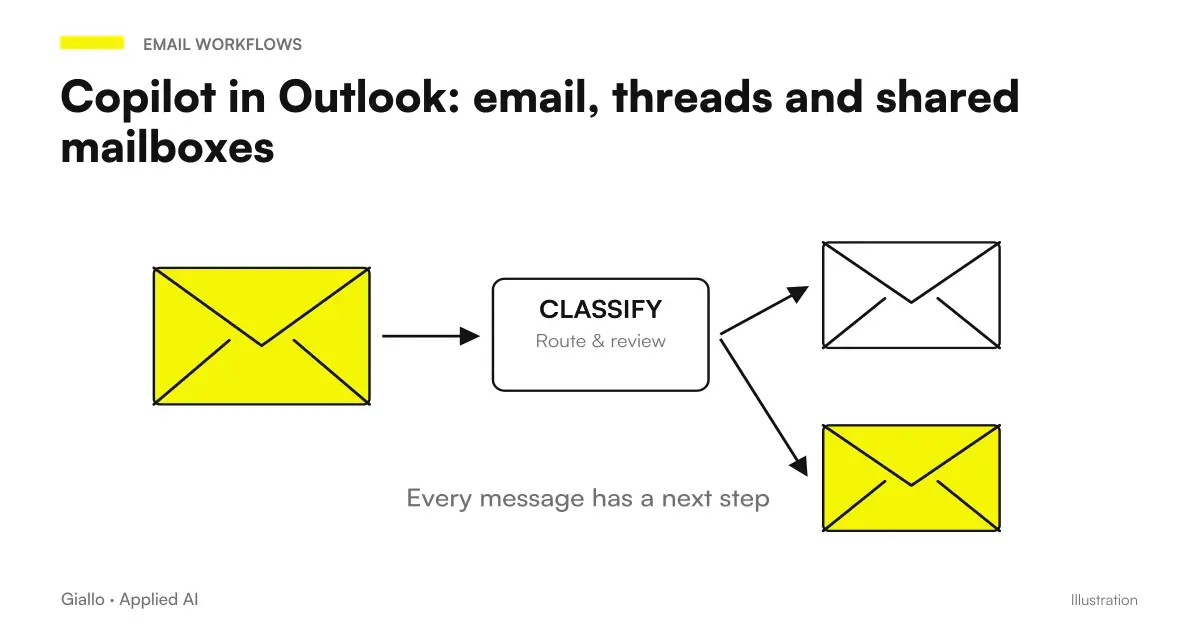 Copilot in Outlook: email, threads and shared mailboxes
FAQ
What does AI email sorting mean?
It is a process that proposes a category and a manager for a received request, considering message and attachments together. Preparing a response is a step distinct from sorting.
How to handle an email with two different requests?
The workflow can propose multiple categories or create tasks linked to the same request. Retain a contact who coordinates the case, without accidentally duplicating work.
What happens when the category is uncertain?
The request must remain visible in a review queue. A residual category prevents the message from being discarded just because it does not match the classes expected.
Can AI figure out if an attachment is missing?
It can compare the attachments present with those requested in the text and flag a possible anomaly. The presence of a file does not prove that it contains the expected document: the result must be verifiable.
What metric to use in the pilot?
Measure category and assignment accuracy, lost attachments and the time until someone first takes ownership. Also record corrections: do not infer savings solely from the number of emails processed.
Do I need to change the mail system?
Not necessarily, but available accesses and integrations must be verified. The flow can start with internal proposals before writing into existing systems.