
AI expense reports: from receipts to approved reimbursement requests
AI expense reports for SMEs: compare originals with extracted data, check currencies, duplicates and policy, then approve claims and verify exports.
Reading time: 12 min
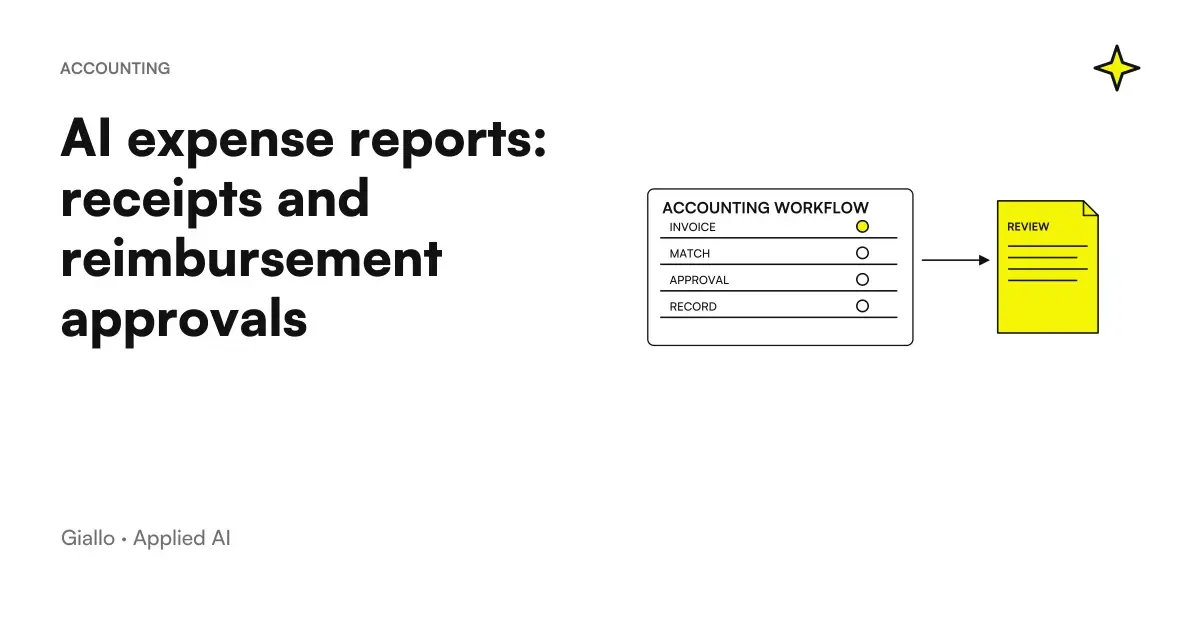
An expense note stream with AI prepares the receipts data and anomalies to be verified before the refund is approved. Original document, amount, currency, reason and request must remain linked. The company policy defines who decides; extraction, approval, export and payment are different phases.
The useful case is not a generic reading of receipts. It is the transition between employee and administration: what has been presented, what information is missing and which contact person can approve. An ordered table does not demonstrate the deductibility of expenditure and does not replace the tax checks of the competent professional.
Technical primitives are documented at 9 October 2026 and cases are hypothetical. For the administrative framework read AI for Accounting; for overall adoption starts from AI for businesses. Here we follow a refund request until its operational outcome.
In summary
- Original and proposed data must be visible in the same request.
- An illegible receipt produces uncertain fields, not invented values.
- Currency and conversions require explicit sources and rules.
- A duplicate suspect remains a proposal to be verified.
- The policy is the company's and the decision has a manager.
- Export and payment are not implicit consequences of extraction.
What fields to collect in the refund request?
Define the request template before choosing the tool. The employee must know what information to provide and the administration must know what to check. In addition to the document, the date, merchant, amount, currency, reason, project or cost centre may be needed. The fields depend on the actual policy rather than a universal list.
n8n documents an Information Extractor that produces text-structured data through attributes or schema. The function can help prepare the fields, but does not certify the document or guarantee the correctness of the readings. Official Information Extractor.
| Field | Source or Responsible | Status to be shown |
|---|---|---|
| Document | File submitted | Present, illegible or to be supplemented |
| Date | Value in Receipt | Extracted or to be verified |
| Amount and currency | Original Document | Distinct Values and Uncertainties |
| Reason | Statement by the applicant | Complete or Missing |
| Project | Business Process Data | Candidate or confirmed |
| Category | Policy and proposal | Applied rule or doubt |
| Approve | Organization | To be assigned or assignment confirmed |
| Result | Registered Decision | Approved, refused or to be clarified |
Keep read and declared data distinct. The reason for the expense may not appear in the receipt; the system should not invent it from the operator's name. A hotel document doesn't prove which clerk you're looking at. If the applicant has not filled in the relevant field, the proposal shall indicate the absence and prepare the necessary passage.
The same applies to the project or cost center. A candidate may be suggested by the authorized context, but must remain verifiable. The full request helps reduce transcription, without turning AI into a source of business decisions. The broader method is discussed in AI to delete data entry.
How to deal with illegible receipts or missing information?
The quality of the source matters. A cut photograph may hide date or amount; a scan may contain multiple documents; a file may be a copy of a receipt already submitted. The stream must retain the original and show which fields are not verifiable. Do not fill a partial amount with the most plausible number.
The requester should receive a clear request for additional information through the intended process: which field is missing, which document it concerns and why it is needed. If the system can prepare a message, that text remains a proposal until the action has the appropriate authorisation. A reimbursement request should not be rejected automatically just because the first file is hard to read.
Distinguish absent document, received document and verified document. They were different. A checklist can mark what is missing without claiming that everything else is valid. The guide to customer document collection with AI applies this distinction to another documental practice, useful when the team handles many incomplete requests.
If the original contains multiple charges, determine how to represent them and how to link each entry. A file does not always equal a single line of the expense note. The proposal must show the perimeter, so the administration can see if an item has been skipped or duplicated. L'AI Document Automation helps distinguish the reading of the source from the materials produced.
How to manage currency and conversions without confusing them?
Keep the original amount and currency as separate fields. If the process requires a conversion, state the source and the rule approved by the company. Do not derive an exchange rate from the model’s memory or present a converted value without the relevant date and reference. Choosing the criterion requires the person with the appropriate expertise for the case.
The proposal can show three levels: original data, expected conversion from the process and value to be verified for export. This helps to find the cause of a mistake. If the receipt was correct but the final total is wrong, the revision can check the rule or application. If the levels are merged into a single field, it becomes difficult to reconstruct the path.
An ambiguous monetary symbol must not become a certainty. The system may seek evidence in the document or request clarification from the applicant. Even a total composed of different voices requires a representation consistent with the process. The aim is to prepare a verifiable request, without expressing a tax judgment on the components.
For the pilot's budget there is no need to invent a cost per receipt. Collect first the variety of documents, languages and currencies present. A uniform source and sample with problem cases require different tests. The estimate must explain which cases are covered and which remain to be managed manually.
How to recognize a duplicate without rejecting different expenses?
Amount, date and operator are useful signals, but they do not prove the identity of the document themselves. Two real expenses can have similar values. The same document can instead be photographed twice with different file names. The stream proposes suspicion and shows the sources, instead of erasing an entry based on a single signal.
Keep a reference to the request and document. If the employee fixes the file, the system needs to know if it is a new expense or an integration. A note resubmitted after a refusal should not turn into a second refund without verifying the previous case. The structure of the process must preserve these states and the reason for the decision.
The auditor can confirm the duplicate, dismiss the suspect or ask for information. The choice must have a definite effect on the request, keeping the link to the original. Do not use line reduction as a quality indicator: eliminating a legitimate expense makes the process worse even if the final report appears cleaner.
Duplicate suspect card
It shows the two requests, the documents, the same data and the different ones. It indicates why the system proposes verification, without calling it a certainty. The contact person shall decide whether it is the same expenditure, an integration or two separate cases. It preserves the outcome in the path of the request before an eventual export.
How to apply the policy and choose the approver?
The policy must be a recognizable and up-to-date source. Categories, limits and cases that require a decision belong to the company. The system can compare the proposal with that source and report open points, but it does not invent an authorization because the expense seems reasonable. If the policy does not cover a case, the referent must see it.
It indicates who approves and what happens when they are absent. The employee should not have to pursue a request that the workflow assigned to an unavailable person. The route can provide a substitute according to the agreed rules, without automatically assigning the powers to anyone who has access to the platform. The card must show the next step and the person responsible.
n8n documents human review for tool actions. A well-designed revision receives the necessary data and distinguishes approval from rejection. Primitive does not prove that the company policy is correct or that the refund is fiscally treated in the appropriate manner. Official Human Review.
For the required-responsible passage read approval of purchases with AI. It is a different process, but it asks similar questions about the source of the rule, delegation and motivation. An approved request must keep the version of the data that the referent has checked visible, before moving on to the next step.
How to prepare export and payment as separate phases?
Export is about the format and fields that the destination system requires. It must use approved data, keeping references useful for recognizing the request. Before transfer check amounts, currency, status and rows. After verifying the outcome in the system: a positive integration response does not prove on its own that every link is present.
An attempt with uncertain outcome requires verification before repeating the writing. Stable reference prevents the same request from becoming two records. If the process involves changes after approval, define when a new revision is needed. An export prepared by an outdated draft must not use the old decision as a cover.
Payment remains another step. This article does not delegate transfers or propose that the agent perform them. Also in prompt payment with AI the communication is distinguished from the accounting status and financial actions. Keeping the steps separate allows the manager to understand which part of the cycle is really completed.
Two hypothetical scenarios for Italian teams
A maintenance company collects travel expenses
Imagine a Venetian company with technicians presenting receipts and reason for the trip. The stream prepares a request with originals alongside the data. A cut photo produces a field to integrate; a document already present generates a duplicate suspect. The person in charge checks the request according to the policy, without attributing a tax judgment to the system.
The proposal must help the administration team see what is missing and who decides. A technician who corrects the document updates the case through the intended process, without automatically generating a second expense. The scenario reports neither hours saved nor real Giallo cases: it illustrates the controls that make the case usable.
A consulting firm receives a different currency expense
Imagine a Milan-based consultancy receiving a document for a business trip. The request keeps the original currency and amount and states the declared reason. If the process requires conversion, the proposal shows the approved rule and what still needs to be checked. It does not take a plausible exchange rate from the model.
The approver confirms the correct version before export. The study then checks that the target system has received the expected data. The tax treatment and other professional aspects are verified by the competent contact person, separately from the automatic reading of the receipt.
How to manage waste and integrations without creating a second expense?
A refusal must have a useful reason for the applicant. "Not approved" may not explain if a document is missing, if the data is uncertain or if the case requires another referent. The flow keeps these outcomes distinct, so the employee knows what step he can take. The policy and decision remain recognizable, without turning any rejection into a model-generated tax assessment.
If an integration arrives, it updates the relevant case while maintaining the link to the previous request. Do not automatically open a new refund because the file has a different name. The auditor sees which data has been corrected and which remain to be checked. An improved original can solve a reading, but does not replace confirming the reason or project when those fields were missing.
An amendment after approval must be reviewed in the agreed path. Amount, currency and documents are part of the decision: the old confirmation must not silently cover a new version. The request report shows what has been approved and what is still open, before any exports.
The pilot must include these steps and not just clear initial documents. Preparing a complete request is useful; properly managing its follow-up avoids duplication and outdated decisions. It records cases where the referent had to reconstruct the story: they may indicate that the status or reference of the request needs to be improved before widening the flow.
How to measure the test and decide whether to extend it?
Prepare a sample with clear, illegible, repeated documents and with different currencies. Compare each proposal with the source and record correct, uncertain and omitted fields. It measures integration requests, suspected correct duplicates, and false alarms. It also looks at the revision work and the time until the decision, without turning the number of read files into proven savings.
The budget includes acquisition, extraction, policy, approval, export and maintenance. Agree on a test limit and the conditions to expand it. It avoids invented values, implicit exchange rates, thresholds decided by the model and payments treated as an automatic consequence. An anonymized example of a receipt, policy and pending request allows Giallo to evaluate your automation of business processes with referents who know the correct result.
Giallo Studio guides: methodology and sources
How we apply it in the company
Related resources
 AI for businesses: a complete guide to getting started
 AI for Accounting: What It Can Really Do
 Document automation with AI: contracts, forms and PDFs automatically
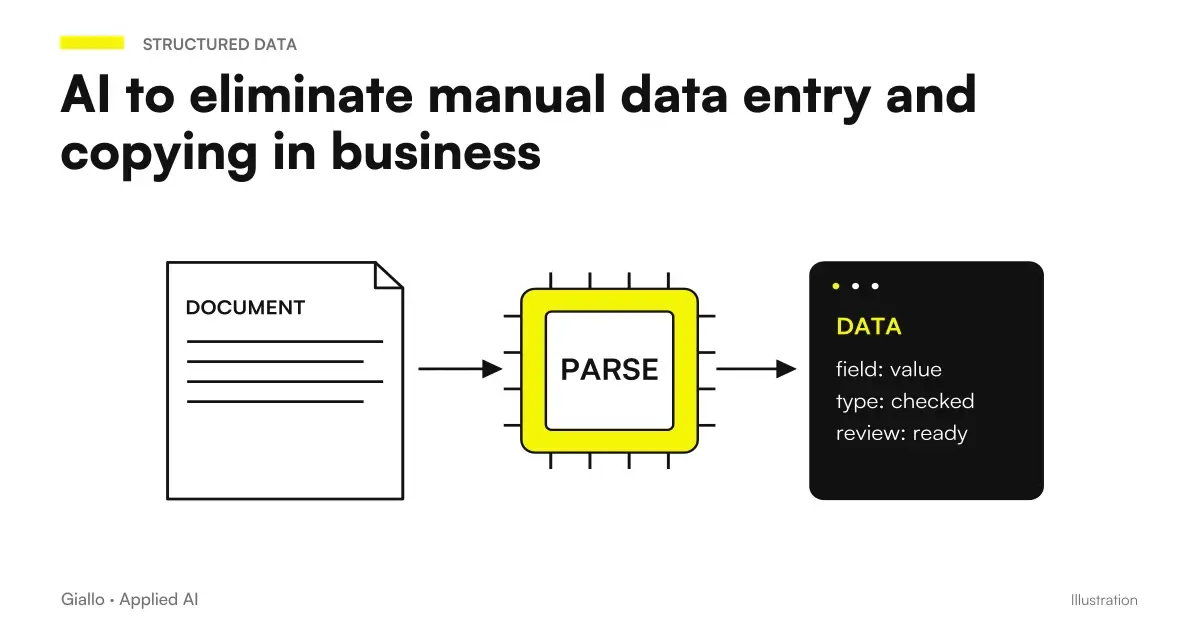 AI to eliminate manual data entry and copying in business
 AI purchase approvals: complete requests and traceable decisions
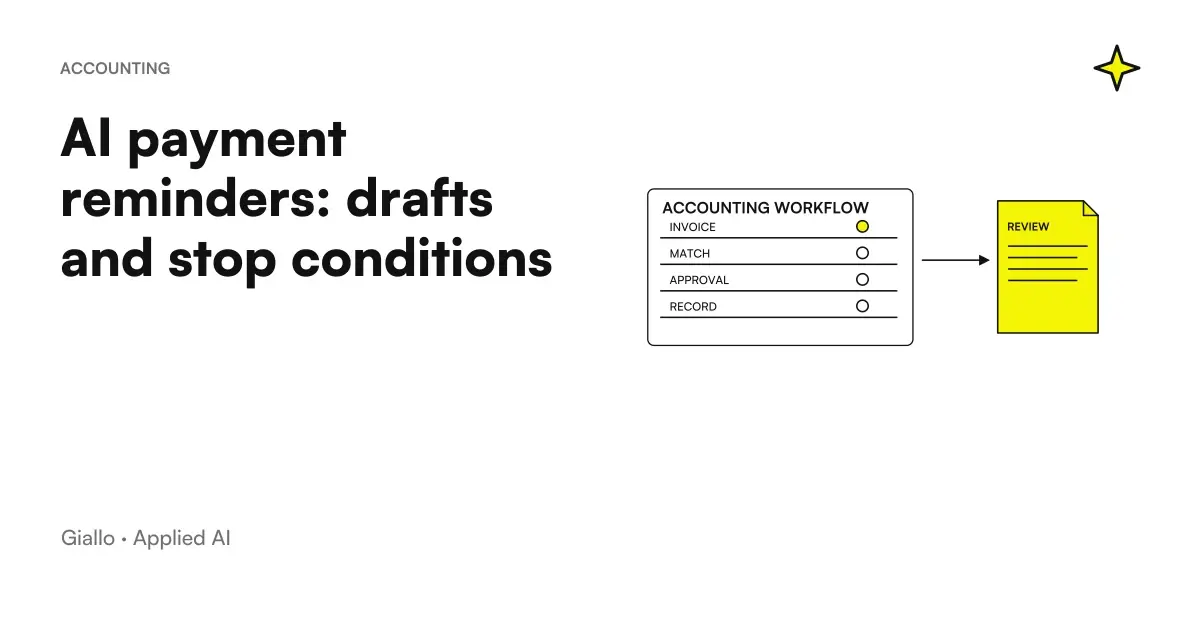 AI payment reminders: prepare the right draft and stop once paid
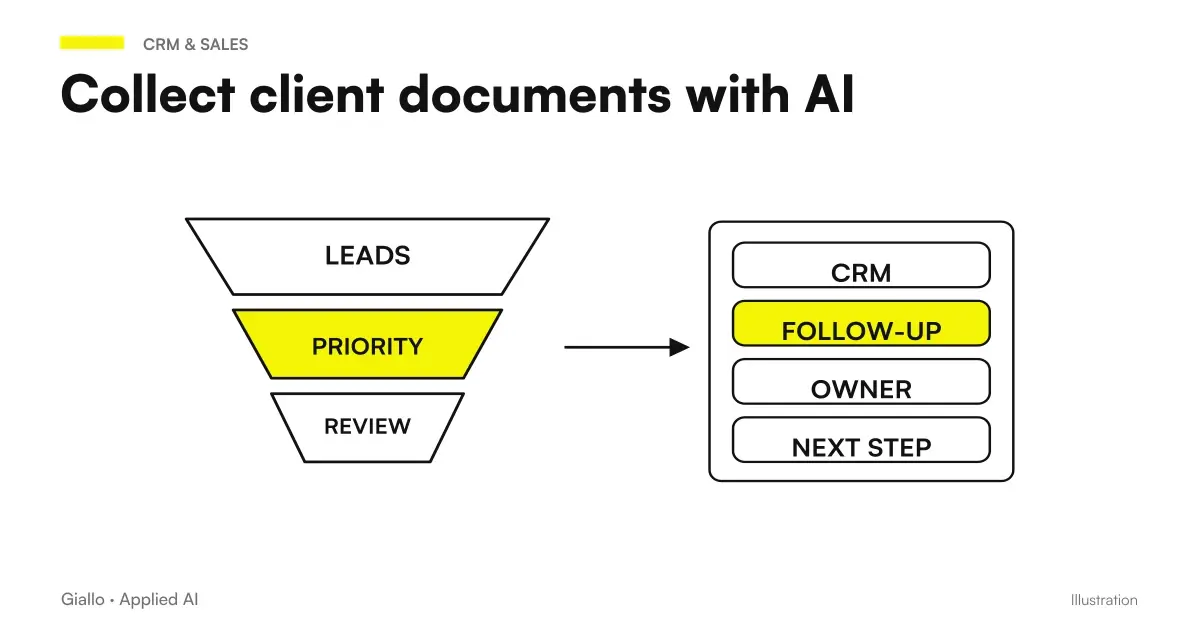 Collect client documents with AI: checklists and case status
 HTTP Hooks: controls for Claude Code
FAQ
What does an AI expense-report workflow automate?
It prepares receipt data, links it to the request and flags possible anomalies according to company policy. The person responsible approves the reimbursement, and the export follows a separate path.
Does reading the receipt prove deductibility?
No, extraction and tax assessment are different activities. The treatment of the documents must be checked by the competent contact for the specific case.
How to handle an unreadable receipt?
Keep the original and report the fields uncertain or missing. Do not fill in amounts and dates with plausible values: ask for the document or verification needed.
How can you avoid reimbursing the same expense twice?
Compare the request reference, the document and signals such as the date, merchant, amount and currency. Similarity suggests a check; it does not, by itself, prove that the expenses are the same.
Who sets thresholds and categories of expenditure?
The company defines the policy and the authorized contact person applies it. The flow must make visible which rule was used and which case requires a decision.
What to check before export?
Check approved data, currency, total and links to the originals. Also check the outcome in the target system and the management of repeated attempts.