
AI consulting for companies: what it is and when it is needed
What is AI consulting for companies, what an AI consultant does, when it is worth it and how to choose the right one. Practical guide for SMEs.
Reading time: 8 min
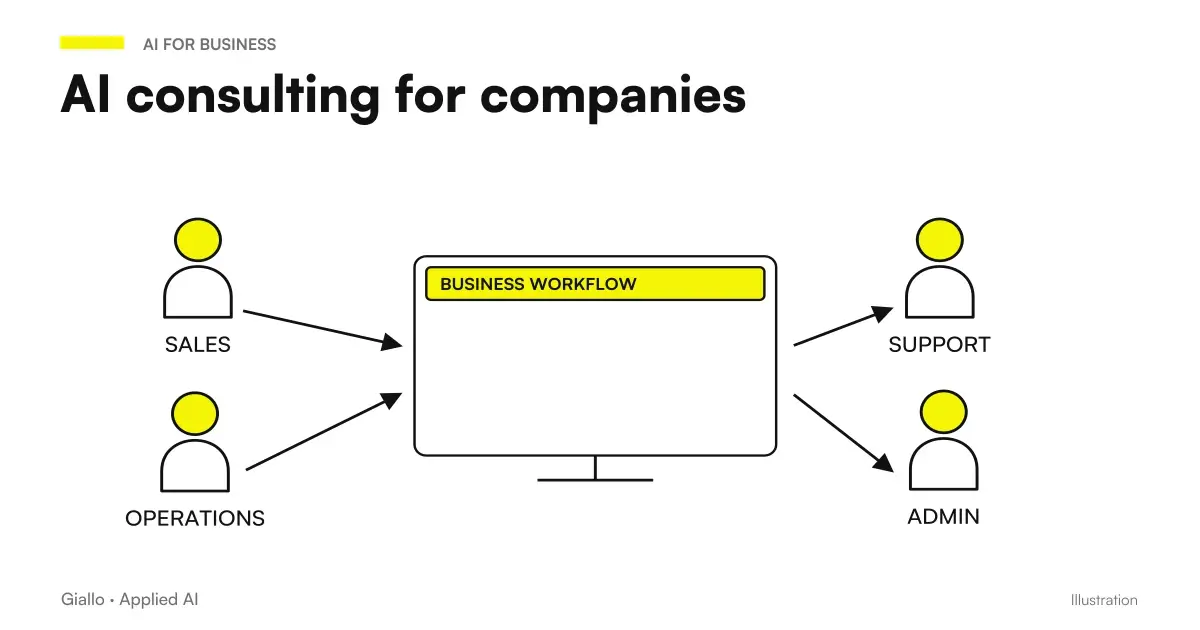
In the last two years almost every company has tried some AI tool: ChatGPT to write texts, Copilot for emails, maybe some chatbots on the site. In many cases the result was disappointing: the tool works, but it does not change anything concrete in the way of working.
The problem is not the tool. It is that buying a license is not the same as using AI in a useful way for your company. Between the two there is a passage that is often missing: understanding which processes are worth automating, how to do it reliably and how to integrate the result into systems already in use.
This is where AI consulting comes in. It is not about selling software, nor about doing generic training on "how to use ChatGPT". Serious advice starts from the specific problem of the company and comes to a measurable result: less hours on that process, less errors, less waiting. This guide explains what an AI consultant really does, when it's worth relying on one, and how to recognize who works on the problem instead of selling smoke.
In summary
- AI consulting always starts with a business problem, not a tool to adopt.
- A serious consultant analyzes processes, chooses the right tools, and measures results — he doesn't just set up an account.
- It makes sense to turn to a consultant when the process is complex, touches sensitive data, or has to integrate with existing systems (management software, CRM, email).
- The cost is always assessed against the expected savings: hours, errors avoided, shorter times.
- A good consultant first proposes a pilot project, not a multi-year contract.
- Every industry has automated repetitive processes: AI consulting is not just for tech companies.
What an AI Consultant Does in Concrete
The work of an AI consultant does not begin by installing any tools. Start by listening. Before touching any software, a serious consultant wants to understand how the company works: what are the slowest processes, where manual work is accumulated, where more mistakes are made, what consumes people more time.
The typical process of an AI consulting follows these steps:
- Analysis of existing processes. The consultant maps the real workflows —not the ones in the organization chart, but the ones people really follow every day. Identifies bottlenecks, repetitive activities, points where human error is most frequent.
- Selecting priorities. Not everything is automatable, and not everything is worth automating. The consultant assesses expected impact (spent time, reduced errors) and implementation effort for each area. It always starts where the relationship is most favorable.
- Choice of suitable instruments. Only after defining the problem do you choose the tool. Sometimes it is a AI Agent made to measure, sometimes it is a AI Automation on existing platforms, sometimes it is the integration of a language model into a management software already in use. The tool follows the problem, not the other way around.
- Configuration and integration. The consultant configures the flow, connects it to existing systems (CRM, email, ERP, business drive) and tests on real cases before going into production. This phase also includes the management of GDPR compliance when the data is sensitive.
- Team training. Automation is not useful if the worker cannot use it or does not trust the results. The consultant trains the people involved and defines how to handle cases where the system is wrong — because it is always wrong, sooner or later.
- Measurement of results. A serious project closes with numbers: how much time you save, how many mistakes you avoid, what is the ROI compared to the investment. Without metrics, you don't know if it worked.
This process can take days or months, depending on the complexity. A pilot project on a single process often takes only a few weeks. To get an idea of the costs and expected return, you can read the guide on ROI of an AI project.
When it makes sense to rely on a consultant
You don't always need a consultant. To use ChatGPT for emails or to generate simple text, a good manual or a few hours of experimentation is all it takes. Counselling serves when the situation is more complex.
- You have already tried AI tools without getting concrete results or understanding why they don't work.
- The process to be automated touches on sensitive data (customer records, accounting documents, contracts).
- You want to integrate AI with existing software: management software, CRM, billing system, document archive.
- You are evaluating multiple tools and don't know which one to choose or how to compare them.
- The process involves multiple people or multiple departments and serves coordination.
- You want to build a measurable advantage over competitors, not just "use AI".
When you can do it yourself (at least at first)
- The process is simple and isolated: drafting texts, summaries of documents, response to standard emails.
- You want to explore the possibilities before deciding whether to invest.
- The team is already familiar with digital tools and wants to experiment autonomously.
The border is not always clear. Many companies start on their own, get stuck on something specific and then turn to a consultant for the next step. It is not a mistake: often having already experienced it yourself speeds up the consulting work, because you understand better what did not work.
If you are still evaluating whether and how AI applies to your reality, the AI Guide for SMEs is a good place to start. For a broader view on how companies use AI today, see also AI for Companies: Complete Guide.
How an AI consulting project is carried out
A well-structured AI consulting project has clear stages and a precise moment when you decide whether to go ahead or stop.
Phase 1 Dia Diagnosis (1-3 days). The consultant collects information: interviews with people working on processes, analysis of flows, review of tools already in use. Output is a map of processes with priority areas and an estimate of potential benefits. Nothing is yet being built at this stage.
Phase 2 pilota Pilot project (2-4 weeks). You choose a process with high impact and low complexity. You build the first version of automation or AI flow, you test on real data, you fix problems. At the end, you have concrete numbers: how much time you save, how well the system works, what is still missing.
Phase 3 Decisione Decision and rollout. Based on the pilot, it is decided whether to extend to other processes, improve the existing one or stop because the benefit does not justify the investment. The rollout takes place gradually, with training and support for those who use the system.
Step 4 Monitoraggio Monitoring. In the following months, the system continues to function, abnormal cases are handled, the flow is updated when business processes change.
This approach —diagnosis, pilot, decision, rollout —is the safest way to avoid investing in something that doesn't deliver results. Be wary of those who immediately propose long contracts without first demonstrating value on a concrete case.
How to Choose the Right Consultant
The AI consulting market quickly filled with people calling themselves "AI experts" after taking some online courses. Distinguishing those who work on the problem from those who sell enthusiasm is not always easy, but there are precise signs.
- It starts with your problem, not the tool. If the consultant talks to you about a specific tool before you understand what you do and where you waste time, it's a negative signal.
- He asks you how you measure the results today. A serious consultant wants to know what the baseline is: how many hours you spend on that process, how many mistakes you make, how long you wait. Without baselines, improvement cannot be measured.
- It proposes a pilot project before the big contract. Those who work well are not afraid to demonstrate value on a small scale before asking for a longer commitment.
- It doesn't promise total automation. AI is wrong, it has limits, it requires supervision. Those who say that "it will do everything on its own" don't know the technology well or are not honest.
- He knows the implications of GDPR. If your processes touch on personal data of customers or employees, the consultant needs to know how to handle them in a compliant manner — it's not enough to install a tool and hope it goes well.
- It has concrete examples of past work. Not generic ("I have worked with various SMEs"), but specific: what process, what result, how long.
- It also tells you what not to do. A consultant who identifies limits and processes where AI is not the right answer is more reliable than one who finds AI everywhere.
You can delve into the topic of Costs of AI Consulting to have a more precise reference on what to expect in economic terms before starting a conversation with a counselor.
How much does it cost
The costs of AI consulting vary greatly and depend on the complexity of the project, the number of processes involved, and the expertise of the consultant. Giving precise figures without knowing the specific situation would be misleading, but it is useful to have an orientation reference.
One initial analysis (diagnosis of processes, map of priorities, estimate of benefits) typically requires one to three days of work. This has a low cost and is the safest way to figure out if it is worth moving forward.
A pilot project On a single process —from configuration to testing on real data —it typically takes two to four weeks of work, with costs depending on the technical complexity and integrations needed.
A Structured Project which covers multiple processes, with team training and support in the following months, is a more significant investment and is always assessed in relation to the expected savings.
The rule of thumb: If a consultant presents you with an estimated ROI before you leave —based on real data from your process, not on generic percentages.you are talking to someone who works on the problem. If the cost is never related to the expected benefit, it is a warning sign.
Practical examples
Work consultancy study — document and practice management
A practice with six employees received dozens of customer emails every day requesting documents, asking for payslip clarifications and seeking updates on ongoing cases. Answering required finding information in the business management software, copying data into emails, and often asking a colleague. Each reply took an average of eight to ten minutes.
The consultancy led to a workflow that reads incoming emails, classifies the request, retrieves relevant data from the business management software and generates a draft reply. The employee checks it, corrects it if necessary and sends it. Average time per reply fell to two to three minutes. The practice recovered about two hours a day of administrative work, reassigned to higher-value activities.
For similar examples in the professional field, read AI for accountants and professional firms.
E-commerce — returns management and after-sales service
An e-commerce with about two hundred orders a day received a volume of after-sales requests (order status, return start, complaints) that occupied two full-time employees. Responses were often late in seasonal spikes, impacting customer satisfaction.
Counselling has introduced a AI Agent able to answer the most frequently asked questions (shipping status, return procedure, refund times) and to scale to the human operator only complex cases or complaints that required evaluation. The volume handled independently by the agent reached about 65% of the requests. Operators focused on cases that really required attention, with improved response times for these as well.
You can find more examples of AI automation in the company to understand how these projects apply to different sectors.
Comparison: Do it yourself vs with a consultant
| Criterion | Do it yourself | With a consultant |
|---|---|---|
| Boot Time | Quick for simple tools | Longer, but firmer |
| Integration with existing systems | Difficult without technical skills | Managed by the consultant |
| Risk of errors in processes | High if the flow is not well tested | Low: Tests on real data before go-live |
| GDPR Compliance | Your responsibility, often not considered | Included in the project |
| Measurable result | Rare: Missing baselines and metrics | Part of Deliverable |
| Scalability | Limited: often ad hoc solutions | Built to Last and Grow |
| Initial cost | Low (software licenses) | Higher, but justified by ROI |
Mistakes to Avoid When Choosing an AI Consultant
Choosing based on the lowest price. AI consulting is an investment, not an expense. A project that's done wrong — that doesn't deliver results or that creates compliance issues — costs much more than the price difference.
Relying on those who have never worked in your industry. AI applies differently to a manufacturing company, to a professional practice, to an e-commerce. Those who only know technology without understanding the business context struggle to identify the right priorities.
Not asking for verifiable references. A good consultant has clients willing to tell their experience. If there are no references, or they are vague, it is a signal.
Signing long contracts before seeing results. The pilot model protects both parties: the client sees real results before committing, the consultant demonstrates the value without having to convince in words. Those who do not propose it have something to hide or are afraid of being measured.
Ignoring team training. An AI system that people don't use — because they don't trust, because they don't know how it works, because no one trained them — is wasted money. Check that the training is included in the project.
Expecting it to fix everything. AI reduces manual work on specific, repetitive processes. It does not replace human judgment on complex decisions, it does not eliminate the need for supervision, it is not infallible. Beware of those who promise otherwise — the AI Hallucinations are a real problem that any serious project must handle.
How to apply it in the company
If you are considering AI consulting for the first time, a practical approach is to start with an internal mapping before engaging someone from the outside. Ask these three questions to your collaborators:
What activity do you do each week that you consider more repetitive and less useful? The answers identify natural candidates for automation.
Where do you waste more time waiting for information or approvals? Bottlenecks in workflows are often the best place to intervene.
What is most often wrong with our organization because of distraction or forgetfulness? Fatigue errors are among the easiest to eliminate with AI systems.
With this information, a first conversation with a consultant is much more productive. You can already present specific problems instead of asking "what can AI do for us" —a question that almost always leads to generic answers.
If you want to understand how AI integrates with your customer sales and management tools, read the guide on AI for CRM and Sales. If your main goal is to reduce manual workload, find cases and methods in the guide on how Reduce manual work with AI.
For companies that manage the insertion of new customers or suppliers, AI can do a lot even in the phase of onboarding. You can explore the Process Automation Services and the AI Agent Services offered by Giallo Studio, or visit the page The Lab to see how we work on concrete projects.
Conclusion
AI consulting for companies is not a fad and is not something for large companies with unlimited budgets. It is a structured way to understand where AI can really make a difference in the way you work, choose the right tools and measure results.
The starting point is not the tool: it is the problem. If you know where you waste time, where you make mistakes, where your customers wait too long — you already have everything you need to start a useful conversation with a consultant.
Do you want to understand which processes in your company make sense to automate? Write to us or read the complete guide on AI for Italian SMEs posto the right place to start if you are still considering options. If you are already thinking about numbers, the guide on AI costs in the company helps you build a realistic estimate before contacting anyone.
You can also directly explore our AI consulting services for SMEs or the page services to understand how we operate.
Giallo Studio guides: methodology and sources
How we apply it in the company
Related resources
 AI for SMEs: a practical guide to really getting started
 How much does business AI adoption cost?
 How to Calculate the ROI of an AI Project
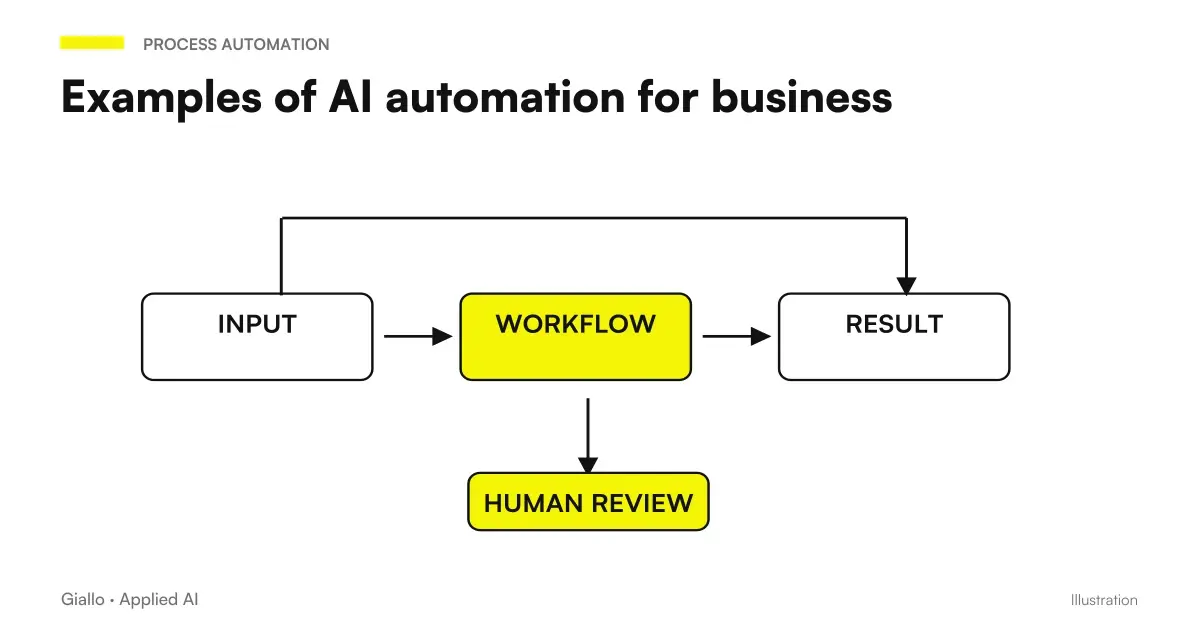 Examples of AI automation in the company: real cases for SMEs
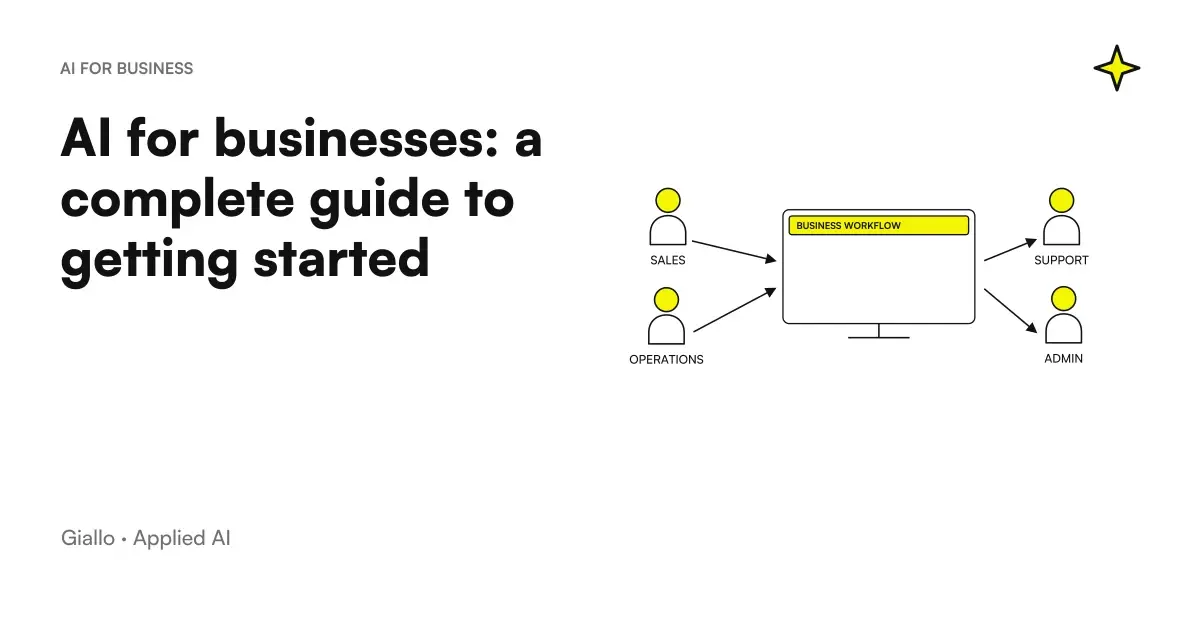 AI for businesses: a complete guide to getting started
 AI for restaurants: reservations, allergens and responses to reviews
 AI for physiotherapists: bookings, reminders and patients
 AI for renovation firms: changes, SAL progress reports and site documents
FAQ
What does an AI consultant actually do for a company?
They analyse existing processes, identify where AI can reduce manual work or errors, choose suitable tools, configure workflows, and train the team. They do more than sell software: they guide the company from the problem to a measurable result.
When should you hire an AI consultant instead of doing it yourself?
When you have already tried AI tools without concrete results, when you do not know where to start, when the process to be automated is complex or touches sensitive data, or when you want a system integrated into existing software (business management software, CRM, email).
How much does an AI consultancy cost for an SME?
Costs vary considerably: from an initial analysis taking a few hours to structured projects costing a few thousand euros. The right assessment is based on expected savings (hours, errors, time), rather than the absolute cost. A good consultant presents an estimated ROI before work begins.
How do you distinguish a good AI consultant from one selling empty promises?
A serious consultant starts with your specific problem, not a tool to sell. He asks you what processes you want to improve, what you measure today and how you will evaluate the result. He proposes a small-scale pilot project before large investments. He avoids promises of 'total automation' and 'AI thinking for itself'.
Is AI consulting only for tech companies?
No. The sectors that benefit most today are often the least focused on technology: professional firms, manufacturing companies, e-commerce, agencies, and service SMEs. AI applies to repetitive processes, and those exist in every sector.