
How much does AI cost in the company: a guide to real prices
The real cost of business AI: price ranges by project type, factors affecting quotes and how to avoid wasted spending.
Reading time: 12 min
The question ‘how much does AI cost in the company’ has an honest answer that no one willingly gives: depends almost entirely on how many exceptions the process you want to automate has, not on the technology. Building the same agent for a clean process and for one full of special cases can mean a cost three times as high.
That said, ranges exist and are knowable. This guide puts them in line, explains what moves the quote up or down, and most importantly distinguishes the three categories of spending that are confused: subscriptions, project, exercise.
In summary
- There are three distinct categories of expenditure: instrument subscriptions, cost of implementation, recurring operating costs.
- The automation of a single process starts indicatively from 1.500 €; a tailor-made AI agent from 3.000 €.
- The factor that moves the quote the most is the number of integrations with existing systems.
- The second factor is the exceptions of the process: particular cases cost more than the rule.
- Almost always convenient starting from subscriptions to understand where there is value, then build.
- A quote that doesn't talk about integrations and what happens after release is incomplete, not cheap.
The three categories of expenditure
They are constantly mixed, and from there almost all the confusion about costs arises.
Subscriptions to instruments. A few tens of euros per month per person. They serve to work better: write, summarize, analyze. They do not integrate with your data and do not automate your processes. It is the correct starting point for anyone.
Cost of implementation. The real project: analysis, development, integrations, putting into production. It is one-off and varies a lot.
Operating costs. What you pay each month for the system to continue working: API consumption, hosting, maintenance, adjustments when something changes upstream.
The ranges by project type
These are the orders of magnitude we work with, the same ones published on the page prices. They are wide ranges on purpose: the position within the range depends on the variables explained below.
| Project Type | Indicative cost | What Moves the Price |
|---|---|---|
| Automation of a process | 1.500 – 8.000 € | Number of systems to connect, amount of exceptions |
| Custom AI agent | 3.000 – 15.000 € | Managed channels, integrations with management software or CRM |
| AI knowledge base (RAG) | 6.000 – 25.000 € | Document volume, permissions, sensitive data |
| Custom software or business management system | 8.000 – 20.000 € | Number of modules and users, integrations |
| Company website | 2.500 – 8.000 € | Number of pages, content to be produced |
| E-commerce | 3.000 – 15.000 € | Products, languages, stock synchronization |
| PWA or web app | 5.000 – 25.000 € | Functions, users, data complexity |
Details for single entry are in how much does an AI agent cost, how much does an AI chatbot cost and how much it costs to automate a process.
What Really Moves the Quote
There are four variables that matter, and none pertain to the AI model used.
- The integrations. Connecting a system means understanding how it speaks, managing errors, maintaining it over time. Every integration is a project piece, not a check.
- Exceptions of the process. "We usually do this, except when...": every "except" is work. A process with five exceptions costs much more than twice as much as one with two.
- The quality of the starting data. If the documents are messy, if the registry has duplicates, if each department names things differently, a part of the project goes into remediation.
- The level of autonomy required. A system that proposes costs less than one that acts, because the latter requires checks, thresholds, traceability and error management.
The path that costs less than ever
There is a sequence that reduces waste more than any price negotiation, and hardly anyone follows it.
- Subscriptions for three months. A few tens of euros per person. It serves to find out where AI brings value in your real work, not in theory.
- Measure what it costs today the candidate process: how many hours, how many errors, how long to wait. Without this number you will never know if the investment went well.
- Automate a process only, the one with the best relationship between repetitiveness and pain.
- Verification of numbers after a few months.
- Extend only after verification.
Step 2 is the one that is always skipped and that is worth more than all the others. Without a starting measure, the evaluation of the result becomes an opinion — and that is why many AI projects are judged to be ‘disappointing’ without anyone being able to say anything about what.
Practical examples
Studio accountant, 6 people. It wants to automate the sorting of emails and the preparation of recurring responses. One process, two integrations (post and document management software), a few exceptions. We are in the lower part of the automation range: around 2,000-3,000 €, plus the monthly consumption that at those volumes is marginal. Measurable return in hours saved by the secretariat.
E-commerce, 15 people. He wants an assistant who responds to customers on orders, shipments and returns, connected to management software. An agent on multiple channels with significant integration: central part of the agent range, around €8,000. Here monthly consumption begins to count, because there are many conversations.
Service company, 40 people. He wants an interrogable knowledge base on procedures, contracts and specifications, with different permissions per department. High document volume and granular permits: upper part of the RAG range. It is the case that it is best to do first a reduced project on only one department, measure and then extend.
Workshop, 4 people. He wants to speed up the quotes. Here the honest answer is that you often don't need a project: a subscription and half a day to build a prompt model solve much of the problem at a cost that is a twentieth. Not all needs deserve a project, and it is useful for those who make the estimate to tell you.
How to read an AI quote
After receiving two or three quotes, the problem becomes to compare them. It is not simple, because they often describe the same thing with different words and include different perimeters. There are five items to look for.
The analysis. Is there a phase of study of the process before development? If it is missing, the supplier is estimating on assumptions. A project without analysis is no cheaper: it is riskier, because surprises emerge when the code is already written.
The integrations, listed one by one. “Integration with existing systems” is not a line item: it is a promise. Names must appear: which business management software, which CRM, which inbox, and in which direction data travels.
Error management. What happens when the downstream system does not respond, when an unreadable document arrives, when the request leaves the expected cases. It is the part that distinguishes a prototype from a system that holds, and it is worth a significant share of the work.
Testing. Who checks that it works, on how many real cases, with what acceptance criterion. A project without written acceptance criterion ends in endless discussions about what "it works".
What happens next. Support, fixes, updates when changing a connected system. It should be written if it is included, for how long, and what it costs next.
Comparable estimate
- Describe the current process with your numbers
- List integrations with proper names
- Says what happens when something goes wrong
- Defines how the result occurs
- Clarifying recurring costs
Quote Hiding Work
- List technologies instead of results
- It says "integration with your systems"
- Does not name post-release
- It has a single digit without decomposition
- Promises very short time without analysis
When AI is not convenient
It's worth saying in a cost guide, because it's the assessment that saves the most: there are cases where the correct answer is not to do the project.
- The process changes all the time: Automate a moving target
- It happens a few times a month: saving will never pay for development
- Exceptions are more numerous than standard cases: you're coding chaos
- The starting data is unreliable: the system will amplify the error
- No one in the company will follow the system after release
The last point is the one that sinks the most projects. An AI system is not an appliance: it must be observed, corrected, updated when something changes around it. If no one has the time or mandate to do so, the project degrades in a few months and the cost becomes integral — you have spent and you have nothing left.
Mistakes to Avoid
- Evaluating only the initial cost. Operating costs exist and must be estimated first — see how much it costs to maintain an AI system.
- Choosing the lowest quote without comparing what it includes. The omitted additions reappear as variants in the course of work.
- Starting with a custom-made project without ever using AI. You end up automating what you imagine, not what you need.
- Not measuring the starting point. It makes it impossible to judge the result.
- Automating a broken process. An automated confusing process remains confusing, and faster.
- Ignoring training. A tool no one knows how to use is a cost, not an investment.
How to apply it in the company
Before asking for a quote, prepare three informations. They will save you more than any discount.
- The ten-line process: what comes, who touches it, what comes out, what are the exceptions
- Today's Numbers: how many times a month it happens, how long it takes, how many mistakes it produces
- The systems involved: management software, CRM, mail, e-commerce, with names and versions
With these three things in hand, different estimates become comparable and estimates much closer. Without it, each supplier estimates in the dark and covers itself with margin — that is why the same jobs receive such different offers.
The reasoning on overall budget is in AI budget for SMEs, while the choice between doing it yourself and relying on someone is in DIY AI or agency.
Conclusion
The costs of AI in the company are knowable, but depend on variables that lie in your process, not in technology. An automation project starts from 1,500 €, a custom-made agent from 3,000 €, and the position within the range decide it integrations and exceptions.
The strategy that wastes less is always the same: subscriptions to understand, a process measured to start, extension only after verification. Whoever skips the first step buys solutions for problems he doesn't have; whoever skips the second will never know if he did well.
If you want to understand what processes in your company can be automated with AI, Giallo Studio can help you turn the problem into a real workflow. You can see systems working in The Lab or starting from AI for Companies: Complete Guide.
Giallo Studio guides: methodology and sources
How we apply it in the company
Related resources
 How much does a custom AI agent cost
 How much does it cost to automate a business process
 The hidden costs of AI projects
 AI budget for SMEs: where to start
 Subscription or custom AI: which makes sense?
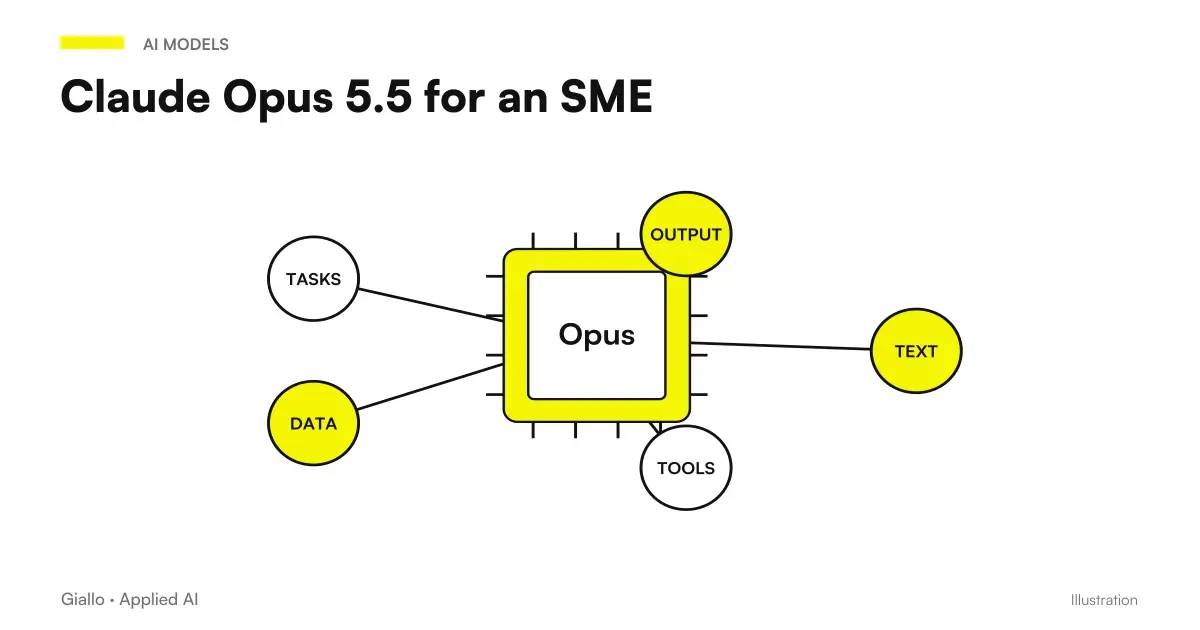 Claude Opus 5.5 for an SME: five concrete uses and when not needed
 Claude model pricing: API rates and the cost of getting work done
 GPT-6 Astra: pricing, real costs and when it is worthwhile
FAQ
What is the minimum budget to start with AI in the company?
To automate a single delimited process, you start at approximately €1,500. Below that threshold you stay in the territory of generic tool subscriptions, which is a great starting point but is not a project: it does not integrate with your systems and does not solve your specific process. The budget depends much less on the size of the company and much more on how many exceptions the process you want to automate has.
Why can two quotes for the same project differ by a factor of three?
Almost always for three reasons: how many integrations with existing systems are included, how much analysis is done before writing code and what happens after release. A quote that omits the integrations and says nothing about support is not cheaper: it is incomplete, and you pay the difference later.
Should I start with a subscription or a custom project?
Almost always from the subscription. It serves to understand where the AI brings value in your real work, and costs a few tens of euros per month. The custom project makes sense when you have identified a specific, repetitive and expensive process, and when the subscription is not enough because you need integrations with your data and your systems.
Are the costs one-off or recurring?
Both, and this is the most common evaluation mistake. There is a one-off implementation cost and recurring costs: token-based API usage, hosting, maintenance and updates when a connected system changes. Evaluating a project only by its initial cost is a poor assessment.
How much does API consumption affect total cost?
For most medium-sized business projects consumption is a smaller item than development, often in the order of a few tens or hundreds of euros per month. It becomes significant when volumes are high or when processing long documents all the time. It should be estimated first, because it is the item that scales with use.
How do I know if a quote is appropriate?
Look at three things: if it describes the current process with your numbers, if it lists integrations one by one, and if it says what happens in the six months after release. A quote that answers these three questions is comparable to another. One that only talks about technologies is not.