
Customer Complaints with AI: Priorities, Facts, and Responsibilities
AI for customer complaints: separate facts from requests, prioritise cases and prepare escalation, with workflow checks, scenarios and pilot metrics.
Reading time: 12 min
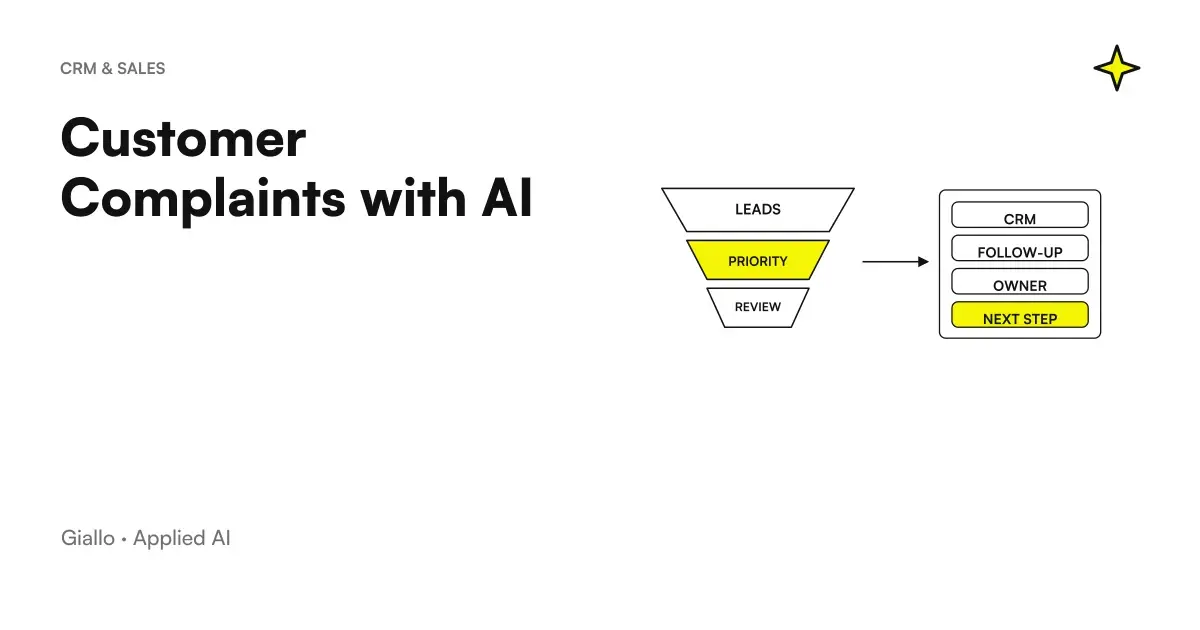
The customer complaints with AI they manage well when the system prepares a readable card: what is contested, what facts are documented, what priority to apply and who has to decide. The delicate point is not to write a kind answer. It is to prevent an urgent dispute from being lost, assigned to the wrong office, or closed with an unauthorized promise.
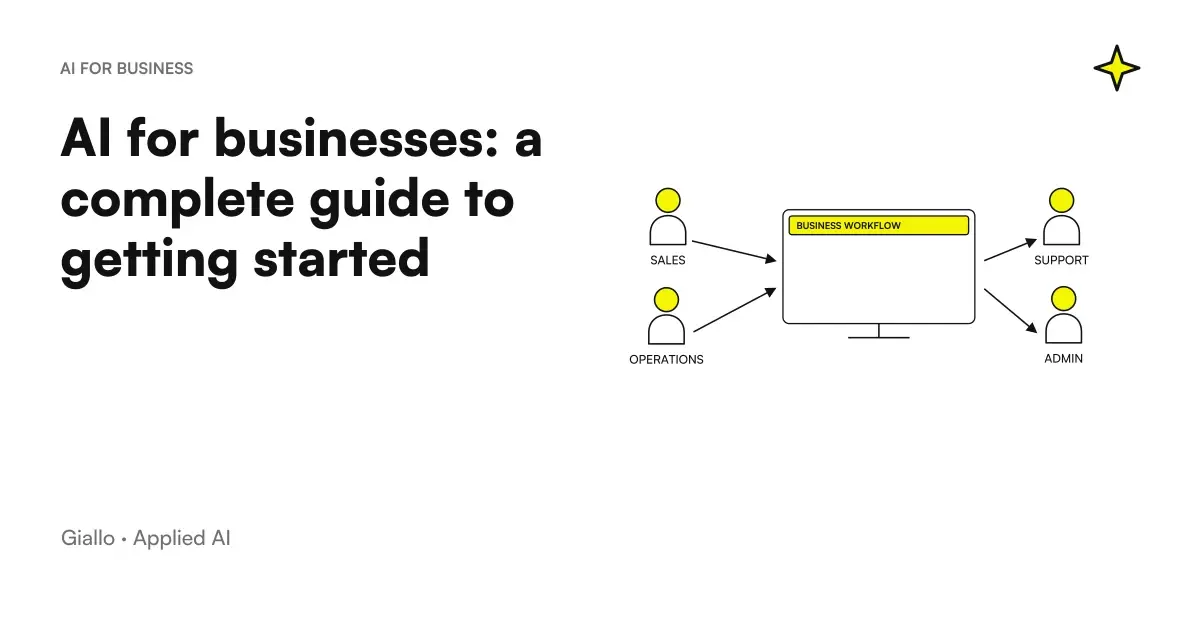
This guide deals with the triage of disputes and escalation, with official sources verified the 9 October 2026. The AI Guide for Companies helps to choose the process; the ticket management with AI covers the general queue. Here the useful result is a better prepared decision, with visible facts and responsibilities.
In summary
- The complaint must remain traceable even if the category is uncertain.
- Declared facts, evidence, and conclusions must be distinct.
- Priority follows business criteria, not just the tone of the customer.
- The draft must not create economic commitments or automatic admissions.
- Every escalation must come to a responsible and have a next step.
What problem solves the triage of complaints?
A message can contain a dispute, a question, and an economic request together. If the system treats it as a normal frequent question, it produces a correct answer in appearance but leaves the problem open. The operator must be able to recognize these elements without reconstructing the conversation from scratch each time.
First, define what the company considers a complaint. A request about the status of the shipment may become a dispute after multiple promises are not fulfilled. A technical report may describe an isolated failure or disruption involving other people. The category must guide the work and be able to change when new facts arrive.
The system may propose multiple labels, for example delivery and billing, but the responsibility for the practice must be clear. Two offices involved must not mean two incompatible responses. The card should indicate a main referent and the required verifications to others, avoiding an ownerless relay. The project of AI for corporate customer care defines how this route connects to the wider service.
What should the dispute sheet contain?
| Field | Information to be retained | Error to intercept |
|---|---|---|
| Practical ID | Unique Reference and Source Channel | New practice for each answer |
| Affected report | Order, Contract or Relevant Service | Link to the customer of the same name |
| Declared Facts | What the Customer Tells | Statement turned into proof |
| Evidence available | Attachments and records available | Attachment cited but not readable |
| Customer request | Result that the person asks | Request confused with established right |
| Proposed priorities | Criterion and pattern | Urgency inferred only from capitals |
| History | Previous Steps and Answers | Promise already made forgotten |
| Responsible and action | Who verifies what, and next step | Practice assigned without activity |
Keep the original text accessible to authorized users. The card is a reading tool, not a definitive source replacement. When the model summarizes, it can miss a clarification or misinterpret a date. The operator must be able to control the passage that supports an important proposal.
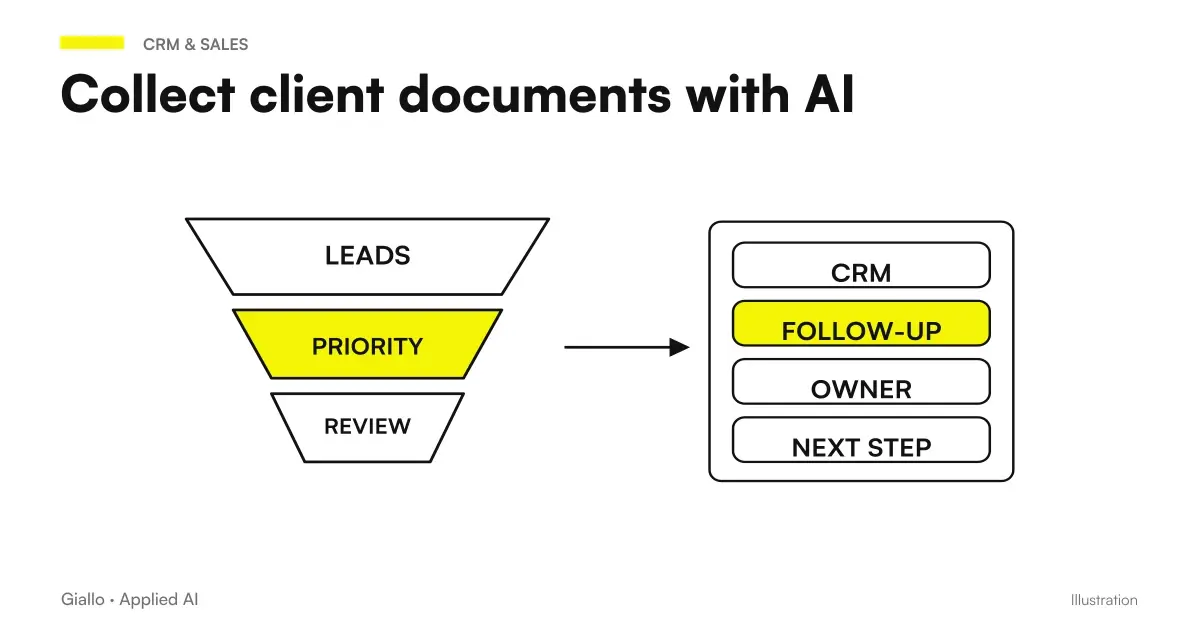
Attachments should be associated with the correct practice, with a note on their status. "Photo present" does not amount to "confirmed damage". To organize incomplete material may serve the flow of Customer Document Collection, adapted to the dispute and limited to the necessary data.
How to classify without losing ambiguous cases?
Construct categories with concrete descriptions and a few representative examples. "Commercial problem" is too broad if it has to decide who to send a dispute to on the invoice. A useful taxonomy distinguishes what changes the operational path, without creating dozens of labels that no one will use. In the pilot, the proposal of a category should also preserve the uncertain cases; the in-depth study on JEV to sort ticket shows how to connect the triage to a review queue.
The n8n's Text Classifier documents a separate branch for input without clear match. It is a function to configure: the project must use a useful path for these cases. It is not enough to add a classifier and assume that each message is handled.
Provide a provisional category when the content is insufficient. If someone only writes “it happened again”, the system should look for the authorised reference or ask a targeted clarifying question. It must not create a plausible explanation to fill the fields. An explicitly stated gap is more useful than an invented fact.
What signs deserve escalation?
The priority matrix must be approved by the company. It can consider a firm service, reported consequences on security, involvement of multiple orders or repetition of the problem. These signals must be evaluated with the available data and with the competent contact person, without turning the model into an expert in the field.
If the client reports a serious risk, the draft must direct the case to the intended path. He must not make a diagnosis or state that the problem is harmless. For some categories it may be appropriate to stop the automatic response and immediately show the operator original text, reference and missing information.
Also define escalation for lack of internal response. A practice can be classified correctly and remain stationary in the queue of an office. You need a rule on the next step, with an alternate recipient and a track. AI does not solve an organization that has not assigned responsibility.
A reliable history before the draft
The history must distinguish customer messages, company responses, and internal verifications. A sentence proposed by the model but never sent should not be recorded as a promise made. An internal note can also be reserved and must not appear in the reply to the customer because it is useful to the operator's reasoning.
For each step it retains date, author or system and link to the source. If two conversations concern the same event, the link must avoid duplication without erasing the differences. The manager may decide to combine the practices; the model may propose it, showing the reasons and uncertainties.
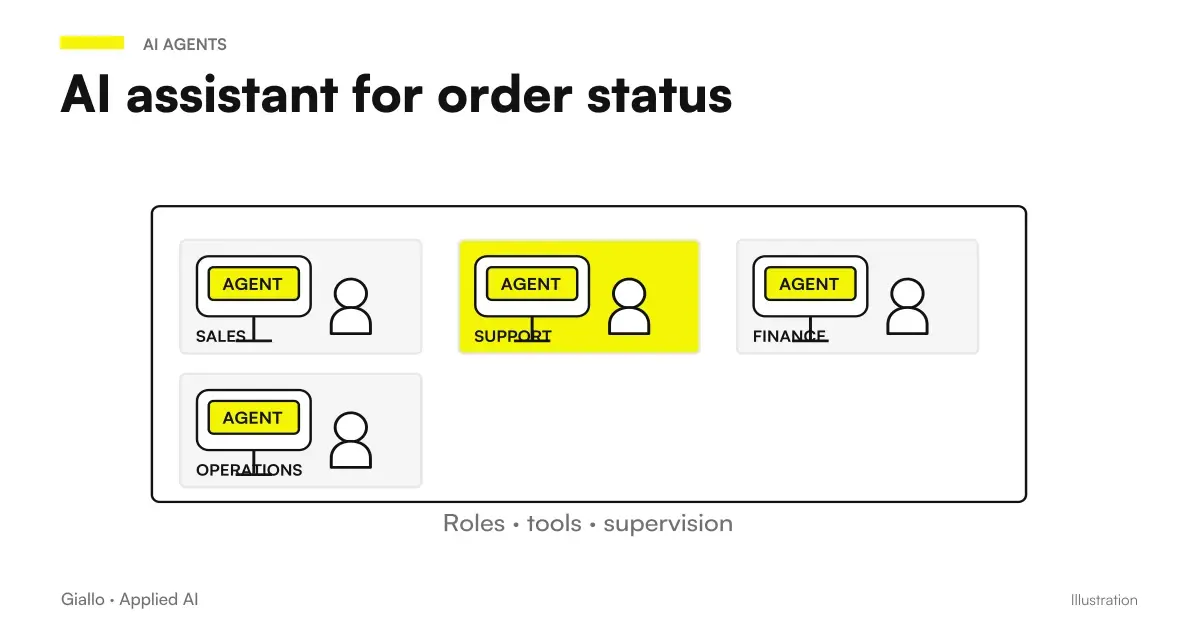
When the problem concerns a delivery, the operational data comes from the source of the Assistant on Order Status. A customer message can signal that the tracking does not tell the whole situation. In that case the card must show the discordance, do not silently choose the most comfortable version.
What can the proposed answer say?
A first draft can confirm receipt, pick up the problem accurately and indicate the next actual step. If a document is missing, you should ask for what is needed. If a verification is in progress, it must say so without inventing a solution date. The text is based on what the process can really maintain.
The prompt techniques for customer care help set tone and structure, but do not replace content controls. A well-written sentence can still promise an unapproved replacement or attribute a fault before verification. The review must look at commitments, not just courtesy.
For sensitive actions or responses, a human confirmation may interrupt the path before execution. The n8n documentation on tool approval describes this possibility. You still have to choose which steps require review and show the actual parameters to approve.
Hypothetical scenario: a furniture manufacturer in Verona
In this hypothetical scenario an SME receives a dispute about an incomplete delivery. The client also claims compensation and attaches photographs. The stream links order and lines, extracts the amount declared missing, and prepares a history of previous communications. The photos remain evidence to be verified.
The request goes through logistics and commercial, but has a unique referent. The warehouse controls the shipment; the commercial assesses the economic demand according to the company route. The assistant does not communicate that the customer is right or that he will be paid. Prepare a draft describing the ongoing verification and the data still needed.
The pilot measures correct links to orders, information retrieved without unnecessary requests, and cases reopened for wrong promises. It is useful to include unclear photographs and partial deliveries actually provided for by the order. No results are assumed at the start: the test serves precisely to evaluate these errors.
Hypothetical scenario: a maintenance company in Bari
A second hypothetical situation concerns recurrent interventions. A customer describes a problem in a calm tone, but reports that the service is stationary. The system proposes a priority based on the declared block and the related contract, rather than the level of irritation of the message. The technical manager checks the impact.
The timeline shows that an intervention had already been planned. The operator must decide whether to confirm it or activate the escalation path. The draft does not invent a technician's availability. If the agenda is not up-to-date, it indicates that the person responsible is verifying the next step and keeps the practice open.
The test sample includes ordinary requests, repeated problems and cases without contractual reference. The most useful measure is the share of relevant cases that come to the correct referent with the necessary data. A reduction in email length would not, by itself, prove an improvement in service.
Closing, waiting, and reopening must have different meanings
A practice pending a document is not resolved. A submitted proposal does not prove that the client has accepted the outcome. Define states that correspond to observable facts and make clear who must act. If a request waits for an internal check, do not attribute the wait to the customer just to remove the case from the team queue.
The person responsible should record the reason for the closure and the steps taken. The note may contain a confirmed solution, a different agreed path or a reasoned decision according to company rules. The model may prepare the summary, but the operator verifies that it describes what really happened and not just a proposed answer.
When a new message arrives, the system must understand whether it is about the same contest or a different event. It can propose the link by showing order, theme and history. If the practice has been closed and the client reports that the problem continues, a re-opening path or a new linked verification is required, without erasing the previous outcome.
The pilot can measure re-openings due to premature closures and cases left without a next step. Not all reopenings are a mistake: new information may arrive. It records the reason, so the person responsible distinguishes an outdated decision from new facts and a closed practice while there was still a lack of planned activity.
How to set the pilot and its budget?
Choose a queue and define a sample with outcomes checked by operators. In the first step, the model prepares the category, priority and record without sending replies. Compare the proposal with the human assessment and record the reasons for corrections. You need to understand which errors change the case’s path.
For the model, consider current candidates and measure quality on your data. The Documentation by Claude Haiku 5.5 offers a product reference for a classification and extraction candidate. It does not prove that it is the most suitable to the complaints of your company or to every language present in the queue.
The budget includes historical preparation, connections, accesses, evaluation of drafts and maintenance of categories. Model calls are one voice, not the whole project. It also estimates the time required for managers to check for exceptions and correct the policy. Without this presidium the flow can produce more work than it takes away.
Checks to be performed before expanding the queue
- An uncategorized complaint comes to a person and remains traceable.
- A customer statement is not presented as a verified fact.
- An unsent draft does not appear in the history as a promise.
- An urgent case expressed in a quiet tone receives the expected verification.
- Economic action requires the appropriate path of approval.
The errors that make the flow unhelpful
The first error is to optimize only the response time. A quick response without a concrete next action can lengthen the dispute. It also counts passes between offices, reopenings and requests for information already available. They are signals of the quality of the path, not the speed of writing.
The second is to treat emotion as a fact. A hard tone does not prove a fault of the enterprise; a gentle tone does not eliminate a serious problem. The model should retain both dimensions when helping to read, without using one to replace the other. Priority must be based on legible criteria.
The third is to confuse claim, return and refund. The Return Management and RMA He follows his own practice. A dispute may start that path, but its opening does not decide every economic consequence. Maintain links and responsibilities, avoiding a “solved” state that hides activities that are still open.
A first queue to decide on with real data
Start with frequent and well-recognised complaints, with a contact person available to check the proposals. Prepare categories, fields, and escalation before choosing the interface. The result to be asked of the pilot is a clearer and properly routed practice, with a cost of sustainable control.
To design this step, the service AI agents can link reading, sources and approvals to the work of the team. It brings anonymized examples of disputes, approved responses, and cases that require a handler. They are the elements to define a concrete flow and evaluate it before extending it.
Giallo Studio guides: methodology and sources
How we apply it in the company
Related resources
 AI for ticket management: shorter waits, more resolutions
 AI customer support prompts: ready-to-use examples
 AI for Business Customer Care: How It Really Works
 AI returns and RMA management: prepare the case for an operator
 AI assistant for order status: responses from verified data
 Collect client documents with AI: checklists and case status
 AI for businesses: a complete guide to getting started
FAQ
Can AI handle customer complaints?
It can prepare triage, gather information and propose a draft. Responsibility for the decision must remain assigned to a person or an approved process. The model must not promise refunds or admit liability just to close a conversation.
How to prioritize a complaint?
Use explicit business criteria, such as reported consequences, service blocking, and already failed steps. The tone of the message is a clue, not a sufficient rule. A quiet request can describe an urgent problem.
What data does the complaint form need to have?
A reference to the relationship, stated facts, evidence, the customer's requests and the history. Add the person responsible, next action and information still missing. Every verified fact must be traceable to a source.
What to do when the complaint does not fall into the categories?
Keep a review path for cases without a clear match. Do not delete a message because the classifier does not know where to send it. The exception queue must have an owner and defined review times.
Can AI send an answer automatically?
Any automation must be limited to approved content and actions. Financial proposals, admissions and exceptions require the procedure specified by the business. In the pilot, starting with drafts for the operator is useful.
How to tell if triage AI really helps?
Measure correct priorities, lost requests, handoffs between departments and corrections to drafts. Also check urgent cases that the system treats as routine. The number of replies produced does not demonstrate that complaints have been resolved.