
AI assistant for order status: responses from verified data
AI order status assistant: identify the customer, read statuses and timestamps, and handle partial orders or stale data without inventing promises.
Reading time: 12 min
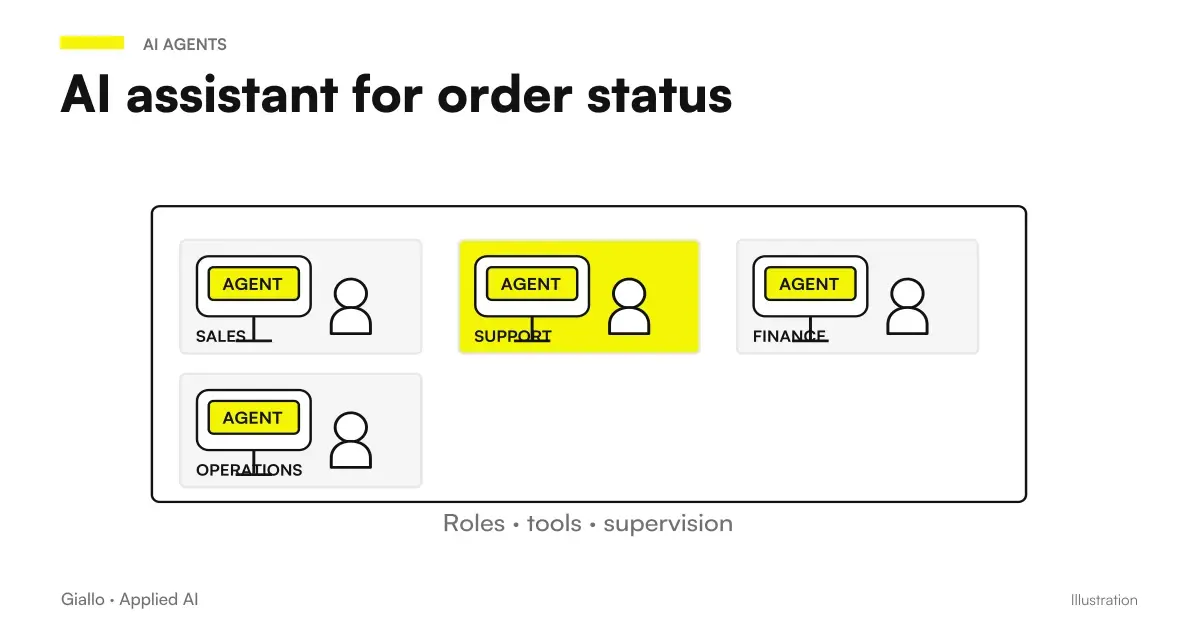
A AI assistant for order status responds by reading an order identified and authorized in the management software or commercial platform. Its task is to translate status, shipments and last update into a clear response. You must not promise a delivery that the source does not confirm, nor expose the record to those who know only one number.
The query is about a transactional response, different from an FAQ of the corporate customer care. Official sources verified the 9 October 2026, without customer proof or invented savings. The guide AI for businesses helps to choose whether this microprocessor has priority over other requests.
In summary
- Identifying the order and authorizing the reading are two distinct controls.
- Trade status, preparation and shipping may have different sources.
- The answer must report the time reference useful for interpreting the data.
- Partial orders and unavailable sources require explicit outcomes.
- The pilot starts from the consultation, leaving changes and refunds outside the first perimeter.
What question must the first version solve?
Define a strict promise: read the status of an order and indicate the next known step. Do not add address change, cancellation, refund and claim in the same initial function. These steps have different authorities and consequences. A reliable consultation is a project that is already useful and easier to verify.
The customer's question may be brief, but the data to be read is not always unique. “Where is my order?” may mean received order, ready goods, party parcel or attempted delivery. The system must recognize necessity without confusing these states. Before choosing the model, prepare a map of the sources and meaning of the values.
The Guide to AI for Logistics and Shipping offers the framework of exceptions. Here we focus on customer response, not route planning. If the source does not contain a prediction, a more fluid text does not make it available. The correct answer may be a partial consultation with the operator.
How to identify the customer without relying on chat text?
The project must link the request to an appropriate identity or verification path. An order number is a reference, not a privilege. The person may have read it in an forwarded email or typed it in error. The reading function must then apply permissions independent of the phrase "this is my order".
Shopify documents logins and verifications on its order status page. It is an example of a platform with a specific path, not a guarantee that each custom chatbot would automatically inherit the same controls. Shopify Order Status Page.
Do not ask for more personal data than the planned verification requires. The model must not choose a different identification procedure on its own in each chat. If the user fails the check, the response must not reveal details of the record to “help them”. Prepare a support path that retains the problem without exposing another person’s order.
What fields should the consultation read?
| Field | Source to be defined | Use in response |
|---|---|---|
| Order ID | Management software or platform | Select the correct record |
| Customer-order relationship | Authorization system | Decide what details are readable |
| Trade Status | Orders | Distinguish received, confirmed or other phase |
| Preparation status | Warehouse | Clarify what is ready or still in the works |
| Shipping and tracking | Logistics or Courier | Describes the data available on the packages |
| Partial Lines | Order and Fulfillment | Avoid a unique outcome for the whole order |
| Source timestamp | System that produces the data | Show how recent the information is |
| Exception and Assignee | Queue assistance | Prepare the transition to a person |
The table describes the contract of the project. Not every management software exposes these fields; the initial verification must ascertain which ones are really available. If the system provides only a general state, the chatbot cannot infer all the details of the shipment. The answer must remain within that perimeter.
Distinguish date of the event, date of synchronization and date of consultation. A record read now may contain an event from yesterday. Presenting it as “updated now” without explaining the reference makes the message ambiguous. The Guide to synchronize CRM and management software addresses the coherence between sources when multiple systems retain the same data.
What to say when the data is old or missing?
Freshness must follow a rule of the process. Do not invent a universal threshold: an order in production and a package in delivery have different times. The system can submit the latest available data with its reference, or request an operator verification when the information is not sufficient for the application.
"I can't find a verifiable update" and "the order doesn't exist" are different outcomes. An unavailable source does not demonstrate absence of the record. Don't use a convenient answer that closes the chat but sends the customer on the wrong path. The message must clarify the limit and indicate a possible next step.
n8n documents a human fallback workflow when AI cannot help. It is a passing primitive, to be connected to a queue and a person really available; its example does not measure your response time. Human fallback.
How to handle shipments and partial deliveries?
A response should follow the relevant parts of the order. If one line is shipped and another is still in preparation, submit them separately. A valid tracking for a neck is not necessarily the tracking of the whole supply. The Shopify platform documents a page capable of representing partial fulfillments, but the custom function must verify its data contract.
It also checks what the source means by "completed". It can be an order processed from the warehouse, not a delivery confirmed by the customer. The map of meanings must be explicit and approved by those who know the management software. It is a check that should not be entrusted to the model at every turn.
A part is delivered and a part has no tracking
It presents the two states separately and cites the available time reference. Don't invent a tracking or date for the missing part. If the application requires information that the system does not expose, prepare a verification for the operator with order, affected lines and met limit.
When does the question stop being a consultation?
An address change or cancellation request is a new action. The project must recognize it and route it into the intended process, without using the same read-only tool as a shortcut. The conversation may remain continuous, but the authority and verification must change. A customer who asks “then undo it” has not turned a reading into an authorized writing.
Even a dispute requires a path of its own. "Result delivered but I have received nothing" should not be treated as a repetition of the question about tracking. The guide to customer complaints with AI faces stated facts, urgency and escalation. For a return request, the route returns and RMA distinguishes practice and reimbursement.
The consultation must leave the operator with a useful delivery: read source, status, still open application and relevant data. It is not enough to transfer all the chat without synthesis. The manager must be able to verify the facts, recognizing what the customer has stated and what the system has confirmed.
Two hypothetical scenarios for e-commerce and distribution
Hypothetical example: an online store in Lucca receives requests after a partial shipment. The customer passes the verification path and asks where the order is. The source shows a passing neck and a line still in preparation. The assistant distinguishes the two parts and does not use the first tracking as a universal response.
The date for the missing line is not available. The function avoids "coming tomorrow" and prepares a verification for the operator. In the pilot the team checks that the response remains consistent with the data and that the customer does not have to explain the problem again. No reduction in unmetered chats is declared.
Hypothetical example: a component distributor in Piacenza consults the management software. The commercial sees an updated state in a system, while the assistant receives a synchronized copy first. The project shows the reference and signals insufficient freshness for demand. The operator can check the authoritative source without attributing an error to the customer.
The group corrects the synchronization and tries a temporarily unavailable source. The answer must distinguish unavailability and absent order. The next step evaluates whether an existing status page is enough or whether the conversation adds value. The comparison is linked to customer care automation, with criteria defined on the actual request.
How to avoid a more precise response from the source?
Prepare examples of approved formulations for different levels of information. "Reliant on the courier" must not become "arrive tomorrow" without a source to support that prediction. If the system has an estimate, the response must present it with the relevant context and not turn it into a promise of the enterprise.
Linking to tracking may be useful, but it does not prove that the data is up-to-date or that the carrier covers every event. When sources diverge, it shows the verified passage and the limit of the consultation. If a manual check is needed, prepare the practice for the team instead of proposing a plausible explanation of the delay.
In the pilot, assess the final text as well as the fields read. The assistant could retrieve the correct status and add unsupported information while writing. Count retrieval errors and additions in the response separately, including a persistent question about the delivery date. Quality also depends on maintaining a boundary when the customer seeks a certainty that is absent.
What model does it take to answer about the state?
Reading and authorisation must be system checks. The model can interpret the question and formulate the result, but it must not reconstruct a status from chat clues. A template with verified data may be enough for a standard answer; AI is useful when the request changes form or requires a bounded explanation.
Haiku 5.5 can be a candidate to be measured by routing and bounded responses, according to the official page. A different model can be evaluated on complex cases, but no comparison of names solves an old source or a missing permit. We do not attribute to the model a measured quality on your shop.
How to organize the pilot without changing orders?
Prepares synthetic or anonymized cases by normal, partial, non-existent, unauthorized order, given old and source in error. Write the expected result before performing the test. In the initial phase it generates drafts for operators or limits the route to a test environment, keeping economic and logistical changes out of the perimeter.
It measures consistency of response with the source, correctness of escalations, and information exposed to unauthorized users. The latter case must be an explicit negative proof, not an occasional check. It also compares repeated requests: a closed chat that generates a phone call after is not necessarily resolved.
Define the denominator: correct answers between evaluable requests, not total conversations with different conditions. Separately records unavailable source and misinterpretation error. The team needs to know whether to improve integration, map of states or formulation. The measure becomes useful when it indicates which component to correct.
What costs separate in the estimate?
The budget includes access to data, customer identification, map of states, channel, escalation, testing and maintenance. Add calls to the model only where the stream uses them. The cost of a fragile integration may be more important than choosing between models on the list.
Also ask how management software status changes, tracking formats, and unavailability periods are handled. A platform with an already useful status page can reduce the need for a custom function. The assistant makes sense if it improves the path of the question, not just if it copies the same information into a new chat.
What mistakes produce plausible but wrong answers?
The first is to authorize from the knowledge of the order number only. The second is to equate evasion and delivery. The third is to present a reading timestamp as a source update. The fourth is to invent a prediction. The fifth is to treat partial orders as a single record without exception.
The correction starts from the data contract and the liability map. A response should make clear what is known and what requires verification. If the team does not know how to answer this distinction in the manual process, the chatbot will hide it behind a fluid phrase instead of solving it.
Which order to use for the first analysis?
Choose a recurring request and an anonymized order with its states over time. Rebuild where the operator reads the data, what details they can show, and when they switch to a colleague. The pilot can start from that question, avoiding exposing the whole platform to a generic assistant.
To create a AI Agent connected to the real state, Giallo starts from the source and the authorization path. The guides to corporate customer care and Logistics help to separate information response, operational exception and subsequent action.
Giallo Studio guides: methodology and sources
How we apply it in the company
Related resources
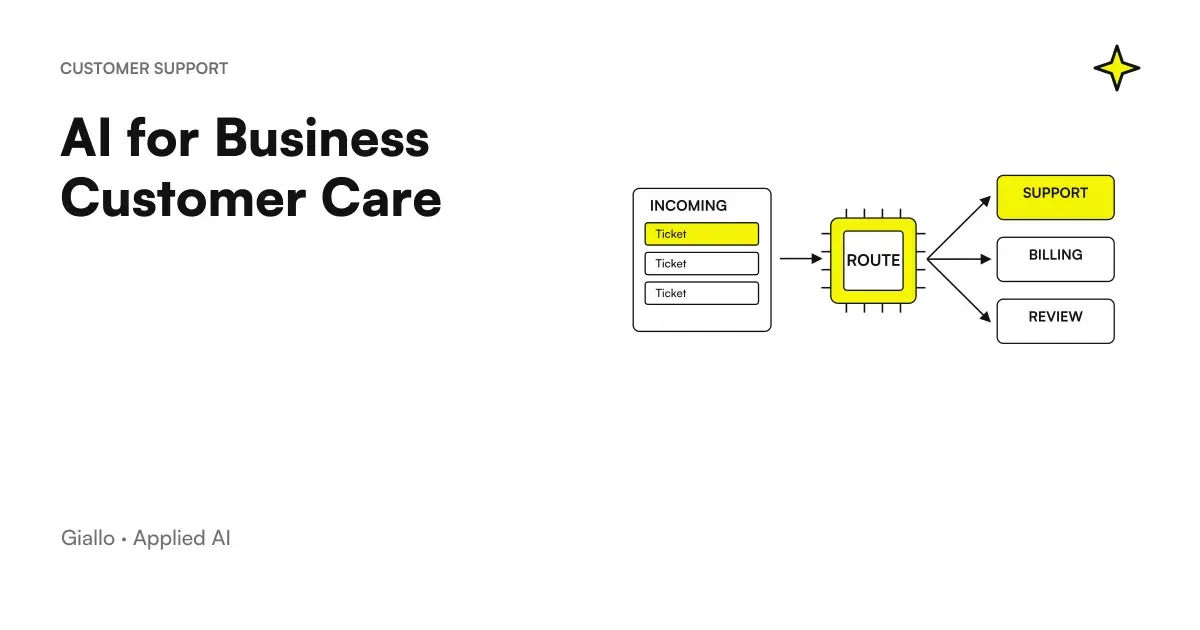 AI for Business Customer Care: How It Really Works
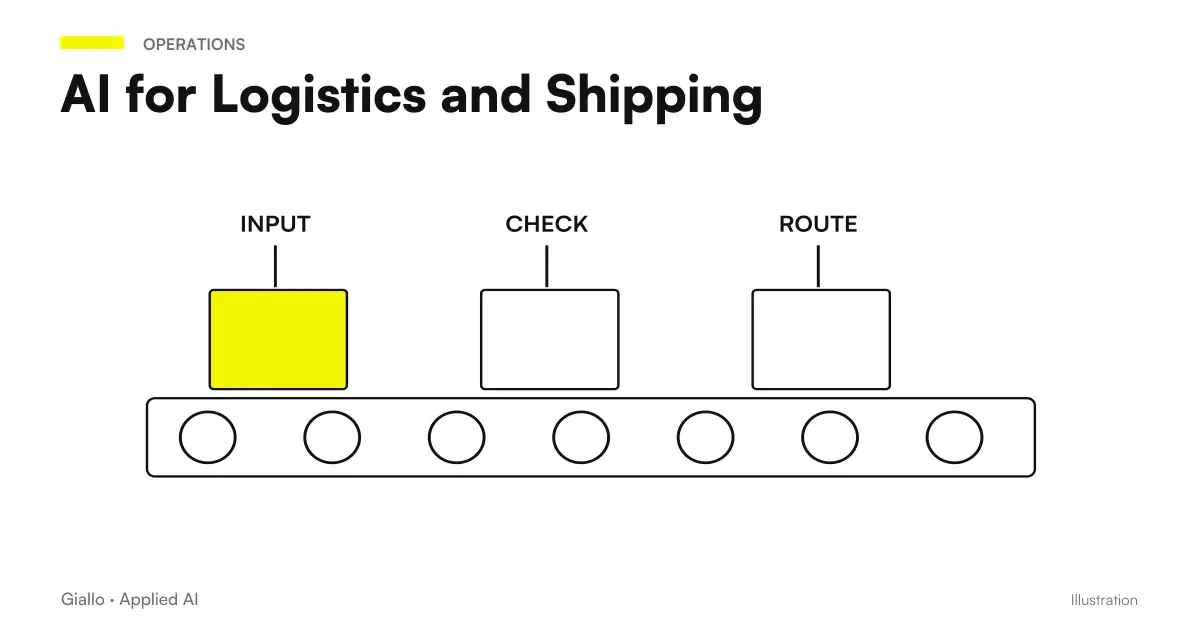 AI for Logistics and Shipping
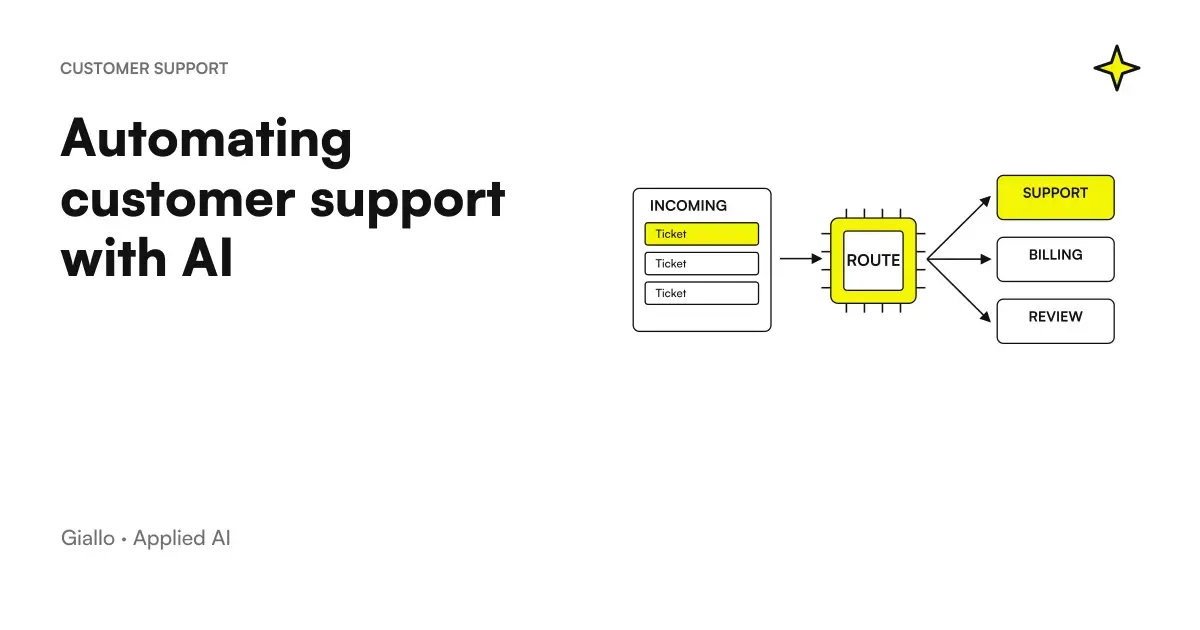 Customer Care Automation: When AI Responds for You
 AI returns and RMA management: prepare the case for an operator
 Customer Complaints with AI: Priorities, Facts, and Responsibilities
 Synchronise CRM and business software with AI: data, conflicts and retries
 AI for businesses: a complete guide to getting started
 ChatGPT Ads targeting: context, audiences and privacy in Europe
FAQ
What does an AI assistant do about the status of orders?
It reads the authorized order data and presents them in an understandable response. It must distinguish operational status, shipping and delivery forecast. It cannot invent an update when the source does not contain it.
Is knowing the order number enough to see its details?
The number identifies a record, but does not automatically establish the right to read it. The project must use a reliable identification and authorisation process. Show only the data needed for the request.
How to manage an out-of-date status?
State when the data was read or updated and apply the process's freshness rule. If a reliable source is missing, escalate to an operator. An old timestamp must not become a delivery promise.
What to answer for a partial order?
Distinguish line items, packages or shipments according to the available source. Avoid a single answer presenting everything as delivered. If a part cannot be verified, state this separately.
Can the assistant change the address or cancel the order?
These are different actions from checking order status. The first pilot should exclude them from its scope or include a separate check. An informational answer does not authorise a change.
What metrics indicate if the pilot works?
Measure answers consistent with the source, authorisation errors, correct escalations and repeated requests. Also check partial orders and missing data. The number of closed chats does not establish quality.