
AI for Accounting: What It Can Really Do
AI for accounting: simplified and ordinary accounting regimes, what can be automated and what remains with the professional, with legal references.
Reading time: 9 min
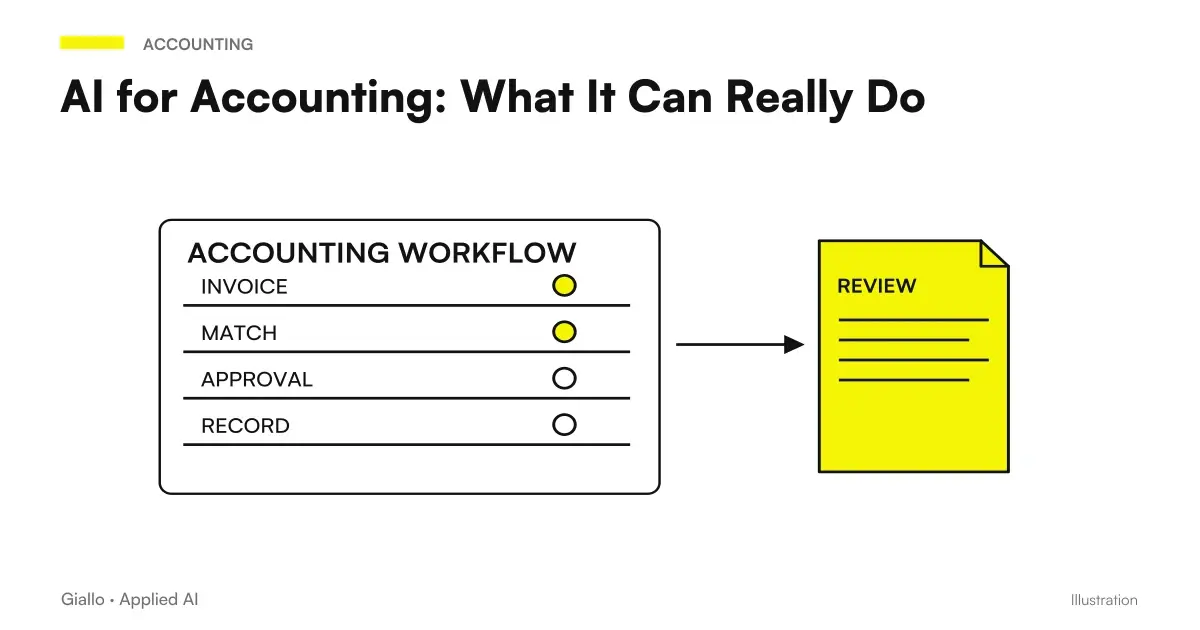
An AI in accounting reads, sorts and proposes: it does not sign, does not qualify a dubious operation, does not decide in the place of those who studied to do so. The work it takes away is the transcription: open a document, understand what it says, bring it into the management software in the correct form. It is the task that takes up the most hours and requires less specialist expertise, which makes it the first point to look at in a studio or administrative office.
However, the starting point is not technology. It is understanding which accounting records a company is required to produce and how long it must retain them, because an automation project that ignores these constraints risks saving time on a badly designed workflow. The following sections start there, rather than with the software.
In summary
- The obligation to keep Newspaper Book and Inventory Book It concerns those who engage in business activities, not small business owners.
- The scriptures and related documents go preserved for years, not just archived: it is a constraint that the project must foresee from the beginning.
- The Accounting System (simplified or ordinary) changes which automation makes sense to build first.
- The use case with the fastest return remains the Data Extraction from documents with different layouts.
- A Arithmetic Control on totals intercepts more errors than avoids a more sophisticated model.
- Tax qualification, doubtful cases and signature remain to the professional: they are not delegable.
What needs to be written, and for how long
Before automating anything worth knowing what the law asks to keep in order. The entrepreneur who carries out business must keep the newspaper book and the book of inventories, in addition to the other scriptures required by the nature and size of the enterprise, and store neatly the originals of letters, telegrams and invoices received together with copies of those sent: says the Article 2214 of the Civil Code, which excludes only small business owners.
Those same scriptures must then be kept for ten years from the date of the last recording, together with invoices, letters and telegrams received and copies of those sent, as established by the Article 2220 of the Civil Code: the same rule explicitly admits the preservation through recordings on image media, as long as they remain legible at all times. A digital archive indexed by a system that understands the contents of documents, not just the name of the file, is exactly the tool that makes that storage usable instead of a repository from which nothing is extracted anymore.
Why searching an archive of years matters more than the speed of insertion
A document enters the accounts in seconds but remains relevant for years: during an audit, when a client asks for an old supporting document, or when litigation reopens a closed case. An archive searchable only by filename or registration number forces people to remember what a document was called to find it. A system that also indexes the contents answers questions such as "the supply contract with that supplier from the year before last", which is how people actually search.
Simplified or ordinary: change what is best to automate first
Not all companies keep accounting the same, and the regime changes where AI makes the most. Minor companies that do not exceed, in the previous year, the amount of revenue provided for simplified accounting (€500,000 for those who provide services, €800,000 for other activities) are exempted from keeping the ordinary accounting records, as established by the Article 18 of Presidential Decree 600/1973: they must, however, write down chronologically receipts and expenses, with amount, counterpart and reference to the document, in special registers.
| What you need to do | Simplified Accounting | Ordinary Accounting |
|---|---|---|
| Required Recordings | Receipts and expenses noted by date | Double-entry bookkeeping across all accounts |
| Where AI Makes More | Reconciliation between receipts and invoices issued | Cross-checks between linked accounts |
| Main risk of an error | Stay isolated on single annotation | It propagates across multiple prospectuses |
| Critical time for automation | End of month, so as not to accumulate backward | Every periodic closure |
After passing the threshold for two tax periods, or by choice, we move to ordinary accounting: from that moment a classification error does not remain isolated on a line, because the double lot propagates it on linked accounts. A system that marks anomalies before periodic closure, instead of discovering them later, is proportionally worth more in ordinary than in simplified.
The real bottleneck: interpret, not transcribe
On already structured data (a total, a date, a VAT number) a traditional automation is enough: it costs less and does not err in an unpredictable way. AI serves where the document requires interpretation: a new provider never seen before, a wrongly photographed receipt, a description written differently by each customer. That's where rule automations stop and language models work well.
- Extracting data from documents with different layouts: high benefit, low difficulty
- Sorting incoming documents by type: high benefit, low difficulty
- Reconciliation between bank movements and invoices: average benefit, requires rules of tolerance defined with those who know the accounts
- Research in archive with questions in natural language: average benefit, grows with the years of historian
Why an arithmetic check beats a more sophisticated model
If taxable plus tax does not return with the total written on the document, that document must end up in a queue of exceptions before it is registered, regardless of how safe the model seems to read. This check, trivial to write, intercepts almost all extraction errors without depending on the skill of the system that read the document. It is worth more than any subsequent improvement of the model, and must be built first.
The same goes for off-standard cases: a system trained on recurring documents tends to respond with confidence even when it shouldn't, the behavior described in AI hallucinations: how to avoid them. It is an extra reason to keep the exception queue clearly visible instead of hiding it behind a recording proposal that seems plausible.
Extraction work is not just about general accounting in the strict sense. The same logic, applied to the active and passive cycle, is the heart of AI and Electronic Billing; applied to the comparison between documents of different providers, is the theme of AI for procurement and supplier management. Often they are the same documents seen by different functions, and a project thought in isolation risks reconstructing from scratch a job already done elsewhere in the company.
A company with regular suppliers, a studio with different customers
In one example: a commercial company that receives passive invoices from about twenty regular suppliers starts from a favorable point, because the layouts are repeated and the system learns them quickly. The first month serves to build trust with those who control the registration proposals; from the second, most recurring documents pass with few corrections.
Another case is the study that follows the accounting of multiple independent clients. Here the volume is distributed on different suppliers for each customer, so the layouts are almost never repeated: it is the scenario in which AI clearly exceeds any rule automation, because a traditional parser should be reconfigured for each supplier of each customer, while a linguistic model reads documents never seen applying the same criterion. The compromise is that the classification by cost center should be calibrated customer by customer, not once for everyone.
A third, less discussed case is a business moving from simplified to ordinary accounting after exceeding the revenue threshold mentioned above. This is the time to rethink the workflow from scratch rather than expand the existing one: checks sufficient for a record of receipts and expenses are no longer enough when an error spreads across linked accounts. Building the automation with double-entry bookkeeping in mind costs less than rebuilding it a year later.
What the Professional Should Not Delegate
AI can
- Read and transcribe non-standardized documents
- Report amounts that do not square before registration
- Search an archive of years with questions in natural language
- Preparing drafts of recurring communications
The professional must
- Fiscally qualify a dubious operation
- Decide on the treatment of a particular case
- Signing scriptures and statements
- Respecting professional secrecy about customer data
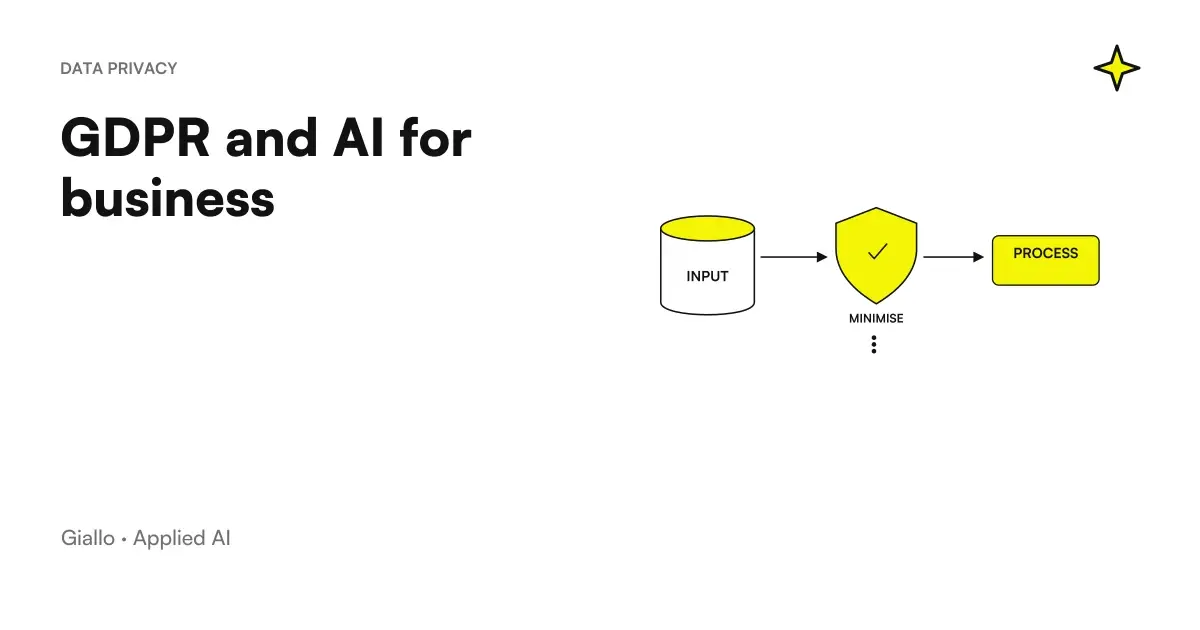
The last point is not a formality: the accounting documents contain data of natural and legal persons, so the framework described in GDPR and AI in the company, with a written agreement with who provides the service and verification of where the documents are processed. For a study it is the condition that makes the tool usable or not, not a detail to be fixed afterwards.
Collect expense notes without losing the justification
Before the accounting examination, an expense note must link request, travel and justification, avoiding repeated documents or missing fields. expense notes with AI deepens this operational preparation: data extraction, application of company policy and request for integration. Tax treatment remains an assessment of the competent professional.
The test month before loosening the controls
- It counts how many documents pass by the administration in a month and how much time they absorb today.
- Parties holding human confirmation on each proposal for registration, without exception.
- It marks which documents end up correct and for what reason: new supplier, amount that does not return, layout never seen.
- Only after seeing the same provider go uncorrected for consecutive weeks, does it consider easing control over that provider only.
Once the reconciliation between bank movements and invoices is reliable, the natural next step concerns those who have not yet paid: linking that clean data to a reminder system like the one shown in Automatic payment reminders with AI It only makes sense if the upstream reconciliation already works, otherwise you automate a prompt based on the wrong data.
Accounting remains one of the functions where AI is most easily measured, because the transcription work it takes away is quantifiable in hours from the first month. What does not change is where the responsibility passes: the scriptures remain those provided for by the Civil Code, their preservation remains a multi-year obligation, and the qualification of doubtful cases remains a professional decision.
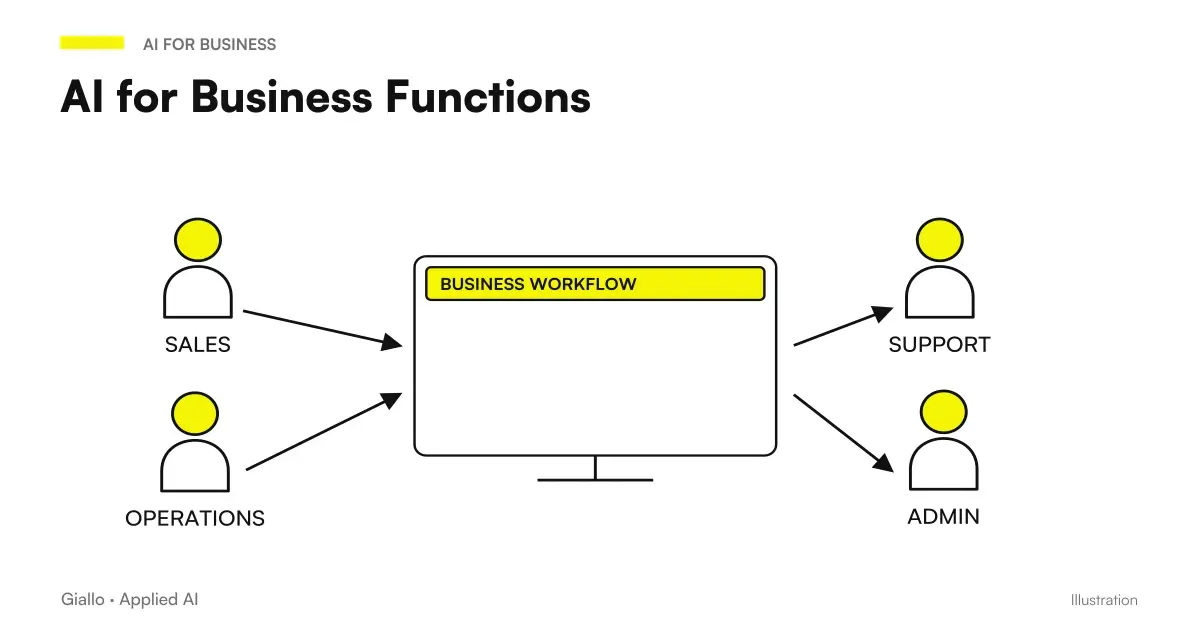
Before leaving it is worth looking at two things together: how much would the project really cost, with the method described in how much it costs to automate a process, and how it fits into the rest of the business functions you are already automating or want to deal with later, summarized in AI by business function. If your firm or company wants to understand which administrative process to start from, Giallo Studio works with accountants and administrative offices to set the first project on the documents that really generate the volume, without disassembling what already works today.
Giallo Studio guides: methodology and sources
How we apply it in the company
Related resources
 AI and e-invoicing: what can be automated
 AI for procurement and supplier management
 How much does it cost to automate a business process
 GDPR and artificial intelligence in the company
 AI for Business Functions: Where to Start
 AI returns and RMA management: prepare the case for an operator
 AI assistant for order status: responses from verified data
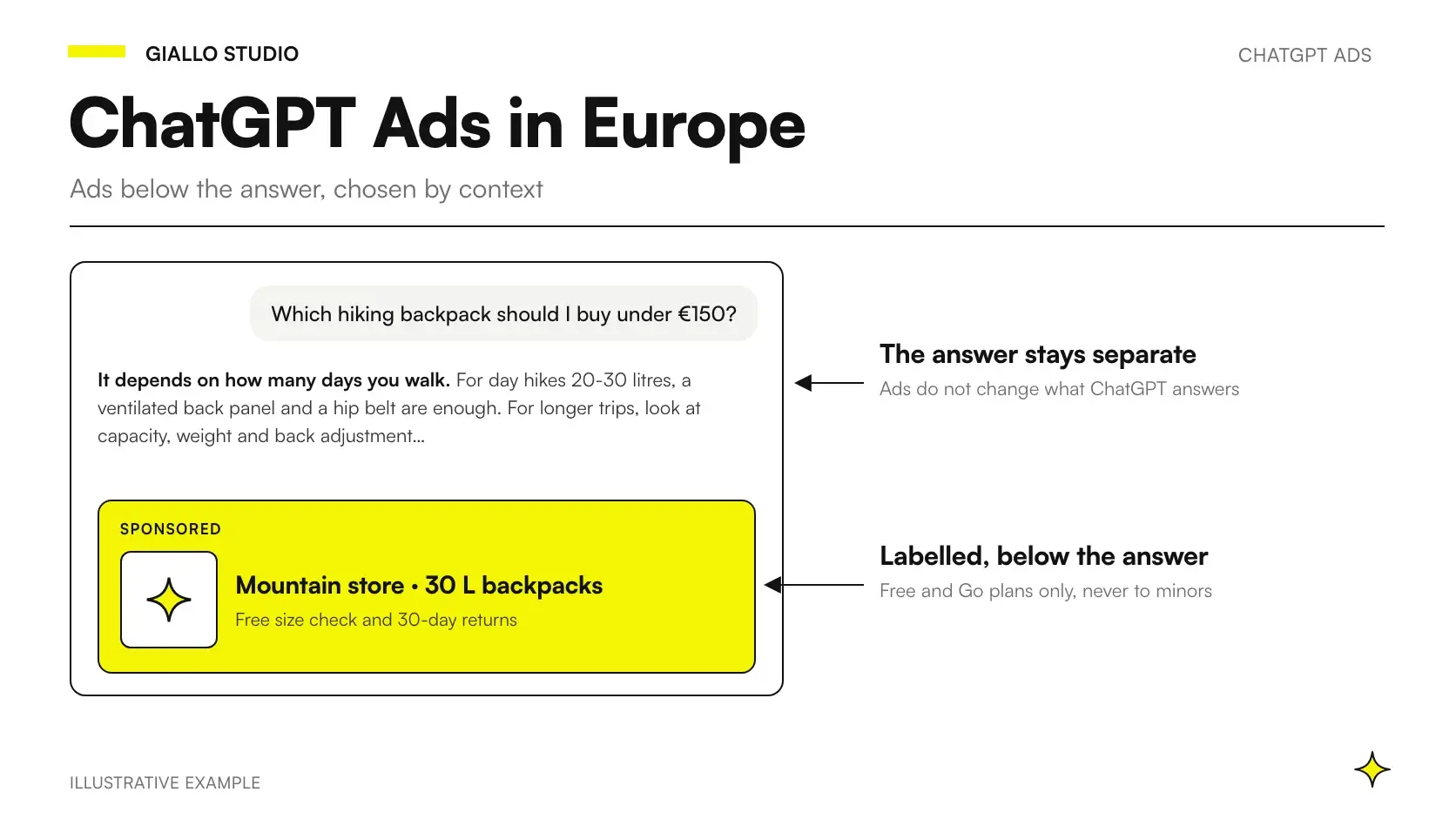 ChatGPT Ads: what it is and how advertising on ChatGPT works in Italy
AI by sector
The same reasoning, applied to the other areas we follow.
- AI for consultants: proposals, client data and project delivery
- Creating quotes with AI: how to speed up the process
- AI for catering and banqueting: event quotes and customers
- AI for CRM and sales: automate the sales process
- AI for call centres: what changes?
- AI for Business Customer Care: How It Really Works
- AI for businesses: a complete guide to getting started
- AI for dentists and dental practices: recalls, quotes and scheduling
- AI for driving schools: enrolment, lessons and exam reminders
- AI for e-commerce: compliant returns, product descriptions, discounted prices and reviews
- AI for car rental: renter fines, contracts and return damage
- AI for electricians: wallboxes, solar power and installation deadlines
FAQ
Does simplified accounting need less automation than ordinary accounting?
It needs a different kind of automation. In simplified accounting, the work focuses on receipts and payments recorded by date, so AI is most useful for reconciliation and classification. Ordinary accounting involves double-entry bookkeeping and requires closer cross-checks, because an account error spreads across several linked statements.
Can an AI record an invoice without anyone checking it?
Technically yes, but this is a choice that needs to be earned over time, rather than enabled on day one. Start by having a person confirm every proposed entry, measure how many proposals are corrected over a few months, and consider removing the human step only for the most consistent suppliers.
What happens to documents after registration?
They remain part of the accounting records and must be retained, rather than simply filed in a disorganised pile. This is why a document automation project makes sense only if it considers how those documents will be found years later, not just how they enter the system today.
Do I need to change my business management system to get started?
In most cases, no. A well-designed project reads and writes through the existing business management system’s interfaces, or through data exchange files. The system does make a large difference to project cost: one that exposes data in an organised way costs significantly less to connect than a closed system.
Who remains responsible if a transaction is classified incorrectly?
The professional or the person in the company who signs the accounting records, exactly as today. AI can flag an unusual or ambiguous transaction, but the tax classification of an uncertain case requires judgement that cannot be delegated to an automated system, however reliable it may be on standard cases.
Where should a practice with few clients start?
Start where time is actually being lost: usually sorting documents arriving from different clients in different formats. This is a small use case, measurable within a few weeks, and it lets you see whether the chosen provider works before extending the project to anything else.