
Import email and PDF orders into business software: AI, checks and confirmation
Import PDF orders into business software: extract line items, codes, quantities and units, check duplicates and review the summary before saving.
Reading time: 12 min
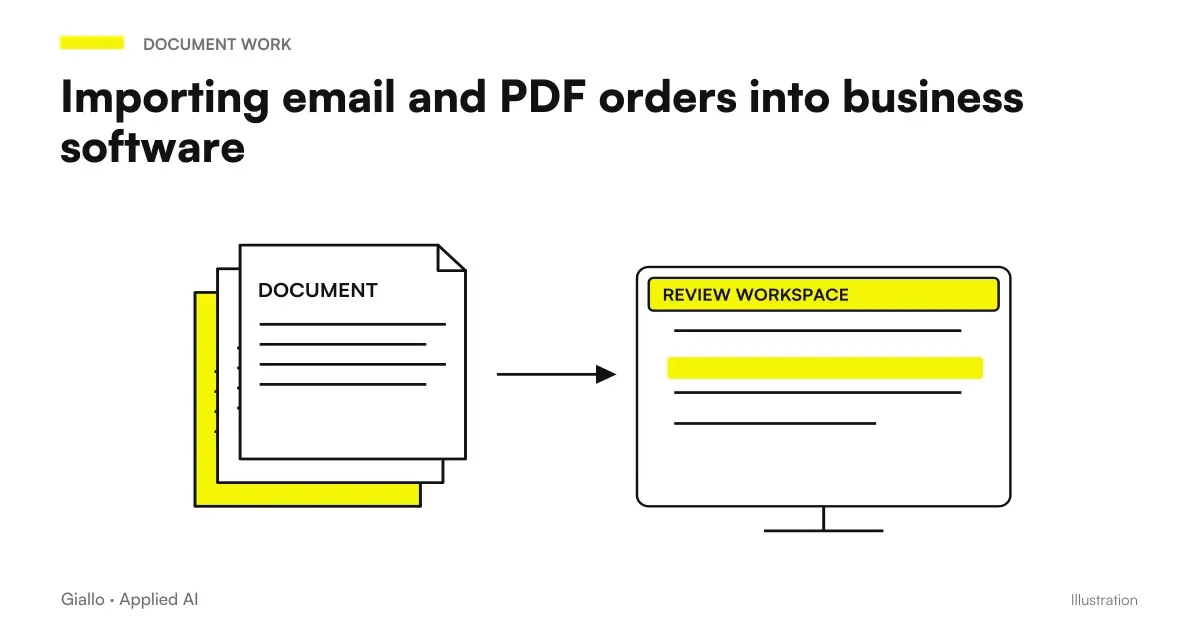
Importing PDF orders into business management software with AI means turning a customer order already received into a proposed header and rows that can be checked. Codes, quantities and units must be compared with the catalog; duplicates and missing information remain visible before registration. Extracting data and writing in management software are two different stages.
The route serves when the order comes from email or PDF and someone copies it. It is not about creating a quote: the customer has already made a request to be acquired. The problem is to retain its meaning in the system, without changing items or packages to fit the first match found.
Technical primitives are documented at 9 October 2026; the cases are hypothetical. The guide on AI to delete data entry covers the general transcription work. Here we deal with the microprocess of the order, to be connected to the framework of AI for businesses.
In summary
- The proposal includes head, lines and reference to the document received.
- Extract code and catalog code must remain distinguishable.
- Parts, packages and other units require approved conversion rules.
- An ambiguous or duplicate order switches to a verification queue.
- The confirmation concerns the precise summary that will be recorded.
- The outcome should be checked in the management software even after a successful attempt.
Which fields to extract from the header and rows?
Prepare a schema that reflects the target system and document. The header can include customer, order reference, date, destination and notes. Each row contains reported code, description, quantity, and units. The additional fields depend on your process: don't make them mandatory just because they are present in an example of another company. For integration, fields must have explicit types and rules of absence; the guide to JEV to extract typed data separates the proposed data from the required validation prior to registration.
n8n documents an Information Extractor that prepares structured information from a text through attributes or schema. This ability can support the proposal, but does not prove that each PDF is readable or that the extracted values are correct. Documentation Information Extractor.
| Field | Date to show | Anomaly to be made visible |
|---|---|---|
| Customer | Value in the document and candidate in management software | Unconfirmed identity |
| Order Reference | Original number or text | Absent or already present |
| Article code | Excerpt code and proposed correspondence | Not Found or More Candidates |
| Quantity | Value and location in source | Missing or reading uncertain |
| Units | Original unit and unit required by the system | Undefined conversion |
| Destination | Available date and reference | Conflicting Addresses or Locations |
| Status | Proposed, verified, registered or to be clarified | Attempt with unreconstructed outcome |
Keep the reference to the original line. If a proposal looks wrong, the operator must be able to open the PDF and immediately find the point to check. An unsourced summary can reduce copy-paste but increase revision. The readability of the comparison is a part of the project, not a convenience to add later.
How to read different PDFs without losing lines?
The PDF can contain accessible text, scans, tables on multiple pages, or notes that modify a line. Do not treat OCR, extraction and reasoning as synonyms. Microsoft distinguishes structured document capabilities and generative approaches in the model choice guide: the choice depends on the material and the output. Microsoft Document Intelligence.
The test must include broken lines, long descriptions, and documents with multiple sections. An extractor can return an ordered table and omit a relevant note. Ask that absent or unreadable information be marked, without completing it with a guess. It controls the number and content of rows relative to the document, not just if the output format is valid.
If the same order arrives in the attachment and in the email body, determine which source prevails and how to report differences. A change in text can be about an updated version; a copy can only be a forwarding. Don't leave the implicit decision to the model. The Guide to mail sorting and attachments helps to keep the request complete before extraction.
For more general documents return to the Document Automation. The distinguishing point of the order is that each line must become a data usable in management software, with controls on the catalog and registration. A good summary of the PDF does not meet this criterion.
How to associate codes with the catalog?
Keep the code first exactly as it appears in the source. Then it applies the normalization rules allowed by the catalog, as a treatment of spaces or capitals when the system allows it. Do not remove random characters: a separator can distinguish two articles. Correspondence must be reproducible and show the candidate used.
When the customer uses their own code, they need an approved equivalence table or verification. A similar description may suggest candidates, but it does not prove the identity of the article. If the catalog returns multiple matches, the case remains open. The operator sees original code, candidates, and relevant differences, instead of receiving a hidden choice.
The catalog must have a recognizable version or update. A discontinued item or modified packaging may change the meaning of the order. For the preparation of data upstream read update supplier price lists with AI. Importing the order should not correct the whole catalog at the same time without a separate assignment.
Do not use the model to guess a missing code. It can suggest a question for the contact person or gather evidence while keeping the status “to be verified”. Selecting the wrong item can affect availability, delivery and invoicing: checking the row is more useful than a generic statement about document accuracy.
How to manage quantities, units and packages?
The number must have a unit. A package request does not amount to a piece request and a quantity reported in a note may change the main line. The summary shows original value, original drive and proposed conversion, with the catalog rule used. If the rule is missing, the system doesn't have to invent it.
A purely demonstrative example clarifies the risk: one pack contains six pieces and the document requires two packs. If the management software registers pieces, the proposal can indicate twelve pieces only when that equivalence is confirmed in the catalogue source. These numbers illustrate control, not a valid result or rule for your products.
Distinguishing extraction and calculation makes reviewing easier. The model can help you read the request; the approved conversion should follow a deterministic and verifiable rule. If the result is incorrect, you know if the problem was quantity reading or conversion. Mixing the two steps into a free text makes it harder to understand the cause.
Summary to show before recording
For each line it has code in the source, proposed article, quantity, original unit, conversion and reference to the document. Highlight missing fields and multiple candidates. The auditor must confirm the precise summary to be recorded. Open rows do not become complete because the rest of the order is correct.
How to avoid duplicates and manage a failed attempt?
Define a document identification key and a uniqueness rule consistent with the business management system. The order number, customer and other references may be useful, but the rule must be checked: the same customer may reuse a number or send a revision. Forwarding the same document must not create a second record simply because it arrives in a new message.
When a call fails, the outcome can be uncertain. Before repeating it, check if the system has already created the order. Preserve references of the proposal, attempt and possible record. The Guide on integrate business management software with n8n deepens idempotence and failures: they are integration problems, not the quality of AI writing.
Human review of actions can be designed through a dedicated passage. n8n documents human review for tools: control must receive the necessary information and distinguish approval and rejection. Official Human Review. This primitive does not imply that your management software already supports that path.
After registration check the actual record. Head, rows and units must match the approved version. The positive response of integration does not replace data control. If the result is not rebuildable, the case remains open and the referent avoids a new indistinct attempt.
Two hypothetical scenarios for the orders office
A spare parts wholesaler receives customer codes
Imagine an Italian wholesaler with PDF orders using internal customer codes. The stream extracts the lines and consults the approved equivalences. For an unmatched line it shows two candidates, without automatically choosing. The operator shall confirm the article with the source available or request the necessary clarification.
The proposal retains original quantities and units. An order forwarded later is recognized as a case to be compared with the existing one, not inserted again. The project can reduce transcription only if it keeps these controls visible; the scenario does not promise hours saved or integrations already operational.
A food distributor receives different packages and destinations
Imagine an Emilian distributor receiving an order with packages, pieces and multiple locations. The proposal keeps the lines separate and shows which destination concerns each part. A delivery note is kept in the source, without turning it into an unverified logistical certainty.
The manager checks equivalences and venue before confirming the registration. The next work on the status of the order is addressed in the AI assistant for order status. The comparison with deliveries and invoices belongs instead to the DDT control, orders and invoices. The acquisition prepares correct data for these processes, without declaring them already completed.
How to manage an updated order after the first proposal?
A new version can edit a single line, a destination, or the entire request. Keep the link to the previous reference and show what changes. Do not automatically treat the new PDF as another order and do not overwrite the first one without the intended path. The referent needs to know which version represents the request to be acquired now.
If the first proposal has not yet been registered, the revision concerns the updated version. A confirmation on the previous summary does not automatically cover different quantities or articles. The system should show the fields changed and the anomalies still open, so the person responsible does not have to reread everything to find a change. The decision remains linked to the precise summary that will enter the management software.
If the order already exists in the system, the case is different from a first import. The change may have consequences for subsequent activities and must follow the relevant business process. The flow may prepare the differences, but it should not erase or rewrite the order without an appropriate decision. The similarity of the reference alone does not clarify what is allowed in the target system.
Also check for removed lines. A comparison that only shows new articles can ignore a quantity deleted from the updated version. Keep distinguishable additions, changes, and entries no longer present. The referent verifies the source and meaning, without calling each absence a certain deletion if the document is incomplete.
In the pilot sample include at least the logic of a revision, using demonstrative data. The expected outcome should be prepared first: same reference, recognizable differences and no new indistinct insertion. We do not report a test performed here. The method is to verify that the project has distinguished versions, not just that it can extract a table from a PDF. When the check shows a limit, the report must indicate the phase involved and the decision needed before resuming.
How to evaluate the pilot and the cost of the flow?
Use a representative sample with different layouts, absent codes, mixed units, and repeated documents. The referent prepares the expected order and checks heads and lines of the proposal. It records omissions, wrong matches, conversions, and cases of duplication. It also measures the time it takes to review the summary and correct it.
If the extraction is correct but the import does not maintain the units, changing the model does not solve the problem. If the catalog is incomplete, you need to work on the source. So keep separate document results and integration results. The test should make visible where the work is concentrated before extending the process to all orders.
The budget includes document reading, catalog mapping, integration, revision, and maintenance. A pilot spending threshold should be agreed and monitored; it is not a universal estimate. The provider should explain what happens when access fails or changes the format. Avoid direct import without summary, guessed SKUs, implicit conversions, and repeated attempts without verification.
To leave, choose a family of orders and maintain human confirmation of the proposal. An anonymized PDF, a demonstration catalogue extract and the expected result allow Giallo to evaluate the business process automation for your case, before authorising writes to the business management software.
Giallo Studio guides: methodology and sources
How we apply it in the company
Related resources
 AI for businesses: a complete guide to getting started
 AI to eliminate manual data entry and copying in business
 Document automation with AI: contracts, forms and PDFs automatically
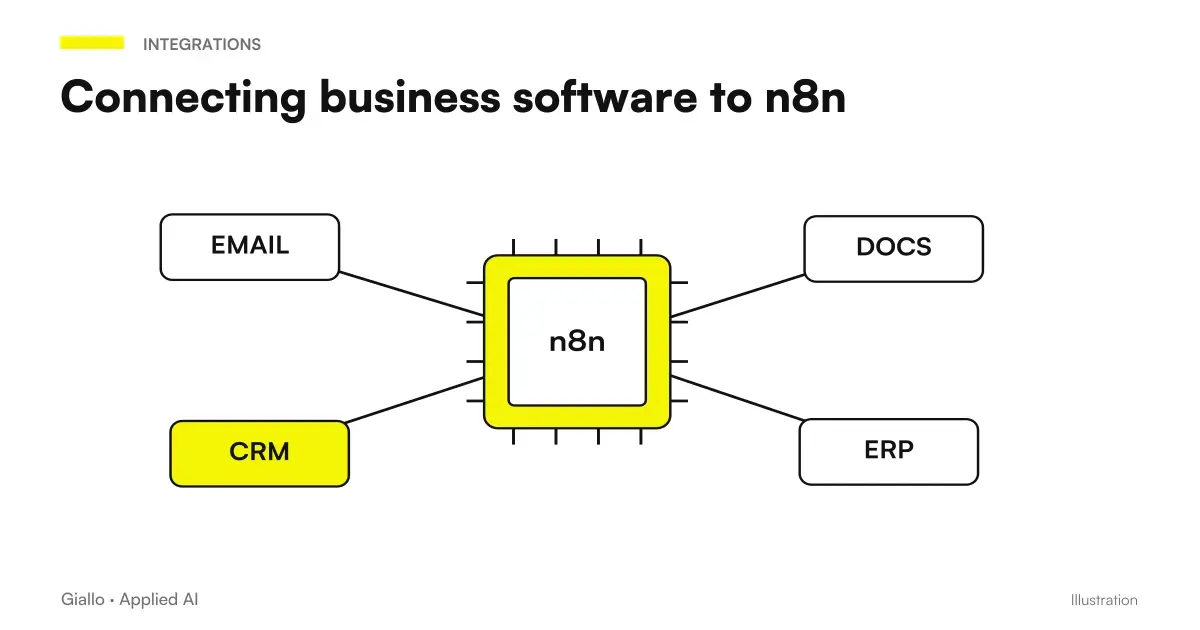 Integrate business software with n8n: APIs, webhooks and HMAC signing
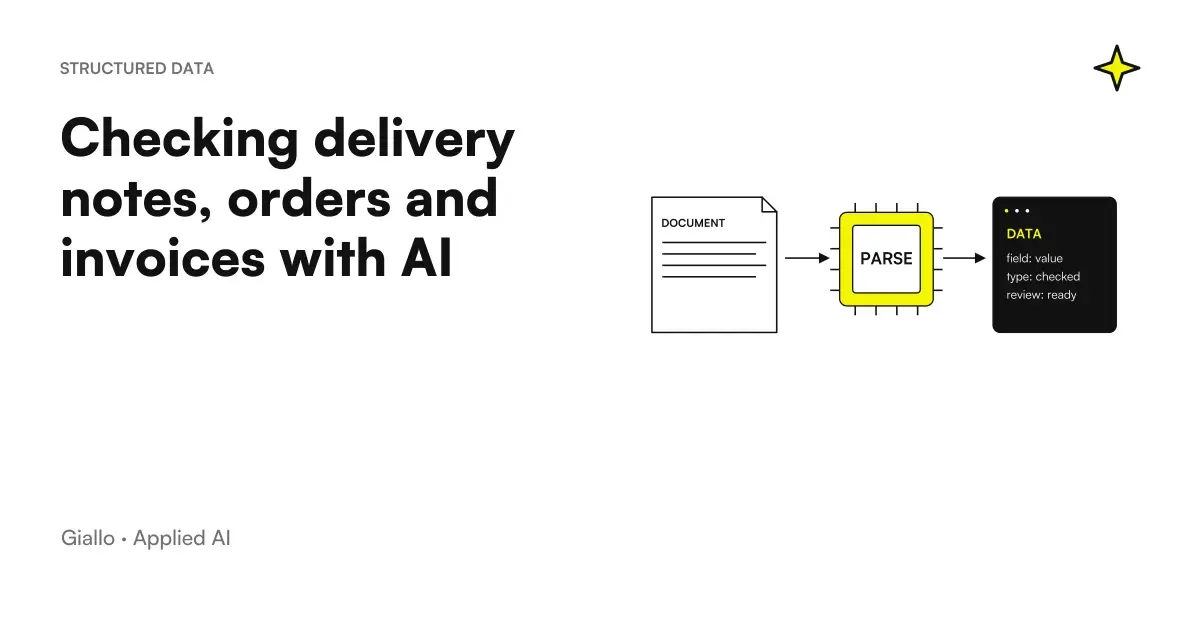 Check delivery notes, orders and invoices with AI before recording them
 Update supplier price lists with AI: changes for approval
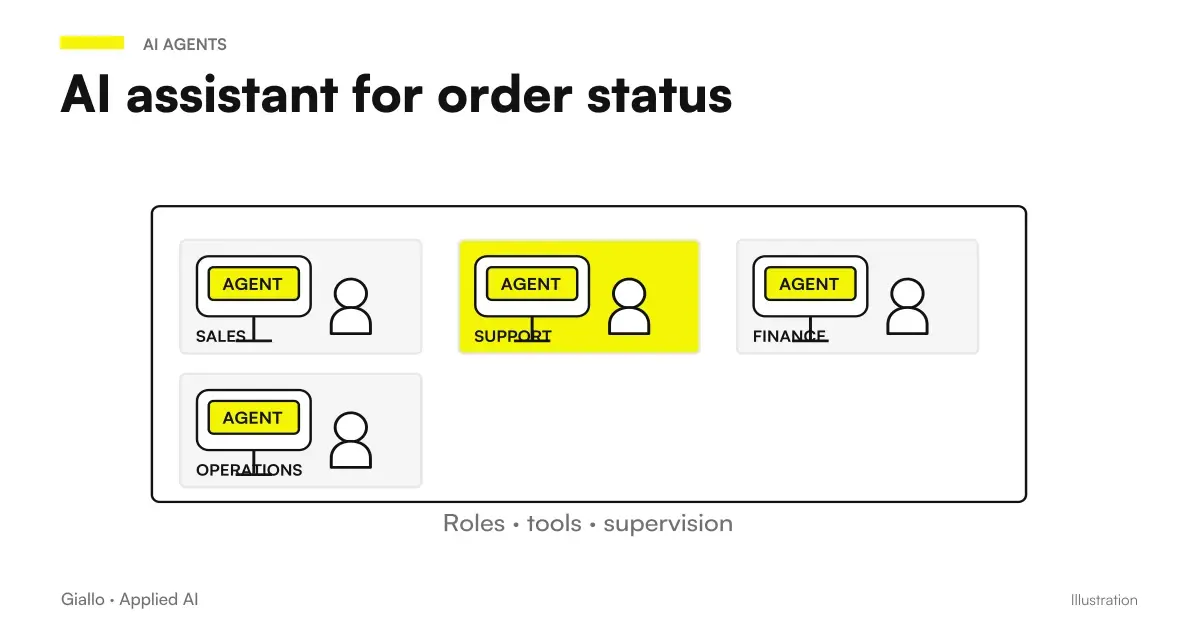 AI assistant for order status: responses from verified data
 Claude Code hooks for subagents and teams
FAQ
What is needed to import PDF orders into a business management system?
You need header and line-item fields, a reference catalogue and a supported integration path. The proposed import must show codes, quantities, units and anomalies before the order is recorded.
Can a similar code be matched automatically?
It must not be treated as a definite match. The workflow can suggest candidates, but an ambiguous code must remain pending verification against the commercial source and catalogue.
How can you avoid entering the same order twice?
Use identifying references and a uniqueness rule verified in the destination system. A retry after an error must check whether the order has already been created.
Can AI choose missing quantities and packs?
It must flag missing or ambiguous information. Conversion between individual items and packs requires an approved rule and catalogue data, not an estimate by the model.
What should you check in the pilot?
Compare the header and every line item with the document, including omitted lines, duplicates and units. Then verify the import result, not just the proposed table.
Does the flow also create a quote?
The article concerns a customer order already received. Preparing a commercial offer is a different process, with its own sources and pricing decisions.