
Update supplier price lists with AI: changes for approval
Update supplier price lists with AI: match SKUs, units and packs, compare prices and validity, and prepare proposed changes for approval. Pilots and anomalies.
Reading time: 12 min
Update supplier price lists with AI means to turn PDFs or sheets received into a proposal to modify the catalog: recognized lines, matched codes, comparable prices and anomalies to be decided. The important step is the preview before import. Reading a price does not entitle you to replace the current one, especially if units or packages have changed.
This page is about a provider's versioned catalog, not the choice between offers dealt in compare supplier quotes. Technical sources verified on 9 October 2026 and hypothetical Italian cases. The guide AI for businesses links this work to other SME flows.
In summary
- The new price list must be identified by supplier, version, coverage and validity.
- SKU, unit of measurement and packaging determine if two prices are comparable.
- An absent line does not automatically equal a deleted article.
- The preview distinguishes accepted changes, new lines, and matches to verify.
- The pilot measures errors left over and review time, as well as extraction.
Which price list are you importing into the catalog?
Identify the source first: provider, document name, version, and validity period. The date of arrival in the mail may not be the date from which the price is valid. If the file does not indicate it, the system must show a missing data, do not assume that the last attachment received replaces the entire catalog.
Clarify coverage as well. A price list may contain the full product range, a category, a promotion or only changed rows. This condition affects how absent items are handled. Without it, an import can deactivate products that are missing simply because the file is partial.
The person responsible must be able to open the source and recognize the reference. The guide to AI for purchases and suppliers deals with commercial conditions; here they become data to be compared with the version already used. It avoids that the model summarizes the document losing just the note that changes the basis of the price.
What fields do I need to compare lines?
| Field | Risk if missing | Proposed verification |
|---|---|---|
| Supplier Code | Match for ambiguous description | Map to internal code |
| Description and variant | Similar products traded | Relevant measurement, material and version |
| Unit of measurement | Prices on different bases | Noted unit and authorized conversion |
| Pieces per pack | Wrong unit cost | Explicit amount, not inferred from name |
| Price and currency | Incorrect economic comparison | Separate numeric value and currency |
| Conditions and discounts | Total traded per base price list | Recognisable Commercial Rule |
| Start of validity | New price applied too soon | Date verified by the manager |
| Row Status | Article deleted for absence | Full coverage or explicit decision |
The table is a proposed contract to adapt to the catalogue. If the spreadsheet already has clean columns, a structured import may be enough. AI comes in where the source varies or is written inconsistently. It must not freely calculate conversions that the business has not defined.
The n8n Information Extractor documentation shows extraction with schema. This primitive helps to prepare the lines, but does not prove that the code read matches the right product. Checking the catalog is a distinct step.
How to match SKU without just trusting descriptions?
It uses the relationship between external code and internal code as its first source. A description may contain abbreviations, similar names, or errors. AI may propose candidates for a line without a map, but the system must leave the doubt visible. An uncertain match must not automatically overwrite the price of an item present.
Check variants and packages. ‘Great healing’ may indicate more dimensions; an almost identical signature may refer to different material. The quality of the text does not eliminate these differences. For a proposal it shows at least the fields that motivate the matching and the source; the person responsible must be able to choose no correspondence.
An approved report can become a map for upcoming updates, with owner and provenance. Do not store every suggestion of the model as a definitive identity. The guide to AI for stock and inventory management explains why a consistent registry is needed before a reliable search.
Why can packaging and currency distort the variation?
A hypothetical example clarifies the problem: one line shows 12 euros for a six-piece package, another 3 euros for a piece. Comparing 12 and 3 as if they were the same base does not describe the unit cost. They are educational numbers, not a supplier's observed prices. The conversion must use explicit quantities and units.
Currency is another separate field. The project must decide whether it retains prices in the original currencies or applies an exchange from an authorized source. Don't let the AI choose a value remembered by the model. The preview must indicate the base used, so the approver understands the comparison and its time reference.
Distinguish list price, agreed price and conditional discount. If the document contains multiple layers, the catalog must know which field to update. A net price may depend on minimum quantity or agreement; copying it as a universal value may produce the wrong economic information while having read the PDF correctly.
What to do with new, missing or out-of-date items?
A new line may require registry, category, and supplier relationship. Separates the creation of an article from the updating of an existing one. If an entry is missing in the received version, check coverage before proposing deactivation. Absence, suspension and end production have different meanings.
A future version should be preparable without immediately becoming effective. Preserve the period and define who decides the activation. If the date changes or a corrective document arrives, the preview must bring out the new reference. Do not replace an approved version without showing what is different.
An article does not appear in the new file: what question to ask?
Is the document complete or partial? Is the category included? Has the provider declared a deactivation or just omitted the line? Keep the current price until the process provides a different choice and brings the case to the manager. Absence must not automatically become deletion.
What should the preview look like before importing?
Show the current value, proposed value, source and reason for the difference for each row. Group new rows, updates, unchanged rows and cases to check. Do not force the person responsible to read the entire price list to find a few exceptions, but allow them to open the details and look for unreported errors.
Approval must refer to the version of the preview. If the Annex or Code Map changes after the decision, the system must recognise that it is importing different data. n8n documents a human review of the tools: a usable capacity for the gate, to be connected to the catalog contract. Human review.
After writing, check the result in the business management software. An import may be partial or fail on some rows. Distinguish approved from recorded, retaining which rows actually went through. The purchase approval concerns another decision: catalogue price and authorisation of expenditure do not coincide.
Two hypothetical scenarios of updating the catalog
Hypothetical example: a Novara parts retailer receives a PDF. Descriptions vary and some packs change. The system prepares lines and matching candidates. A new code seems close to one present, but differs in size: the preview leaves it in verification instead of updating the existing product.
The manager approves the correct report and checks the cost on the same unit. The file only covers one family: the other articles are not disabled. The test measures correctly matched lines, unreported errors, and revision time. It does not attribute to the flow sales or margins never observed.
Hypothetical example: a material distributor in Perugia receives an Excel. Columns are structured, but the version indicates future validity and quantity discounts. The import prepares the values without applying them immediately. The manager sees which field represents the base price and which depends on the lot.
A corrective sheet comes after approval. The group compares the differences and decides the version, without silently updating the catalog. For customer orders use Importing PDF Orders, which must read the relevant economic version. For the shop remains the control described in AI for e-commerce.
How to limit generative work?
A consistent tabular source does not require a model for every cell. Parsing, format checks and numerical comparisons can follow rules. AI is a candidate for varying headers, document rows or matches that need review. Keep these proposals separate from conversions and authorisations.
You can compare Sonnet 5.5 as a candidate for articulated documents, according to its official page. It is not a promise of accuracy on the catalog. It evaluates the model on the sample and considers the verification time: an elegant answer may be less useful than a simple line with precise source.
Which pilot proves that the import is reliable?
Choose a provider and a category. Prepare a current and a new version with known cases: unchanged price, changed packaging, absent SKU, new line, partial document and future date. First generate the preview without writing the catalog. A manager builds the correct reference and compares each category of outcome.
Measure correct extractions, approved matches, wrong matches, and anomalies let through. Count false alarms: too many blocked lines can cancel the benefit. If you use percentages, specify whether the denominator is rows, articles, or documents. They are different units and should not be mixed.
Then try a limited writing in test, verifying outcome and repetition of the same import. The result must recognize the version already applied, instead of producing duplicates. It is a proof of the project, not a capability to be automatically attributed to the AI node. The phase only widens when preview and result are consistent.
What checks do you do after a partial import?
Keep the list of approved rows and compare it with what the business management software accepted. A rejected row must have a readable reason: code, format, constraint or missing data. Do not resubmit the entire document as though no row had gone through. The retry must know which items are already recorded and which still need action.
It also checks that the reading of the catalog returns the expected values and validity. A technical confirmation of the request may not coincide with the availability of the price to the function that uses it. The operator must be able to distinguish the transfer outcome, row status and current value, while retaining the link to the approved source.
Who uses the price after import?
The new cost can feed purchases, quotes or sales catalog, with different rules. Before loading clarify which views read the data and from which date. The update of the supplier list must not automatically modify an offer already approved by the customer without the path envisaged by the company.
It retains the reference to the version used for each economic proposal that must remain reconstructable. If the price changes, the operator can understand which source supported the previous document. In the pilot it checks a new validity and a quote still open: the updated data must arrive where expected without silently rewriting a decision already made.
How much does maintenance weigh in the budget?
The cost includes source reading, code map, unit and pricing rules, screen, integration and monitoring. Add the work of those who approve the new pairings. A supplier that changes format often requires more maintenance than a stable sheet, even with equal rows.
Ask for a separate quote for start-ups, imports, and format changes. The quality of the registry can be the main project: without a reliable map, AI produces proposals but the person responsible remains submerged. We do not indicate savings percentages without a test on the catalogue and exceptions.
What errors damage prices and catalog?
The first is to match by description without checking variants. The second is to compare different packages as unit prices. The third is to use a partial file to delete articles. The fourth is to apply a future version to reception. The fifth is to consider the approved preview as evidence of successful writing.
The fix starts with rules and data, not a request to the model to be more precise. Each anomaly must have an owner and a next step. The catalog becomes reliable when the team can explain from which source a value comes and which version was recorded.
What price list to lead to the first analysis?
Choose two anonymized versions of the same supplier and an extract from the catalog. It indicates codes, units, and cases that require work today. The comparison makes it possible to understand whether a structured import is sufficient or an interpretation is needed. It is a reversible choice to measure before involving the whole assortment.
To link preview and catalog, the path of custom software can start with this pair and the code map. The guides to AI for Warehouse and comparison estimates help to keep distinct registry, prices and purchase decision.
Giallo Studio guides: methodology and sources
How we apply it in the company
Related resources
 AI for procurement and supplier management
 AI for stock and inventory management
 AI for e-commerce: compliant returns, product descriptions, discounted prices and reviews
 Compare supplier quotes with AI: prices, quantities and terms on a common basis
 AI purchase approvals: complete requests and traceable decisions
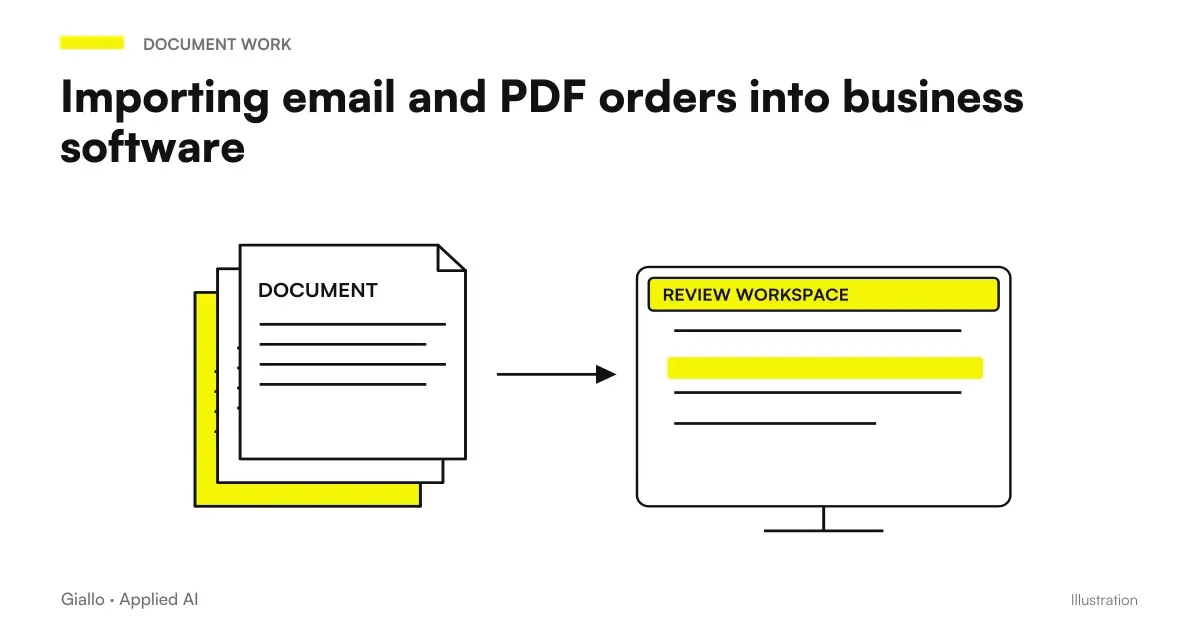 Import email and PDF orders into business software: AI, checks and confirmation
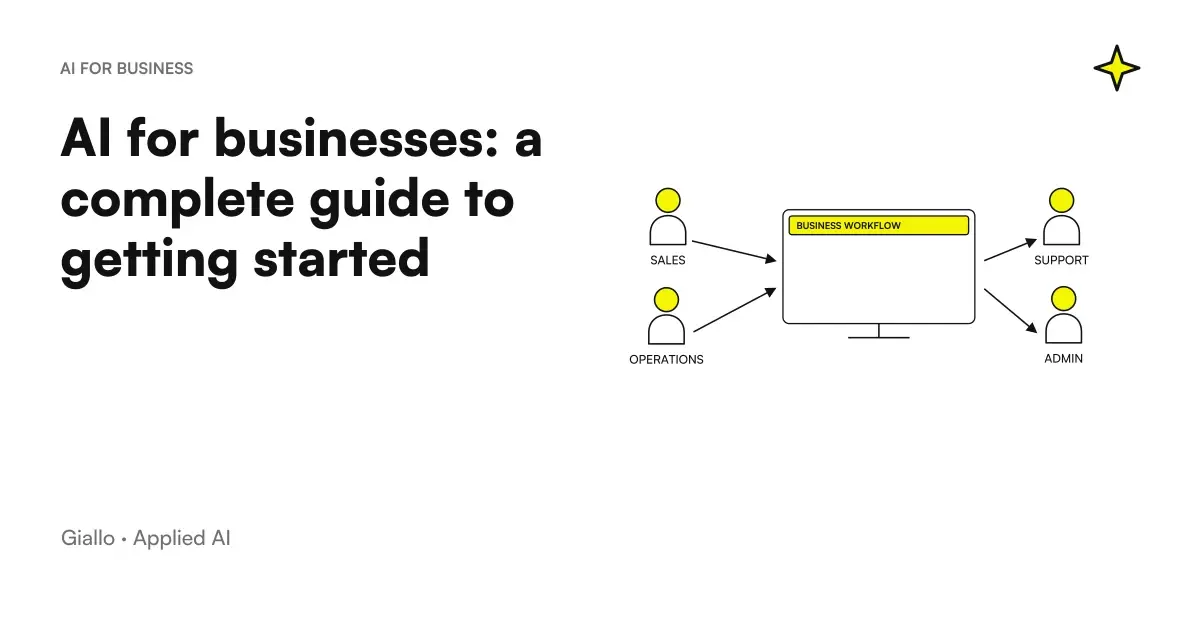 AI for businesses: a complete guide to getting started
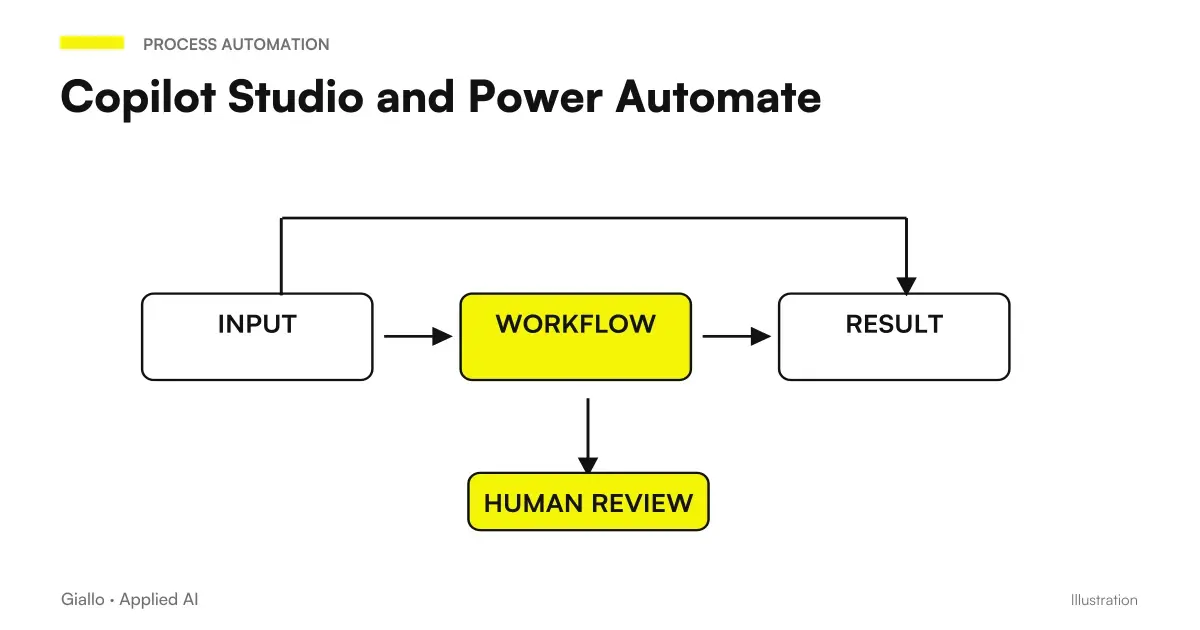 Copilot Studio and Power Automate: agents and workflows
FAQ
What does AI automate when updating price lists?
It can read varied sources and propose fields and matches. The workflow must check codes, units, packaging, currency and validity. The import uses an approved version, rather than every plausible value found in the file.
Is a different price always a change in cost?
No. It may refer to different packaging, another currency or a discount. Compare prices on the same basis first. A numerical difference alone does not prove that the product has become more expensive.
How should an unmatched SKU be handled?
Put the row in a review queue. A similar description may suggest a match, but does not authorise overwriting a product record. Preserve the relationship between the supplier’s code and the internal code.
Can I delete products missing from the new file?
Not automatically. A file may be incomplete or cover only one category. Establish whether the source is complete and which rule handles absence. Deactivating a product requires a recorded decision first.
Which version of the price list should take effect?
The version approved under the defined dates and commercial rules. The receipt date and start of validity may differ. Retain the source and reference to explain which price is used in the catalogue.
How to measure the pilot test?
Measure the accuracy of extracted rows, matches, anomalies found and review time. Also check the errors the system allows through. The number of imported rows alone is not enough to demonstrate quality.