
AI for estate agencies: leads, viewings, listings and documents
AI for estate agencies: portal lead replies, listings with APE data, disclosed virtual staging, organised case files and anti-money laundering checks.
Reading time: 9 min
The AI for Real Estate Agencies serves where the agent wastes time without doing mediation: responding to requests coming from the portals at every hour, fixing visits with the owners, writing the ads, putting together the property file. The true mediation, i.e. negotiation, proposals and relationship with the parties, remains to the registered agent: the Act 39 of 1989 binds the membership to the person and does not allow to delegate the mediation functions except to another registered agent.
There is a second reason for setting up the assistant with care: almost every line of an ad or assignment has a norm behind it. The energy class comes from the EPA, cadastral data from the visa, the conditions of the contract from forms filed, and the Civil Code asks the mediator to communicate to the parties the circumstances he knows about the deal (Art. 1759). A model that fills the blanks with plausible text, here, creates problems for the agency.
In summary
- The AI assistant of an agency responds to requests from portals with the data of the real estate card, collects budgets, times and situation of the mortgage and proposes visits; negotiation and proposals remain to the agent.
- In ads, energy performance and class indices should be copied from the EPA: the Legislative Decree 192/2005 makes them mandatory in sales and rental ads.
- Photos with virtual decor can fall within the definition of deep fake of AI Act, which from August 2, 2026 asks to declare them.
- Visor, floor plan, EPA and condominium fees form the file: AI reads them, extracts the data and reports what is missing.
- Estate agents are subject to anti-money laundering obligations: the assistant prepares customer due diligence, and the agent assesses and signs it.
- Tasks and proposals are filled out on the forms filed: the AI enters the data, does not write new clauses.
Requests from the portals at ten o'clock in the evening: what the agency assistant answers
A request from the portal on a two-room apartment is almost always one of three questions: it is still available, how much are the condominium fees, when you can see. If the answer comes the next morning, the writer may have already set up visits with other agencies. An assistant connected to the property card immediately answers with the agency data and asks the questions that the agent would ask on the phone: area and budget, purchase with or without mortgage, times, house to sell first.
With this information he proposes the visiting hours and passes to the agent an ordered card. What contacts to call first the demo on the lead scoring in CRM; to power the CRM without copying anything there is the guide on lead generation automation. The same assistant can be on the agency website, with the limits described in the guide to chatbot for the company site.
There are questions to which the assistant does not answer, by choice: «would the owner accept 280?», «can I leave a deposit?», «are there problems with the condominium?». The first two are negotiation, i.e. mediation, and remain with the registered agent. The third touches on the circumstances that the mediator must communicate to the parties: the reply is given by the agent, with the documents in hand.
Visits and report to the owner: the work that comes back every week
Setting up a visit means setting up three agendas: that of the person looking for a house, that of the agent and that of the owner, or that of the tenant if the property is inhabited. The assistant knows the bands agreed with the owner, groups the visits of the same property in the same half day, reminds the agent who has the keys and sends the reminder the day before, with the possibility to cancel in a message.
After the visits there is an easy task to postpone: the report to the owner. From the voice notes of the agent the assistant prepares a weekly summary with the visits made, the recurring objections (price, brightness, expenses) and the proposals arrived. It serves to talk about price with facts instead of impressions, and remains a text of the agent: the model drafts it, the agent rereads it and sends it.
AI-written announcements: each data must have a document behind it
The drafting of the ad is the easiest task to entrust to AI: long description, short version for portals, English text for those looking from abroad. Prompts that work are collected in the guide to prompt for real estate agents. The limit is only one: the model writes well even when it does not know, and in an ad things not known become errors published on all portals.
| Date of announcement | Where it must come from | Rule or Caution |
|---|---|---|
| Energy Performance Indexes and Class | APE in progress | Mandatory in sales and lease listings, except for residential buildings used less than four months a year (D.Lgs. 192/2005, art. 6, paragraph 8) |
| Cadastral category, annuity, identification data | cadastral view | To copy, never to estimate |
| Area and distribution of premises | Plan and measures taken by the agent | Always tell if the surface is commercial or walkable |
| Communal expenses and deliberate work | Administrator's views and minutes | Circumstances to be communicated to the parties (art. 1759 c.c.) |
| Description, exposure, strengths | Agent's inspection and photo | No qualities that the property does not have |
On the EPA the sanction is written in the norm: the person in charge of the announcement who does not report the energy parameters risks an administrative sanction from 500 to 3,000 euros (D.Lgs. 192/2005, art. 15, paragraph 10). A well-done automation blocks publication if the energy class field is empty, instead of letting it fill in to the model.
Virtual home staging and retouched photos: when to be declared
The image generation tools furnish an empty living room in a few minutes or repaint the walls of a room. For those who sell it is a help to imagine the spaces; for those looking for a home it can become a photo that does not correspond to what you will find at the visit.
The AI Act calls deep fake an image generated or manipulated by AI that resembles existing places and would appear falsely authentic, and the Article 50 asks those who use the system that produces it to make known that it has been artificially generated or manipulated. The obligation applies from August 2, 2026. The European Commission guidelines on Article 50 of July 2026 clarify that adding or removing objects in a real photo, including furnishings, is a manipulation to be declared with a visible label: write it in the caption and keep in the gallery also the original photo. The complete process, from the photo to the label, is in the guide to virtual home staging with AI. The full framework of deadlines is in the Guide to the AI Act for Companies.
The property file: what AI reads and what it almost always lacks
Before the announcement comes the file. The owner can download free visures, floor plans and mortgage inspections of their properties from the service of personal consultation of the Revenue Agency, accessing with SPID, CIE or CNS. Asking him at the first meeting avoids chasing documents when there is already an interested party.
An assistant who reads company documents Extracts the data you need from PDFs (sheet, particle, subaltern, category, annuity, energy class, EPA date) and reports the gaps. The complete file counts early: the owner must make the EPA available to those who want to buy or rent from the start of negotiations and deliver it at the end (D.Lgs. 192/2005, art. 6, paragraph 2). A document that is missing slows everything down just the moment it is needed.
- Updated cadastral view, with identification and registered data
- Cadastral plan, to be compared with the state of the places
- APE in progress, with indexes and energy class
- Act of provenance
- Statement of condominium expenses and deliberations on works, by the administrator
- Rules of condominium, if any
The comparison between floor plan and the status of the places remains an agent's or technician's job. The AI may notice that the floor plan shows a wall that is not in the photos; it cannot tell if the difference is regularizable.
Task, forms and anti-money laundering: what the assistant prepares and what the agent signs
Two rules change the way AI is used in agency documents. The first: the mediator who uses forms or forms with the conditions of the contract must file a copy of them before using them at the commission established in the Chamber of Commerce (law 39/1989, art. 5, paragraph 4). The assistant then fills out your filed forms with the file data; it does not generate assignments or purchase proposals with written clauses at the moment.
The second: agents who perform real estate mediation with registration in the register of companies are subject to anti-money laundering legislation, also as intermediaries in leases but only for monthly rents equal to or greater than 10,000 euros (D.Lgs. 231/2007, art. 3, paragraph 5). The adequate verification of the customer and the actual holder takes place, among other things, at the assignment of the assignment (Art. 17). The AI can prepare the list of documents, check that the copies are complete and legible, fill out the registry part. The risk assessment and any decision remain with the agent.
Identity documents and data on the actual holder do not pass from personal chats or free tools. What happens to the data entered in AI services, and how to choose suitable tools, is the theme of the guide on AI and corporate privacy.
Two examples: a three-room apartment in class F and a Saturday of visits
The three-room apartment with the infiltration fixed. An owner entrusts the agency with selling a three-room apartment from the seventies with an APE energy performance certificate in class F. At the first meeting, the agent records the information by voice, including a previous leak from the terrace that has already been repaired; the owner downloads the land-register extract and floor plan through the personal consultation service. The assistant prepares a draft listing with the ratings and class copied from the APE and flags two points to the agent: the APE date to check, and the leak, to include among the circumstances disclosed to anyone making an offer. The agent decides the final text and how to present it.
The Saturday of visits. On Friday nights twelve requests arrive from the portals on the same two-room apartment for rent. The assistant responds to all with the data of the card, asks for times, number of people and guarantees offered, and proposes the bands that the owner has indicated for Saturday. Confirmations start with address, intercom, and agent name; after visits, a message asks for a match. On Mondays the agent finds the ordered ballots and calls first the people who asked to make a proposal.
Where AI gets a real estate agency in trouble
- The energy class "estimated" by the model because the EPA had not yet arrived: it is precisely the data that the law asks to report.
- Rounded surfaces, or swapped between commercial and walkable, which then end up identical on all portals.
- Photo with virtual furniture without caption, or touches that make visible defects disappear at the visit.
- A chatbot that responds to offers and counterproposals, or that promises timing for the deed.
- Purchase proposals generated from scratch instead of on deposited forms.
- Copies of customer documents left in chats and shared folders without access control.
Where to start in an agency with two or three agents
Four works of the agency have a dedicated guide: the real estate valuation with AI, the acquisition of assignments without purchased lists, the rental management and the virtual home staging.
The most secure entry point is the response to requests from portals, because it works on data that the agency has already published and does not write anything new about the property. Then comes the ad draft, with the mandatory fields blocked until the documents are there, and the file. Anti-money laundering and forms come last, when the rest works and the rules are written.
An agency lives by trust, and trust is lost with a wrong data rather than a slow response. If you want to link these steps to the management software and portals you use, start from the page AI for real estate: leads, announcements, evaluations and documents related to CRM.
Giallo Studio guides: methodology and sources
How we apply it in the company
Related resources
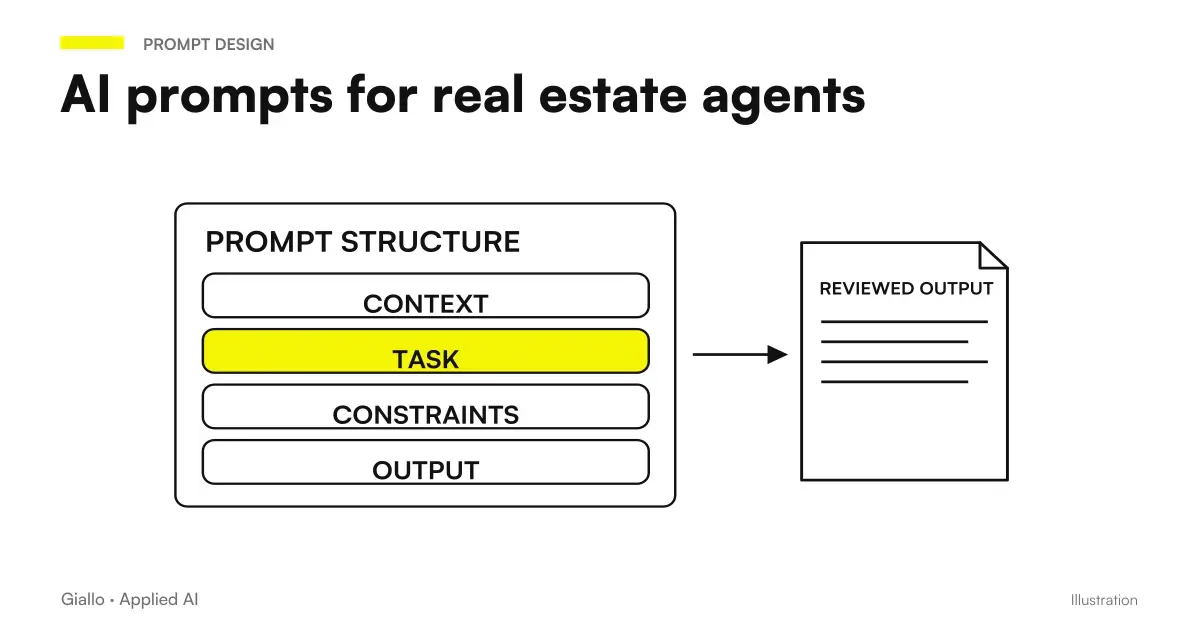 AI prompts for real estate agents: ready-made examples for ads, emails and customers
 Real Estate Assessment with AI: What Automatic Estimates Do and Where They Stop
 Win property listings with AI: lawful channels and limits
 AI rental management for estate agencies: from enquiry to registration
 Virtual home staging with AI: how do you do it, how reliable it is, what to declare
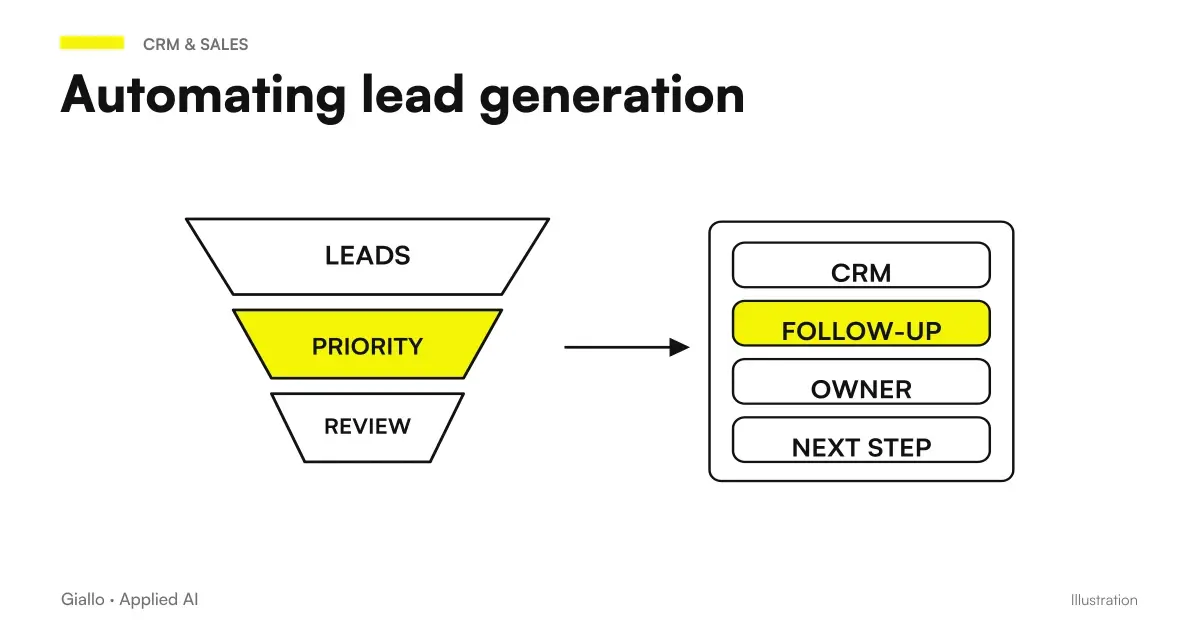 Lead generation automation: how AI populates your CRM
 AI for business document analysis: a practical guide
 AI Act: the guide for Italian companies
 Business website chatbots: how they work and when they make sense
 AI and corporate privacy: what happens to your data in AI tools
AI by sector
The same reasoning, applied to the other areas we follow.
- AI for plumbers: quotes, on-site jobs and customers
- AI for business knowledge bases: find the information you need
- AI for hotels: booking, guest requests and automated reviews
- AI for Logistics and Shipping
- AI for gardeners and grounds maintenance: quotes and customers
- AI for stock and inventory management
- AI for ticket management: shorter waits, more resolutions
- AI for shops: customer messages, stock by size, returns and loyalty cards
- AI for Business Functions: Where to Start
- AI for notaries and notarial firms: case files, documents and clients
- AI for photographers: requests, selection of shots, galleries and image rights
- AI for car workshops: quotes, appointments and customers
FAQ
Can the agency chatbot negotiate the price with someone enquiring through a property portal?
No. Law 39 of 1989 ties brokerage activity to a registered individual and does not permit its functions to be delegated except to another registered agent. The chatbot responds with listing data, gathers budget, timing, and mortgage status, and suggests viewings; offers and counteroffers go to the agent.
Can I get AI to write real estate ads?
Yes, as a draft to review. Energy performance indices and the energy class must be copied from the APE, because Legislative Decree 192 of 2005 makes them mandatory in sale and rental listings and provides a penalty for the person responsible for the advertisement. Land registry data and floor areas come from the registry extract and floor plan, never from a model’s estimate.
Should photos with virtual decor be reported in ads?
It is always advisable to do so. The AI Act asks those who use images generated or manipulated by AI that seem authentic to declare it, and the European Commission guidelines of July 2026 also consider the addition or removal of objects in a real photo, including furnishings, to be declared. A clear caption and the original photo in the gallery avoid disputes at the visit.
Can AI carry out anti-money laundering customer due diligence?
It can prepare it: a document list, checks that copies are complete and readable, and entry of personal details. Risk assessment and decisions remain with the agent, who is an obliged entity under Legislative Decree 231 of 2007. For rentals, the obligations apply only above the monthly rent threshold specified by law.
Can I use AI to generate sales mandates and purchase offers?
Better to use it to fill them out. Law 39 of 1989 asks the mediator to file the forms and templates with the conditions of the contract before use: the assistant inserts the file data into your filed forms, without writing new clauses at the moment.
What documents of the property can the AI read to prepare the file?
Land registry extract and cadastral floor plan, APE, deed establishing ownership, statement of condominium expenses, and the administrator’s resolutions. The assistant extracts data and flags missing information or inconsistencies; comparing the floor plan with the property’s actual condition remains the agent’s or technician’s work.