
AI for photographers: requests, selection of shots, galleries and image rights
AI for photographers: bookings, quotes, selection, galleries and biometric data. Rights and deepfakes, including 70-year protection for simple photographs.
Reading time: 10 min
The AI for Photographers especially before and after the shot: in requests for dates and quotes that arrive while you are on a set, in the first selection of thousands of files after a wedding, in the delivery of galleries and in reminders for the choice of photos of the album. The look, composition and editing that signs your style remain your work, and the law today puts it in writing.
In the last few months, three rules have changed on this very ground. Copyright law protects works of "human" ingenuity, even created with the aid of artificial intelligence provided they are the result of the author's intellectual work (L. 633/1941, art. 1, as amended by Law 132/2025). The right to simple photographs has gone from twenty to seventy years. Finally, from August 2, 2026, those with AI manipulate an image to make it a deep fake must declare it.
In summary
- For a photographer, AI is especially needed on requests for dates, quotes, first selection of shots and delivery of galleries, not on style.
- Since 18 December 2025, the exclusive right to simple photographs It lasts seventy years from production, no longer twenty.
- Unless otherwise agreed, the bride and groom can publish and reproduce their portraits on commission without asking for permission; for your portfolio, however, they need their consent.
- A gallery that finds people from a selfie treats Biometric data: as a rule, the explicit consent of those who are recognized is required.
- Adding or removing people with AI can create a deep fake: from August 2, 2026 it must be declared, although in a light form for artistic works.
“Are you available on 14 June?”: answering enquiries while you are on a shoot
For wedding photographers the first question is almost always a date, and the answer lies in the calendar. An AI assistant connected to the agenda immediately answers if the date is free, sends the presentation of the packages and asks the questions you need for the quote: place of the ceremony and reception, times, rite, number of guests, album yes or no. You receive a full card instead of a message with a question mark, even if the request comes on a Saturday, while you are at work on another wedding.
The true estimate is prepared by you, starting from a draft. The AI composes the packages, adds second photographer or video if required and writes the conditions you choose, including the rights part we talk about later. The technique is that of automation of quotes with AI, and the reminder to those who do not respond follows the rules of automatic follow-up. One thing the assistant never has to do: block a date without your confirmation, because a double booking in season does not recover.
AI selection and retouching: does the photo remain yours?
After a wedding the first skimming is mechanical work: doubles of the same burst, eyes closed, out of focus, exposure tests. Assisted selection software proposes a first choice and group the similar shots, then you decide what enters the gallery. Also in retouching the AI accelerates masks, skin, dust on the sensor and color uniformity between two machine bodies.
In terms of rights, this does not change the authorship of the shot. Article 1 of the Copyright Act, in the text in force since 10 October 2025, protects works created "with the aid of artificial intelligence tools, provided that they constitute the result of the intellectual work of the author". And even when a photo does not reach the level of creative work, it remains a simple photograph, that is, an image of people or facts of natural and social life obtained by the photographic process (Art. 87). On this the photographer has the exclusive right of reproduction, dissemination and distribution, which since December 18, 2025 lasts seventy years from the production (Article 92, as amended by Article 47 of Law 182/2025).
The delicate point is another: when AI doesn't retouch but changes what happened. The AI Act calls deep fake an image generated or manipulated by the AI that resembles existing people, places or events and that would appear falsely authentic, and asks the user to make known that it has been generated or manipulated; for works manifestly artistic or creative it is enough to reveal it adequately, without hindering the fruition (EU Regulation 2024/1689, Article 50). The obligation applies from August 2, 2026, and the copyright implications are deepened in copyright and AI-generated content.
Interventions that don't usually change what happened
- First assisted selection: doubles, eyes closed, out of focus
- Exposure, color, skin, dust on sensor
- Align the color of two cameras in the same gallery
Interventions to be evaluated as deep fake
- Insert in the group photo a relative who was not there that day
- Change a gesture, an expression or who appears in a scene
- Generate a whole scene and deliver it as a reportage of the day
The boundary is not always clear, and prudent choice costs little: if you have generated or replaced people, tell the bride and groom in the delivery and write it in the post when you publish. What tools generate or modify images, and with what limits, you find it in best AI models for images.
Who can use the photos, and for what: the table to keep next to the quote
Italian law distributes rights differently depending on the job, and many discussions with customers arise here. The table summarizes the main rules of Law 633/1941 for the most common jobs.
| Work | Who can do what | Norma | What to Write in the Quote |
|---|---|---|---|
| Wedding or portrait on commission | Unless otherwise agreed, the person photographed can publish and reproduce the portrait without the consent of the photographer; those who use it commercially owe you a fair fee | Art. 98 | Personal and social uses of the bride and groom, commercial uses, obligation to mention your name if it appears on the photo |
| Photographer's portfolio, website and social media | To display or reproduce a person's portrait requires their consent | Art. 96 | Release of the spouses; for the guests recognizable consent apart, or photos excluded |
| Product shots for a company | For photos of things in the possession of the client the exclusive right goes to the client, unless otherwise agreed; photos of 'material objects' are excluded from the simple photographs | Art. 87 and Art. 88 | License: Channels, duration, exclusive, use in your portfolio |
| Photos taken by a study employee | The exclusive right lies with the employer, within the scope of the subject matter and purposes of the contract | Art. 88 | The rules in the employment or collaboration contract |
| Any simple photograph | Exclusive right of the photographer for seventy years from production | Article 92 | Name of the photographer and year on the specimens delivered |
The last column is the one where AI is useful. From the type of work chosen in the request form, the assistant inserts the right clause into the draft of the quote, taken from texts that you had a lawyer write or review once. On export, an automation can add to each file name and year: the Art. 90 asks that the specimens bear the name of the photographer and the year of production, and if they are missing the reproduction is not considered abusive, unless the photographer proves the bad faith of the reproducer.
Online galleries, faces and archives: where privacy comes in
Delivery is the easiest stream to automate. When the gallery is ready, the bride and groom receive the link with the date by which to choose the photos for the album; if they do not choose, a reminder arrives; when the selection is closed, the studio receives the list of files to be formatted. They are always the same messages, and the AI customizes them with the couple's favorite names, place and photos.
More delicate are two functions that tunnel platforms can offer. The first is the face search, like "load a selfie and find your photos". The GDPR says that photographs become biometric data only when they are treated with a specific technical device that allows a person's unique identification (Recital 51 and Article 4(14)), and that is precisely what this function does. The processing of biometric data to identify a person is prohibited except for exceptions, including the explicit consent of the data subject (art. 9).
The second is the archive. Many photographers promise to keep the files "forever", but the privacy policy must indicate the period of retention of personal data or the criteria for establishing it (GDPR, art. 13). Decide how much you keep the online gallery and how much the RAW archive, write it in the contract and let an automation send the notice before the deadline, with the offer to download everything. The overall picture of the data you rely on cloud services is in Business Data and AI.
The question remains of your shots posted on the site and on social media. The law allows the extraction of text and data from content that is legitimately accessed when the use has not been expressly reserved by the rights holders (Art. 70-quater), and from 2025 a new art. 70-septies confirms that the rule also applies to AI models. If you don't want your portfolio to end up in the training archives, the reservation should be written down: get advice from a lawyer on the form.
A wedding season and a still life set: two examples
The Wedding Photographer Who Works Alone
Think of a photographer who works alone, with a second photographer on call, and who from May to September shoots almost every weekend. In his case the requests come mainly in winter, and in summer they come while he is on set. The assistant answers on the dates, collects the details and prepares the draft of the estimate, which he approves in the evening. After each wedding the assisted selection reduces the first skimming, and the gallery starts with its reminder calendar. For the portfolio only the photos with the release recorded in the work card enter: the automation signals those where you recognize guests without consent. Those who organize the same marriages have different flows, described in AI for wedding planners.
The Still Life Study Working for Companies
A studio photographs products for catalogues and online stores. Here the issue is the licence, rather than a release form. For photographs of objects in the client’s possession, Article 88 assigns the exclusive right to the client unless otherwise agreed, while Article 87 excludes photographs of "material objects, technical drawings and similar products" from simple photographs. Where one category ends and the other begins is assessed case by case, which is why the contract matters more than the law in still-life photography: channels, duration, exclusivity and permission to use the shots in your portfolio. The AI prepares that part of the quote from the client’s form, removes backgrounds and creates colour variants, and renames files according to the client’s naming scheme. If a colour variant is generated rather than photographed, it is advisable to tell the client: a colour shown online that does not exist in stock is a problem for the client before it is a legal issue.
The Mistakes a Photographer Pays After Years
The first is to promise in writing more than you control: a date blocked by the assistant without confirmation, an archive "forever" that the contract does not say how long it lasts. The second is to publish in the portfolio photos of guests recognizable only because the bride and groom have signed: their release covers them. The third is to deliver a photo with people added by AI without saying it, perhaps in an album that the family will keep for decades. The fourth is uploading entire galleries to AI services without knowing where they end up: it is personal data of dozens of people who did not choose that provider.
Where to Start in Your Studio
If the requests come to you while you are at work, start with the first response on the dates and the draft of the estimate. If the bottleneck is after the shot, start with the gallery delivery and album reminders, which require fewer links than the other streams. Either way, write the rights and archive clauses first: automation will repeat them identical to each customer, so they need to be right. For the use of AI in small tasks there is the page AI for SMEs, and the demo on Automatic quotes with AI shows how a draft is born from a free request. If you want to link calendar, request form and gallery in a single stream, Giallo Studio It builds it around the way you already work.
Giallo Studio guides: methodology and sources
How we apply it in the company
Related resources
 Copyright and AI-generated content
 AI quote automation: save hours on every offer
 Best AI Models for Images
 AI for wedding planners: suppliers, deadlines and guest data
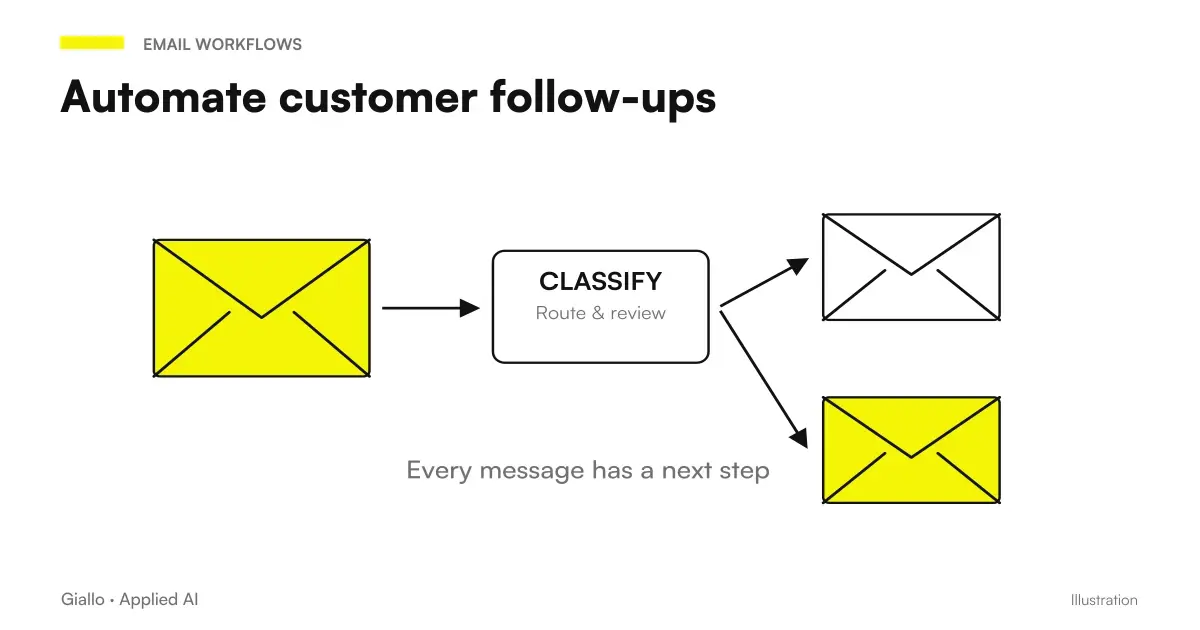 Automate customer follow-ups: fewer missed contacts, more closed deals
 AI for cleaning companies: specifications, shifts, DUVRI and safety data sheets
AI by sector
The same reasoning, applied to the other areas we follow.
- AI for internal business training
- AI for Business Functions: Where to Start
- AI follow-ups: keep track of every contact
- AI for ticket management: shorter waits, more resolutions
- AI for physiotherapists: bookings, reminders and patients
- AI for gardeners and grounds maintenance: quotes and customers
- AI and e-invoicing: what can be automated
- AI for hotels: booking, guest requests and automated reviews
- AI for pharmacies: customers, service bookings and loyalty
- AI for plumbers: quotes, on-site jobs and customers
- AI for electricians: wallboxes, solar power and installation deadlines
- AI for estate agencies: leads, viewings, listings and documents
FAQ
If I select and retouch the photos with AI, do they remain my works?
Copyright law, in the text amended by law 132/2025, protects the works of human ingenuity even when they are created with the aid of artificial intelligence tools, as long as they are the result of the author's intellectual work. Assisted selection and retouching do not remove the authorship of a shot that you have composed and taken. An image generated from scratch with a prompt is another matter, to be assessed on a case-by-case basis.
How long does the exclusive right on simple photographs last?
Seventy years after the production of the photograph. This is stated in Article 92 of Law 633/1941 in the text in force since 18 December 2025, after the amendment of Article 47 of Law 182/2025: before that it was twenty years. For photographic works of creative character the rules of the intellectual works apply.
Can the newlyweds post the wedding photos without asking me?
Unless otherwise agreed, yes: Article 98 of the Copyright Act allows the person photographed to publish and reproduce the portrait executed on commission without the consent of the photographer. If someone makes commercial use of it you are entitled to a fair fee, and your name should be indicated if it appears on the original photograph. If you want different rules, write them in the contract.
Can I use wedding photos in my portfolio and on social media?
To display or reproduce the portrait of a person you need his consent (Article 96 of Law 633/1941). Ask the bride and groom for a written release for the portfolio, and remember that they cannot give it instead of the guests: for those who are recognizable you need a separate consent, or that photo remains outside.
Can I enable a gallery feature that lets people find their photos using a selfie?
A face search processes photographs using a technical method that uniquely identifies people, making the face biometric data (GDPR, Article 4 and recital 51). Processing biometric data to identify a person is prohibited unless an exception applies, usually explicit consent (Article 9). Before enabling it, assess with your privacy adviser how to collect that consent from the people appearing in the photos.
If I add or remove someone from a photo using AI, must I disclose it?
Since August 2, 2026 those who use an AI system to generate or manipulate images that constitute a deep fake, that is, that would seem falsely authentic, must make known that they have been generated or manipulated (Art. 50 of the AI Act). For works manifestly artistic or creative it is enough to reveal it adequately, without impairing enjoyment of the work. If in doubt, state it in the delivery and in the post.
Can I prevent my photos posted online from being used to train AI?
The law allows the extraction of text and data from content that is legitimately accessed when the use has not been expressly reserved by the rights holders (Article 70-quater of Law 633/1941), and Law 132/2025 has confirmed that the rule also applies to AI models. The reservation of rights must therefore be stated in writing: have a lawyer advise on the right form for your site and the platforms you use.