
AI for human resources: concrete uses
AI for HR: which uses carry minimal risk, which fall under the AI Act's high-risk rules and where an SME should start.
Reading time: 10 min
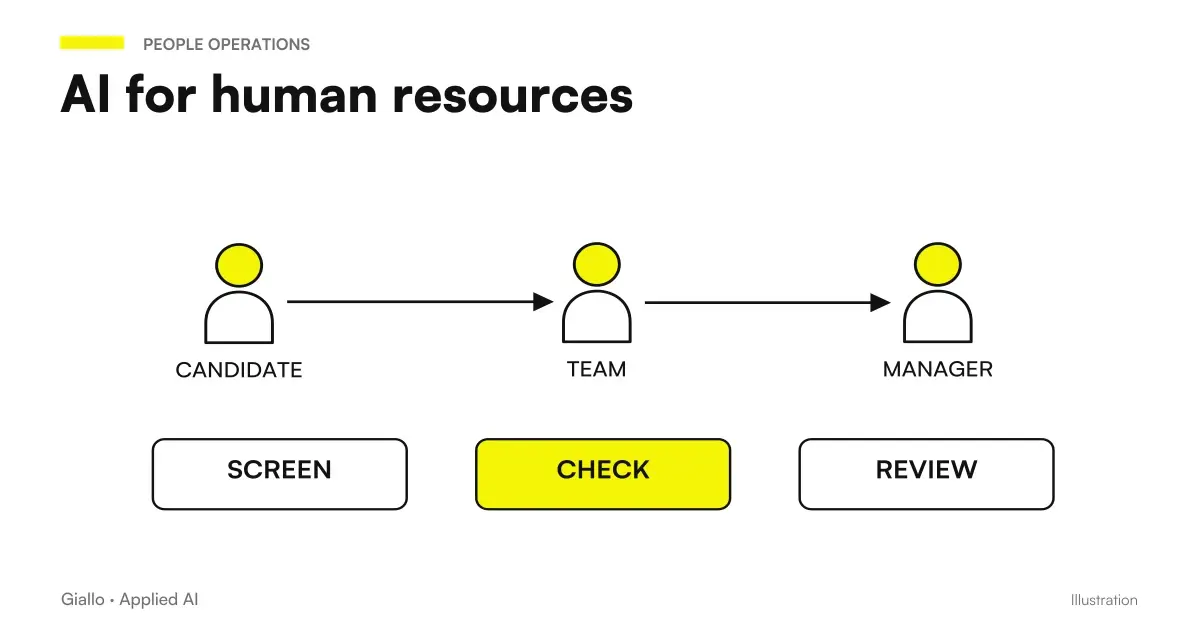
In human resources the question that separates a quiet use of AI from a regulated one is not about technology: it is about whether the system decides something about a person, or simply respond and organize. On the one hand there is a large territory made up of recurring questions, documents to be prepared, procedures to be found. On the other an area where the norm asks for precise guarantees before it even begins.
The two areas do not weigh equally in an SME. The first one has value almost everywhere, because the staff office is often one person who also does other things. The second makes sense only with volumes that today most Italian companies do not.
In summary
- The boundary line is: the system respond or decides on a person?
- Questions about holidays and procedures, drafts, research in documents: territory to minimum risk.
- Selection, evaluation, assignment with automatic criteria: high risk according to Annex III of the AI Act.
- Recognition of emotions at work is among the practices that the AI Act prohibits, except for medical or safety exceptions.
- Those who work should be informed when an automated system affects their working conditions.
- The project with the best ratio of effort to benefit is almost always the assistant on internal procedures.
The questions that the staff office always feels the same
In every company there are a small number of questions that go back to infinity, and that today interrupt those who deal with staff several times a day.
- "How many vacation days do I have?", "how do I ask for a permit?", "what is the procedure for..."
- Drafts of letters, internal communications, service notes to be prepared quickly
- Search in contracts, regulations and procedures scattered between different files
- Summary of a circular or legislation, with what it changes in practice
- Materials for inserting those who enter for the first time
The first point is the one with the fastest return. The recurring questions are a few dozen and come back all the time: an assistant connected to the company regulations absorbs almost all of them, with the mechanism described in RAG: what is it. The condition for it to work is that the regulation exists in writing and up-to-date, which is not yet true in many SMEs.
Where the rule asks for guarantees before leaving
Here the picture changes sharply. Annex III of Regulation (EU) 2024/1689, the AI Act, classifies as high risk AI systems for employment and management of workers: those used to hire or select people, and those that affect conditions of the relationship, promotion, termination, assignment of tasks on behavior or personal traits, or surveillance and performance assessment.
| Usage | Why it's high risk | What it takes |
|---|---|---|
| Filter or sort applications | Impacts on access to work | Real Human Surveillance, Information, Periodic Verification |
| Assessing performance | Impacts on career and pay | Documented criteria, possibility to challenge |
| Assigning tasks on a behavioral basis | Impacts on working conditions | Transparency of the criteria used |
| Monitor behavior or emotions | Area with specific prohibitions | Preliminary verification, in some cases is not allowed |
The last line deserves a different attention from the other three: it is not just additional obligations, but a border that in some cases cannot be crossed. Before evaluating software that promises to read people's climate or mood, you need to understand exactly what that promise is based on.
There is then an obligation that applies regardless of the level of risk: when an automated system affects the assignment of tasks, the management or termination of the relationship, the Art. 1-bis of Legislative Decree 152/1997 requires to inform the person before the start of the activity, explaining logic and data used. And if the system comes to a decision based solely on automated processing with significant effects on a person, the Art. 22 of the GDPR: the person has the right to human intervention, to express his position and to contest the decision.
What changes below and above fifty employees
Makes sense almost always
- Assistant on procedures and permits
- Internal documentation search
- Recurring Communications Drafts
- Materials for the insertion of new
Needs a consistent volume
- Automatic screening of applications
- Automatic assignment of complex shifts
- Structured analysis of annual assessments
The right column begins to make economic sense over fifty or a hundred people, depending on the sector and how many cases it treats each year. Below that threshold, the cost of the project and the fulfillments it brings with it does not pay off, and you end up managing with the structure of the high risk a number of cases that you could follow by hand in an afternoon.
The reason is not just technical: criteria to be written before starting, human review to be organized, periodic checks to be carried out are a fixed cost, which exists even if the cases to be dealt with are few. It is the same reason why a small studio does not install a video surveillance system with automatic analysis to control two gates: the compliance requirement weighs the same, the benefit does not.
Two companies, two different HR projects
An associated study with forty people among partners and collaborators. An internal assistant linked to the regulation and procedures absorbs most of the recurring applications that come to the administration today. Minimal risk, no particular obligation other than clear disclosure: it is the HR project that I would recommend first to almost anyone, regardless of the sector.
A manufacturing group with multiple plants and frequent seasonal hiring. The volume of applications justifies a tool to support selection, but here we enter the high risk for all purposes: we need written criteria before we start, human review on a real share of the applications, information to the candidates, periodic verification of who passes the screening compared to who is applying. The theme is deepened in AI for Recruiting and Selection.
A professional studio with ten people. No structured project: volumes do not exist either by selection or by formal evaluations. It makes maximum sense to subscribe to a generic tool to prepare communications and documents, without building anything dedicated.
The project that almost every SME should do first
If I were to indicate only one for an Italian company under a hundred people, she would be the assistant on internal procedures. It is not the most ambitious, but it is the one with the most favorable relationship between required work and obtained benefit.
The reason is simple: recurring questions about holidays, permits, refunds and procedures exist in every company and no one measures them, because they are short interruptions dispersed throughout the day. Add up, they are often worth more than an activity that is carefully monitored just because it is more visible.
- Collect the applications received in a short period: they will be a few dozen, very repetitive.
- Check which ones already have a written, up-to-date response.
- Write the ones that are missing: it is the most useful part of the project, regardless of the software.
- It links the assistant only to that material, not to the entire corporate archive.
- You expect me to say "I'll get you in touch with the office on this" when he doesn't have a definite answer.
The fourth point is the one that you underestimate the most. Opening the assistant to the entire company archive worsens responses instead of improving them, because it increases the likelihood of fishing for an old or irrelevant document, and can bring out confidential information to those who should not see them.
One change that manually maintained procedures often fail to follow promptly is renewal of the applicable collective agreement: when leave entitlements, pay increments or allowances change, the assistant keeps answering from the old version until someone updates the source text. Assign someone responsibility for checking which assistant answers need revision after every renewal, rather than discovering it through a question the system answers incorrectly with confidence.
How to announce it without worrying anyone
In the area that deals with people, the way you introduce an instrument weighs as much as the instrument itself. An assistant answering questions is well received, because it removes friction. A system that evaluates or filters is looked at with suspicion, and it is a legitimate suspicion, because it concerns decisions about someone's professional life.
The sequence that works is to declare what you introduce before someone notices for themselves, explicitly explain what the system does not do, and always leave the channel active with a person for those who prefer to keep asking a colleague. The same principle, applied to an entire internal regulation on the use of AI, is in corporate policy on the use of AI.
A final practical aspect: if the questions asked to the assistant are preserved, it must be said who can read them and why. An employee who fears that their questions will end up in an evaluation stops asking them, and at that point the instrument loses much of its value.
A project that intersects with two others
The assistant on internal procedures shares the work base with two other projects that are often treated as separate for no reason. The internal training of those who enter recently is technically the same facility: it changes the audience and the selection of content, not the structure. Building them at different times without keeping it in mind means paying twice the same writing job as the procedures.
The management of requests for permission also touches on the same data and often the same people as Staff shifts: those who approve a shift change are frequently those who also manage permits. If you plan both projects, drawing them together saves work even if you then carry them out at different times, because the collection of company rules is the slowest step of both, and it should only be done once with the same person who knows them by heart today.
Before introducing any system that touches selection, evaluation or monitoring, it is worth moving on from the method described in How to Assess the Risks of an AI System: it helps to understand in advance if the project you have in mind is the quiet one or the one that asks for structure. If you want to start from the territory at minimal risk without building anything from scratch, an evaluation with Giallo Studio can help you choose which procedures to put first in front of an internal assistant.
Giallo Studio guides: methodology and sources
How we apply it in the company
Related resources
 AI for staff shift scheduling
 AI for recruiting and staff selection
 AI for internal business training
 AI Act: the four levels of risk explained
 How to Assess the Risks of an AI System
 Corporate policy on the use of AI: how to write it
 Copilot in Word: documents and proposals from sources
 ChatGPT Ads cost: CPC, CPM, minimum budget and welcome credit
AI by sector
The same reasoning, applied to the other areas we follow.
- AI for business reporting: fewer hours, the same data
- AI for restaurants: reservations, allergens and responses to reviews
- AI for recruiting and staff selection
- AI for renovation firms: changes, SAL progress reports and site documents
- AI for customer callbacks
- AI for wellness centres and spas: admissions, gift vouchers and packages
- AI for cleaning companies: specifications, shifts, DUVRI and safety data sheets
- AI for medical practices: reception, appointments and reminders
- AI for phone bookings
- AI for technical firms: surveyors, architects and engineers
- AI for SMEs: a practical guide to really getting started
- AI for removals: inventory, quotes, permits and damage
FAQ
What is the easiest way to tell if an HR use of AI is risky?
Ask whether the system decides something about a person or simply answers questions and organises information. Answering questions about leave and procedures is straightforward. Selecting people, evaluating them, or assigning tasks using automated criteria falls within the AI Act’s high-risk systems.
Is an assistant that answers employees’ questions already compliant?
In terms of risk, yes, because it doesn't decide anything. However, it should only be linked to written and updated material, and configured to say when it doesn't know the answer instead of improvising: it's a matter of quality of service, not just compliance.
Can AI read employees’ emotions or the workplace mood while they work?
The AI Act prohibits the use of systems to recognize people's emotions in the workplace, except for medical or safety reasons. Before evaluating software that promises this type of analysis, carefully verify what it really does and on what legal basis.
Is it necessary to inform employees if a system affects their working conditions?
Yes. Legislative Decree 152/1997 requires workers to be informed when an automated system affects hiring, management of the employment relationship, task assignment, or performance assessment, with details about the logic and data used.
How many people does a business need for a structured HR project to make sense?
For the assistant on internal procedures, immediately: it costs little and the volume of questions exists in any company. For automated selection or evaluation, under fifty people the number of cases dealt with rarely justifies cost and compliance obligations.
Who decides if an assessment made with AI support is reliable?
It always remains a human responsibility. The system can organize data and suggest an order, but whoever signs the evaluation must be able to motivate it without relying only on the score of the software, and be able to modify it.