
How much does it cost to automate a business process
Business process automation costs: price ranges, return calculations and which processes to automate first.
Reading time: 10 min
Automating a business process costs indicatively 1.500 – 8.000 €. But the number that really matters is not that: it is How much that process costs you today, because it is the only way to know if the investment makes sense.
This article lines up the two things: how the cost of automation is made up, and how it is honestly calculated if it is convenient. With a warning that's worth more than anything else: not all processes need to be automated, and recognizing those that don't deserve it is the expertise that saves the most.
In summary
- Reference Range: 1.500 – 8.000 € by trial.
- The cost depends on the number of systems to connect ed exceptions, not by technology.
- The most important selection criterion is the frequency: is what pays off the investment.
- It is necessary to measure the current cost of the process before to automate it.
- Not all processes deserve AI: if the rules are strict, traditional automation costs less.
- Automating a confusing process produces faster confusion.
How the cost is made up
An automation project is divided into phases with fairly constant weights.
| Phase | What it includes | Indicative weight |
|---|---|---|
| Mapping | Understand what is happening today, with the exceptions | 20% |
| Flow Development | Building Logic and Steps | 30% |
| Integrations | Connecting the systems involved | 30% |
| Testing and putting into production | Evidence on real cases, corrections | 20% |
Mapping is the phase that companies would like to skip to save, and it's the one that saves the most. The reason is simple: is where exceptions emerge, and the exceptions discovered during analysis cost a fraction of those discovered during development.
The Account That Decides Everything
Before asking for a quote, do this calculation. It takes ten minutes and changes the conversation.
- How many times a month Does the process happen?
- How many minutes does it require every time, including interruptions and reminders?
- Who executes it And how much does an hour of that person cost to the company?
- Multiply: times × minutes ÷ 60 × hourly cost = monthly cost of the process.
- Multiply by twelve: annual cost.
Compare the annual cost with the cost of automation. If automating costs €4,000 and the process costs €1,200 a year, the return comes over three years: it almost certainly does not suit. If the process costs 9,000 a year, the investment pays off in months.
Which processes automate themselves well
Excellent candidates
- They happen every day or several times a day
- They follow rules that you can explain in a voice in two minutes
- They have few special cases
- The starting data is reliable
- An error is immediately noticed and corrected
Bad Candidates
- They happen a few times a month
- Decisions depend on a person's experience
- Exceptions are more numerous than standard cases
- The process is constantly changing
- No one will follow the system after release
There is a frequent trap: the process that bothers most often is in the right column. It is annoying precisely because it is complicated and full of exceptions. The temptation is to start from there; the right choice is almost always to start from a tedious and frequent process, which no one signals because no one particularly hates him.
AI or traditional automation?
This distinction saves a lot of money and is rarely explained by those who sell.
If the process works on structured data and strict rules — ‘if the amount exceeds X, send for approval'. you don't need AI. It needs classic automation, which costs less, is faster and never errs in an unpredictable way.
AI is needed when there is free text to interpret: emails written differently each time, non-standardized documents, requests formulated in natural language, attachments to read. There traditional automation stops and AI becomes the only road.
- Data in columns, numeric rules → traditional automation
- Email, PDF, open-ended spoken requests → AI is needed
- Classify, summarize, extract from text → Needs AI
- Copying data between two systems with known formats → traditional automation
Many projects are hybrid, and this is the best case: AI interprets input and switches to classical automation execution, which remains predictable. The theme is deepened in AI automation: what it is and how it works and in examples of AI automation in the company.
Practical examples
Insertion of supplier invoices, commercial company. Sixty bills a month, seven minutes a month, run by the administration. It's seven hours a month, about eighty-four a year. The process has clear rules but the documents are PDFs with different layouts: it serves AI for extraction. Project in the lower-middle part of the range, return within the year.
Preparing quotes, installation company. Forty requests per month, twenty minutes each between reading, checking list and drafting. Over thirteen hours a month. The process has exceptions on the price lists for historical customers: they must be mapped. Central part of the range, quick return because the volume is high.
Management of a complex practice, professional study. It happens four times a month, takes two hours, and each case is different. Sixteen hours a month seems like a lot, but the rules are not codifiable: the decision depends on the judgment of the professional. Here integral automation is not convenient; it is better to automate repetitive contour pieces — document collection, formal checks, draft preparation.
The last example is the most instructive: often the right answer is not to automate the process, but to automate a part of it. Costs a fraction and gets much of the benefit.
The cost of not automating
In the evaluations you always compare the cost of the project with the expected savings, and almost never with the cost of leaving things as they are. Yet the manual process has a price that the company already pays, only it does not appear in any budget line.
There are three components that are worth making explicit. The first is the waiting time: a request that remains firm two days because the right person was engaged is a customer who in the meantime asked elsewhere. The second are the unmeasured errors: no one keeps track of misentered invoices or quotes with the wrong price list, but they exist and cost in rework and credibility. The third is the mental load: repetitive activities that occupy capable people, subtracting them from things that no system can do.
When comparing these three items to the cost of automation, many decisions change. Not because the savings in hours are huge, but because the real gain is often elsewhere: the request that receives response in ten minutes instead of in two days does not save the company time, it closes more contracts.
Before automating, simplify
There is a passage that is worth more than any technology and that almost nobody does: look at the process and wonder if all the steps really serve.
Many business processes have accumulated controls and steps that responded to a problem years ago, or that exist because "it's always been done that way". Automating them means crystallizing them, and paying to make something faster that shouldn't have been there.
Before you ask for a quote, try to take it off. Each deleted step is development work saved and one break point less. It often happens that this pruning alone reduces the problem to the point of making the project much smaller — or no longer necessary.
The theme connects to the choice between classical automation and AI, and the criteria described in examples of AI automation in the company.
Mistakes to Avoid
- Starting with the most annoying process. It is usually the least suitable.
- Not measuring the current cost. Without that number you'll never know if it went well.
- Automating a confusing process. First it settles down, then it automates.
- Using AI where classic automation is all it takes. It costs more and is less predictable.
- Ignoring exceptions at the request stage. They will come back as full-cost variants.
- Not planning for who will maintain it. See how much it costs to maintain an AI system.
How to apply it in the company
Make a list of repetitive processes and for each one mark three numbers: how many times a month, how many minutes, who does it. Sort by decreasing annual cost. Then, on the first three, ask yourself how many exceptions they have.
The right candidate is the one who stands high for cost and low for exceptions. Almost never is what everyone complains about, and it's normal: perceived suffering and real cost are two different things.
Once chosen, measure the current cost accurately for a month before starting. That number will be your comparison term and is worth more than any savings promise in a quote. The overall picture is in how much AI costs in the company and in AI budget for SMEs.
A final note on the timing: the phase that seems slower, that is, the mapping, is the one that shortens everything else. Companies that spend a few days accurately describing the process arrive in production before those that start developing immediately, because they don't have to go back to every discovered exception.
Conclusion
Automating a process costs between €1,500 and €8,000, and is convenient when the process is frequent, regular and measured. Frequency pays off the investment; exceptions cause it to rise; the absence of a starting measure makes it impossible to judge the result.
The advice that is worth most of all: choose a tedious and frequent process instead of the one that drives you crazy. The former automates itself well and pays off quickly, the latter consumes budget and produces disappointment.
AI becomes useful when it enters processes. Giallo Studio helps SMEs and teams to build concrete, measurable and sustainable automations.
Giallo Studio guides: methodology and sources
How we apply it in the company
Related resources
 How much does AI cost in the company: a guide to real prices
 How much does a custom AI agent cost
 AI budget for SMEs: where to start
 The hidden costs of AI projects
 How much does it cost to maintain an AI system
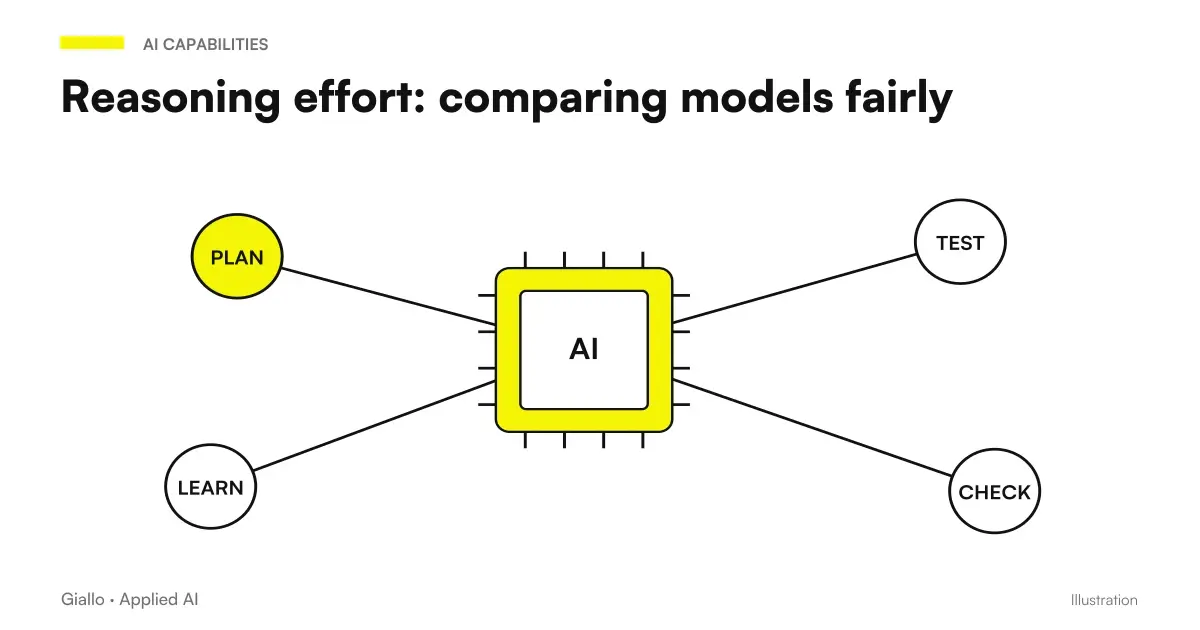 Reasoning effort: what changes in model comparisons
 Copilot Studio: prices, credits and cost of agents
FAQ
How much does it cost to automate a business process?
The order of magnitude is 1,500 – 8,000 €, depending on how many systems must be connected and how many exceptions the process has. A linear flow with only one integration lies at the bottom; a process that touches three systems and has many particular cases lies at the top.
How do I know whether it is cost-effective?
You need just one number: what the process costs you today. Multiply its monthly frequency by the time it takes and the hourly cost of the person doing it. If the process's annual cost is lower than the automation cost, automating it is not worthwhile — at least for economic reasons.
Which processes should be automated first?
Those with three characteristics together: high frequency, clear rules, few exceptions. A rare but complex process is the worst candidate, although it is the one that bothers the most. Frequency is what pays off the investment; clear rules are what makes it achievable at predictable cost.
Does automation eliminate jobs?
In practice, almost never for Italian SMEs: it shifts time from repetitive activities to tasks nobody could do because they lacked the hours. The typical result is not fewer staff, but the same team handling more volume or serving clients better. This depends on the company's choices, rather than the technology.
How long does it take to see the return?
For a high frequency process the return is often measurable within a few months, because the saving accumulates every time the process runs. For less frequent processes the times lengthen proportionally, and that is why frequency is the most important selection criterion.
Do you need AI to automate a process?
Not always, and recognising the distinction saves money. If the process follows strict rules and the data is structured, traditional automation costs less and is more reliable. AI is needed to interpret free text, unstructured documents or requests expressed in varying ways.