
AI for staff shift scheduling
AI shift scheduling: what the software optimises, what AI interprets, and which statutory rest periods must be respected.
Reading time: 10 min
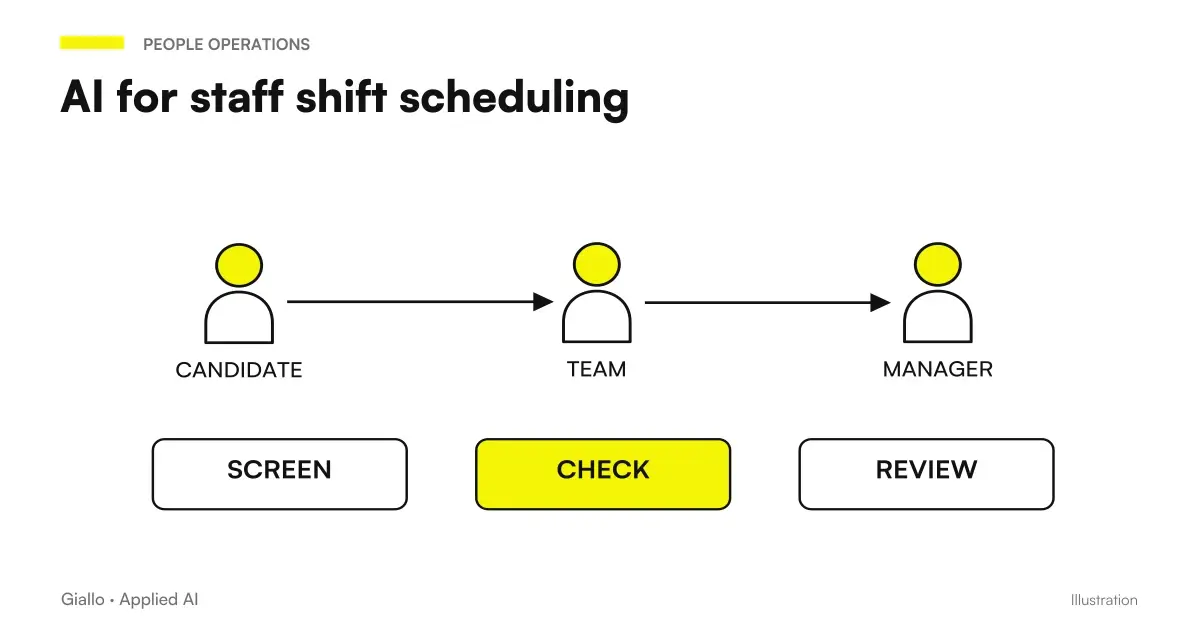
Those looking for artificial intelligence to create work shifts usually imagine a button that generates the calendar of the month. The part that calculates a plan while respecting constraints is an optimization problem, and solve it better dedicated computing engines than a language model. AI's contribution to shift management lies elsewhere: interpreting written requests in words, explaining why the plan is done that way, and most importantly managing last-minute changes.
Confusing the two problems produces the most expensive error in this area: letting a language model decide whether an assignment meets a mandatory rest. That control should be written as a strict rule, because it concerns a right of the worker before even a technical constraint.
In summary
- Generating the plan is optimization; reading the requests and explaining the choices is language: they are two different jobs.
- The time you really lose is in the Shift Changes, not in the monthly schedule.
- The Rests of the D.Lgs. 66/2003 remain strict rules, never a suggestion of the model.
- Who works should be informed if an automated system affects the assignment of tasks, for the Art. 1-bis of Legislative Decree 152/1997.
- Under a certain size, those who know the staff are faster than any software.
- The most useful work is often not software: it is writing down the rules that today live in one head.
Optimization and Language: Two Crafts in the Same Project
| Tasks | Nature of the problem | Suitable Tool |
|---|---|---|
| Gathering availability and word-written requests | Language | Model AI |
| Calculate the plan that meets all constraints | Optimization | Dedicated computing engine |
| Explain why the plan assigns that shift to that person | Language | Model AI |
| Check a proposed change against constraints | Rule | Deterministic code |
| Communicate the updated plan to everyone | Distribution | Simple Automation |
Many projects on this theme fail in the second row of the table: they also use a language model to generate the calendar, not just to understand the requests. A model can propose a plausible assignment that violates a rest, because it is not solving equations: it is guessing a plausible text sequence. For the calculation of the plan, you need an engine that treats constraints as rules, not suggestions.
The real bottleneck is the changes, not the starting plan
The plan is done once a month or a week. The changes happen every day: a voice request, a chat request, a colleague who covers without warning anyone, the person responsible who discovers the hole a few hours earlier. It is there that time accumulates that no one stops to measure.
- The exchange request comes on a single channel, written as it happens.
- The system identifies who, when, why and with whom you want to trade the shift.
- Automatically verify compatibility with rests, skills and minimum coverage.
- He proposes a roster of colleagues who can cover, taking into account those who have already given availability recently.
- The manager approves with a touch, not rewriting the plan from scratch.
- Everyone sees the same updated version, not three different copies between bulletin board, group chat and memory.
The last point weighs more than the others. The daily problem is rarely not knowing who can cover: it is that three people have three different versions of the plan, and none coincide with the real one.
Exchange requests are not evenly distributed throughout the year. They focus before summer closures, when everyone wants to move something around at the same time, and in the months with more absences from illness, when the holes to cover increase without warning. A system that handles changes should be thought of for these peaks, not for the average flow: it is at peak times that the single channel and automatic constraint verification make the difference from a shared Excel sheet.
Rests that remain out of the question whatever the software
A shift management system with artificial intelligence can propose, explain, warn. It cannot negotiate the constraints that the law places to protect those who work.
These constraints should be inserted into the system as rules that block the plan if violated, never as criteria that the model "usually" respects. A plan that software generates in a second but that violates a rest does not save time: it shifts the problem to later, when someone notices it.
What to know before turning on a system that assigns shifts
A system that affects the assignment of tasks treats data about people and has effects on their concrete working conditions: it is not just a technical choice.
- Those who work go Informed if an automated system affects the assignment of tasks or tasks, as required by the Art. 1-bis of Legislative Decree 152/1997, introduced in 2022.
- If the same system also records presences or displacements with control tools, it applies Article 4 of the Workers' Statute: needs union agreement or, failing that, authorization of the Labour Inspectorate.
- The award criteria must be knowable by those who suffer them, not an opaque mechanism.
- It must remain a real human intervention: the person responsible approves or corrects, not just ratifies.
- It should be checked over time that the system does not always download the same uncomfortable shifts on the same people, because they are the ones with the most declared availability.
The last point is the one that nobody controls and that does the most damage. An algorithm that only optimizes coverage can penalize without anyone deciding the most available people, precisely because they are the most comfortable to use. The general framework on these systems is in the four levels of risk of the AI Act and in HR uses told in AI for Human Resources.
When it's really convenient: two companies compared
A cooperative that runs a residence for the elderly, shifts over three bands twenty-four hours a day. In such a case the skill constraints (who is enabled to which task) and the minimum night coverage are rigid, and the exchange requests come every day from dozens of people. The sensible project starts right from the changes: that is where the day of the coordinator is lost, not in the monthly plan.
A small shop with six people on two shifts. Those who do the shifts know everyone, the availability changes little, and building a system would be a never-return expense. It makes maximum sense a single channel for requests, written and shared, with no computing engine behind it.
A network of counters with ninety operators on multiple locations. Here planning itself is a complex job, with different skills per window and coverage constraints per time slot. It is worth a real project, with an optimization engine for the plan and the AI to interpret requests and explain assignments to those who receive them.
The question that decides is not how many people there are, but how many different constraints are intertwined: skills, schedules, individual agreements, minimum coverages per band. A residence with round-the-clock shifts has few employees but very tight constraints; a store with the same number of people may have almost none. It is the number of constraints, not the number of heads, that justify a structured project.
Questions Unmasking Badly Done "AI" Software
The shift management software market is crowded, and many claim to be "artificial intelligence-based" without saying what it means in practice. Few questions are enough to figure out who you're dealing with.
How are mandatory rests treated? If the answer is about learning from historical data instead of strict rules, the plan may not conform and no one would notice until a problem emerges.
Can you see why the system proposed just that assignment? A plan that is not explained cannot be corrected in a targeted way, nor defended in front of the recipient.
What happens when someone is missing at the last moment? It is the most frequent situation in real practice, and it is where many products stop leaving the problem entirely to the person responsible.
Collecting those rules is almost always the longest work of the project, more than the configuration of the software itself. It must be done together with those who do the shifts today, and the benefit remains even if the software project stopped: those written rules serve to anyone who had to replace that person, which is already reason enough to do them. The same principle, applied to the training of those who enter the company, is described in AI for Internal Training.
Starting from scratch does not mean immediately choosing between "no AI" and an "automatically generated schedule": it is better to proceed in stages. The first step is a single channel for requests, with no algorithm behind it; that alone already removes much of the disorder. The second is an automatic compatibility check on a proposed change, which only answers "is it possible?" without deciding anything for anyone. The third is a proposal for who can provide cover, which the manager approves or rejects. The fourth — generating the complete schedule from scratch — only makes sense when there are many constraints: many companies discover that the second stage solves almost the entire perceived problem and that they do not need the fourth.
To figure out if your case makes sense, measure for a month two numbers: how many hours it takes to make the plan and how many exchange requests arrive out of schedule. If the second data is high and messy, that is the project to start, and it is also the least risky to build. The internal policy on who decides what, useful even before choosing a supplier, is set in corporate policy on the use of AI, while the framework of business functions where to start is in AI by business function.
A system that assigns shifts still treats data of the people who work with you: before activating it it is also worth closing the privacy side along with those who follow the staff, as described in GDPR and AI in the company. If you need help figuring out which piece of the problem to deal with first, a Customized AI Agent can be built to handle the shift changes, leaving the monthly plan to those who already do it well.
Giallo Studio guides: methodology and sources
How we apply it in the company
Related resources
 AI for human resources: concrete uses
 AI for Business Functions: Where to Start
 AI Act: the four levels of risk explained
 GDPR and artificial intelligence in the company
 Corporate policy on the use of AI: how to write it
 Qualify sales enquiries with AI: missing data, priorities and assignment
 Meta Personal Superintelligence: What Muse Spark Does
 ChatGPT Ads cost: CPC, CPM, minimum budget and welcome credit
AI by sector
The same reasoning, applied to the other areas we follow.
- AI for removals: inventory, quotes, permits and damage
- AI for veterinary clinics: recalls, prescriptions and pet owners
- AI for technical firms: surveyors, architects and engineers
- AI for wedding planners: suppliers, deadlines and guest data
- AI for medical practices: reception, appointments and reminders
- AI for procurement and supplier management
- AI for wellness centres and spas: admissions, gift vouchers and packages
- AI for marketing agencies: content, reports and AI labels
- AI for renovation firms: changes, SAL progress reports and site documents
- AI for travel agencies: quotes, packages and assistance to travellers
- AI for restaurants: reservations, allergens and responses to reviews
- AI for automatic appointment scheduling
FAQ
Can artificial intelligence to create shifts replace those who do them today?
It can propose a draft that respects the known constraints, not assign the shifts alone. Those who do the shifts today know individual agreements, pairs of people who do not work well together, urgencies not written anywhere: that knowledge must be collected first, the software does not invent it.
What distinguishes AI shift management from classic planning software?
A classic planner asks to insert constraints into structured forms. A system with extra AI reads free-form written requests, such as a shift change chat, and translates them into constraints, or explains in plain language why a plan is made in a certain way.
Does the software check mandatory rest periods, or do they need manual checks?
They should be coded as strict rules that block the plan if violated, not entrusted to a model that usually respects them. The reference is Legislative Decree 66/2003 on daily and weekly rest: they are legal constraints, not optional parameters of the program.
Is it better to automate scheduling or shift changes?
In most SMEs it is better to start from shift changes: they are continuous, messy, and consume more time than monthly planning. The initial planning justifies a structured project only above a certain number of people and workstations.
Do workers need to be informed if shifts are decided by an automated system?
Yes. Legislative Decree 152/1997, with the article added in 2022, requires workers to be informed when an automated system affects the assignment of tasks or duties, in addition to what is already provided for by the Workers' Statute on control tools.
With few people does an AI tool make sense for shifts anyway?
Often not for planning: those who know everyone do the plan by hand in a short time and no software beats that speed. It makes sense instead a single channel for change requests, even without any optimization algorithm behind.