
AI for recruiting and staff selection
AI for recruitment and staff selection: what can be automated without risk, what falls under the AI Act's high-risk rules and how to avoid discrimination.
Reading time: 10 min
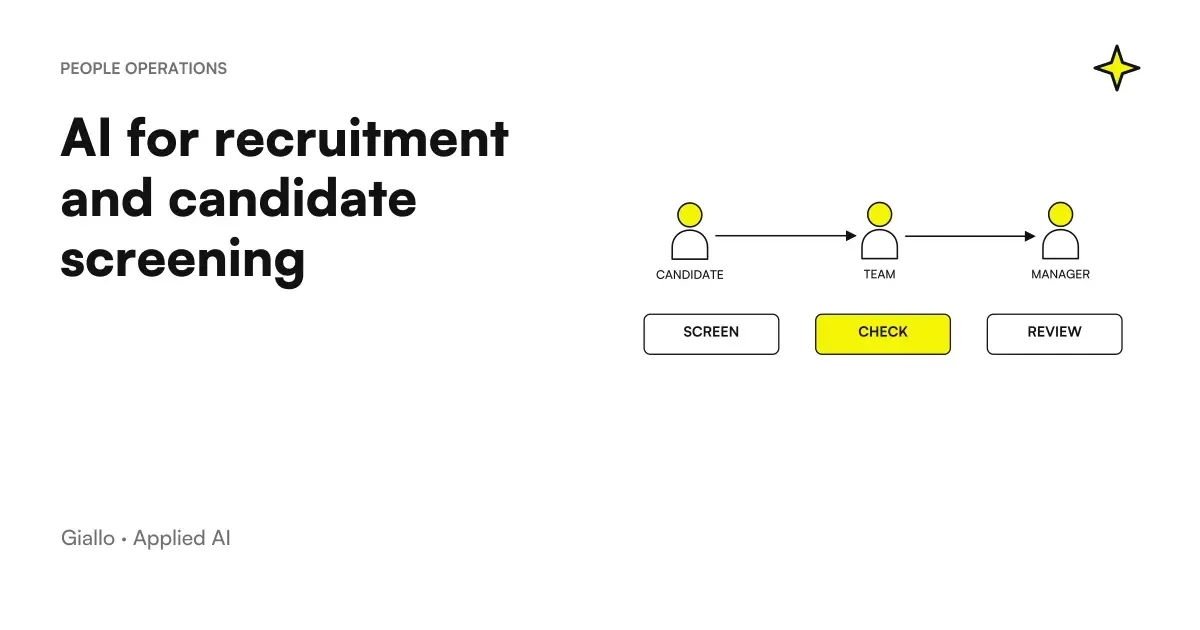
Using AI in staff selection is possible, but it is one of the few business activities where the norm demands guarantees before leaving, not after something goes wrong. The reason is not bureaucratic: a wrong automated choice here affects a person's access to work, which often will never know why it was discarded.
It is advisable to immediately distinguish two zones. The outline of the process, where AI takes away work without touching any decisions, and the evaluation of candidates, where structure, written criteria and control are needed over time. The two zones border closely, and understanding which side of the border a tool really is is the first thing to clarify before signing a contract with a supplier.
In summary
- Write announcements, respond to candidates, arrange interviews: territory without special constraints.
- Sort or exclude candidates with automatic criteria: high risk According to the AI Act.
- The risk of Indirect discrimination is concrete: it arises from criteria that seem neutral.
- Summarizing an application is only useful if the original document remains accessible.
- For most Italian SMEs the volumes They do not warrant automatic screening.
- Periodic verification of outcomes is the only way to notice unwanted drifts.
What AI can do without touching the real selection
There is an entire piece of the recruiting process where AI renders well and no specific rule applies, because no decision about a person is made.
Write the ad. An effective ad is specific about tasks and context, not generic. AI helps remove formulas that narrow the audience for no reason, such as stricter requirements than the role really requires.
Respond to candidates. Questions about timing, venue, mode, application status remain often unanswered today due to lack of time, with image damage being paid later when those profiles are needed.
Prepare the talks. Summarize the relevant experience for those who will conduct the interview, suggest areas to deepen: useful, provided that those who read the summary can always trace back to the original document.
After the interview. Reordering scattered notes in a written assessment with a fixed structure helps selectors compare candidates with the same criteria, instead of remembering from memory the impressions of different weeks. The evaluation, however, writes it and signs it who conducted the interview: the AI puts order in the text, does not replace the judgment of those in the room with the candidate.
The fine line between summarizing a candidacy and deciding it
The question that exposes the gray area is simple: if the system proposed the opposite order, would it change who is hired? If the answer is yes, the system is deciding, regardless of what it is called.
The mechanism by which discrimination arises without anyone wanting it is not intuitive. A system trained on past assumptions also learns the implicit preferences of those choices: if in the past more people with a certain path have been hired, the system will treat that path as a positive signal, even if no one has written it in any rule.
This also applies to tools that seem harmless, such as an automatically correct aptitude test or software that analyzes written answers to open questions: if the reference model was built on an unvaried group of people, it will treat as "typical" a profile that is actually only the one most represented in the starting data.
- The Work Continuity penalizes those who have had interruptions for family or health reasons
- The distance from the venue penalizes those who live in areas less served by transport
- The type of school or university correlates with the initial socio-economic context
- One formal linguistic mastery excessive penalizes foreign candidates even in roles where it is not needed
None of these criteria are born with discriminatory intention. Everyone can produce that effect, and that's why they need to be verified periodically by looking at who really gets past the screening, not the intentions of who wrote the rules.
What it takes to use it well when it really decides
- Criteria written before starting: what evaluates the system and with what weight, not after seeing the results.
- Real Human Surveillance: those who decide must be able to see the complete candidatures, not just the order proposed by the system.
- Information to Candidates, in understandable language and not hidden in a clause: the same obligation that the D.Lgs. 152/1997 imposes on those who are hired applies, in fairness to the candidate, even before the decision.
- Periodic verification of outcomes: who passes, who does not, with what characteristics in common.
- Traceability, in order to be able to rebuild after months because a candidacy was treated like this.
The fourth point is the one that hardly anyone does and that protects the most. Once in a while looking at the composition of those who pass the screening over those who have applied is the only concrete way to realize that the system has developed a systematic preference before it becomes a serious problem.
Three volumes of nominations, three different choices
A company that receives a few hundred nominations a year. Volume that begins to justify a project. The most sensible choice is to use AI to summarize and organize, keeping human reading on all nominations instead of introducing a score that orders them: you get much of the benefit by staying out of the high risk.
A company that receives a few thousand. Here an automatic screening becomes realistically necessary to manage volumes. It should be treated in full as a high-risk project: documented criteria, human review on a real share, periodic verification of outcomes, information to candidates from the first contact.
An SME with a few dozen applications per year. No selection project. AI remains useful on the outline: announcement, responses, interview organization. Building a screening for such a small number of cases means paying for development and fulfillment for a problem that, at those volumes, does not yet exist.
The practical criterion for choosing between the three avenues described above is not the size of the company itself, but how many applications actually arrive each year for the same open position. A small company that rarely takes on but for a single role much in demand and well publicized can receive more applications than a larger one that continuously takes on different profiles and little sought after: it is always better to count the real cases of the year just passed, not to estimate them by eye from the number of employees in staff.
The steppath before you get to the score
Between "no AI in selection" and "full automatic screening" there is a middle ground that for many companies is the right choice, and that hardly anyone considers.
- First level. AI only works on the outline: announcement, responses, interview logistics. No evaluation.
- Second level. Summarizes applications for those who will read them, without ordering them. The original document always stays a click away.
- Third level. Report presence or absence of stated objective requirements in the ad, such as a certification or language, without producing an overall score.
- Fourth level. Overall score and order of candidates: from here you are fully in the high risk.
The first three levels give much of the practical benefit by staying in a much simpler territory to manage. Even at the third level, however, attention is needed: an "objective" poorly worded requirement, such as a specific certification when there are equivalents, filters out valid candidates for a formal detail.
What to watch after six months
If you have introduced a system that affects selection, periodic checking is not a formal fulfillment: it is the only way to notice drifts that no one has wanted, before they become a habit.
| What to watch | What It Indicates |
|---|---|
| Composition of those who apply compared to those who pass the screening | If the system is disproportionally excluding a group |
| How many times does the decider deviate from the proposed order | Whether human surveillance is real or just formal |
| Outcome of interviews with respect to the score awarded by the system | If the criteria really measure what matters for the role |
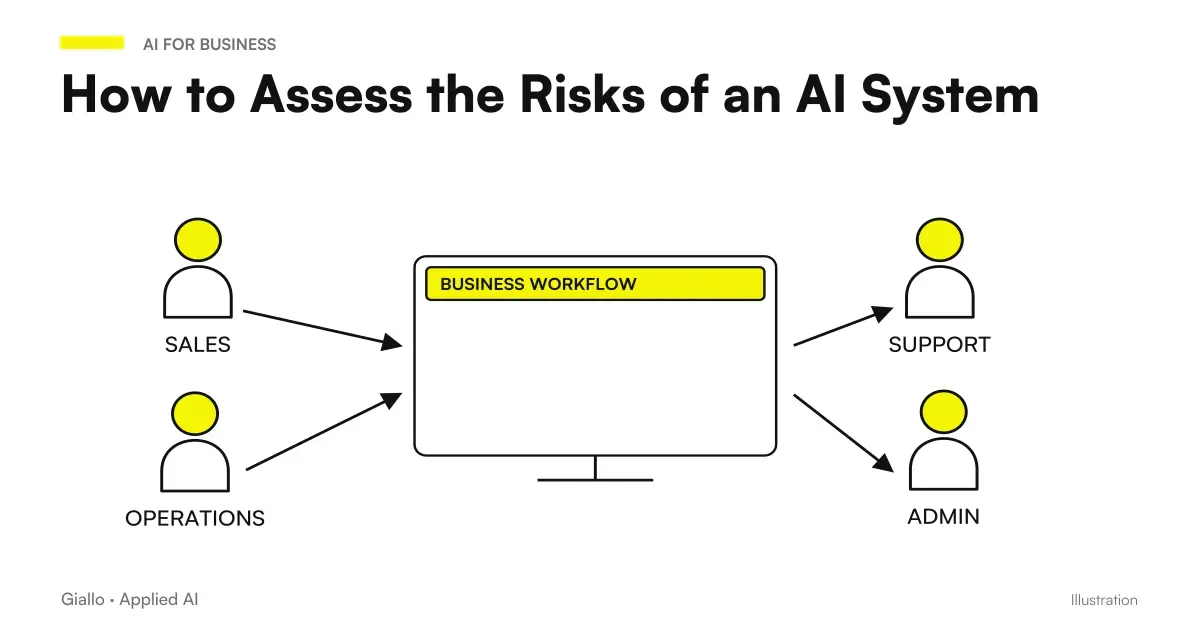
If in six months no one has ever deviated from the system proposal, it is basically deciding the machine, not the person who should do it. The same logic applies to the outcome of the interviews: if the one who comes with the highest score is not the one who goes best once at work, the criteria are measuring the wrong thing and need to be reviewed, not the candidates. The general method of arriving at these verifications in a structured manner is in How to Assess the Risks of an AI System.
Finally, there is one aspect that technical assessments tend to ignore: how candidates perceive an automated process. A company that responds late and communicates little, and then turns out to use an automatic screening, suffers reputational damage that falls on future applications, precisely in the sectors where the best profiles choose from multiple offers. Paradoxically, the AI used on the outline, with quick responses and clear updates even to those who are not chosen, is what most improves this perception.
A selection system still processes personal data of people who are not yet your employees, often in significant amounts. If an application is rejected on the basis of automated processing alone, without anyone ever looking at it, the Art. 22 of the GDPR: the candidate has the right to obtain human intervention and to challenge the decision. The complete verifications on the retention of applications and legal basis are in GDPR and AI in the company, while the general obligations for an SME introducing such systems are summarised in AI Act: what obligations does an SME really have.
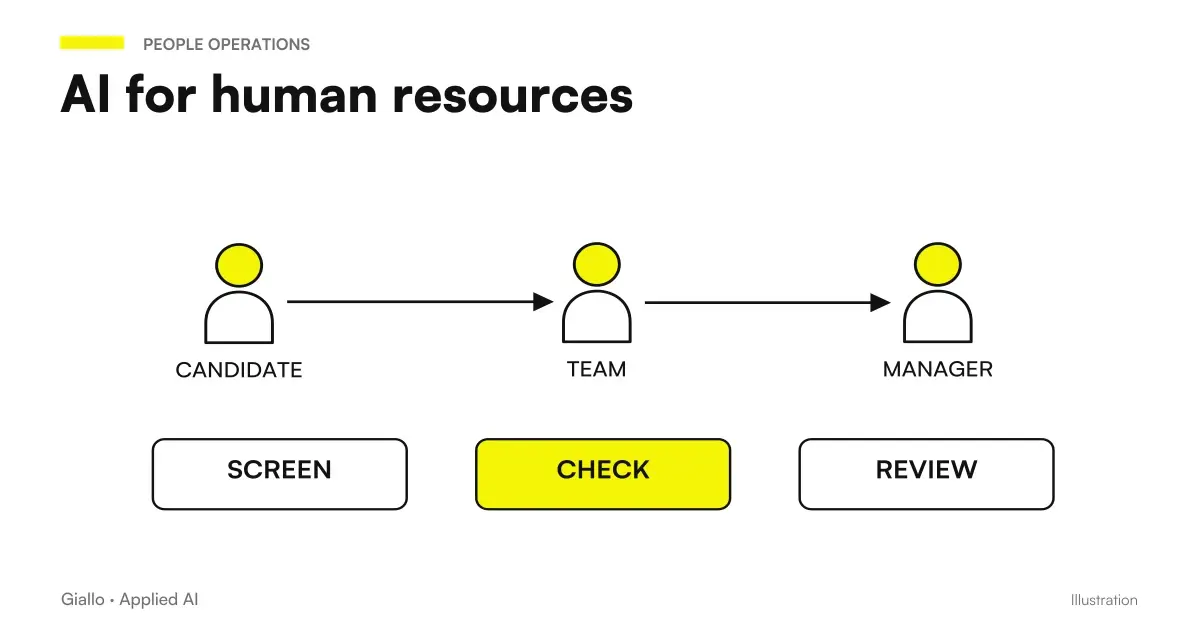
The larger picture of minimal risk HR uses, useful for figuring out what to do before you even get to the real selection, is in AI for Human Resources. Recruiters often also follow the insertion of hired people: if this is your case, AI for Internal Training shows how the same writing work of the procedures serves both projects. If you want to understand which of the two paths makes sense for your volumes before choosing a supplier, an evaluation with Giallo Studio always starts from counting how many applications you manage today, not from the software.
Giallo Studio guides: methodology and sources
How we apply it in the company
Related resources
AI by sector
The same reasoning, applied to the other areas we follow.
- AI for customer callbacks
- AI for business reporting: fewer hours, the same data
- AI for cleaning companies: specifications, shifts, DUVRI and safety data sheets
- AI for human resources: concrete uses
- AI for phone bookings
- AI for restaurants: reservations, allergens and responses to reviews
- AI for SMEs: a practical guide to really getting started
- AI for renovation firms: changes, SAL progress reports and site documents
- AI for hairdressers and beauty salons: bookings and fewer schedule gaps
- AI for wellness centres and spas: admissions, gift vouchers and packages
- AI for gyms and sports centres: class bookings, medical certificates and memberships
- AI for medical practices: reception, appointments and reminders
FAQ
Can a company use AI to choose who to hire?
It can use it as a support, not as a sole decision-maker. Sorting or filtering candidates with automatic criteria is classified as high risk by the AI Act because it affects access to work: it is allowed, but requires real human oversight, information to candidates and periodic verifications.
Why does a screening system risk discriminating even unintentionally?
Because it learns from past selections, including the unwritten preferences of those selections. Criteria that seem neutral, such as work continuity or distance from the venue, can systematically penalize certain categories of candidates without anyone deciding.
Is summarizing a resume with AI already a form of automated selection?
It depends on how it is used. If the decider reads the original document anyway, the summary is just a help. If the summary is the only thing someone reads, the system is in fact choosing what matters, even without assigning a score.
Is an automated selection tool still worthwhile with only a few applications per year?
Almost never. Below a few hundred applications per year, the project’s cost and related compliance obligations do not pay for themselves. Instead, use AI around the process: job adverts, responses to candidates, and interview organisation.
Do candidates need to be informed if part of the process is automated?
Yes, and it is an obligation that adds to the general one on the AI Act: when a system affects selection it must be said in an understandable way, not in a hidden clause. It is also a choice that protects the company's reputation towards future candidates.
How do you check that a selection system is not penalizing someone?
By periodically reviewing the composition of those who pass screening compared with those who applied, and how often decision-makers diverge from the ranking proposed by the system. If nobody ever diverges, human oversight is only a formality.