
AI marketing prompts: copy, campaigns and content
Ready-to-use AI marketing prompts: copy, social posts, email, campaigns and SEO content for Italian SMEs. Real examples and a table by funnel stage.
Reading time: 9 min
AI prompts for marketing are instructions you give to an AI tool to get copy, content and promotional text ready. or almost promozionali for use. It is not a question of asking "write a post for Instagram": an effective prompt specifies the context, audience, tone and format. The difference between a generic output and one you can actually use is all in this information.
For an Italian SME the concrete value is this: shorten the time that goes from "I have to communicate X" to "I have the first draft to review". It is not a matter of eliminating the person —the final judgment remains yours —but of stopping from starting with the blank sheet each time. A well-built prompt reduces the production time of marketing content from 50 to 70% on repetitive tasks such as product cards, promotional emails and social posts.
In this guide you will find ready-to-use prompts divided by funnel and channel, a summary table, common errors and how to integrate everything into a real flow for your business.
In summary
- An AI prompt for effective marketing always includes: Activity Context, public, format and tone.
- The most robust use cases for SMEs are: Product Sheets, promotional emails, social posts, mail objects and copy for ads.
- AI produces a first draft: it must always be reviewed before publishing, especially on specific tone and data.
- Using a prompt table for funnel (awareness, consideration, conversion) helps to cover every step of the customer journey without forgetting pieces.
- The main risk is generic content: always add real details (offer, local context, season) to distinguish yourself.
- For recurring campaigns, build a prompt template with the fixed info of the activity already prefilled.
How to Build an AI Prompt for Marketing That Works
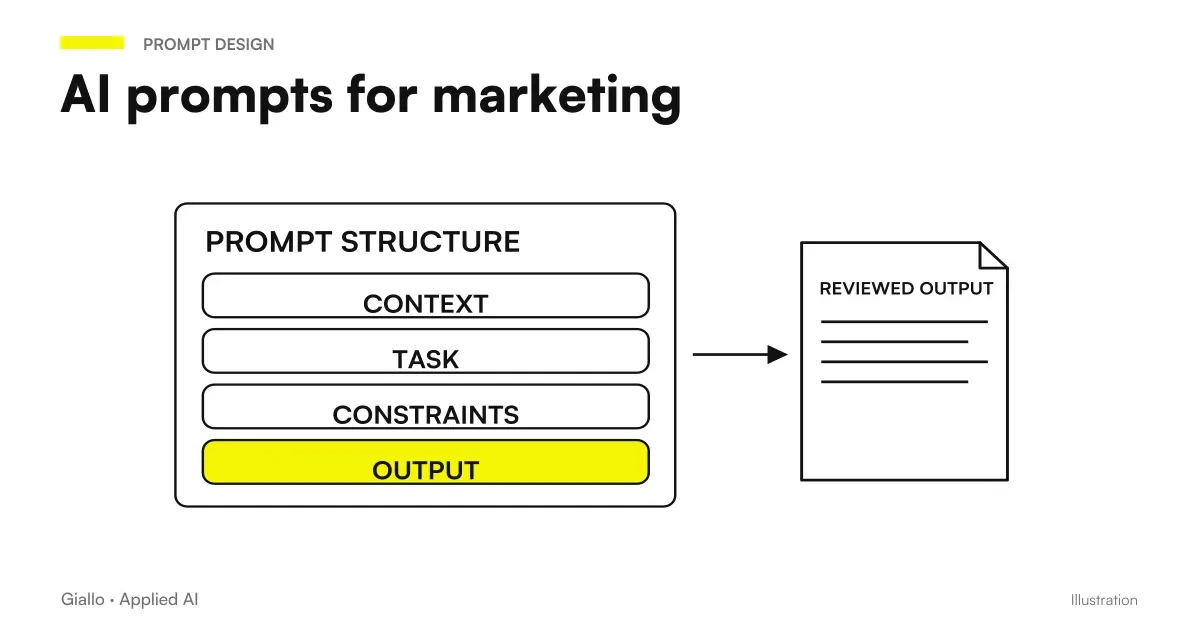
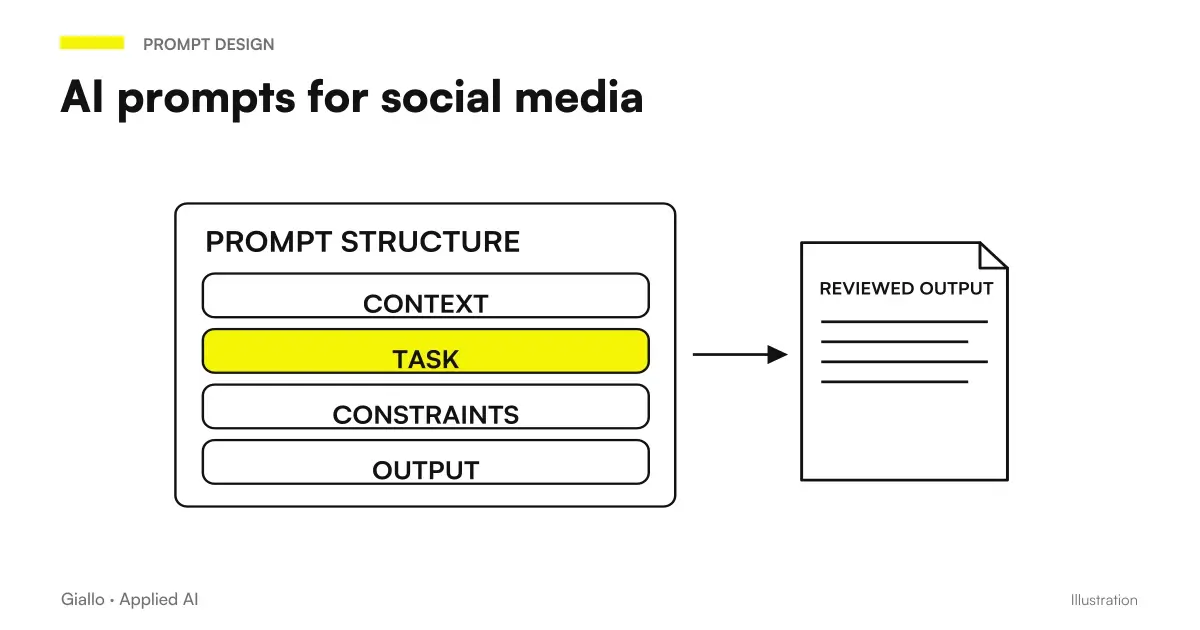
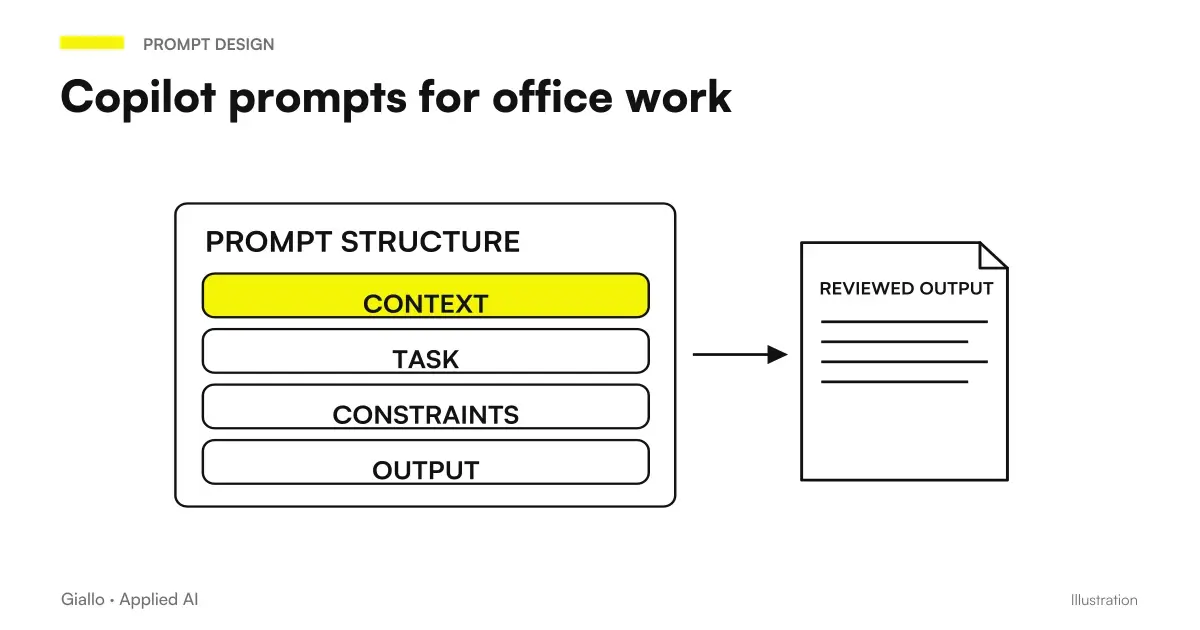
Before you see the examples, it is worth understanding the structure. An effective marketing prompt has four components:
- Role and Context: who you are and what you sell ("I am the owner of a pharmacy with galenic preparations service in Milan...")
- Objective and format: what you want to get ("...write 3 email items for the November newsletter")
- Public: to whom the message is addressed ("...the public are regular customers over 50 health-conscious")
- Style Constraints: tone, length, what to avoid ("...hot and direct tone, no superlative, maximum 60 characters per object")
Without point 1, AI invents a generic context. Without point 3, the tone is wrong. Without point 4, you get text to correct anyway. To learn more about prompt construction logic you can read the guide on prompt engineering.
Ready prompts for each stage of the marketing funnel
The following table collects ready prompts divided by phase of the funnel. Adapt them with your business name, product and audience.
| Phase | Objective | Ready prompt (replace [placeholder]) |
|---|---|---|
| Awareness | Social posts of visibility | "You're a copywriter for [business type] in [city]. Write 3 versions of an 80-100-word Instagram post that tells [product/service] to customers who don't know us yet. Tone: [hot/professional/ironic]. No hashtags yet." |
| Awareness | Introductory blog article | "Write the intro (150 words) of a blog article for [activity] on [topic]. The reader is [public] who does not yet know our offer. Main keyword: [keyword]. Tone: [tone]." |
| Consideration | Email nurturing | "You're the marketing manager of [business]. Write an email of 150 words for customers who have visited the [product] page but have not purchased. Emphasize [main benefit], add a social proof (e.g. 'Beyond X customers...') and close with soft CTA." |
| Consideration | E-commerce Product Sheet | "Write a product card for [product name] sold on an Italian e-commerce. Audience: [target]. Include: SEO title (max 60 car.), short description (50 words), 3 bullet benefits, descriptive paragraph (100 words). No generic adjectives like 'excellent' or 'excellent'." |
| Conversion | Google Ads Announcements | "Write 3 variations of Google Ads ad for [product/service]. Each variant: Title 1 (max 30 car.), Title 2 (max 30 car.), Description (max 90 car.). Goal: click. Landing page: [URL or topic]." |
| Conversion | Email offer / promo | "Write a promotional email for [specific offer: e.g. 15% discount on supplements until June 30] for [business] customers. Subject: 3 options (max 50 cars. each). Body: 120 words. CTA finale: button with text '[CTA text]'." |
| Retention | Post-purchase email | "Write a post-purchase thank you email for [activity]. Include: warm thanks, short instructions on [how to use the product], invitation to leave review on [Google/Trustpilot]. Tone: human, not robotic. Max 100 words." |
Practical examples: prompts used in real Italian contexts
Pharmacy with galenical service — monthly newsletter
Prompt:
I own a pharmacy with a pharmaceutical compounding service in Bergamo.
Write 3 email subject lines for the October newsletter aimed at regular customers over 50,
focusing on autumn remedies (vitamin D, immune defences, probiotics).
Tone: professional but warm. Max 55 characters per subject line. No emoji.
Typical Output: three items such as "How to deal with autumn with raised defenses", "Vitamin D: when and how to integrate it" and "Your personalized probiotics are here". Drafts ready in 10 seconds, to be chosen and adapted.
Tax consultancy firm — LinkedIn post
Prompt:
You are the social media manager of an accounting firm in Turin.
Write a 100-word LinkedIn post that explains the 16 October deadline
for VAT payments in simple terms, aimed at small business owners. Tone: clear, no technical jargon.
End with a question that invites comments.
The generated post functions as a starting point: the accountant adds the correct technical detail, but does not have to build the structure from scratch.
Small E-commerce — Repetitive Product Cards
An e-commerce craft product with 200 items can generate the first drafts of bulk card by switching to AI a list of products with basic features. The prompt includes: category, material, size, intended use. The AI writes a draft for each; the holder corrects the tone and adds details about the production process. Time per card: 20 minutes to 3-4 minutes.
For more specific uses related to content, see also ChatGPT to create content and the guide to AI prompt by email.
AI prompt for social channels: Instagram, LinkedIn, Facebook
Social media has different formats and requires adaptations in the prompt. It always indicates the exact platform and format.
Prompt for Instagram (post feed + stories + capture)
Post feed: "Write the capture for an Instagram post of [activity]. Topic: [theme]. Tone: [e.g. inspirational/practical]. Structure: 1-line hook, 3-4 sentences body, final CTA. 5 relevant hashtags in Italian at the end."
Textual Stories: "Create 5 text slides for Instagram Stories that promote [offer/event]. Each slide: max 10 words, direct tone. The fifth slide is the CTA: [text call to action]."
Caption Product: "Write the capture for the photo of [product] on Instagram. Audience: [target]. Don't describe the image, tell the benefit. Max 80 words. Emoji: max 2, relevant."
Prompt for LinkedIn (B2B, professionals, SMEs)
Post authority: "Write a 120-word LinkedIn post about [professional topic] from the point of view of [role, e.g. tax consultant / workshop owner]. It starts with an uncomfortable or counter-intuitive phrase. Close with an open question."
Case of success (without sensitive data): "Write a LinkedIn post that tells how [business type] solved [generic problem] for an industry customer [sector]. Don't mention names. Structure: problem, approach, result. 100 words, professional tone."
For a wider collection of social prompts see AI prompt for social media and the guide to best AI tools for social.
Prompt for SEO and organic content
AI is useful for organic marketing on precise tasks: generating variants of title tags, writing meta descriptions, creating clusters of related keywords, intro drafters, and article structure.
Useful prompts:
- Title tag SEO: "Write 5 variants of title tag (max 60 car.) for a page that sells [product/service] to [city/area]. Main keyword: [keyword]. Include a specific number or advantage in at least 2 variants."
- Meta description: "Write 3 meta descriptions (max 155 car.) for the same page. Include the keyword '[keyword]' and an implied call to action."
- Article structure: "You're an SEO content strategist. Propose the structure (H1 + H2 + H3 main) for an article of 1500 words on '[topic]' for an audience of [target]. Include the real questions the user asks."
To deepen the use of AI for organic positioning, read the guide on AI prompt for SEO and Best AI for SEO.
Mistakes to Avoid
- Prompt too vague. "Write a post for my business" doesn't work. AI doesn't know who you are, what you're selling, who you're talking to. Each prompt must have at least context + format + audience.
- Copying output without revision. AI can invent data, use a tone that is not yours, or generate generic text that sounds the same as all competitors. The draft should always be read and adapted.
- Using the same prompt for different platforms. A copy for LinkedIn does not work on Instagram. It always adapts format, length and tone to the platform.
- Not providing context on the real offer. If you don't specify pricing, seasonality, active promotion, AI invents or generalizes. Copy becomes unusable because it doesn't reflect your proposal.
- Expecting strategy, not just text. AI can write individual pieces, but it cannot define goals, priority channels, and budgets for you. The strategy remains with you or your advisor.
How to apply it in the company
For an SME with limited resources, the most practical way is to build a template prompt library Reusable. It works like this:
- Identify recurring content. What texts do you write at least once a month? Newsletters, social posts, updated product sheets, seasonal emails? Start there.
- Build the basic template. Take a prompt that worked and replace the variable parts with [placeholder]: [product], [offer of the month], [CTA]. Save it in a shared document.
- Head with 3 variants. Always ask the AI to generate 3 versions for each content. Having choice reduces the risk of publishing the first draft without thinking about it.
- Review before publishing. Control tone, specific data, and brand consistency. Add the real element that only you know: a production detail, a customer story, a local data.
- Measure the time saved. After a month, compare hours spent on content production before and after. Typical savings on repetitive tasks is 50-60%.
If you want to automate further — integrating AI directly into your CRM, business management software or content approval workflow — it is time to consider a more structured solution. Giallo Studio design custom-made agents and automations that connect your existing tools without having to take care of the technical part.
To see how other AI tools compare on marketing use, explore Best AI for Marketing.
Conclusion
The AI prompt for marketing are the most immediate tool for an SME that wants to produce content continuously without having a dedicated team. The key is not to use AI for everything, but to use it well on repetitive tasks: product cards, monthly emails, recurring social posts. With a precise prompt and a reusable template, you have the first draft in less than a minute. Human work focuses where it's needed: tone review, adding real details, deciding what to publish.
If you want to go from testing with ChatGPT to an AI system integrated into business processes, Giallo Studio designs custom agents and automations. You can also explore concrete cases and tools in The Lab.
Giallo Studio guides: methodology and sources
How we apply it in the company
Related resources
 AI prompts: a complete guide to effective instructions
 ChatGPT prompts: ready-to-use examples to copy and adapt
 AI email prompts: ready-to-use examples for every situation
 AI prompts for social media: ready-to-use posts, captions and content
 ChatGPT to create content
 Best AI for Marketing: Tools and Platforms
 How to create the first Dot in ChatGPT and assign it a project
 Copilot prompts: examples for office work
Prompt Collections
Ready prompts for other roles and tasks.
- AI image prompts: examples for Midjourney, ChatGPT and Firefly
- AI presentation prompts: PowerPoint and Google Slides examples
- AI prompts for Excel and Google Sheets: formulas and data analysis
- AI coding prompts: write, fix and explain code
- AI email prompts: ready-to-use examples for every situation
- AI SEO prompts: optimise content and rankings
- AI e-commerce prompts: product descriptions, email and support
- AI prompts for social media: ready-to-use posts, captions and content
- AI document analysis prompts: contracts, reports and PDFs
- AI sales prompts: emails, offers and follow-ups
- AI customer support prompts: ready-to-use examples
- AI video prompts: Runway, Kling and Gemini alternatives to Sora
FAQ
What is an AI prompt for marketing?
A marketing prompt is a text instruction you give an AI tool (ChatGPT, Claude or Gemini) to obtain a specific output: a social post, promotional email, slogan or product description. The more precise and contextualised the prompt, the more useful the result is without rewriting.
How long does a marketing prompt have to be?
There is no fixed ideal length, but a good marketing prompt always has at least three elements: the context (who you are, what you sell, to whom), the required format (email, Instagram post, subject), and a useful constraint (tone, length, call to action). Often 3-6 lines are enough to get a solid first draft.
Can I use ChatGPT to create a full marketing campaign?
Yes, with a step-by-step approach. ChatGPT does not plan a campaign in a single prompt, but you can use it to generate individual items: briefs, ad copy, nurturing emails, social posts, customer FAQs. Each item must be requested with a dedicated prompt and then reviewed before posting.
Does AI-generated content work for SEO?
It works if you treat it as a first draft to review, rather than a final output. AI can help with structure, keyword variations, meta descriptions and titles. The main risk is generic content: add first-hand experience, real data and a specific point of view to stand out.
What information do I need to give to AI to get useful marketing copy?
At minimum: sector and business type, the product or service you want to promote, target audience (who they are and what problems they have), desired tone of voice and output format. The more contextual detail you provide, the less rewriting is needed. For recurring campaigns, create a prompt template with this information already included.
Can AI write Google ads or Meta Ads?
Yes. You can ask ChatGPT or Claude to generate headlines, descriptions and variations for A/B testing. Always specify character limits (e.g. Google Ads headline = max 30 characters), the campaign objective (clicks, conversions or brand awareness) and the destination landing page. Optimise the result using your actual performance data.