
AI for Logistics and Shipping
AI for logistics and shipping: transport documents, reservations noted at delivery, exception handling and customer communications. Uses and limits.
Reading time: 9 min
In logistics, the most common setting error is asking a generative AI to schedule turnarounds: it is a computing problem that solves dedicated algorithms better, not a language model. The true value lies in the words around the shipment: the note written by hand in the order, the phone call of those who ask where the package is, the reserve to be noted when a neck arrives bruised.
They are tasks of interpretation and documentation, not calculation, and that is where a system that reads and writes in natural language makes what a routing algorithm cannot give. It is worth saying immediately because it is the first misunderstanding that derails a project: those who propose it thinking about the routes are disappointed, those who build it thinking about the words around the expedition find a solid use case from the first month.
In summary
- The route optimization It's not a generative AI problem: you need dedicated algorithms.
- The Transport Document has minimum content provided for by the standard, in a free form.
- The reserves noted on delivery count more than a phone complaint made later.
- The highest value is in the handling exceptions, intercepted before the complaint.
- The order notes in free language are the text with the most practical impact on failed deliveries.
- The cost of a project depends mainly on how many different couriers They need to be integrated.
The document accompanying the goods, and what it must contain by law
Those who deliver goods without immediately issuing an invoice for each delivery rely on a specific document, born to replace the old accompanying note. It must contain the date, generality of the transferor and the transferee, any person in charge of transport, and the description of the nature, quality and quantity of the goods sold, as established by the Article 1 of Presidential Decree 472/1996. It does not have a mandatory pre-printed model: the same standard admits it in free form, provided it is issued before the start of transport.
This document is not only used to make the goods travel in order: the same rule makes it suitable to overcome the tax presumptions on disposals and to determine how and for what it should be kept, according to the general rules on the preservation of invoices. A system that digitizes transport documents, therefore, is not only speeding up logistics: it is also building the proof that serves to the deferred billing described in AI and Electronic Billing.
The written reservation on delivery: why it matters more than a phone call after
The carrier shall be liable for the loss and damage of the goods from the time it receives them to the time when they return them, unless it proves that the damage results from fortuitous occurrence, the nature of the goods or the behaviour of the sender or recipient, as determined by the Article 1693 of the Civil Code. The same rule adds a detail that changes a lot in practice: if the carrier accepts the goods unreservedly, it is assumed that the packaging had no apparent defects.
This means that a reservation written on the document at the time of delivery, even just "stained neck" or "wet packaging", is worth much more than a phone call made the next day when the neck has already been opened. An assistant who, reading the signed transport documents, automatically recognizes the presence of a reserve and connects it to the correct shipment turns a pen annotation difficult to find into a given consultable months later, when needed for a dispute.
Where Mathematics Ends and Interpretation Begins
| Tasks | Who solves it best |
|---|---|
| Calculate the shortest route for multiple stops | A Dedicated Planning Algorithm |
| Respond to "where's my order" with real data | An assistant connected to the management software and the courier |
| Understand a note written as "deliver only in the morning" | A model that interprets natural language |
| Recognize that a delivery status is an anomaly to report | A system that classifies courier states |
| Decide whether to accept an out-of-policy return | A person, with context in front |
Does the customer see an event or a promise?
When the shipping information arrives at customer care, it must remain clear what is verified. The AI assistant for order status connects source, update and affected lines, distinguishing partial delivery and full order. If the data is old or discordant, prepare the switch to the team without inventing an explanation of the delay.
The exception seen before the complaint
In the traditional flow a delivery problem is discovered when the customer writes. At that point it has already passed time, the customer is already unhappy, and the conversation starts uphill.
- The system reads the states transmitted by the courier continuously.
- Recognizes abnormal states: absent recipient, incorrect address, stock, reported damage.
- Classify the type of problem and its urgency.
- Notify the customer with a specific message for that type of anomaly, not a generic alert.
- It opens an activity for those who have to intervene, with the context already ready instead of a naked signal.
The order notes: the field that no one reads again
There is a field, in almost every management software, where customers write important things that then remain there: preferred delivery times, indications for the intercom, limited traffic areas, floors without elevator.
- Extract time slots and days indicated in the free text
- Recognize recurring access constraints and limitations
- Report ambiguous notes requiring a human decision before shipment
- Pass to the courier the information in the format that his system accepts
It is an inconspicuous use case, because it does not produce a number to show in a presentation, but with a concrete return: every delivery that fails for an indication that there was but did not arrive to the courier costs a second trip, in addition to the discomfort of the customer who had written it thinking it was enough.
What to count before deciding if the project really serves
In one example: An online store with a steady stream of shipments receives more weekly order status requests than it receives on any other theme. An assistant connected to the management software and the courier absorbs the majority of these requests, and the time released is immediately seen on those who respond by hand today.
A B2B company with deliveries by appointment has a different problem: not the status of the shipment, but the coordination, time slots, contact persons on site, unloading constraints. Here the value lies in the interpretation of notes and in a proactive notice the day before, not in the answer to a question that the customer almost never asks.
The most honest way to choose between the two, or to understand that neither applies, is to count for a week the after-sales requests that really arrive and classify them broadly: order status, changes, delivery issues, other. If a category dominates clearly, the project has a precise direction from day one.
There is also a third case, less told but as frequent as the other two: the distributor who works with multiple different couriers depending on the area or the customer. Here the use case is clear from the start, but the cost grows with each extra courier to connect, because each exposes its own states with a different level of detail. The practical choice is to start with the two couriers that cover most of the volumes and treat the others as a manual exception until they are worth integrating as well.
Why an assistant on shipments almost always jams the same way
An assistant who answers on the status of shipments seems a simple project, and almost always fails for one of three recurring reasons, which is worth knowing before leaving rather than discovering them in production.
What Avoids Failure
- Data read by the courier at a frequency consistent with customer expectations
- A path always open to a person on exceptions
- A different message for each type of recurring anomaly
What Causes It
- Been read once a day while the customer expects real time
- No way to talk to a person when the exception does not fit into the intended patterns
- The same generic message for "absent recipient" and "wrong address"
The first point is deceptive because the error is not obvious: a slightly misaligned response to reality is worse than no response, because the customer trusts and then discovers that it was not up to date. The second is the one that turns a useful assistant into an obstacle: those who have a delivery problem and find no way to talk to someone do not become a satisfied customer just because the automatic message was well written. The third one looks like a copywriting detail and is not: an "absent recipient" exception requires action other than an "incorrect address" exception, and a message that treats them the same way still generates a phone call, that is, exactly the work that you wanted to avoid.
The account that must include failed deliveries
The calculation of convenience for logistics has a peculiarity: in addition to the time of the people, there is a direct and measurable cost in failed deliveries, which involve a second trip and sometimes a return. If any of these depend on information that existed in the order notes but did not arrive at the courier, that part is recoverable with the work described above.
Before estimating the benefit, it is best to really count the failed deliveries of a recent period and look at their causes one by one. It often emerges that the main problem is not the missing information but something else, an unreliable courier on certain areas for example, and in that case no system of interpretation of the text solves it: the general calculation method, however, remains that described in how much does an AI agent cost.
Finally, there is an effect worth anticipating instead of finding out in the race: in the early days a system that communicates exceptions proactively increases conversations with customers, not diminishes, because problems that previously remained invisible now generate a message and often a response. It's not a sign of failure: the conversations are shorter, they start from a better position because it was the company that warned first, and they close with a solution instead of a complaint.
The connection to the warehouse from which the goods depart is natural, and is described in AI for stock and inventory management; the one with the suppliers that deliver to you, in the other direction of the chain, is in AI for procurement and supplier management. If you work in production or distribution and want to figure out which shipping flow to start from, Giallo Studio helps to automate communications and exceptions before even touching the warehouse.
Giallo Studio guides: methodology and sources
How we apply it in the company
Related resources
 AI for stock and inventory management
 AI and e-invoicing: what can be automated
 AI for procurement and supplier management
 How much does a custom AI agent cost
 AI Act: what obligations does an SME really have
 Compare supplier quotes with AI: prices, quantities and terms on a common basis
 Copilot in PowerPoint: slides from business documents
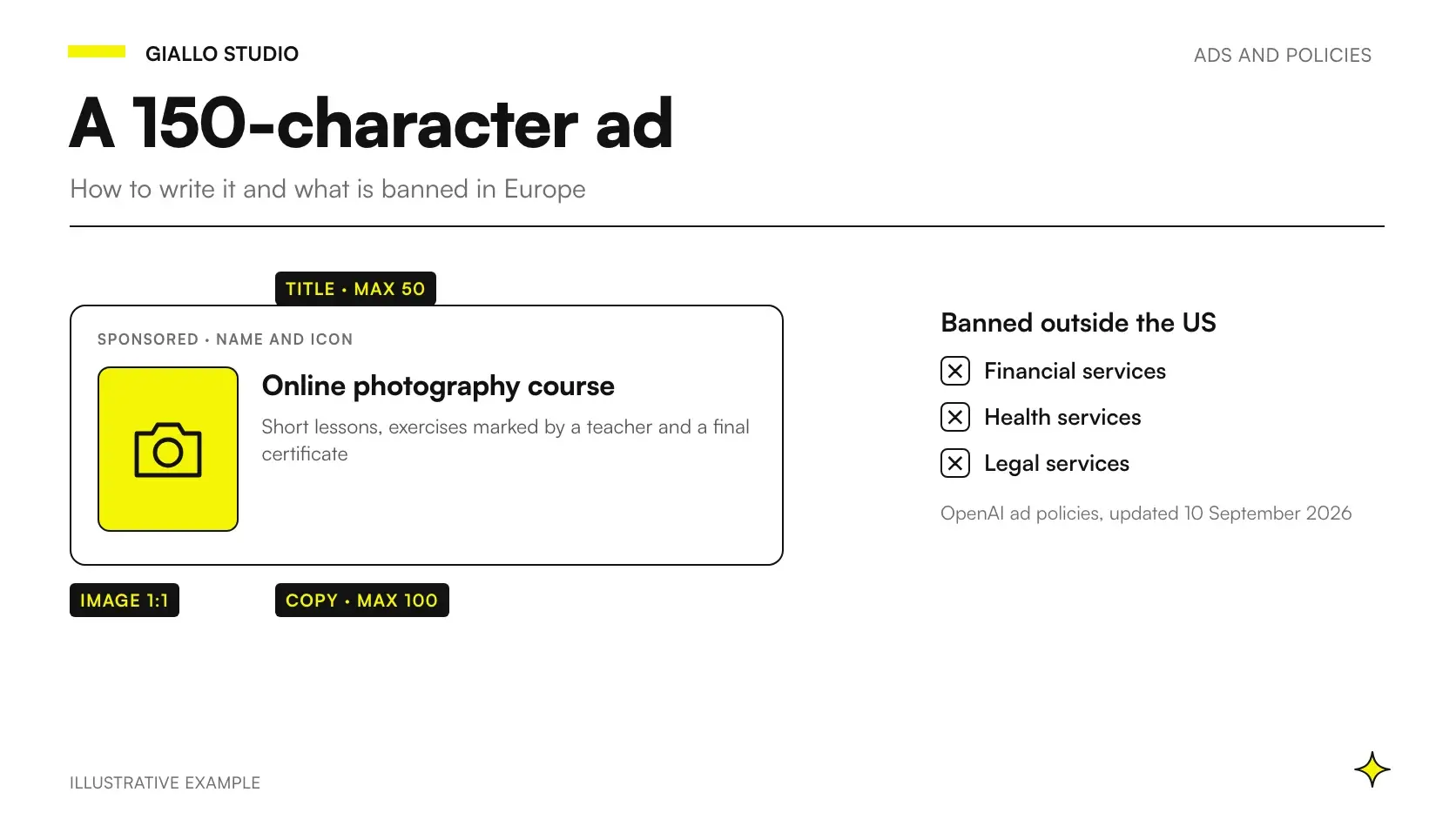 ChatGPT Ads creative: how to write your ads and what OpenAI's policies prohibit
AI by sector
The same reasoning, applied to the other areas we follow.
- AI for business knowledge bases: find the information you need
- AI for stock and inventory management
- AI for estate agencies: leads, viewings, listings and documents
- AI for shops: customer messages, stock by size, returns and loyalty cards
- AI for plumbers: quotes, on-site jobs and customers
- AI for notaries and notarial firms: case files, documents and clients
- AI for hotels: booking, guest requests and automated reviews
- AI for car workshops: quotes, appointments and customers
- AI for gardeners and grounds maintenance: quotes and customers
- AI for customer onboarding: automate the first moment that matters
- AI for ticket management: shorter waits, more resolutions
- AI for opticians: prescriptions, collections, contact lenses and recalls
FAQ
Does the transport document replace the invoice?
No, it has a different function: it accompanies the goods and proves that the delivery has taken place, while the invoice is the tax document of the transaction. The link is that a valid transport document allows to postpone the billing at the end of the month instead of issuing a document for each delivery, as explained in AI and electronic invoicing.
What does the transport document have to contain by law?
The date, the supplier’s and recipient’s details, any party responsible for transport, and a description of the nature, quality, and quantity of goods supplied. There is no mandatory template: it can be issued in any format, provided it contains these elements before transport starts.
Why should reservations be noted on the transport document at the time of delivery?
Because the carrier's liability for loss or damage is assessed from then on, and a document accepted unreservedly assumes that the packaging had no apparent defects. A written reservation immediately is worth much more than a telephone report made days later, when there is no longer a way to check the condition of the goods at the time of delivery.
Is generative AI useful for planning delivery routes?
Route planning is a problem better solved by dedicated optimisation algorithms than by a generative language model. AI comes in beforehand, to interpret constraints written in words in order notes, and afterwards, in communication with the customer.
Do we need to integrate the systems of every courier we work with?
Yes, and it is the part that weighs the most on the cost. Each courier exposes the data with a different level of detail. It is better to start with the two couriers that cover most volumes and evaluate the others at a later time.
Does it make sense for a company that ships little?
It depends on the after-sales requests you generate, not the number of shipments. If you often receive questions about the status of a delivery, the case is there even with limited volumes. If the requests are rare, the time saved does not justify the project.