
ChatGPT Ads: what it is and how advertising on ChatGPT works in Italy
ChatGPT Ads explained: who sees the ads, how they are chosen, what you can already buy in Italy since 31 August 2026 and what is still a US test.
Reading time: 14 min
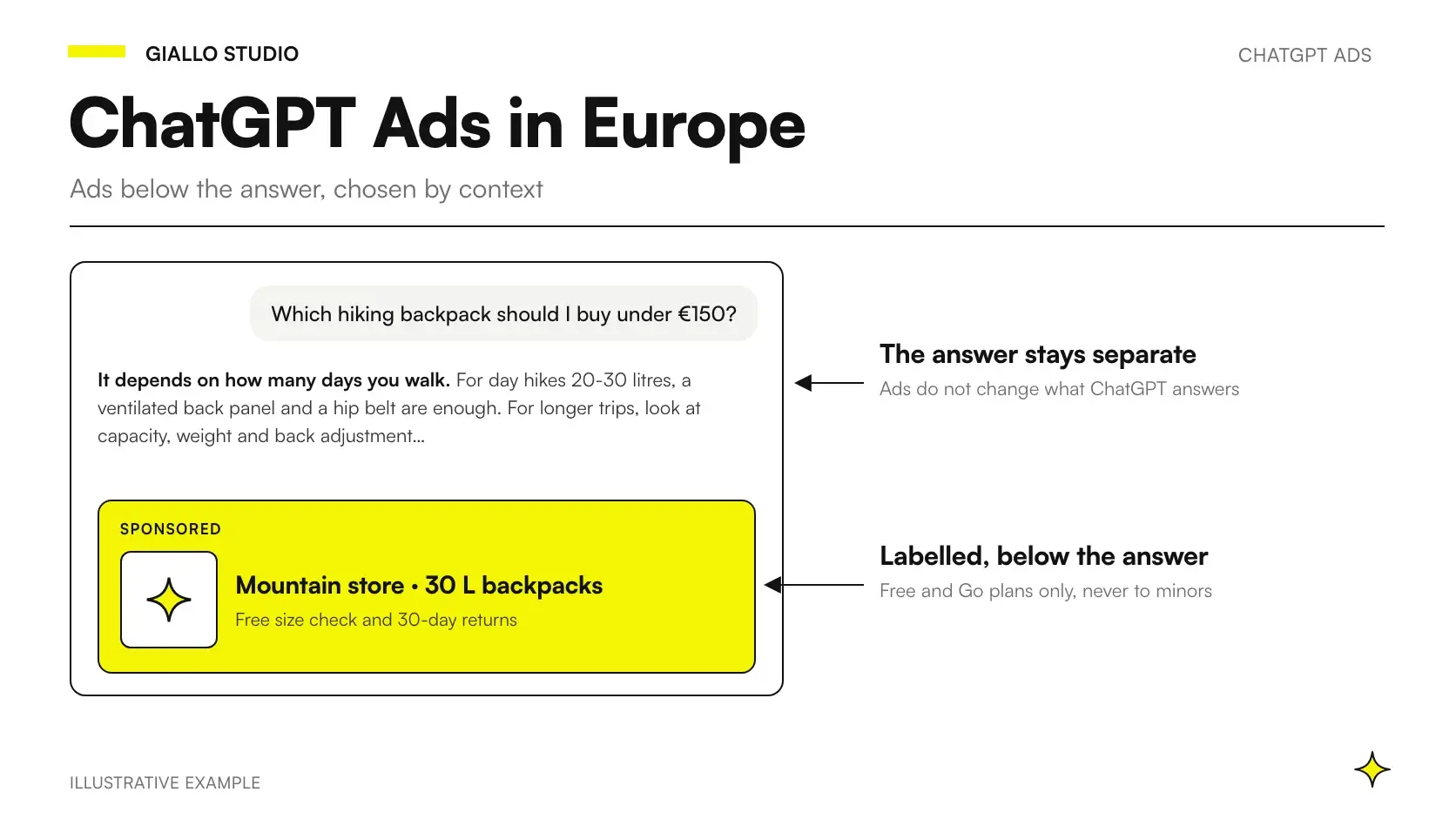
ChatGPT Ads is OpenAI's advertising platform that shows sponsored ads below ChatGPT answers. Ads appear only to users on the Free and Go plans, are labeled as sponsored, and are chosen based on the context of the conversation and an auction among advertisers. In Italy, advertising on ChatGPT has been live since late August 2026, and since 31 August a company with a registered office in Italy can buy it self-serve in Ads Manager.
Anyone who pays for Plus, Pro or a business plan sees no ads. Free-plan users can avoid them with Ads-Free, at the price of lower usage limits. For marketers the point is different: ChatGPT Ads reaches people while they compare options and decide, under rules that differ from Google and Meta, with sectors such as finance, healthcare and legal services still excluded outside the United States.
This guide collects the facts verified on OpenAI's official pages as of 19 October 2026 and points to six in-depth articles: first campaign, costs, comparison with Google, targeting, policy and SMEs.
In summary
- ChatGPT Ads shows labeled, separate ads below ChatGPT answers, only to users on the Free and Go plans.
- OpenAI started the test in the United States on 9 February 2026 and opened self-serve buying in 31 European markets, Italy included, on 31 August 2026.
- The ad is chosen based on the context of the conversation, the advertiser's context hints and a second-price auction weighted by relevance.
- In the European Economic Area (EEA), personalized ads using history and memory are not available initially.
- Outside the United States, OpenAI's policies generally prohibit ads for financial and healthcare services and, for now, those for legal services.
- Advertisers receive only aggregated data and never see users' conversations.
What is ChatGPT Ads, and why did OpenAI introduce advertising?
ChatGPT Ads is the system through which businesses buy ad space inside ChatGPT. The brand OpenAI uses to present it to advertisers is OpenAI Ads, and the entry point is ads.openai.com, which also has an Italian version. You can buy in two ways: self-serve through Ads Manager, OpenAI's beta platform, or through the Ads Solutions sales team, agencies and technology partners.
The stated reason is economic. In the announcement of 16 January 2026 OpenAI explains that advertising funds free and low-cost access, meaning the Free and Go plans, with fewer usage limits for those who do not pay. The same text sets out five principles: mission alignment, answer independence, conversation privacy, choice and control, long-term value.
The channel has grown fast. On 31 August 2026 OpenAI announced that ChatGPT Ads had reached an annualized revenue run rate of $1 billion in under 200 days from launch, with tens of thousands of advertisers (figure stated by OpenAI). In the same announcement OpenAI writes that small and medium-sized businesses now account for a significant share of the business.
When did advertising on ChatGPT start in Italy?
Advertising on ChatGPT reached Italy in two stages: first through OpenAI's sales team and partners, then self-serve. Here is the timeline, reconstructed from official communications.
- 16 January 2026. OpenAI announces that it will test ads on the Free and Go plans in the United States and publishes its principles on advertising.
- 9 February 2026. The test starts in the United States, for logged-in adult users on the Free and Go plans (OpenAI). Until April the pilot involves a small group of advertisers.
- 5 May 2026. Ads Manager launches in beta, opened to businesses gradually, and cost-per-click (CPC) bids arrive alongside impression-based ones (OpenAI).
- 11 August 2026. Ads go live in the United Kingdom, Mexico, Brazil, Japan and South Korea as well, after the pilots in Canada, Australia and New Zealand announced in March.
- 18 August 2026. OpenAI announces arrival the following week in 31 European markets, Italy included, initially through the Ads Solutions team, agencies and technology partners (OpenAI).
- 31 August 2026. Self-serve buying through Ads Manager opens in the 31 European markets, India, the Middle East and North Africa. The same day, the European Commission designates ChatGPT as a very large online search engine under the Digital Services Act.
- 23 September 2026. With its arrival in Southeast Asia and Taiwan, ChatGPT Ads is available in more than 60 countries (OpenAI).
- 5 October 2026. OpenAI introduces a visual format during image generation, being tested in the United States from late October, and new measurement tools.
A note on the Italian date. OpenAI did not give a precise day: on 18 August it wrote only “next week”, meaning the following week. The date of 24 August 2026 comes from the Italian press, for example from TuttoAndroid and from Tecnoandroid. For an Italian business the date that matters is 31 August, when direct purchasing became possible without going through an agency.
Who sees ads on ChatGPT?
Ads on ChatGPT appear only to users on one of two plans: Free and Go. According to the “Ads in ChatGPT” Help Center page, checked on 19 October 2026, accounts on Plus, Pro, Business, Enterprise and Edu show no ads.
OpenAI also excludes accounts identified as belonging to people under 18. To recognize them it uses the declared age and an age-estimation system. Ads also do not appear in temporary chats and, during the test, in the ChatGPT Atlas browser. People who use ChatGPT without logging in see only ads suitable for all audiences.
For advertisers the consequence is concrete: the reachable audience is people who use ChatGPT for free or on the Go plan. People working under a company license, for example ChatGPT Business, do not see ads while using their work account.
As for size, OpenAI states that ChatGPT reaches 1.2 billion people a week worldwide (5 October 2026). The official sources checked, however, give neither the number of users on the plans with advertising nor a figure for Italy.
Where do ads appear on ChatGPT, and what do they look like?
Ads appear below the end of an answer, labeled as sponsored and visually separated from ChatGPT's text. One or more ad units can appear below an answer, with one or more products from the same advertiser or from different advertisers.
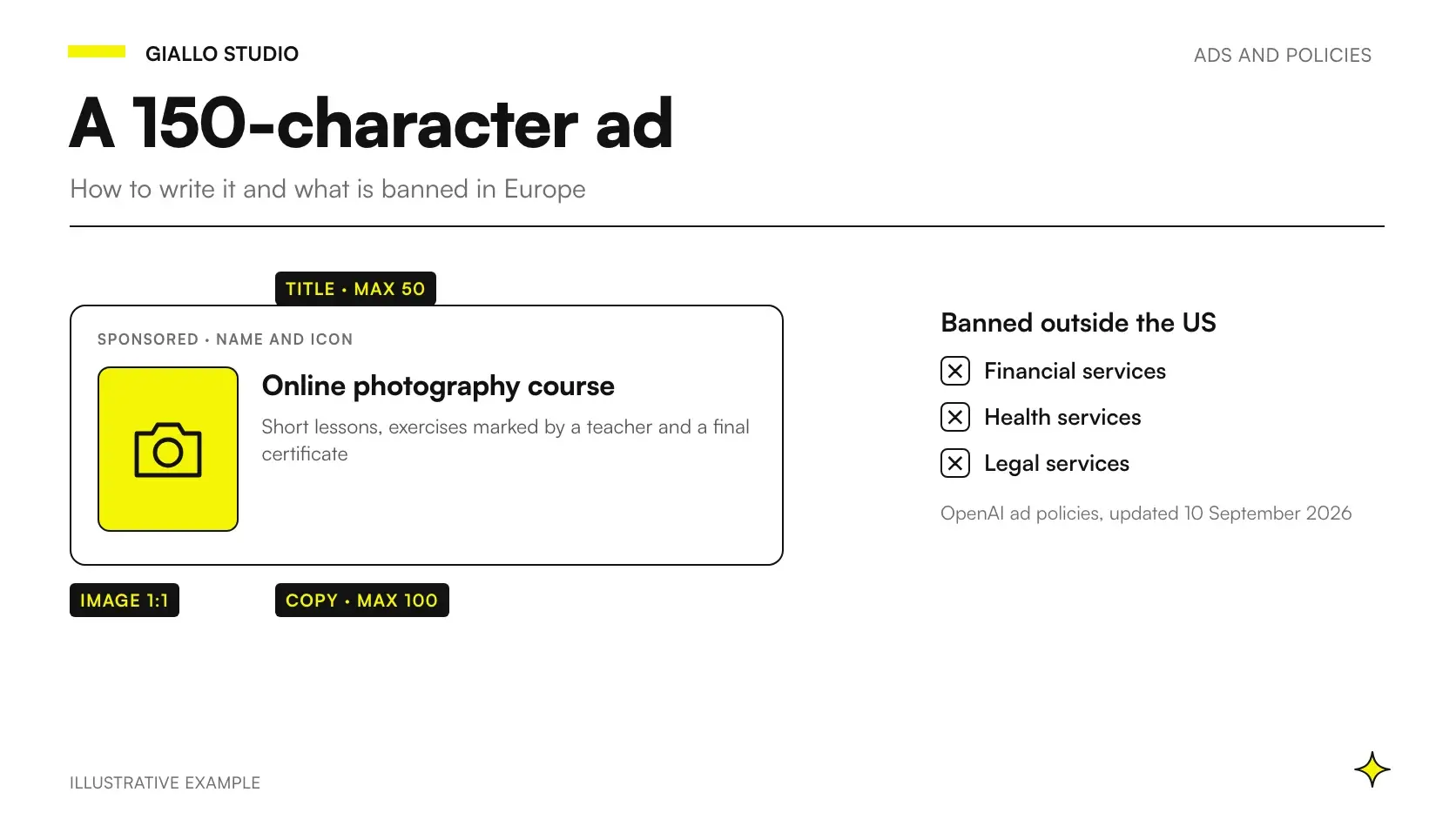
Every standard ad has six elements, listed in the basic guide for advertisers: advertiser name, favicon (that is, the logo), headline, text, destination page and image. Character limits, copy examples and reasons for rejection are the subject of the guide on how to write ChatGPT ads that comply with the policies.
Anyone who sells products has a second format: product feed ads, which show image, title, review stars, price, discounted price and brand. Feed items expire after two weeks, so it is worth updating the catalog automatically (feed guide). The same guide specifies that uploaded products are used only for ads and do not appear in ChatGPT's organic answers.
Two other formats exist but do not yet apply to Italy. The first is the visual ad during image generation, being tested in the United States from late October 2026. The second is Sponsored Agents, conversations with an AI agent that represents the business, in alpha for selected advertisers in the United States (Help Center).
How does ChatGPT Ads work, and how is an ad chosen?
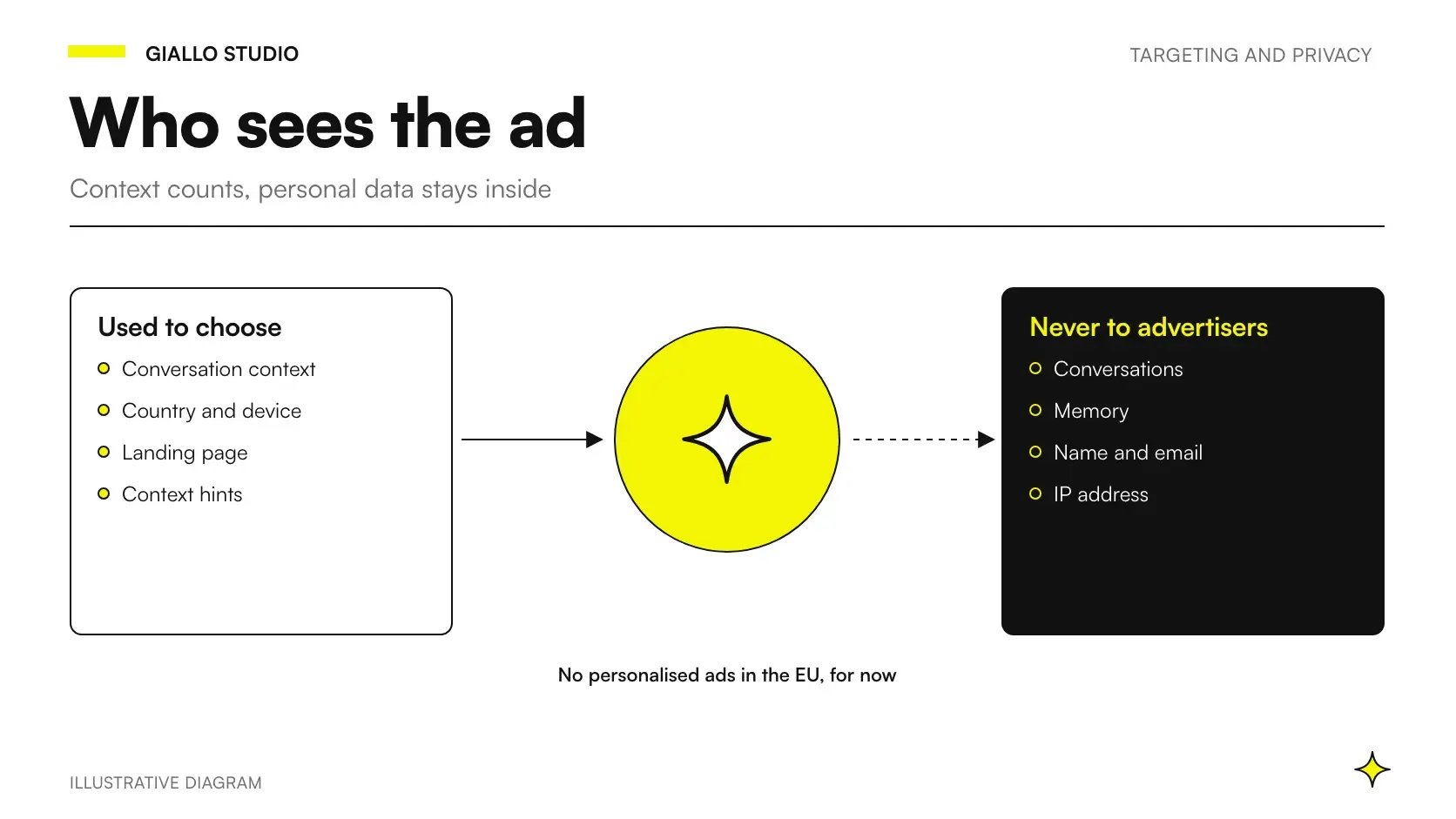
The system chooses the ad based on expected relevance and predicted results. The signals declared by OpenAI are the context and intent of the current conversation, the destination page, the ad's headline and text, the context hints and the advertiser's targeting choices. When personalization is on, signals from broader ChatGPT use are added, such as past chats and memory.
The context hints take the place of keywords. They are descriptions, written for each ad group, of the conversations, topics or terms in which a product is relevant. OpenAI specifies that they do not work as exact match and do not guarantee appearing in specific conversations. For example, a hiking gear store does not buy the keyword “waterproof hiking boots”: it describes conversations such as preparing for a mountain hike in autumn.
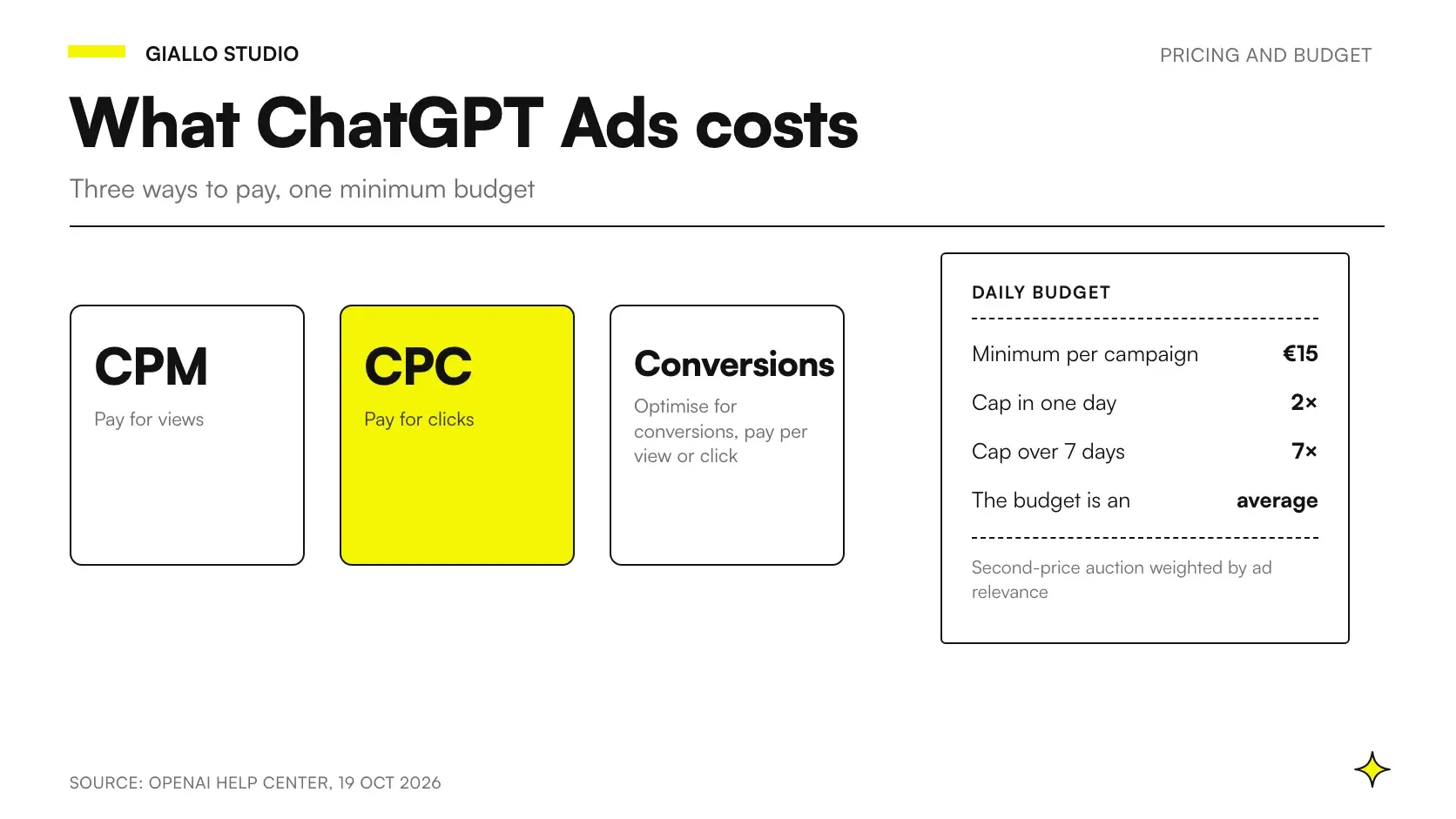
When several ads are eligible, the winner is decided by a second-price auction weighted by relevance (basics guide). The bid counts, but the system combines it with the ad's relevance. The advertiser sets a maximum bid per ad group and chooses the objective: views (CPM), clicks (CPC) or conversions, which are paid per impression or per click, never per conversion.
There is an important limit in Europe. According to the Help Center, personalized ads are not initially available in the European Economic Area (EEA) and Switzerland, so for an Italian user what matters most is the current conversation. The OpenAI EU privacy policy, updated on 24 August 2026, already describes consent-based personalization and generic ads based on chat context, location and time of day. What this means for data, GDPR and cookie banners is explained in the guide to ChatGPT Ads targeting and privacy in Europe.
What applies in Italy today, and what is still a US test?
The status shown is that of the official pages checked on 19 October 2026.
| Function | Status in Italy | Source |
|---|---|---|
| Ads below answers, for Free and Go users | Available | Help Center |
| Self-serve buying in Ads Manager | Available from 31 August 2026 | Ads Manager availability |
| Buying through the Ads Solutions team, agencies and partners | Available | Ads Manager availability |
| Bids per view, per click and optimized for conversions | Available | Basics guide |
| Product feed ads | Available in Ads Manager, with no stated geographic limits | Feed guide |
| ChatGPT Ads app for Shopify | Available from 23 September 2026 in the markets where ChatGPT Ads is live | OpenAI, 16 September 2026 |
| Personalized ads using past chats and memory | Not available initially in the EEA and Switzerland | Help Center |
| Ads for financial and healthcare services | Generally prohibited outside the US | Advertising policies |
| Ads for legal services | Currently prohibited outside the US | Advertising policies |
| Visual ads in image generation | US only, testing from late October 2026 | OpenAI, 5 October 2026 |
| Sponsored Agents | US only, alpha for selected advertisers | Help Center |
The platform is in beta and changes often: before planning a campaign, recheck the official page for the feature you are interested in.
Do ads change ChatGPT's answers?
No, according to OpenAI. The Help Center states that ads run on systems separate from the chat model and that advertisers cannot shape, rank or alter answers. An ad is a paid placement: seeing one does not mean OpenAI recommends that company. For more on how ChatGPT builds its answers, see the guide on How ChatGPT Works.
This is a stated commitment, not an external check. As of 19 October 2026, no independent audits of the separation between ads and answers appear to have been published. The pilot projects with DoubleVerify and Integral Ad Science announced on 5 October concern brand suitability, meaning the contexts in which ads appear, not the independence of answers.
The advertising policies, updated on 10 September 2026, add two concrete safeguards. Ads do not appear near sensitive conversations, such as personal health, mental health and politics. And ads that imitate the look, functions or voice of ChatGPT so as to seem part of the product are prohibited.
On the regulatory front, on 31 August 2026 the European Commission designated ChatGPT as a very large online search engine. The service has declared at least 45 million average monthly users in the Union and has until January 2027 to comply with the additional obligations of the Digital Services Act.
How do you advertise on ChatGPT as an Italian business?
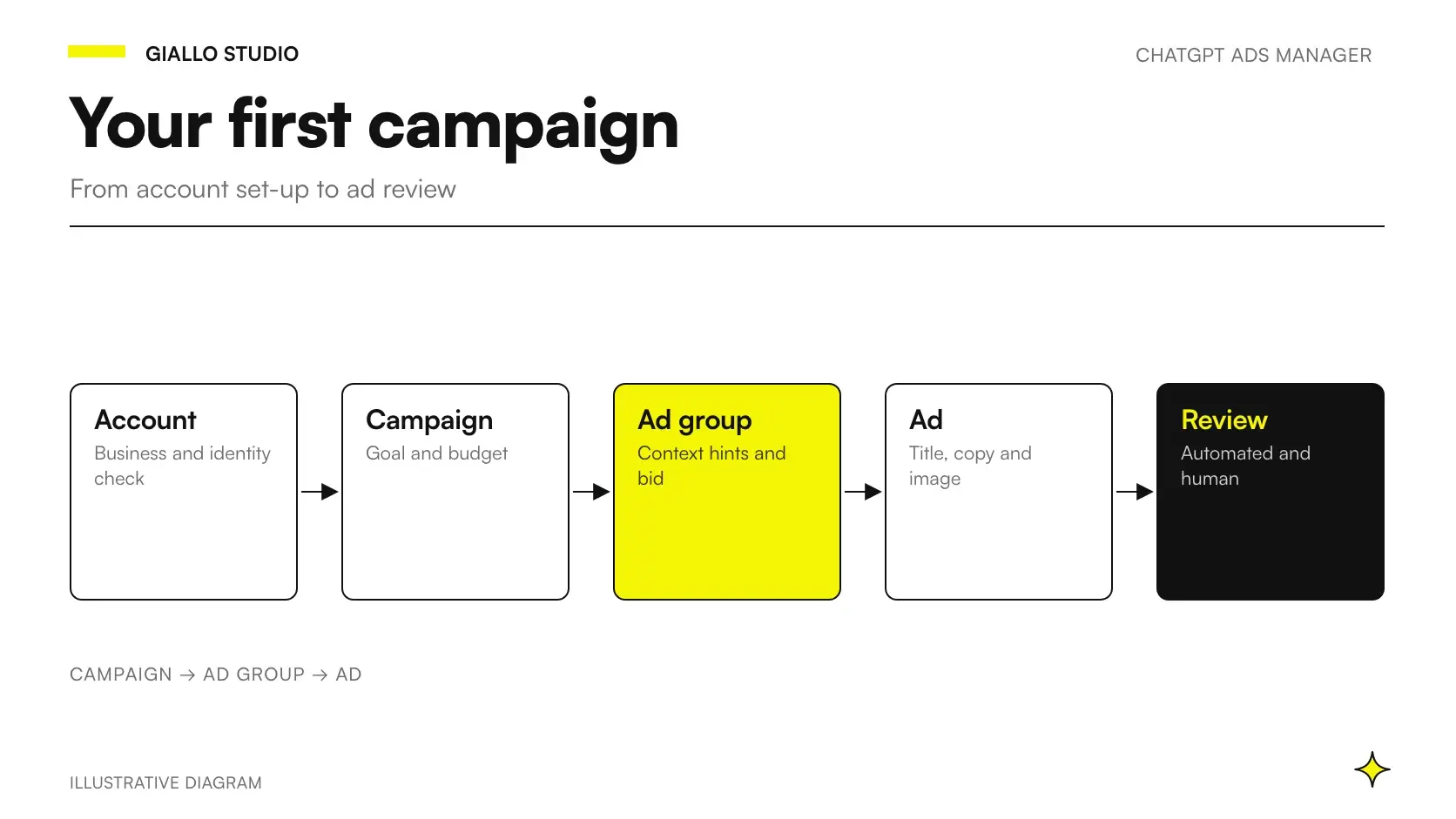
Self-serve buying requires three conditions. The legal entity that advertises and receives the invoice must be based in an available country, and Italy is one. The account goes through verification via Persona and a queued review, which OpenAI says it cannot speed up. The account name and logo are mandatory, because they appear in the ad: without them, ads do not run.
The structure has three levels: campaign (objective, budget, countries), ad group (context hints and maximum bid) and ad. The destination page must be readable by OpenAI's crawler, because an ad whose landing page cannot be evaluated by the review systems is not eligible. All the steps, from registration to the pre-launch checklist, are in the guide to ChatGPT Ads Manager and your first campaign.
The minimum daily budget per campaign is €15 in Europe and is an average over seven days: on a single day spending can reach double (campaign guide). Standard payment is postpaid, by credit card. For EEA companies the contract is with OpenAI Ireland Ltd and is governed by Irish law (Advertising Terms).
The Italian OpenAI Ads page offers first-time ChatGPT Ads users €500 in ad credit in return for €500 spent (ads.openai.com). According to the credit terms, unless the offer states otherwise, the credit expires 90 days after issue. OpenAI does not publish average CPCs or CPMs in euros: what is known and how to set a test budget is covered in the guide on how much advertising on ChatGPT costs.
To measure results there are static UTM parameters, OpenAI's Pixel and a Conversions API. How to connect these events to leads, CRM and sales opportunities is the topic of the article on new formats and lead measurement in ChatGPT Ads.
Which industries can advertise on ChatGPT in Italy?
In the initial phase, the policies focus ads on consumer and home goods, local services, travel and experiences, digital products and education. Outside the United States, the policies define ads for financial and healthcare services as generally prohibited, and ads for legal services as currently prohibited. Today alcohol, tobacco, gambling, politics and adult content, among others, are excluded in all markets.
The consequence for Italy is clear-cut. Today an e-commerce store, a tour operator, an online school or a local service can give it a try. A law firm, a financial advisor or a medical clinic, in practice, cannot. Which SMEs genuinely make sense on this channel, and how to set up a test, is the topic of the guide to ChatGPT Ads for small business.
Example: an outdoor furniture e-commerce store
A company from Veneto sells garden tables and chairs online. It falls under the home and lifestyle category, so it can advertise. Before buying, its customers ask ChatGPT how to choose a table that withstands rain or what dimensions are needed for six people: this is the comparison moment when ads appear. The company can open the account with its S.r.l., upload the catalog as a product feed and write context hints about terrace and garden furniture, after checking the landing page and order tracking.
Example: a financial advisory firm in Milan
The firm would like to be found by people who ask ChatGPT how to set up a supplementary pension. Today it cannot buy ads: outside the United States financial services are generally prohibited, and building a plan on an exception is not worthwhile. The workable route is organic: clear, up-to-date and verifiable content that helps generative engines cite it, that is, GEO applied to ChatGPT. If OpenAI opens the category in Europe, the firm can reassess.
ChatGPT Ads vs Google Ads: what changes for marketers?
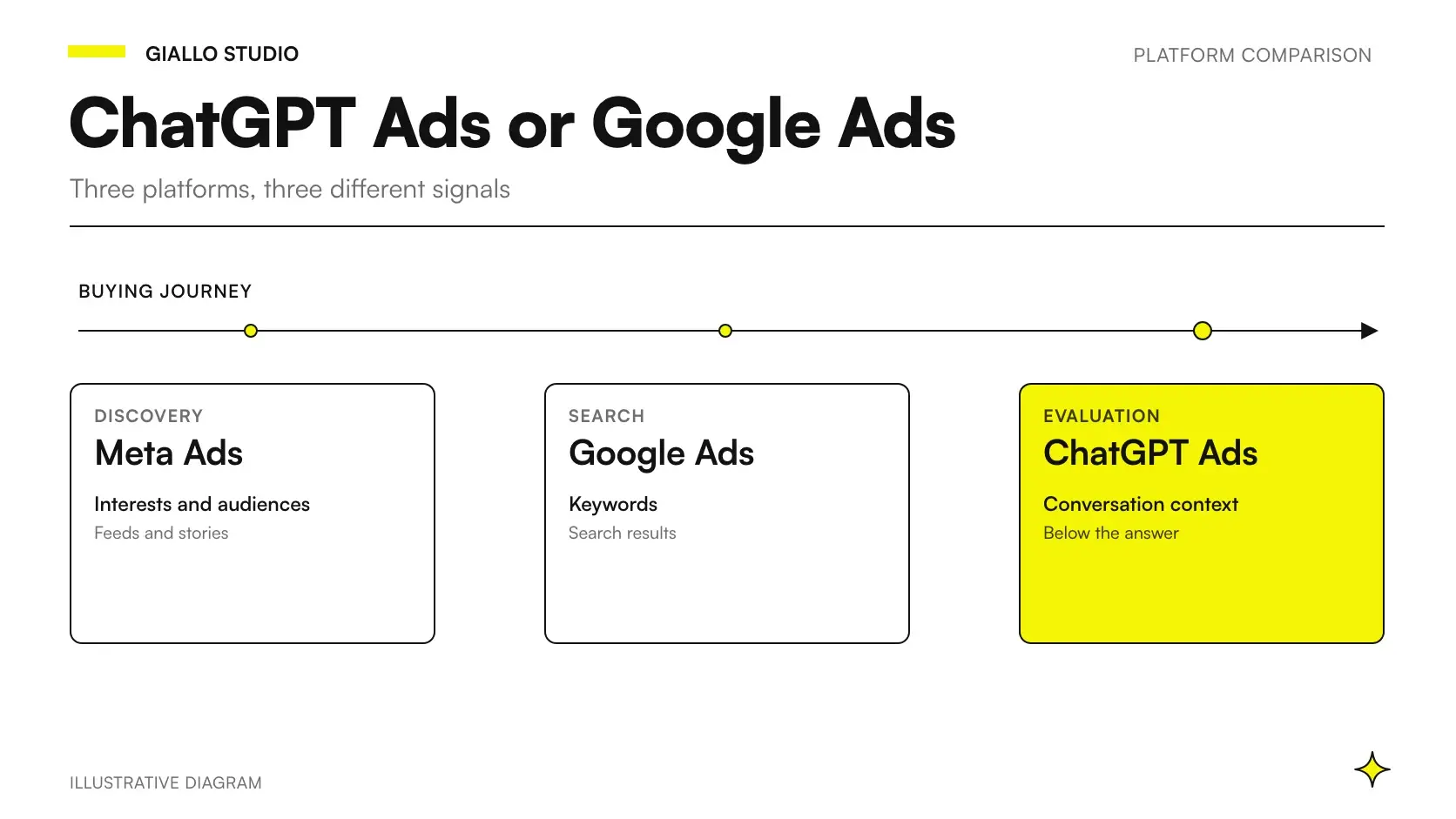
The main difference is the moment. On Google people type a few words and choose among results; on Meta they scroll a feed. On ChatGPT they explain what they want to achieve, what matters to them and what constraints they have.
Three practical changes follow for anyone running campaigns. Targeting is written in natural language, with context hints, instead of keyword lists. The destination page weighs on the choice of ad, because it is one of the declared signals. And there is no history or reference point: OpenAI itself writes that it does not yet have performance benchmarks for advertisers, industries or campaign types (Official FAQs).
ChatGPT Ads does not replace Google Ads or Meta Ads: it is a beta channel alongside platforms with years of data. The full comparison, with a matrix by type of business, is in the guide ChatGPT Ads vs Google Ads.
What are the most common misconceptions about ChatGPT Ads?
- Thinking you are buying keywords. Context hints guide the matching, but treating them as a keyword list produces poorly relevant ad groups.
- Believing that paying gets you into the answer. The ad stays below, separate and labeled, and feed products do not enter organic answers.
- Confusing a US test with an Italian feature. Promising visual ads or Sponsored Agents to an Italian client means promising something that cannot be bought today.
- Using prices read online as a benchmark. The figures reported by the press, for example by Digiday, concern the managed pilot in the United States, with minimum commitments from tens to hundreds of thousands of dollars, not Italian self-serve.
- Expecting personalized targeting in Europe. In the EEA personalization is not initially available: the real work is on relevance to the conversation.
What has OpenAI not yet published about ChatGPT Ads?
As of 19 October 2026, this information is missing or has not been published:
- Reference prices in euros. No official average CPC or CPM for Italy.
- Industry benchmarks. OpenAI says it does not have any yet.
- The official launch date in Italy. OpenAI wrote “next week”; 24 August is the date reported by the press.
- Whether a sole proprietorship counts as a legal entity. The guide speaks of a “legal entity” without detailing which legal forms are admitted.
- When personalization will arrive in the EEA. The Help Center lists it as not available at the start, with no dates.
- A public ad repository. Article 39 of the DSA requires one for designated services, with obligations applying to ChatGPT from January 2027; an OpenAI repository does not yet appear to be online.
- Independent results. The published cases, such as Newegg or WeightWatchers, are self-reported by OpenAI or its measurement partners.
How do you use ChatGPT without ads?
It is a common question: among the suggested searches in Italian on Google and Bing, recorded on 19 October 2026, both “chatgpt con pubblicità” (ChatGPT with ads) and “chatgpt senza pubblicità” (ChatGPT without ads) appear. The answer depends on the plan.
Free plan: ads, with an Ads-Free option
Free plan users see ads, but can turn on Ads-Free mode from the ad controls in settings. It removes ads in exchange for fewer messages and no tools such as image generation and deep research. You can switch back whenever you like.
Go plan: ads, without Ads-Free
The Go plan shows ads and does not offer Ads-Free mode. To remove them you have to go back to the Free plan and turn on Ads-Free, or move to a plan that has no advertising, such as Plus or Pro.
Plus, Pro, Business, Enterprise and Edu: no ads
These plans show no ads. The differences between the free and paid versions are covered in the guide ChatGPT Free vs Plus.
One detail avoids confusion: turning off personalization does not remove ads. It only changes the signals used to choose them, which remain based on the current chat.
Where should you start if you are evaluating ChatGPT Ads?
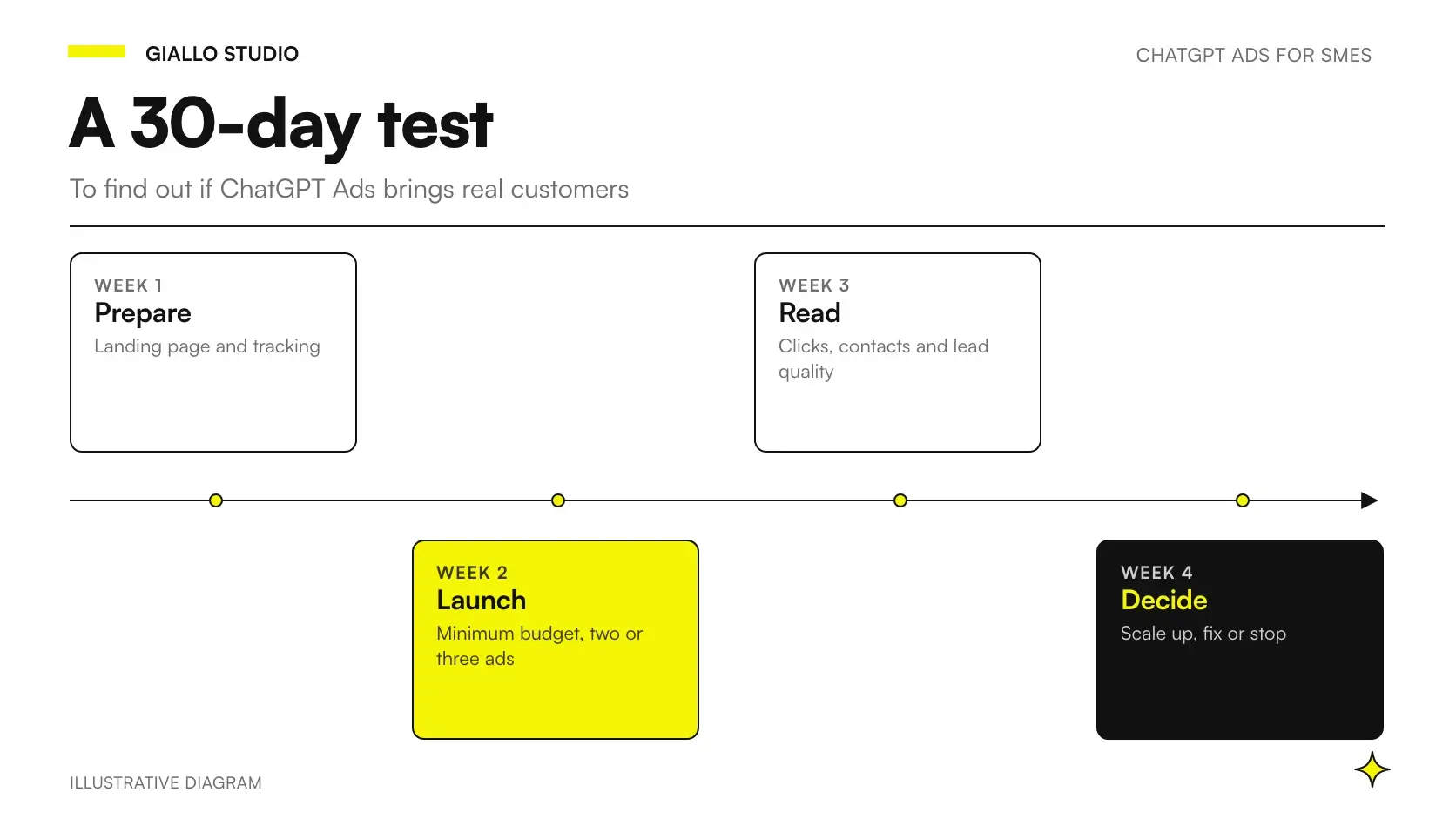
ChatGPT Ads is a real channel in Italy, available to buy since late August 2026, but still young: no benchmarks, many features only in the United States, regulated sectors excluded. For an SME the sensible choice is a small, well-measured test, prepared with four checks.
- Eligible category. Check that your product or service falls within the categories allowed outside the United States.
- Account in the name of the right entity. Country, currency, time zone and company name must be chosen carefully at setup: some fields may not be editable on your own afterwards.
- Landing page and tracking ready. A page readable by the crawler, static UTMs and conversions recorded before the first euro is spent.
- A spending cap set in advance. Budget and test duration fixed beforehand, with a clear criterion for continuing or stopping.
If you want to find out whether ChatGPT Ads makes sense for your business before opening the account, work with AI consulting by Giallo Studio to start from these four checks and a measurable test plan.
Giallo Studio guides: methodology and sources
How we apply it in the company
Related resources
 ChatGPT Ads Manager: how to create your first campaign, step by step
 ChatGPT Ads cost: CPC, CPM, minimum budget and welcome credit
 ChatGPT Ads vs Google Ads (and Meta Ads): differences and when to use each
 ChatGPT Ads targeting: context, audiences and privacy in Europe
 ChatGPT Ads creative: how to write your ads and what OpenAI's policies prohibit
 ChatGPT Ads for small business: is it worth it? Best-fit sectors and a 30-day test
 ChatGPT Ads: new formats, lead measurement and availability in Italy
 Free ChatGPT vs ChatGPT Plus
FAQ
Is ChatGPT Ads available in Italy?
Yes. Ads reached Italy in late August 2026, and since 31 August companies with a registered office in Italy can buy them self-serve in Ads Manager. The official availability page, checked on 19 October 2026, lists Italy as available.
Who sees ads on ChatGPT?
Only users on the Free and Go plans. Plus, Pro, Business, Enterprise and Edu have no ads, and OpenAI does not show ads to accounts identified as belonging to minors. Temporary chats are ad-free too.
How do you use ChatGPT without ads?
With a Plus or Pro subscription, or with the Ads-Free mode on the Free plan. Ads-Free removes the ads but lowers message limits and removes tools such as image generation and deep research. Turning off personalization, by contrast, does not remove ads.
Do ads influence ChatGPT's answers?
No, according to OpenAI. Ads run on systems separate from the chat model, and advertisers cannot modify, rank or alter answers. However, as of 19 October 2026 there is no sign of an independent audit that verifies this.
Can advertisers see my ChatGPT conversations?
No. Advertisers receive only aggregated data, such as views and clicks. They never receive chats, history, memories, name, email, precise location or IP address.
How much does it cost to advertise on ChatGPT?
There is no price list: the price comes from an auction, per view (CPM) or per click (CPC). In Europe the minimum daily budget is €15 per campaign. OpenAI does not publish average costs per click in euros.
Do you buy keywords on ChatGPT Ads?
No. Instead of keywords, the advertiser writes context hints, meaning descriptions of the topics and conversations in which their offer is relevant. They do not work as exact match and do not guarantee that the ad will appear in a specific conversation.