
Automatic quotes from a free text message
Turn an unstructured message into a quote: extract dates and locations, calculate using a distance table and generate a PDF ready to send.
Reading time: 9 min
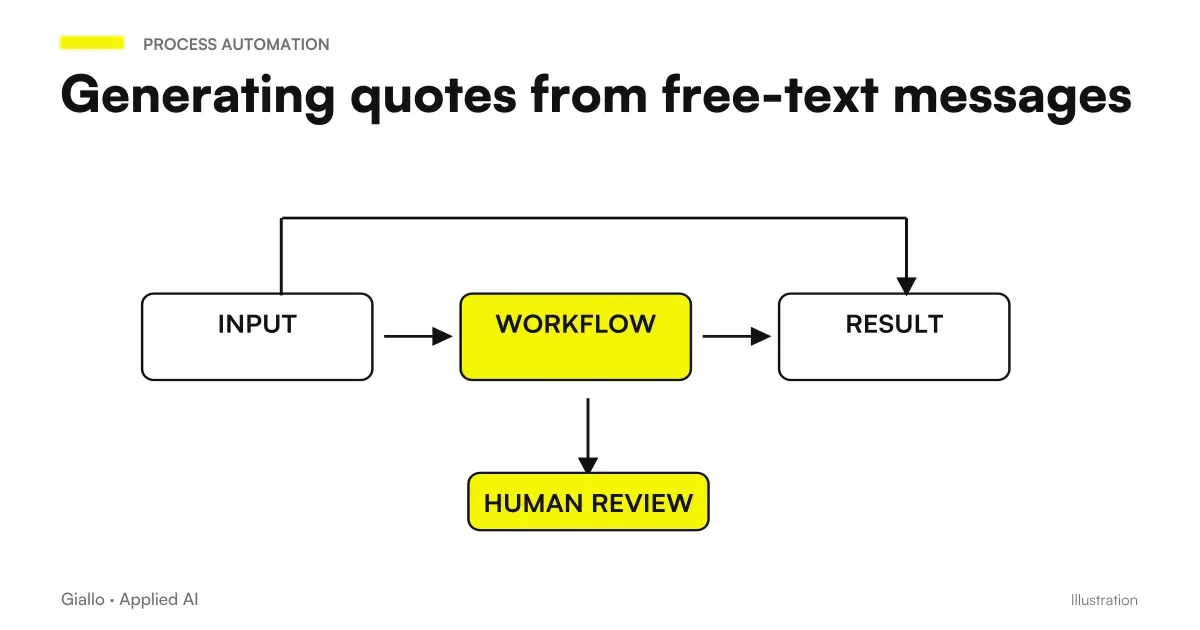
Generate automatic quotes from a free text message It means taking a written request in a hurry —often in English, with dates in an unpredictable format —and turning it into a structured document with a price.
It is an interesting case because the difficult part is not where it seems. The calculation is arithmetic: fare, transport, driver, tolls. The fragile part is understand what the customer asked, when he wrote it in a three-line message without structure.
This article describes the flow built in CRM for car rental of Rial Rent, where requests come from different channels and in different languages.
In summary
- The fragile part is not the calculation, it is the extraction: the dates appear in about ten different formats.
- You need date, places, vehicle, kilometers and whether or not a driver is present: these are the price variables.
- The calculation uses a distance table to recurring destinations, not a generic estimate.
- If the location is not in the table, the system will declare instead of inventing a value.
- The quote comes out in PDF with real photos of the vehicle, but it send one person.
What should be extracted from a message
A typical message contains, in sparse order, five pieces of information. The parser searches for all of them and reports which ones are missing.
| Information | Difficulty | Because it's critical |
|---|---|---|
| Start and end dates | High | They appear in many formats; they determine duration and therefore price |
| Place of delivery | Medium | Determine the cost of transportation |
| Place of return | Medium | Often different from delivery, and almost always forgotten in manual calculations |
| Vehicle required | Low | It should also be recognized when written in an approximate manner |
| Driver yes or no | Low | Change a whole quote entry |
Dates are the sore spot. In the same flow of requests European and American formats coexist, months written in words in two languages, two-digit years, intervals expressed with hyphens or with prepositions. A serious parser recognizes about ten and, when the interpretation is ambiguous —the classic day/month versus month/day — asks for confirmation instead of choosing.
The calculation, and the distance table
Extracted the variables, the estimate consists of known entries:
- Rental Rate, depending on the vehicle and duration.
- Transport of the vehicle, if delivery or return take place outside the base.
- Driver, when required.
- Tolls, estimated on the route.
Distances come from one table of recurring destinations built from the base of Milan: airports, main Italian cities, Switzerland, Austria, C Costate d'Azur. It is not a real-time geographic calculation, and it is a deliberate choice: the real destinations of a high-end rental are a few dozen and repeat, while a map service introduces an external dependency, a cost per call and results that change over time.
The interesting case is that out of table. The system does not estimate: it declares that that destination is not mapped and asks to enter the distance. It is the same principle applied to extracting data from documents in read the fines in PDF — an automation that admits that it does not know is worth more than one that guesses.
The PDF: a commercial document, not a receipt
The quote comes out in PDF with the Real photos of the vehicle that the customer will receive, not catalog images.
Looks like an aesthetic detail. In a high-end rental it is substance: those who rent a sports car are also buying an experience, and seeing the exact car — color, setup, conditions — reduces subsequent questions and misaligned expectations. The quote becomes the first piece of the service instead of a module.
Why Sending Remains Manual
The system prepares the draft. One person reads it and sends it.
It is not excessive prudence: a price is a commercial decision. The same request may merit a different rate depending on the customer, the period, the availability in the fleet, an ongoing negotiation. None of these variables are in the message.
What Automation Does Well
- Extract variables from the message without re-reading it three times.
- Apply cost items without forgetting one.
- Compose the document in the company format.
- Make the draft available even after hours.
What Remains to the Person
- Decide on the final price and any margins of negotiation.
- Check the real availability of the vehicle.
- Evaluate the customer and the history of the relationship.
- Write the accompanying message.
The general theme is dealt with in AI quote automation.
The dates: why they are the fragile point
It is worth dwelling on, because it is the piece that breaks most often and the one that you underestimate most during the project phase.
A rental request contains at least two dates, and people write it as it comes. In the same stream they live together:
- European format and American format, with the same appearance and opposite meaning when the day is less than thirteen.
- Months written in words, in Italian and English, abbreviated in different ways.
- Two-digit years, which become ambiguous at the turn of a decade.
- Ranges expressed with a hyphen, with a preposition, or on two separate lines.
- Relative dates — "next weekend", "the first weekend of October" — that require a time context.
The rule that avoids the worst damage is one: when the format is ambiguous, don't choose. The classic case is a date when both day and month could stand in both positions. A parser who decides independently produces a quote for a period other than that required, and the document seems perfectly correct: no control intercepts it, because there is nothing malformed.
In the project, ambiguous dates are highlighted and ask for confirmation. It costs one click and prevents the error from reaching the customer.
How much is it worth to automate the draft
There is an important difference between "automating quotes" and "automating the preparation of quotes", and it concerns where the time goes.
The time to write a quote is not in the composition of the document: it is in rereading the message, understanding what the customer asked for, remembering to count the return, looking for distance, putting together the entries. When it comes time to write, the long part has already passed.
What really takes away automation
- Rereading the message to extract the data.
- The search for distance and the calculation of transport.
- The composition of the document in the company format.
- The risk of forgetting a recurring voice.
What doesn't take away
- Verification of vehicle availability.
- The decision on price and margins of negotiation.
- Evaluation of the customer and the request.
- The accompanying message, which is report.
It is the same principle applied throughout the project and described in case study: automation prepares, the person decides.
Practical examples
An overnight request in English. A message arrives at 23:40 with dates in American format and a destination on the French Riviera. The parser extracts the dates, flagging the format ambiguity, identifies the destination in the lookup table, and prepares the draft. The next morning, everything is already ready for review, instead of having to start again from the message.
An unmapped destination. The customer requests delivery to a mountain location not on the table. The system compiles everything else and reports the missing entry: whoever prepares the estimate inserts the distance and the calculation closes.
An incomplete request. The message does not say if a driver is needed. The parser leaves the voice blank and highlights it: it is a question to be asked to the customer, not a value to be assumed.
Another activity with the same pattern. Any quote consisting of known entries on extractable variables lends itself: transport, technical services, catering. The entries change, not the structure. The connection with the rest of the process is in CRM Automation.
Mistakes to Avoid
Taking on a date format. It is the error that produces quotes for the wrong period and is not intercepted by any control.
Estimating unknown distances. A plausible number is worse than an empty field, because no one verifies it.
Forgetting the drop-off. Delivery and return to different places are the norm, not the exception, and calculating the transport only outward underestimates the cost.
Sending automatically. It takes control right where it serves the most, and the first wrong quote sent alone burns the trust in the tool.
Filling in the missing fields with default values. An invisible default is a pending error: better an empty and obvious field.
How to apply it in the company
- Collect twenty true requests and look at how they're actually written. It's the parser specification, much more than any hypothesis.
- List quote entries and for each the data that determines it. If a data is not removable, that entry will remain manual.
- Build the Recurring Case Table — destinations, services, vehicles — instead of looking for a general solution.
- Define what happens when a data is missing: empty and highlighted field, never an invented value.
- Hold the sending in the hand of a person until the flow is consolidated.
The next step in the process — transforming the accepted quote into a contract — is described in contracts and digital signature in app.
Conclusion
The automatic quotations from free text They work when you accept that the value lies in the extraction, not in the calculation. A system that reads a messy request well and leaves the price to a person saves real time; one that calculates automatically on misinterpreted data produces wrong documents with great efficiency.
The two rules: never assume an ambiguous date format, and never estimate what you don't know.
Do you want to understand what processes in your company can be automated with AI? Giallo Studio can help you turn the problem into a real workflow. The service is described in custom software.
Giallo Studio guides: methodology and sources
How we apply it in the company
Related resources
FAQ
Can you generate a quote from a message written in free text?
Yes, if the estimate is calculated from identifiable variables: dates, places, duration, ancillary services. A parser extracts those values from the message and the calculation takes place on known rules. The fragile part is not the calculation, it is the extraction: people write the dates in dozens of different formats.
Do you need a language model to interpret messages?
Not necessarily. For messages containing dates, locations and a vehicle, regular expressions and a dictionary of locations cover most cases with predictable behaviour. A model helps when the request is expressed in a truly conversational way.
What happens if the requested location is not known?
The system must state that it does not know, rather than estimate. A quote calculated using an invented distance looks correct, and the error is discovered only after the client has accepted: it is the costliest error in the entire workflow.
Is the quote sent automatically?
No, and it should not be. The system prepares a PDF draft, and a person rereads and sends it. A price is a commercial decision: automation eliminates form-filling, rather than judgement.
Which entries make up the calculation?
In the project described: the rental rate, vehicle transport, a driver where applicable and tolls, with distances taken from a table of recurring destinations. The items vary between companies, but the reasoning structure does not.
Why put photos of the vehicle in the quote?
Because for a high-end rental, the quote is also a commercial document. Actual photos of the vehicle the client will receive, rather than catalogue images, reduce follow-up questions and incorrect expectations.