
AI Chatbots: What They Are and How They Work
What AI chatbots are and how they work: rule-based versus LLM-based chatbots, when they are enough and when you need an AI agent. SME examples.
Reading time: 10 min
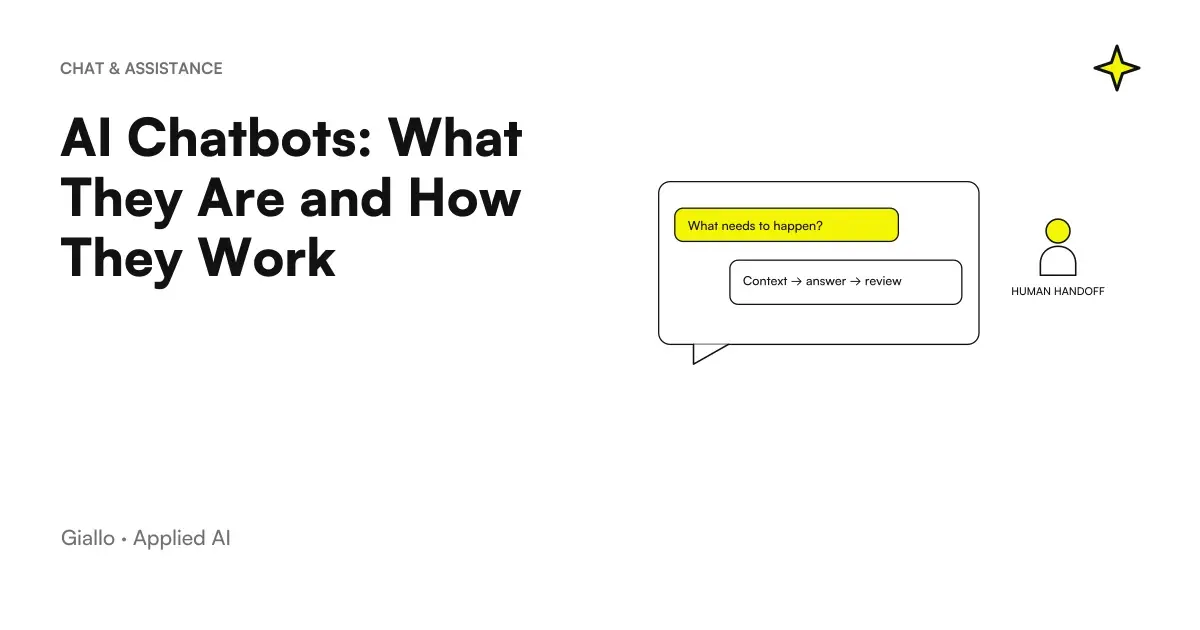
A AI Chatbots is software that converses with people in natural language — usually via a chat window on the site, on WhatsApp or in social media messages. to answer questions, give information and guide the user towards an action. It basically receives a message written in your own words, interprets it and returns a response, all without having to intervene one person for each request.
The important thing to understand immediately is that not all chatbots are the same. There are two large families: those to rules (follow predefined paths and buttons) and those based on LLM, i.e. on Language Models like the ones behind ChatGPT, who understand natural language and generate new answers. Understanding the difference is what keeps you from choosing the wrong tool and being disappointed.
In this guide we see what an AI chatbot really is, how it works, the difference between rules-based and LLM-based chatbots, when a chatbot is enough and when a AI Agent, with concrete examples of customer care for SMEs and e-commerce.
In summary
- A AI Chatbots is software that converses in natural language to answer questions and guide the user, especially in customer support.
- The rules chatbot they follow predefined paths: predictable but rigid, they lock on the unexpected questions.
- The LLM-based chatbots They understand natural language and formulate new answers: more flexible, but they need to be anchored to business data in order not to invent.
- A chatbot speak, informs and responds; a AI Agent It also performs actions on other systems (management software, CRM, bookings).
- For an SME the value comes when the chatbot handles repetitive questions and switch to operator complex cases, with the context already ready.
What is an AI chatbot
A chatbot is, literally, a program that chats. The term has existed for decades: the first chatbots were simple scripts that recognized keywords and responded with pre-packaged phrases. The initials AI signals that today many chatbots use artificial intelligence technologies to understand what the user writes instead of just looking for an exact word.
The most common point of contact is the chat window lower right on a site, but an AI chatbot can live anywhere there is a text conversation: WhatsApp Business, Messenger, Instagram, Telegram, an internal widget, even an email to which it responds automatically. The channel changes; the logic remains the same: Input message, understanding, response.
The thing to keep in mind is that a basic chatbot, converse and inform. It is not designed to perform complex actions on other software: that is the territory of AI agents, which we see later. Confusing the two is the most frequent mistake of those who buy "a chatbot" expecting it to also do operations that would require a different system.
How an AI chatbot works, step by step
Beyond technical differences, almost all modern chatbots follow the same stream when a message arrives.
- Reception. The user writes a question in the channel (website, WhatsApp, social). The message comes to the chatbot as text.
- Understanding. The system interprets intent: what does the user want? A rule chatbot searches for keywords or a chosen button; one based on LLM understands the meaning even if the sentence is phrased unexpectedly.
- Retrieving context. The chatbot looks for the right information: in a default script, in a knowledge base or in business documents (timetables, FAQs, return policies).
- Generation of response. The chatbot formulates the answer. A rules, it is a pre-packaged sentence; with LLM, it is a new answer built on the moment starting from the context found.
- Escalation if needed. If the question is outside its perimeter or delicate, a well-configured chatbot passes the conversation to a human operator, with the historian ready.
The most delicate passage is the second, the understanding: that's where you play the difference between a chatbot that frustrates the user ("I didn't understand, try again") and one that understands the first shot. And it is precisely on that passage that the LLMs have changed the rules of the game.
The Role of LLMs: From Keyword to Meaning
Before language models, making a chatbot understand all variants of the same question was a nightmare: "where is my order", "when the package arrives", "tracking shipment" had to be mapped one by one. With a LLM the chatbot understands that it is always the same intention, even with a typo or a phrase never seen before.
The downside is that an LLM generates the answer more likely, not the certainly true one: if you don't give him the right information, he can invent it. That's why serious LLM chatbots come anchored to company documents with a technique called RAG: the model responds only from the real sources of the company, not from what it "remembers" generically. Without this connection, an LLM chatbot is fast but unreliable on the details that matter.
Rule Chatbots, LLM Chatbots, and AI Agents: The Differences
This is the table you should keep in mind before choosing. They are three different things, with different costs, capabilities and risks.
| Criterion | Rule Chatbots | LLM-based chatbot | AI agent |
|---|---|---|---|
| As you understand | Keywords, buttons, trees of choice | Natural language, even new phrases | Natural language + reasoning about what to do |
| What it does | Reply from script | Responds by generating new text | Reply and perform actions on other systems |
| Flexibility | Low: Locks off course | High on Conversations | High on conversations and operations |
| Main risk | Frustrates the user with "I didn't understand" | Can invent if not anchored to data | Can perform wrong actions without checks |
| When to use it | Simple FAQs, fixed guided routes | Customer support on many questions | When you need to act: orders, tickets, reservations |
| Example | Menu "Timetables / Shipping / Returns" | Reply to "the wash sweater in the washing machine?" | It checks the order status in the business management software and opens a return |
The practical rule: to rules when the paths are few and fixed, LLM When the questions are so many and varied, Agent when in addition to answering you need to do something about another software. Most SMEs start from a well anchored LLM chatbot and add agent capabilities only where you really need it.
When a chatbot is enough and when an AI agent is needed
It is the question that saves wasted money. The distinction is simple: a chatbot speaks, an agent acts. A chatbot replies "your order usually comes in 2-3 days"; a AI Agent check that precise order in the management software and tells you where it really is.
Just a chatbot when
- The goal is to inform: timetables, FAQs, policies, product sheets.
- The answers lie in documents and do not require access to systems.
- You want to filter customer care and reduce repetitive tickets.
- Complex actions remain in the hands of a person.
You need an AI agent when
- The system must act: update an order, open a ticket, change a reservation.
- It must read or write on management software, CRM or calendar in real time.
- A request triggers multiple steps connected between different software.
- You want to automate a process, not just answer questions.
Many projects start as chatbots and grow towards the agent when user requests justify it. It is not an obligatory upgrade: often a well-done chatbot covers 80% of conversations, and for the remaining 20% it makes more sense to switch to an operator. If you want to understand where exactly each tool is located, the guide on differences between assistant, chatbot and agent It clarifies the boundaries.
Practical examples
Three realistic scenarios of Italian SMEs, to make the speech concrete.
1. Clothing e-commerce — pre and post sale assistance. On the website and WhatsApp, an LLM chatbot answers recurring questions around the clock: sizes, materials, shipping times, how to return a product. It is grounded in actual product sheets and the returns page, so it does not invent nonexistent policies. Questions such as “where is my order 4821?” — requiring a check in the business management software — are handed to an operator or, at a later stage, handled by a AI Agent connected to the orders system. Typical result: less repetitive emails, immediate response out of hours.
2. Professional study — first contact filter. A consulting firm receives many information requests ("do you also make tax returns?", "how much does a first consultation cost?"). A chatbot on the site answers the FAQ, collects the essential data of the potential customer and, for qualified cases, proposes to make an appointment. The study receives already filtered contacts instead of answering the same questions a thousand times.
3. B2B service company — documentation support. A company with manuals and technical procedures uses a chatbot anchored to its documents (RAG technique): the customer asks "how do I configure the X module?" and the chatbot responds by quoting the correct manual, not a generic answer. When the question comes out of the documents, the chatbot declares it and opens a ticket instead of inventing.
In all three cases the same principle applies: the chatbot manages the repetitive and low-risk, the person remains on cases that require judgment. It is the model that works.
How to Choose the Right Chatbot
Before evaluating suppliers and prices, it is best to clarify your ideas with a quick checklist. The answers to these questions already tell you what type of chatbot you need.
- The chatbot must only respond or even act on other systems? If it acts, you're looking for an agent.
- Customers' questions are few and fixed or Many and Variables? Fixed → rules; variables → LLM.
- You have updated documents (FAQ, policies, tabs) on which to anchor answers? Without, an LLM chatbot is less reliable.
- On which channels are your customers: site, WhatsApp, social? The chatbot must be where they are.
- It's clear when to switch to human and who gets the conversation? Escalation must be designed, not improvised.
Should I build it custom-made or use a ready-made solution?
For standard needs (FAQ, basic assistance on a few issues) a ready-made SaaS solution is often sufficient and cheaper. A custom-made chatbot is convenient when you have specific documentation to integrate, want to control tone and perimeter of responses, or need to connect it to your internal systems. The question is not "which is better" but "how specific is my case".
Mistakes to Avoid
- Confusing chatbots and agents. Buying "a chatbot" expecting you to change orders or reservations leads to disappointment: that requires a AI Agent connected to the systems. Clarify first if you need anything that speak or that acts.
- Not grounding the LLM chatbot in real data. An LLM chatbot without company sources invents policies, prices and times. It should always be hooked to real documents with a technique Type RAG, otherwise it is fast but unreliable.
- Not planning for escalation to a human. A chatbot that runs blank on a question it can't handle does more damage than any chatbot. It must recognize its own limitations and pass the conversation to a person, with context.
- Covering everything instead of a specific case. A chatbot that "responds to anything" responds badly to everything. Better a clear perimeter (shippings and returns) done well, than a thousand themes handled in half.
- Forgetting about privacy. If the chatbot collects customer data (emails, order numbers, requests), the GDPR rules apply: information, minimization, no sensitive data passed to public tools without criterion.
How to apply it in the company
Introducing a chatbot in a sensible way is a short path, not a big project.
- Start with the real questions. Look at the emails and messages you receive: what 10-15 questions always come back? Those are the first perimeter of the chatbot.
- Prepare the sources. Sort FAQ, shipping page, return policy, product cards. The chatbot is as good as the documents it is based on.
- Choose the minimum type that resolves. Often an LLM chatbot anchored to your documents is enough. Add agent capacity only where it really serves Automate a process.
- Define escalation. Establish when and to whom the conversation passes. Without this, the chatbot becomes a wall instead of a door.
- Measure and correct. How many conversations does it solve on its own? Where does it freeze? Real conversations tell you what to add. One confirmation at a time.
This is the kind of work for which there is a AI Consulting: understand if you need a chatbot, a AI Agent or a Automation process, and avoid paying for capacity you won't use. If the chatbot has to dialogue with management software or e-commerce, it often integrates with a custom software or with the existing site.
Conclusion
A AI Chatbots It is not a magic wand nor a simple button menu: it is a conversational tool that, if based on LLM and anchored to your data, understands natural language and answers customer questions without constant supervision. The secret is to choose the right type —to rules, LLM or agent —based on what you really need: to respond, or even to act. For an SME the advantage comes when the chatbot absorbs repetitive customer care and leaves the operators the cases that matter. From here you can continue with the AI agents to understand when the chatbot must become action, and with the AI Automation to see how these bricks enter the processes.
AI becomes useful when it enters processes. Giallo Studio help SMEs and teams build concrete, measurable, and sustainable automations — and if you want to figure out where to start, take a look at driving as well AI for businesses.
Giallo Studio guides: methodology and sources
How we apply it in the company
Related resources
 AI agents: what they are and how they work
 AI assistant: difference between assistant, chatbot and agent
 LLM: What Language Models Are
 AI automation: what it is and how it works
 AI for businesses: a complete guide to getting started
 AI agents for business: when they are useful and how to adopt them
 AI for ticket management: shorter waits, more resolutions
 AI to Respond to Business Emails: How It Works
FAQ
What is an AI chatbot in simple terms?
An AI chatbot is software that converses with people in natural language, via chat on the site, on WhatsApp or in social messages. It understands the question and responds, usually on a precise domain such as customer support or product information. The most modern ones are based on language models (LLMs) and also understand questions formulated in different ways.
What is the difference between a rule-based chatbot and an LLM-based chatbot?
A rules chatbot follows predefined paths: buttons, keywords, answer trees. It is predictable but rigid, and hangs on unexpected questions. An LLM-based chatbot understands natural language and formulates new answers, so it handles many more formulations, but can err or invent if it is not anchored to reliable business sources.
When is a chatbot enough and when is an AI agent needed?
A chatbot is enough when the goal is to answer questions and inform. An AI agent is needed when the system must also act: check the status of an order in the business management system, open a ticket, modify a reservation. The chatbot speaks, the agent performs actions on other systems.
Can an AI chatbot make mistakes or invent answers?
Yes. An LLM-based chatbot produces the most likely answer, rather than one that is definitely correct: it can generate false information (hallucinations). To reduce the risk, the chatbot is grounded in actual company documents (the RAG technique), and limits are defined on what it can answer, with doubtful cases passed to an operator.
How much does an AI chatbot cost for an SME?
Depends on the type. A rule-based chatbot or a ready-made SaaS solution can start from a few tens or hundreds of euros per month. A custom-made chatbot based on LLM and linked to company documents has a higher project cost, which is assessed on the return: tickets managed without operator, response times, hours freed by the team.
Does an AI chatbot replace customer care operators?
More than replacing them, it filters out repetitive work. A well-done chatbot handles frequently asked questions (timetables, shipments, returns) on its own and passes complex or delicate cases to the operator, with the context of the conversation already ready. Operators focus on problems that require human judgment.