
Lead scoring with Jev AI: Prioritizing requests in CRM
Prioritise sales leads with Jev AI: separate scoring rubrics for fit, urgency and completeness, team-controlled weights and CRM checks.
Reading time: 11 min
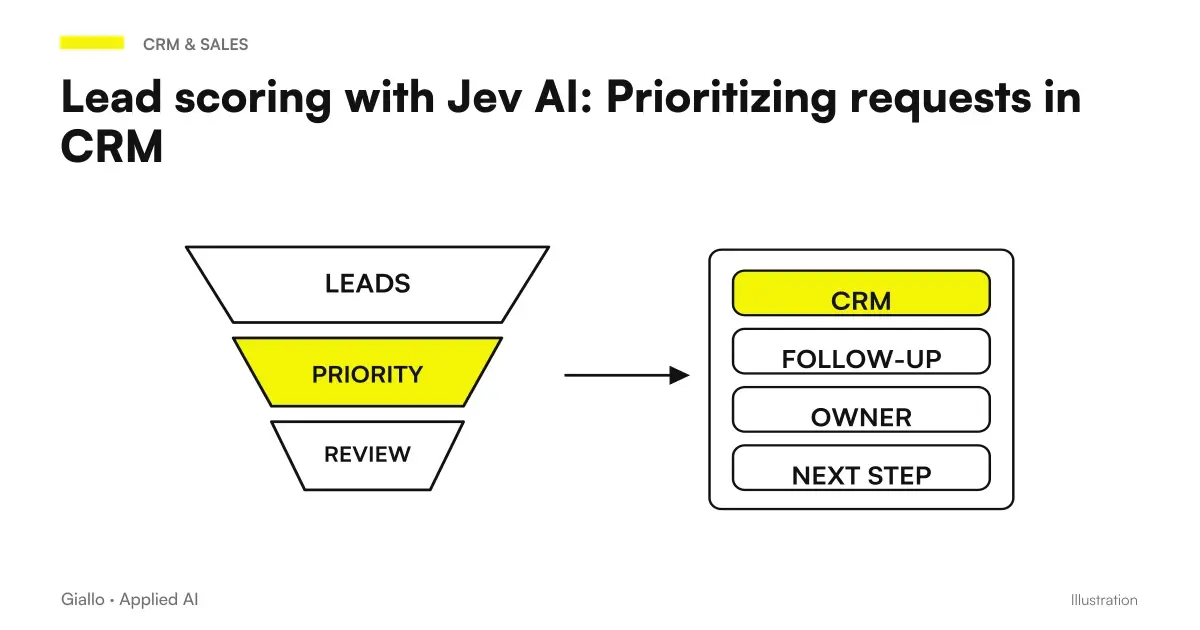
Lead scoring with Jev AI can turn a commercial request into Separate Assessments, to be combined in CRM with rules chosen by the company. The result is a work priority: it does not represent the probability that the contact will buy and does not authorize to discard it automatically.
A team-readable priority
- Fit, urgency, and completeness measure different aspects of the request.
- The weights express a commercial choice and remain controlled by the company.
- Missing information requires clarification, not a fabricated conclusion.
- The score must show version of the address book and data used.
- The review must also look for the good opportunities that ended at the bottom of the queue.
First question: which job needs to change in CRM?
A score becomes useful when it helps someone choose the next task. Calling a contact, verifying a technical specification, asking for a deadline or assigning a referent are understandable actions. A number added to the card without an associated procedure is difficult to interpret: two commercials can use it in opposite ways.
So start from the real queue. Who reads it? How long before the first evaluation? The requests come from a form, email or contacts already present? The guide to qualification of commercial requests with AI helps to identify data and activities. Here we build a column to sort that work, without attributing the sales strategy to the model.
If the goal is to prevent a consistent request from being hidden between generic messages, the initial measure may be the quality of taking charge. There is no need to promise conversion growth. A sale also depends on offer, relationship, price and availability: the commercial triage observes only part of the route.
In the overview on Jev AI and automations for SMEs find the context of the component. For this case, the concrete requirement is to be able to discuss each dimension with the team. If the priority appears inexplicable because it mixes everything in one judgment, it will be more difficult to correct the address book when the offer changes.
Three dimensions, three types of information
The Primitive Score evaluates the content against the ordered levels described. The value is an average of the numbers of the levels weighed by the probabilities; it can be fractional. This position on the address book is not an amount, duration, or probability of purchase.
Three autonomous dimensions can be designed for an SME. The fit measures whether the stated need falls within the supply. Urgency evaluates an explicit deadline or dependency. Completeness indicates whether there is sufficient information for the next step. Descriptions must refer to observable situations, avoiding adjectives such as good or interesting without an operational boundary.
The table is a hypothetical column to be adapted with the commercial manager. The levels indicate working conditions, not verified results of Jev.
| Size | Low Level | Intermediate level | High Level | Next check |
|---|---|---|---|---|
| Compatibility of need | Request explicitly out of offer | Possible compatibility to be clarified | Need consistent with available services | Check perimeter and capacity |
| Declared timing | No Deadline Present | Indicated but flexible horizon | Concrete maturity or dependent activity | Confirm date and feasibility |
| Useful Information | The Main Need Is Missing | Present need, partial operational data | Sufficient data for the first comparison | Check reference quality |
The absence of a deadline does not mean that the project can wait months. It means that the deadline is not in the material. This distinction makes it possible to decide whether to ask for clarification. Similarly, a long description is not necessarily complete: it can tell the company without indicating the problem to be solved.
The delicate point is to separate absence and negative judgment
A very short request can be valuable. A contact writes that they have to automate the placing of orders and asks for a comparison. It does not specify volumes or management software. The need may be consistent with the offer, while the completeness is low. If the two aspects are merged, the system risks rewarding those who know how to fill out the form better than those who have a relevant problem.
To avoid this, it retains a state of information: present, absent or contradictory. It is a design choice that makes the score readable. An absent data activates a question; a contradictory data activates a verification. Neither should turn into a certainty about the budget, decision-making authority or purchase intention.
The documentation on state distinguishes the materials to be evaluated from the required judgments. In CRM you can then set up fields named by message, verified data and relevant offer, keeping the origin of the information recognizable.
Don't bring the whole corporate history into the state without a purpose. The text received and a summary description of the offer may suffice for the first contact. If you use information already present in the CRM, it shows which are confirmed and when they have been updated. The data quality in CRM and sales influences the project before any choice of model.
An explicit formula, with weights discussed by the trade
The pattern of composite scoring proposes separate assessments, normalization and combination of results in the code. Applying it to lead scoring is a design proposal: it is not an official CRM connector nor a method that demonstrates commercial results.
Let's imagine, just to make the calculation readable, three columns from zero to two. A team assigns weight 0.5 to fit, 0.3 to timing and 0.2 to completeness. The weights add up to one and represent a team decision. If the three hypothetical results were 2, 1 and 0, the calculation would be: 0.5 × 2/2 + 0,3 × 1/2 + 0,2 × 0/2 = 0,65.
That value does not say that the contact has a 65% chance of buying. It just means that the combination defined by the team produces 0.65 on its own scale. In the interface it is preferable to call it operational priority and show the three contributions. You can use an ordered band for the job, leaving the detail available to those who need to check.
Before approving the weights, try pairs of requests: one perfectly consistent but without deadline; one urgent but out of offer; one complete but still exploratory. Ask the person in charge who should be read first and why. If the formula gives a different order, disagreement is a decision to be discussed. Changing the weight is simple; making it clear the meaning avoids arbitrary interpretations.
Open the check before using priority in a queue
Compare two requests that the team would sort differently. Look at the individual dimensions, not just the total. If the fit is correct but the formula brings to the top a request out of the offer for urgency only, review the weights or create a verification step before sorting.
It also notes what each band means: reading the referent, asking for clarification or technical comparison. The result must change a recognizable activity.
Hypothetical scenario: component manufacturer in Brescia
Let's consider a hypothetical Italian SME that produces components on design. He receives two requests. The first contains a lot of information about the company but does not attach specifics to the piece. The second describes in a few lines material and use, indicates a deadline and asks if an initial batch is possible. Neither is yet an order.
The manager decides that consistent technical need matters more than the formal quality of the message. The fit of the second request could then carry it in front, while completeness signals that drawing, quantity and tolerances are needed. The next step is a technical comparison, not the automatic sending of a price.
In CRM, the referent sees the three headings and can change their outcome. Production availability is checked in the company system: a close deadline does not imply that the SME can comply with it. When the drawing arrives, the score should be updated to a new version of the data; a previous evaluation must remain recognizable.
The test compares the suggested reading order with that of the salesman and technician. Disagreements may reveal that a dimension is missing, or that the column uses words other than those of the employees. The scenario serves to design the work. It does not contain turnover forecasts or results attributed to a real customer.
Hypothetical scenario: service companies in Tuscany
A hypothetical Italian service company receives requests for training and operational support. One contact asks for a generic course; another describes an internal process that requires flanking. The company's offer includes both activities, but the available staff and the next step are different.
Using a single score for all requests could always favor the most articulated projects. Instead, the manager decides to separate the queues by service type and use the priorities within each. A simple request is no less valuable: it can be ready for a standard proposal, while a complex project requires an evaluation with the consultant.
The contact on the operating support does not indicate a deadline. Its priority preserves this absence and generates an activity of clarification. The course has a declared date, which the clerk verifies with the calendar. The assignment rule takes into account real competence and capacity, managed by the application.
This scenario shows why a good column depends on the organization. The model does not choose which service should grow or which segment is more interesting. It's commercial decisions. The system makes their application to requests more consistent, as long as the team can correct cases and exceptions.
When priority must stop for a verification
A readable total can hide significant uncertainty in one dimension. A disputed fit does not become reliable because completeness is high. In the queue, show a review signal beside the score and define which conditions trigger it: inconsistent information, an unmet need or data from a questionable record.
The Guide on confidence and human review helps interpret the signals of the model. However, the operational decision remains linked to the case. A low priority should not erase the lead, interrupt a relationship, or send out a rejection. The operator can choose to read a contact first for reasons outside the text and must be able to record the choice.
It also checks duplicates before adding tasks and requests. Two messages from the same company may seem like two opportunities, or relate to different departments. deduplication of CRM and catalogs with Jev AI deals with the linking proposal without confusing it with an authorised merger.
Evaluate the pilot without attributing future sales to him
Prepare a collection of requests covering real work: concise and detailed, consistent and off-offer, urgent and dateless, new and already known. The salesperson assigns an expected priority along with the next task. For disputed cases, it retains the reason for the choice. A ranking without business motivation offers a weak reference for comparison.
It examines both the contacts at the top and those left at the bottom. The second part is essential: controlling only high priorities does not bring out the valuable opportunities overlooked. It measures operator changes and the time it takes to verify the suggestion. If reading the score requires more work than a first reading of the message, review the screen and perimeter.
Keep separate API costs, integration and address book management. The article on prices and costs of Jev AI serves to build this estimate. The number of requests processed does not tell the total cost alone: updating criteria, resolving disagreements and assisting users is part of the project.
Also predict who can change a column and how the change communicates to the department. If a new service enters the offer, it is not enough to add a word to the instructions: it is necessary to verify the requests that were previously out of perimeter. Preserve the previous version to reconstruct the choices made. A score received yesterday can remain on the card as a historical data, while the queue uses a new rating. Showing this difference prevents the salesperson from interpreting as a change of contact what comes only from a company decision.
The next step can be to connect the result to the CRM via a controlled flow, as described in the guide to Jev AI API integration. With Giallo, a project of Business Software It can start with shared address books, available data, and precise tasks, so priority becomes a verifiable work tool.
Design your CRM’s lead scoring with Giallo, from scoring rubrics to testing on real enquiries.
Giallo Studio guides: methodology and sources
How we apply it in the company
Related resources
 Jev AI, confidence and probability: when to get a person to intervene
 Deduplication with Jev AI: connecting records without merging the wrong ones
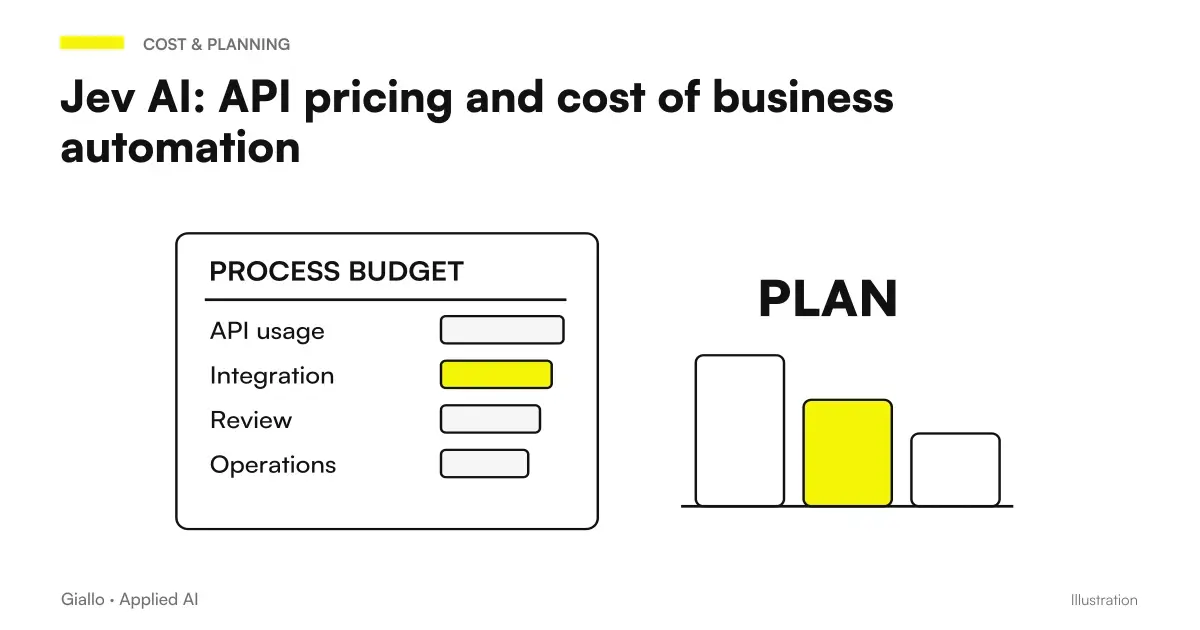 Jev AI: API pricing and cost of business automation
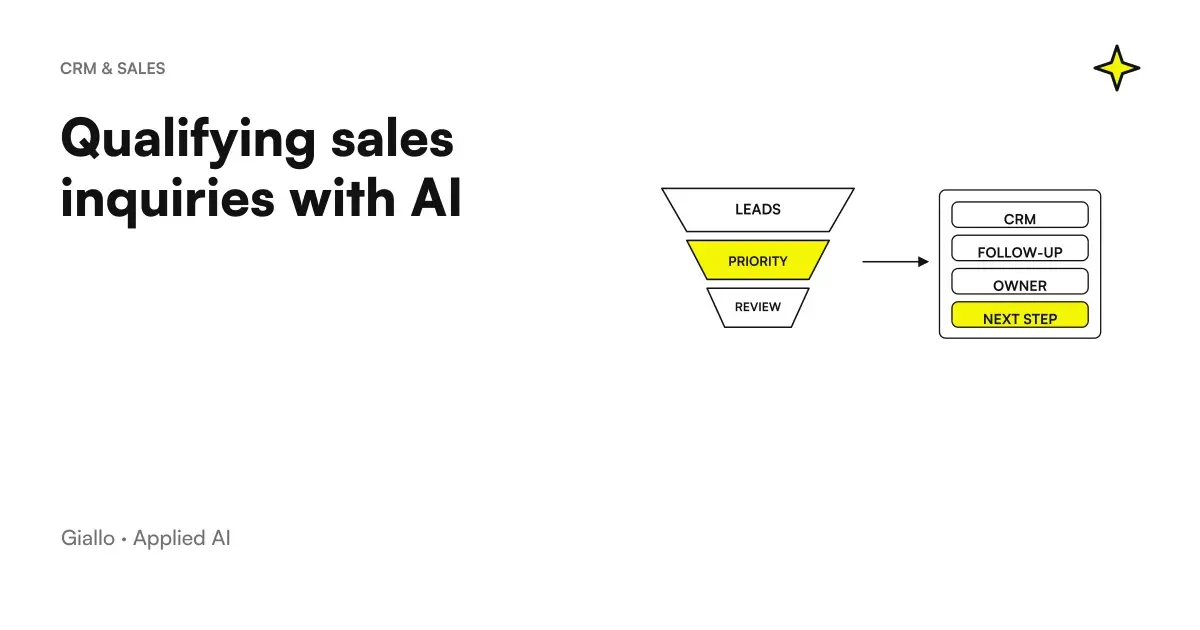 Qualify sales enquiries with AI: missing data, priorities and assignment
 AI for CRM and sales: automate the sales process
Jev AI in business processes
APIs, Decisions, Data, and Controls: Choose the step that relates to your process.
- Business chatbot guardrails: where to use Jev AI
- Jev AI in RAG: choose sources before answering
- Jev AI to extract data from emails and invoices: first find, then choose
- Verify chatbot citations with Jev AI
- Deduplication with Jev AI: connecting records without merging the wrong ones
- Jev AI vs LLM: how to choose the right model
- Jev AI, confidence and probability: when to get a person to intervene
- Jev AI explained: what changes for SME automation
- Document classification with Jev AI: build reliable categories
- Jev AI: API pricing and cost of business automation
- Route support tickets with Jev AI: department, urgency and review
- Jev AI for business: privacy, limits and testing on Italian data
FAQ
Does the lead score indicate the probability of a contact buying?
No. In the proposal described, it is a priority built using scoring rubrics and weights chosen by the company. Estimating a conversion probability would require a separate project with a defined event and suitable historical data.
Who should choose the weights of the sales dimensions?
The sales manager, together with those who handle the requests. The weights describe a decision about work: how much fit matters relative to the deadline or the availability of information. The technical specialist makes the formula explicit and editable.
Should an incomplete request be given a low priority?
Not necessarily. It may describe a highly relevant need but require a clarifying question. Keep completeness separate from the request's value and plan a task to collect the missing data.
Can you add up scores with different scales?
First, put them on a comparable scale. Document the calculation alongside the weights so that the team can reconstruct the priority. A direct sum could give a scoring rubric more weight simply because it contains more levels.
What happens when the commercial offer changes?
Update the compatibility criteria and retain the version applied to earlier scores. Rerun a set of previously assessed cases to check the effects. Avoid comparing scores obtained with different scoring rubrics without disclosing this.
How can you verify the system without waiting for months of sales?
Compare the proposed order with the order chosen by sales staff for representative requests. Look at valid opportunities left at the bottom, out-of-scope requests brought to the top and review time. The test evaluates the work of handling requests, without promising future revenue.