
AI sales prompts: emails, offers and follow-ups
Ready-to-use AI sales prompts: cold outreach, offer presentations, follow-ups, objections and closing. For Italian SMEs and sales teams.
Reading time: 9 min
The AI prompt for sales are structured instructions with which to guide an AI tool in writing commercial texts: from the first cold email until closing. It's not about automating the customer relationship, it's about eliminating the blank sheet lock and always having a solid draft to start from.
The critical point is one: output quality depends almost entirely on prompt quality. A generic prompt produces emails that seem written for everyone and do not convert. A prompt with context, precise recipient, and clear goal produces a draft that the commercial retouches in two minutes and sends with confidence.
In this guide you will find prompts ready for each stage of the sales funnel, with instructions on how to adapt them to your industry and the most common mistakes to avoid.
In summary
- An effective AI prompt for sales always contains: customer sector, problem you solve, desired tone, message goal.
- AI generates the draft; commercial adds local context, personal details, and signature before sending.
- The most useful use cases: Cold outreach, bid submission, post-demo follow-up, object handling, closing message.
- For Italian SMEs the tone works best if direct and concrete, non-formal and long: short sentences, no hype.
- Automating prompts in a CRM or AI agent brings the real benefits: drafts generated in 10 seconds for each lead.
How to structure an AI prompt for sales
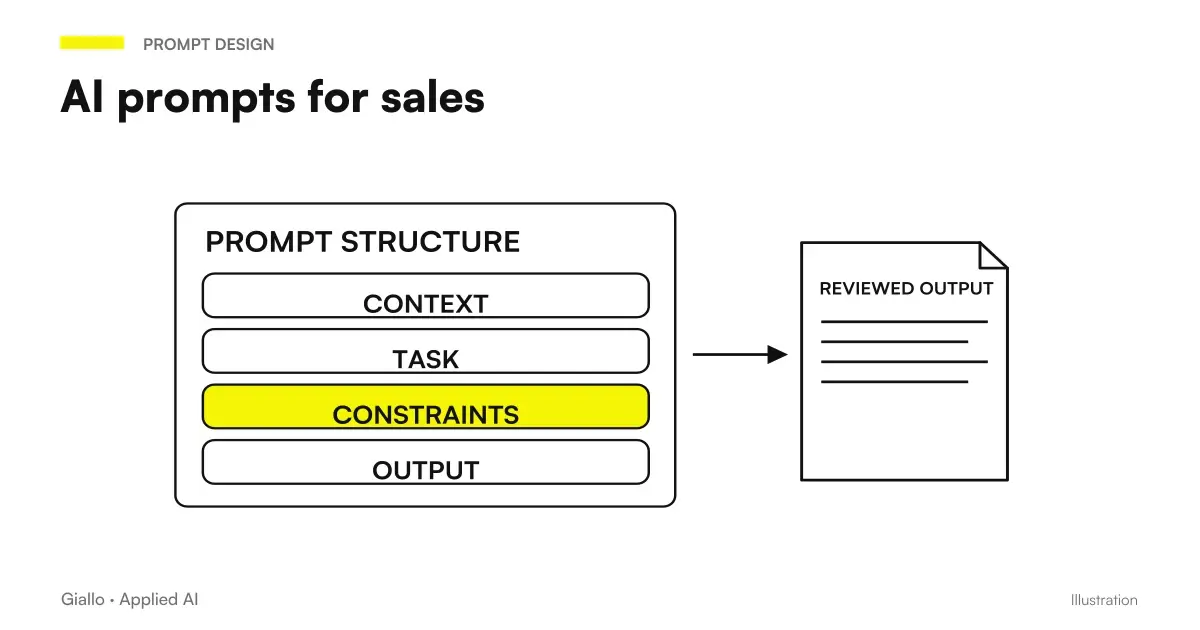
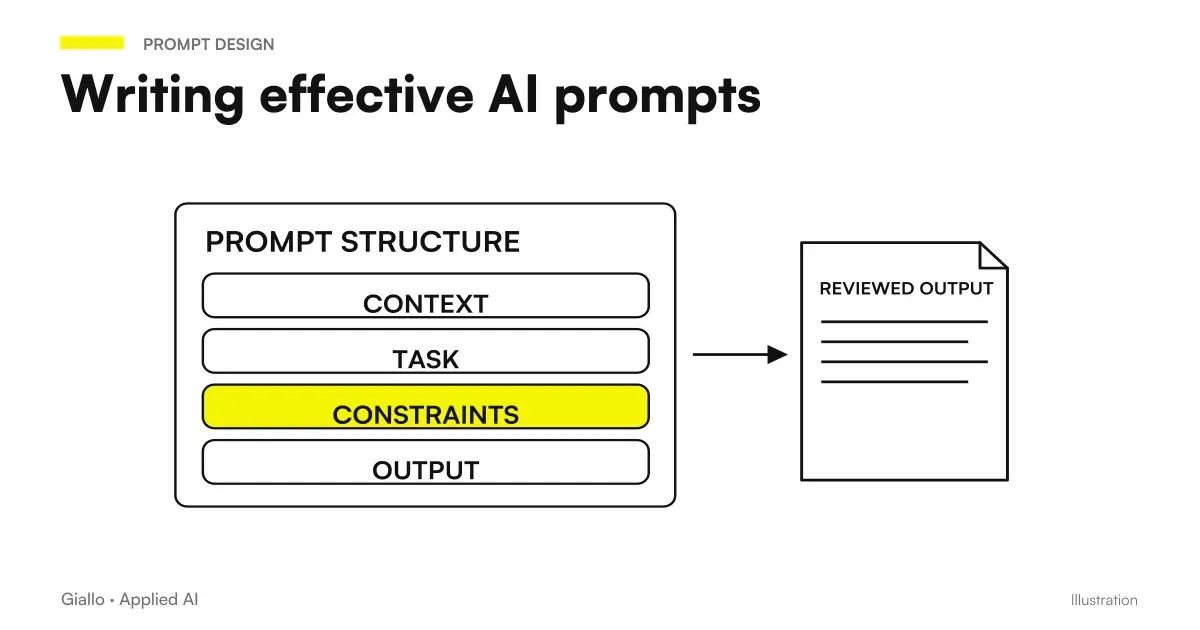
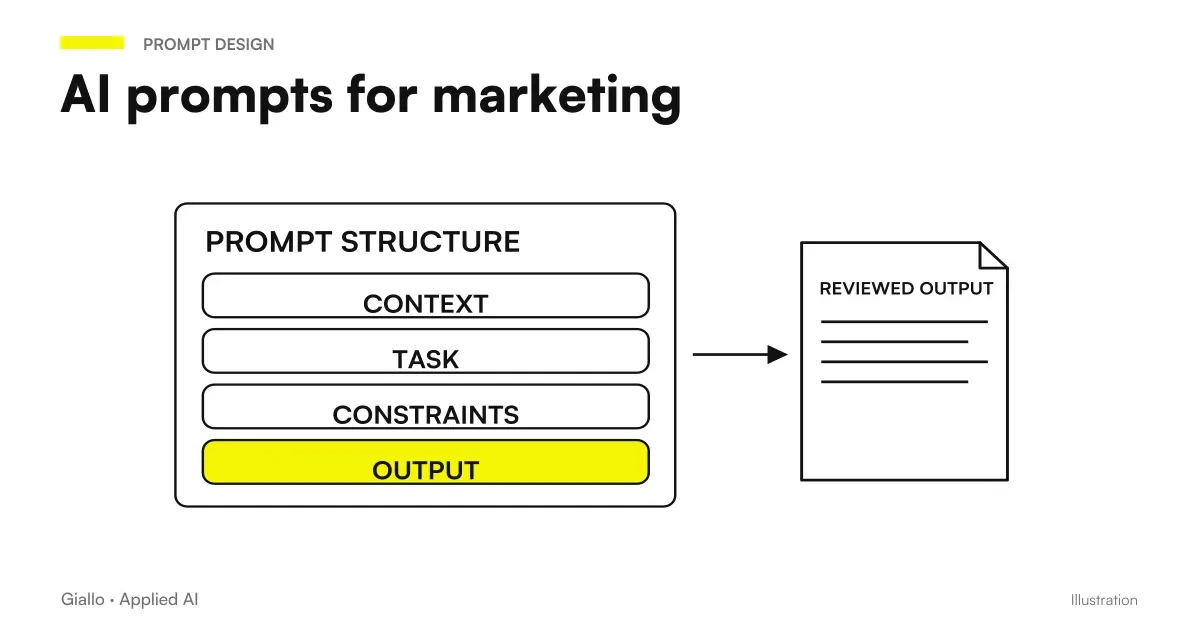
Before you see the ready examples, it is worth understanding the structure. A AI prompt for effective commercial use has four components:
- Role: who is AI in this context ("You are a commercial expert in B2B services for Italian manufacturing SMEs").
- Background: who is the recipient, what sector it operates in, what problem it has or what opportunity it is considering.
- Objective: what the message must get (fix a call, answer a request, reopen a firm negotiation).
- Format Constraints: length, tone, what to include and what to avoid.
Without context (#2), AI produces sentences that could be addressed to anyone. Without the target (#3), the text has no direction. To learn more about the general technique you can read the guide on ChatGPT prompt and the specific one on AI prompt by email.
Table: prompt for each stage of the sales funnel
Here is a map of the most useful prompts for each moment of the negotiation, with the goal and type of output to be expected.
| Phase | Objective | Key prompt to include | Typical Output |
|---|---|---|---|
| First contact (cold) | Open the conversation with a lead who doesn't know you | Lead sector, specific problem of its market, CTA minimum (15 min call) | 4-6-line email with strong subject |
| Offer presentation | Synthesize the value for the lead after a first call | Problem emerged in the call, solution proposed, 2-3 concrete benefits | Email or short document with problem structure → solution → next step |
| Post-demo follow-up | Maintain momentum after a demo or meeting | Date and content of the meeting, objections raised, next proposed step | 3-5 line email with recap and direct question |
| Handling objections | Answering "I think about it," "it costs too much," "it's not the time" | Specific objection, given or use case facing it, reduced proposal | Structured response: acknowledge → answer → step |
| Cold lead reactivation | Reopening a firm negotiation for weeks or months | Last contact, reason for silence (if known), novelty or change of context | Short, curious, pressure-free email |
| Closure | Push towards signing or final decision | Summary value, real (non-artificial) maturity, clear CTA | 2-3 paragraphs with summary and urgent next step |
Ready prompts for cold outreach
Cold outreach is the case where AI helps the most: writing the first email to a complete stranger takes time and often ends up being either too long or too generic.
B2B cold email prompt:
You are a salesperson at [company name], which offers [service/product] to SMEs in the [sector] sector.
Write a cold email of max 6 lines to [Recipient name], [role] at [recipient's company].
The problem we want to address: [describe the specific problem in the sector].
The tone must be direct and professional, without hype. No phrases such as "I am contacting you because I saw your website".
The CTA is: ask for a 15-minute introductory call.
Also write 3 variations of the email subject line.
This prompt works because it forces AI from the recipient's problem, not from the company it writes. For more practical examples on how to use AI in email writing you can see the guide on ChatGPT to write emails.
Prompt for LinkedIn (first message):
Write a LinkedIn connection message of max 3 lines to [name], [role] at [company].
Context: we are in the [sector] sector and offer [brief solution].
Do not explicitly mention selling. Open with something genuinely useful or relevant to their role.
Tone: conversational, not formal.
Prompt for tender submission
After the first call, the most delicate moment is to synthesize the offer so that the lead really reads it — and not archives it.
Post-call follow-up email prompt:
We have just finished a call with [Name], [role] at [company].
The main problem that emerged: [describe the problem in 1-2 sentences].
Our proposal: [describe the solution in 1-2 sentences].
The concrete benefits discussed: [list of 2-3 points].
Objection or concern raised: [e.g. "the budget is limited"].
Write a follow-up email of 5-7 lines that:
- Recaps the value precisely (not generically)
- Addresses the concern indirectly without being defensive
- Ends with a concrete next step (suggesting a meeting/demo/30-minute call)
How to adapt this prompt if you have a ready-made quote
If you already have an offer document, add to the prompt: "Mentally attach this summary to the text: [paste the main points of the quote]. Write the email so that it encourages you to open the attached document, without anticipating all the numbers."
This moves the email from "here's everything we offer" to "here's why it's worth reading what I send you": more effective because it gives a reason to open the attachment.
Prompt for follow-up and silence management
Follow-up is the most annoying task in the sale: you don't want to seem insistent, but you can't disappear. AI prompt by email here help to find the right tone every time.
5-day follow-up prompt (no response):
I sent a proposal to [Name] 5 days ago and have had no reply.
The offer concerned: [brief description].
Write a follow-up of max 3 lines, with a light tone, that:
- Briefly recalls the value of the proposal
- Asks whether anything is blocking the decision
- Does not use phrases such as "I just wanted to follow up" or "I remain at your disposal"
Prompt to reopen a lead stopped for months:
The last contact with [Name] was [date or period].
The reason they did not proceed: [budget not ready / timing was not right / other].
Today there is a development relevant to them: [e.g. a new service, a price change, a case study in their sector].
Write a short email (max 4 lines) that reopens the conversation without applying pressure.
Tone: curious, not sales-oriented. Like a useful update from an industry contact.
Prompt to handle common objections
Objections for sale are predictable. AI can prepare you the best answers before they arrive, avoiding improvisations.
Objections that AI handles well
- "It costs too much" → answer on ROI and comparison with the cost of the problem
- "I need to think about it" → clarify what is blocking progress and offer a smaller step
- "We already have something similar" → specific differentiation
- "It's not the right time" → question about when it will be + keep contact
Objections that require human touch
- Personal or emotional objections ("I don't trust external providers")
- Client's business crisis situations
- Negotiations with complex power dynamics
- When the "no" is definitive and you need to understand the real why
Prompt to respond to "cost too much":
The client [Name] replied to our proposal saying the cost is too high.
The price of our solution is [X €]. The problem it solves is worth [describe the cost of the problem: wasted hours, errors, lost customers].
Write an email reply of 4-5 lines that:
- Acknowledges the objection without being defensive
- Explains the value in terms of return (not features)
- May suggest a scaled-down option as a starting point
Tone: calm, direct, not pushy.
Practical examples for Italian SMEs
Case 1 contabile Accounting consultancy firm, Turin. The firm's salesperson must contact 40 new companies per month that could benefit from outsourced payroll management. With a well-built prompt, ChatGPT generates in 30 seconds a custom email by sector (artisans, e-commerce, medical offices) with calibrated subject and tone. The trade only reviews the last two lines and sends. Saved time: 3-4 hours a week.
Case 2 — Communications agency, Milan. The sales team uses AI prompts not only to write emails, but to prepare responses to objections before each call. Before talking to a marketing manager about a mid-business, they ask the AI to generate the 5 most likely objections for that industry and the related responses. The AI does not participate in the call, but comes prepared who goes.
To integrate these flows into your business CRM, you can explore the Best AI for CRM and evaluate solutions that automate the generation of drafts directly from the lead profile.
How to Use AI Prompts for Sales Support Marketing
AI prompts are not only for direct emails: they also support the commercial materials that accompany the negotiation. To learn more about the use of AI in support content, see the guide on AI prompt for marketing.
Prompt for a short case study (to be used in emails):
Write a 3-line paragraph describing this result achieved for a client:
- Client's sector: [sector]
- Initial problem: [problem]
- Result achieved: [measurable result]
Style: concrete, no superlatives. Structure: first the problem, then the result, in figures if possible.
Mistakes to Avoid
- Prompt too vague. "Write a sales email for my product" produces unnecessary output. Always specify sector, recipient and target.
- Copying and paste without reviewing. AI doesn't know the tone of your relationship with that specific customer. Always reread and add at least one personal detail.
- Using the same prompt for all leads. An identical email sent to 200 people can be seen. At least change the reference to the sector and the specific problem.
- Too formal or too informal tone. Always ask for a variant of the prompt with a different tone and choose the one that sounds most authentic for your market.
- Not saving prompts that work. Create an internal library of validated prompts: the ones that got answered. It is a commercial asset that grows over time.
How to apply it in the company
- Identify the 3 emails you write most often. Usually: cold outreach, post-call follow-up, response to quote request. Start there.
- Build a prompt template for each. With role, fixed context and fields to be filled on a case-by-case basis (sector, name, problem). Head to 5-10 real mailings.
- Measure the response. Opening rate, response rate, fixed calls. Without data you don't know if the prompt improves or worsens compared to your manual writing.
- Integrate into the CRM if the volume justifies it. Many modern CRMs allow you to connect AI prompts to lead profiles. A AI Agent can generate the draft automatically as soon as a lead enters a certain stage of the funnel.
- Update prompts every quarter. The market changes, objections change, the tone that works changes. It treats prompts as a live business document, not as a text to be archived.
Conclusion
The AI prompt for sales They do not replace the commercial: they eliminate the mechanical work of writing and free up time for what matters — the relationship, the negotiation, the closure. For an SME with a small sales force, having drafts ready in 30 seconds for each phase of the funnel is a concrete and measurable advantage.
The starting point is simple: choose the 2-3 emails you write most often, build a structured prompt for each and head on real mailings. You can do this today, without investment and without complex integrations. If you want to understand how to bring these flows into your business tools in a stable way — with agents generating drafts directly from CRM — Giallo Studio can help you turn the problem into a real workflow.
Giallo Studio guides: methodology and sources
How we apply it in the company
Related resources
 AI prompts: a complete guide to effective instructions
 ChatGPT prompts: ready-to-use examples to copy and adapt
 AI email prompts: ready-to-use examples for every situation
 AI marketing prompts: copy, campaigns and content
 ChatGPT to write emails
 Best AI for CRM: Sales Management Tools
 Do Dots work when your computer is off? Cloud, local access and login
 Verify chatbot citations with Jev AI
Prompt Collections
Ready prompts for other roles and tasks.
- AI prompts for social media: ready-to-use posts, captions and content
- AI video prompts: Runway, Kling and Gemini alternatives to Sora
- AI SEO prompts: optimise content and rankings
- AI prompts for real estate agents: ready-made examples for ads, emails and customers
- AI coding prompts: write, fix and explain code
- AI prompts for lawyers: legal documents and communications
- AI presentation prompts: PowerPoint and Google Slides examples
- AI prompts for accountants: ready-made examples for documents, analytics and clients
- AI marketing prompts: copy, campaigns and content
- AI customer support prompts: ready-to-use examples
- AI image prompts: examples for Midjourney, ChatGPT and Firefly
- AI document analysis prompts: contracts, reports and PDFs
FAQ
What are AI prompts for sales?
They are structured instructions for an AI tool (such as ChatGPT or Claude) to generate sales copy: initial-contact emails, offer presentations, follow-ups, responses to objections and closing messages. A good prompt contains context, tone, objective and recipient.
Do AI prompts for sales really work or is the output too generic?
Generic output comes from generic prompts. If you give AI the client's sector, the problem you solve, the right tone and the negotiation context, the result is a solid draft that only needs refinement. The salesperson adds local specifics and a personal tone before sending.
Can I use ChatGPT to write cold outreach emails in Italian?
Yes. ChatGPT, Claude and other models write well in Italian. Specify in the prompt that you want a professional but direct tone, short sentences, and that the recipient is a manager at an Italian SME. Avoid pasting generic English emails to translate: start in Italian from the first prompt.
How many versions of the prompt do I have to test before finding one that works?
Usually 2-3 variations are enough to find the right tone. The first AI response is always a starting point: immediately request variations ('make it shorter', 'use a less formal tone', 'add an industry data point'). Statistical A/B testing is unnecessary: the salesperson immediately recognises which version sounds authentic.
Can AI also handle objections during negotiation?
It can prepare answers in advance: given your sector's most frequent objections, ask AI for a structured response (acknowledge the objection, respond with a fact and propose a next step). AI does not replace real-time negotiation, but prepares the right arguments to have at hand.
What's the difference between a cold email prompt and a follow-up prompt?
A cold email must catch the attention of someone who does not know you: a strong subject line, a first paragraph about the recipient's problem (rather than about you) and a minimal CTA. A follow-up assumes initial contact: it refers to the previous conversation, recalls the specific value discussed and proposes a concrete step.