
Verify chatbot citations with Jev AI
An existing source is not enough: verify AI citations and whether sources support the answer, handle conditions and stop doubtful claims.
Reading time: 11 min
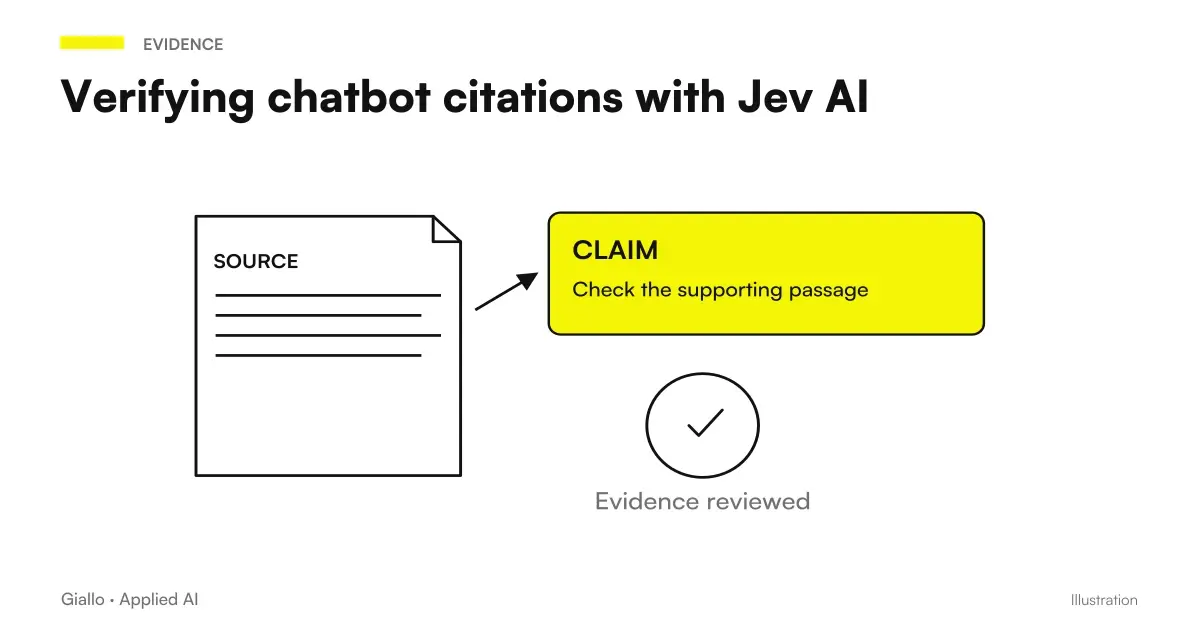
To verify AI citations, you need to check both that the passage exists and that it supports the claim. Jev AI can help with the Second Assessment, but a real source can be misinterpreted: control must retain conditions, context and possibility of revision.
What a response must overcome
- The reference must lead to an identifiable document.
- The passage must support the precise statement used.
- Exceptions and conditions must not disappear in the synthesis.
- A dubious verification must produce a visible action.
- The correct source does not alone certify the entire response.
The problem is too broad a promise
A company chatbot can correctly cite a procedure and respond incorrectly. It happens, for example, when a valid condition for customers with a specific contract becomes a promise to all customers. The reference works, the document exists, the sentence seems authoritative. The error lies in the link between source and conclusion.
The distinction helps to understand why reducing AI hallucinations requires more than one link list. Technical link control is a first step. The next question is what really authorizes the text to be affirmed. The project should explain both outcomes to those who approve the response.
The official cookbook on citations first uses a textual match, then a support, contradiction or irrelevance rating. The application distinguishes verified, unsupported, contradicted or invented references and provides for review of uncertain cases. It is a circumscribed example: it does not prove a universal verification of facts.
The Presentation by Jev AI clarifies the role of the component. Here the aim is to build a control after the response, when the generator has already turned the materials into statements. If the sentence is wrong, the system must be able to stop that sentence without erasing all other useful information.
Break down before judging
The first design choice concerns the unit to be verified. A sentence may contain three statements: the service is included, applies to all locations and is available within a time limit. One source could only support the first. If you send everything as a single block, the outcome is likely to hide the unsupportive part.
For the project, we propose to identify autonomous statements and link each to one or more steps. The process manager decides which are important: business conditions, technical compatibility, economic commitments, obligations or deadlines. Verification of a courtesy formula does not have the same value as checking a promise of repayment.
The check record contains the exact statement, the document reference, the passage and its surrounding context. Also retain the source version. If the reviewer sees only an isolated quotation, they may not notice that the preceding paragraph limits the benefit to a group of customers.
A further useful rule is to keep the original text of the answer. If the control phase rewrites the statement before evaluating it, it can end up verifying a better sentence than the customer would receive. Correction must be a next step, recorded as such.
Existence, support and validity are different controls
The table proposes the responsibilities of a business flow. Outcomes are operational categories to be agreed upon, not model performance.
| Request for control | Example of problem | Proposed Behavior |
|---|---|---|
| Does the reference exist? | Untraceable file or pass | Stop the claim and retrieve the source |
| Is the text really the one indicated? | Altered or incomplete extract | Compare to the original version |
| Does the passage support the phrase? | Condition turned into warranty | Correct or revise |
| Does the source contradict the phrase? | Explicit exception ignored | Block that conclusion |
| Does the source apply to the case? | Document relating to another contract | Search for the applicable document |
| Do the available sources agree? | Two procedures with overlapping scopes | Involve the policy owner |
To verify the existence you can use identifiers and matches in the preserved text. For validity, you often need metadata: date, scope, customer, and document authority. The semantic comparison comes in when you have to evaluate what the passage supports. Separating layers makes errors explainable and limits the work required to the model.
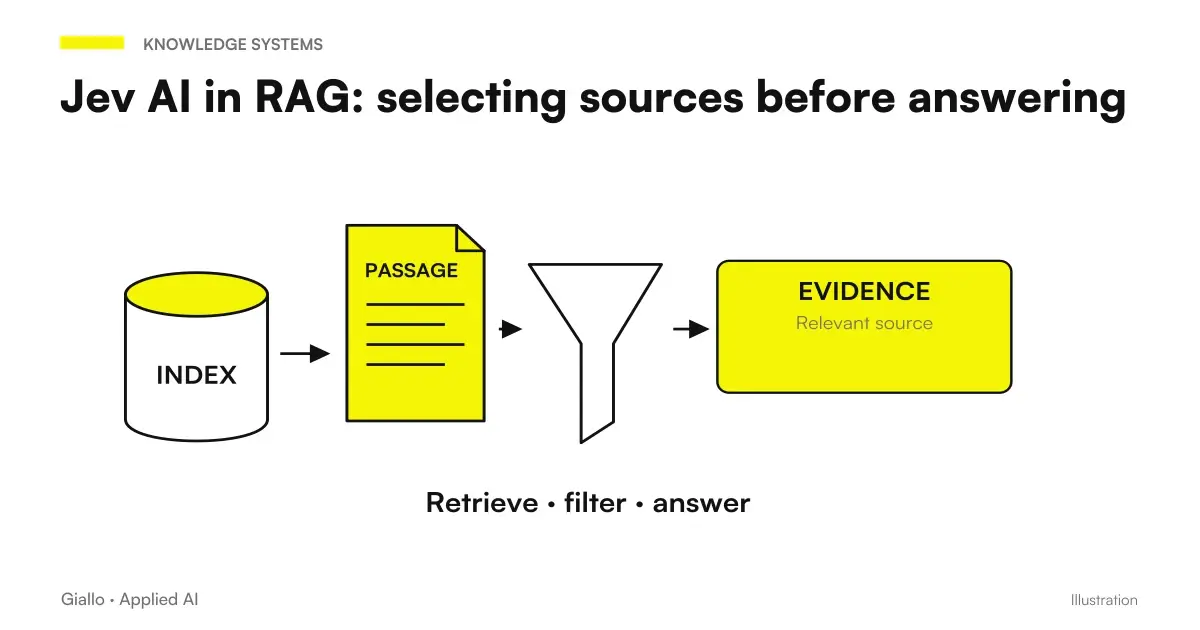
The filtering of sources in the RAG takes place before writing. The cookbook dedicated to the RAG passages distinguishes evidence and conflict. This initial selection helps prepare the context, but in the project we maintain the next control: the generator could still expand a conclusion.
A successful verification must refer to that statement and source. It should not turn into a green stamp on the whole conversation. If the user changes question or adds a detail, the previous outcome is not enough to authorize a new answer.
Hypothetical case: returns for a B2B e-commerce
Consider a hypothetical Italian distributor that sells materials to businesses. The internal chatbot prepares responses for operators, using particular sales conditions and agreements. A customer asks if he can make a product already used.
The standard document provides for a possibility of return with specific conditions; a separate agreement concerns only one family of articles. The generator prepares a sentence that extends that possibility to the product of the request. It cites an authentic excerpt, but neglects the scope of the agreement.
In the project, the control of existence goes beyond the first step: the text is really in the source. The comparison with the sentence then notes that the link is not enough. The operator receives the suspended response and sees the condition ignored. It decides whether to seek the correct agreement or ask for information about the product.
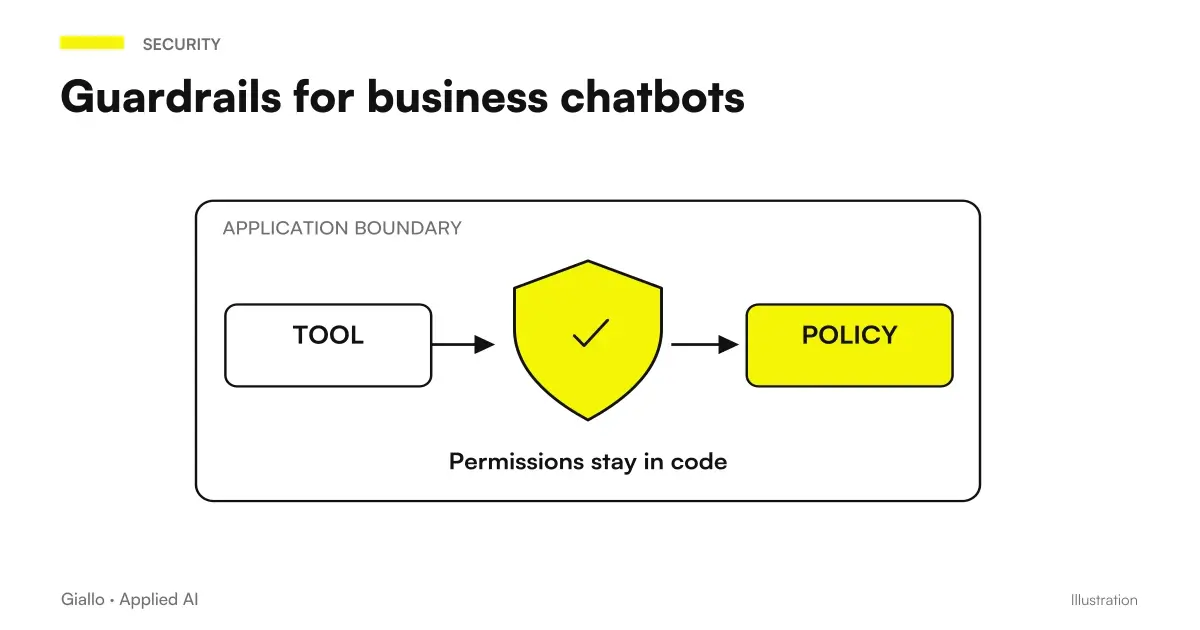
The holder establishes that no return authorization starts from semantic control only. The draft can be corrected and approved; the administrative action follows the process already planned. The guardrail for corporate chatbots They serve to distinguish these moments: approving a sentence and authorizing an operation are different responsibilities.
This case is hypothetical. Its value is to show an error that a simple link check would not see. In the pilot, the company builds examples with correct and wrong scopes to measure how many generalizations are discovered, without attributing unobserved results to the system.
Hypothetical Case: Assistance for a Software Enterprise
A second hypothetical Italian SME sells a management and has a knowledge base with manuals for different versions. Support asks how to activate a feature that is only available with an additional module. The chatbot response describes the procedure, but omits the form requirement.
The cited step contains the correct operating steps. Right above, however, is the prerequisite. That is why the verification card includes a portion of context: a quotation too short makes invisible just the condition that matters. The product contact person decides which paragraphs should accompany the instructions.
The response control reports that the procedure is only usable after verifying the form. The operator can add a question to the customer or confirm the active plan in the authorized system. It is not necessary to declare false the whole answer: it is necessary to make explicit what is missing.
The project of knowledge base company must retain version and dependencies of the content. If the documents do not have this information, the control can highlight a doubt, but do not invent the relationship between manual and installation. The owner of the content remains responsible for clarifying it.
A good test also includes correct cases: if the check stops each procedure, it reduces errors only by preventing work. The assistance then assesses both the forgotten conditions and the correct answers blocked unnecessarily. Balancing is decided on the basis of the cost of contacting a customer again and the time available for review.
Literal matching is not enough for paraphrases
In the project, a quotation in quotation marks and a paraphrase have different controls. The first demands a correspondence with the text; the second can express the same meaning with new words. Treating them the same way would generate both false alarms and too easy acceptances.
Normalizing text also requires attention. Removing double spaces or correcting a line break can help find a passage. Eliminating a denial, threshold, or note can change the meaning. The normalized version is for searching; verification must keep the original material visible.
When the link is approximate, it records how the pass was found. An auditor should understand whether he sees a precise match, a paraphrase or a candidate recovered by similarity. This avoids passing a search result as evidence of support.
For the numbers, dates and codes provided by the process, we propose dedicated deterministic controls. If the answer promises a deadline, the comparison should not depend solely on the feeling that the sentence is similar to the source. Semantic content and point data should be verified with appropriate tools for the respective task.
Review must see disagreement
The official page Confidence It makes clear that value does not guarantee correctness. In the project, an uncertain assessment must open a review with statement and source side by side. It is not enough to show the number: the reviewer needs the context that makes the sentence acceptable or too broad.
Define first what that person can do. It can confirm, restrict the sentence, replace the source or state that there is not enough material. A single approval button incentivizes surface management. A correction with a short pattern allows instead to discover repeated problems in the formulation of the answers.
The Guide to Confidence and Human Intervention covers thresholds for actions. For citations, the choice may differ between an exploratory internal answer and an external commercial promise. The company must decide which content may be released only after approval, regardless of the number displayed.
Open the quick check before approving a sentence
- Is the source applicable to the customer, product or version?
- Does the phrase maintain all the conditions that limit its meaning?
- Does the passage say what is stated or does it only speak on the same subject?
- Is there another relevant source that contradicts the conclusion?
- Does the correction narrow down the promise without introducing new information?
Correcting a sentence without losing control
When a verification reports a problem, the solution should not be to ask the generator to try again until a favorable outcome appears. The project should define a circumscribed correction: narrowing the claim, maintaining a condition or declaring that the available material does not support the conclusion.
The corrected sentence is a new claim and requires its own check. Keep its relationship to the previous one, the reason for the change and the source used. If the document also changes, record that change: a favourable output based on another source does not demonstrate that the first citation was adequate.
For compound responses, we propose a separate state for each relevant part. Some may be usable, others require revision. The operator decides whether a partial response is sufficient to resolve the request. The client should not receive a seemingly complete text when the very condition that determines his choice is missing.
Also set an organizational limit on attempts. After a correction that remains doubtful, the case passes to the intended referent, with the elements already collected. The limit is a choice of process, not a feature attributed to the API. It serves to avoid a circuit that consumes time and produces language variations without adding evidence.
Editor changes become useful when reading by cause. Missing condition, incorrect scope and insufficient source suggest different interventions. The knowledge base owner can update a content; the responder can make a requirement explicit. The final correction solves the case, while the recorded cause helps to reduce its repetition.
A useful proof starts from the mistakes that cost
Prepare a set of responses controlled by business contacts. Some must be corrected; others must contain recognizable defects: non-existent reference, omitted condition, wrong version, reverse denial or conclusion not present. These are examples of proposed tests, not a benchmark already run.
For each statement it records the expected verdict and the reason. Two reviewers can discuss cases of disagreement before the test. If they do not agree on what the source allows to say, it is necessary to clarify the content or the rule, not to look for a threshold that solves a business dispute.
Separately measure the errors let through and the correct sentences stopped. Then check the time of the reviewer: a system that reports the exact point of the problem can be useful even when it does not eliminate all manual verification. Do not declare time reductions until you have observed them in a consistent comparison.
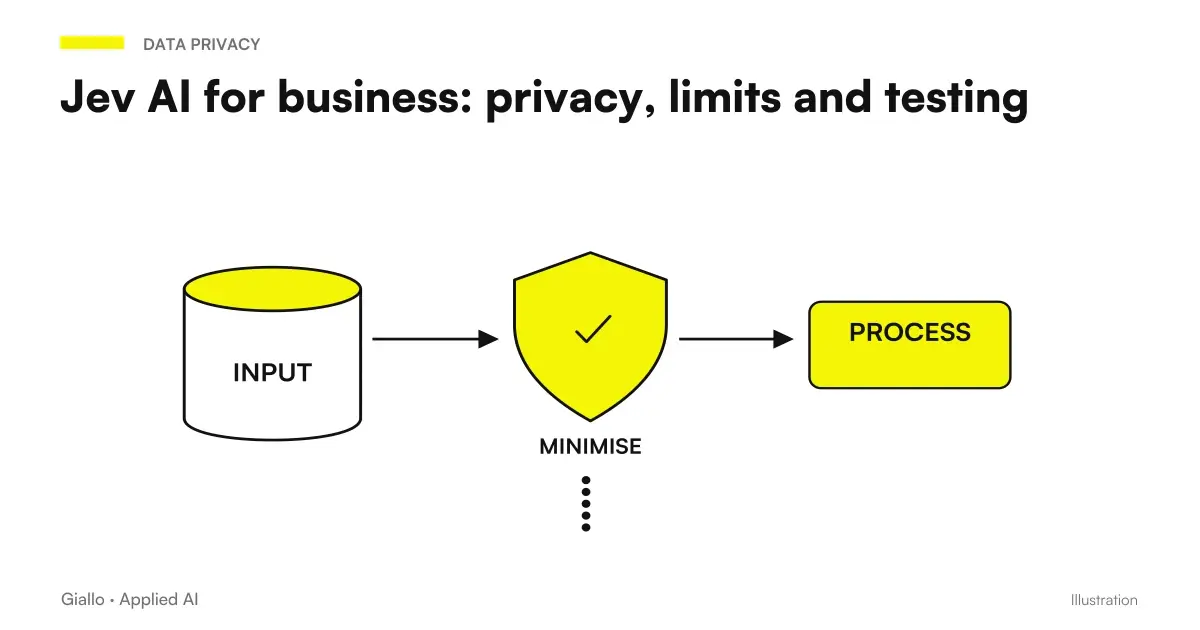
Before linking the control to real documents, verify Italian data privacy and testing. Test materials must have defined accesses and recipients. One AI Consulting can start from the very statements that today require more verification, to build a circumscribed and measurable test.
We verify sources, conditions and review of your chatbot with a pilot on selected documents.
Giallo Studio guides: methodology and sources
How we apply it in the company
Related resources
Jev AI in business processes
APIs, Decisions, Data, and Controls: Choose the step that relates to your process.
- Jev AI in RAG: choose sources before answering
- Jev AI vs LLM: how to choose the right model
- Lead scoring with Jev AI: Prioritizing requests in CRM
- Jev AI explained: what changes for SME automation
- Business chatbot guardrails: where to use Jev AI
- Jev AI: API pricing and cost of business automation
- Jev AI to extract data from emails and invoices: first find, then choose
- Jev AI for business: privacy, limits and testing on Italian data
- Deduplication with Jev AI: connecting records without merging the wrong ones
- Parallel questions in Jev AI: fewer requests and repetitions
- Jev AI, confidence and probability: when to get a person to intervene
- Integrate Jev AI through its API: a workflow for n8n and business software
FAQ
Does a citation present in the document make the answer true?
No. You have to check that the passage supports the very statement, with the same conditions, scope and version of the document.
Does Jev AI automatically check the entire web?
The check described compares a statement with materials selected by your workflow. It does not certify the truth of every piece of information online.
How do I treat a paraphrase without literal correspondence?
Don't consider it automatically invented. Locate the reference passage and compare the meaning; if the link remains uncertain, suspend that part of the answer for a verification.
What confidence level allows you to skip review?
There is no universal threshold. Confidence does not certify accuracy: measure residual errors on cases from your process and decide which claims still require checking.
Do I need to verify each sentence of an answer separately?
Start with claims that change a decision: conditions, amounts, obligations, compatibility and deadlines. Break down sentences containing multiple promises, because a single source might support only part of them.
What do I do when two documents give different directions?
Keep both references and check which business rule establishes their authority. If the conflict remains unresolved, involve the owner of the procedure before using the answer.